
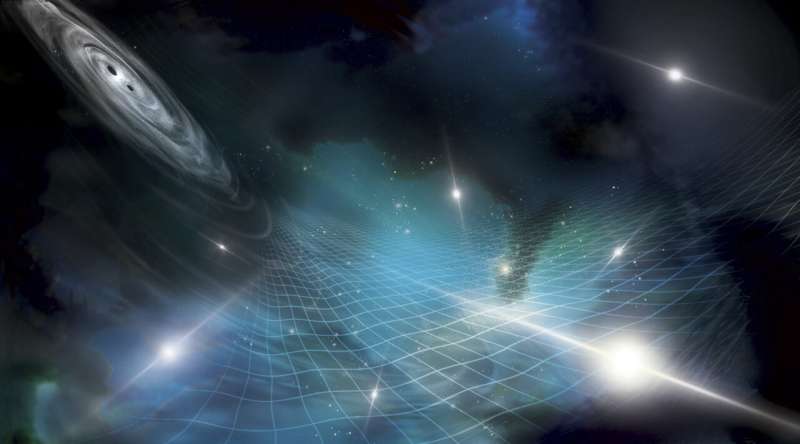
 If you’ve been reading the news lately, you may have heard about NANOgrav and the work they were doing. If you missed it or forgot:
Scientists have observed for the first time the faint ripples caused by the motion of black holes that are gently stretching and squeezing everything in the universe.
They reported Wednesday that they were able to “hear” what are called low-frequency gravitational waves—changes in the fabric of the universe that are created by huge objects moving around and colliding in space.
How did they do that? Well:
No instruments on Earth could capture the ripples from these giants. So “we had to build a detector that was roughly the size of the galaxy,” said NANOGrav researcher Michael Lam of the SETI Institute.
The results released this week included 15 years of data from NANOGrav, which has been using telescopes across North America to search for the waves. Other teams of gravitational wave hunters around the world also published studies, including in Europe, India, China and Australia.
The scientists pointed telescopes at dead stars called pulsars, which send out flashes of radio waves as they spin around in space like lighthouses.
These bursts are so regular that scientists know exactly when the radio waves are supposed to arrive on our planet—”like a perfectly regular clock ticking away far out in space,” said NANOGrav member Sarah Vigeland, an astrophysicist at the University of Wisconsin-Milwaukee. But as gravitational waves warp the fabric of spacetime, they actually change the distance between Earth and these pulsars, throwing off that steady beat.
By analyzing tiny changes in the ticking rate across different pulsars—with some pulses coming slightly early and others coming late—scientists could tell that gravitational waves were passing through.
The NANOGrav team monitored 68 pulsars across the sky using the Green Bank Telescope in West Virginia, the Arecibo telescope in Puerto Rico and the Very Large Array in New Mexico. Other teams found similar evidence from dozens of other pulsars, monitored with telescopes across the globe.
I think it’s great science. You can read more about it here (and it’s where the quotes above come from): Scientists have finally ‘heard’ the chorus of gravitational waves that ripple through the universe at phys.org.
Did you know this is not the first time scientists have used distant objects in space to do science? Indeed, as far back as 1676, Ole Rømer used eclipses of the Jovian moon Io to determine just how fast light moves. It was a brilliant experiment that you can read about, here.

Science is as a much a creative process as it is an analytical process, and I think it is brilliantly creative to use the universe as an instrument to add to our scientific knowledge.
P.S. you can actually measure the speed of light using a chocolate bar and a microwave. Really! See this fun video to see how:
 Smart People I Know