
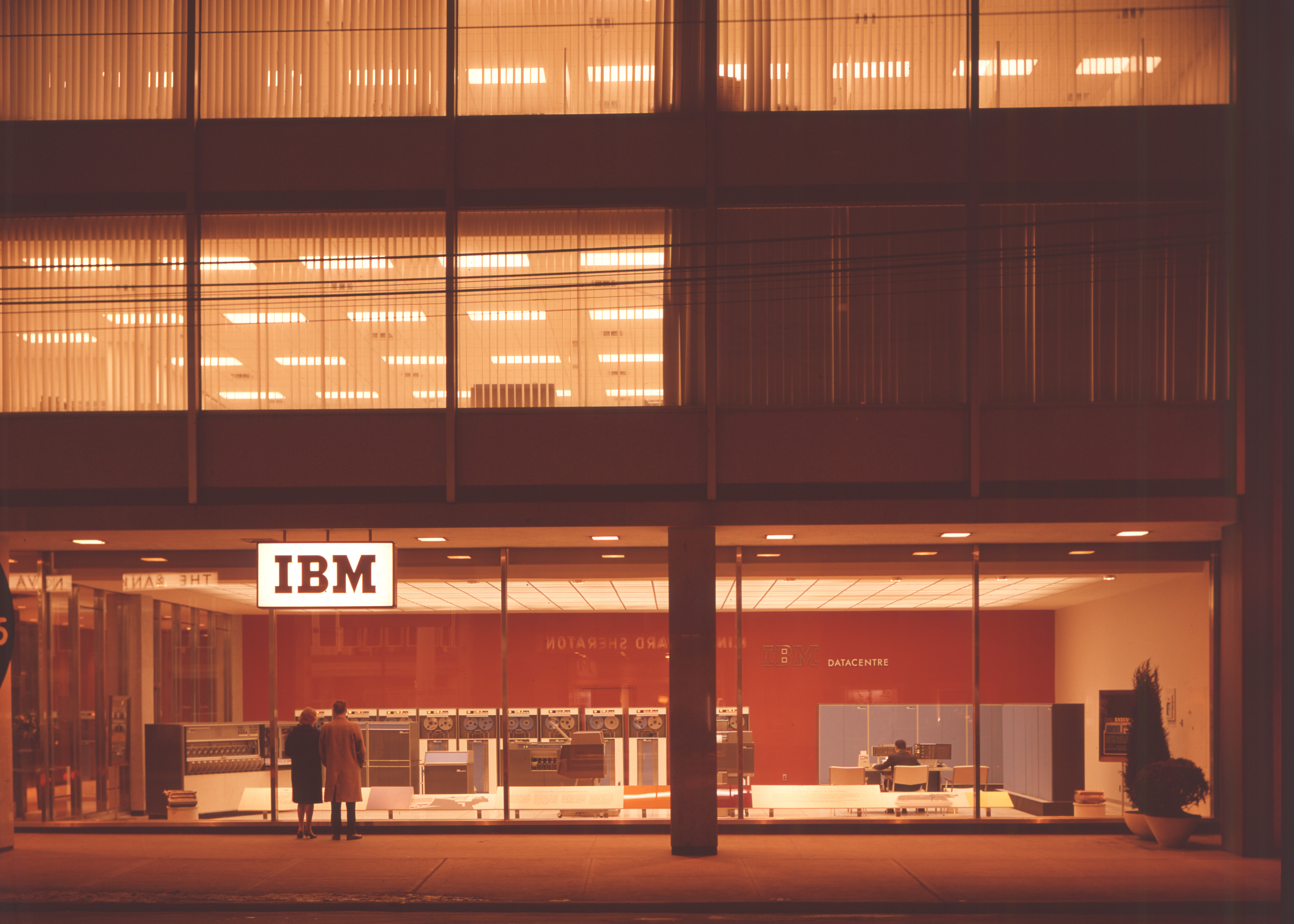
If you were to ask me, on this day, what has changed with regards to computers and IT and IBM in the last 40 years, I would say it’s this:
- Access: Very few people had access to computers 40 years ago. Those folks used mainframes, minicomputers and the occasional personal computer from Commodore or Radio Shack or this new start up called Apple. Now everyone has access to a computer they carry around in their pocket. (We call it a smart phone, but it’s really a powerful computer that makes calls.)
- Ubiquity: Back in the early 80s the vision of everyone having a computer / terminal on your desk was just that: a vision. The few that did have these big monster 3277 or 3298 metal terminals or if you were lucky, a 3279-color terminal. People worked on paper.
- email: One of the drivers of having a terminal on your desktop was to access email. Back then IBM’s email system was called PROFS (Professional Office System) and it meant you no longer had to send you three-part memos (yes people did that with carbon paper between the memo paper, so you could give the cc (carbon copy) to someone else). You sent electronic mail instead. Everyone thought it was great. Who knew?
- Viruses: Viruses were new. My first was called the CHRISMA exec. In those days every Christmas people would send around runnable scripts (ie. Execs) and they would be the equivalent of digital Christmas cards. The CHRISMA digital Christmas card came from outside IBM. It read your address book and sent itself to all the people you knew. Sounds like fun. In fact it overwhelmed the IBM networks and IBMers around the world and we had to shut most things down to try to purge the network of this thing. It took days. Not fun.
- Networks: Companies sometimes had their own networks: IBM had one called VNET. VNET connected all of IBM’s computers worldwide, and it had connection points with outside networks like BITNET too, which is where the CHRISTMA exec was. There was no Internet per se.
- Network size: IBM’s VNET had over 1000 VM computers all connected to each other. All of them had an id called OP which was what system operators used to sometimes control the VM mainframe. Once on second shift another system operator and I wrote a program to messages all 1000+ ops in the world the equalivant of “hi hows it going”. To our surprised many of them wrote back! We manually started messaging them back and even became friends with some of them over time. It was like twitter before twitter or gchat before gcchat, etc.
- Documentation: Computer documentation was hard to come by in the 80s, and if you had any, you might hide it in your desk so no one else could take it. The operators had a special rack of documentation next to where they worked. I was thrilled in the 90s when you could walk into a bookstore and actually buy books that explained how things worked rather than having to get permission from your manager to order a Redbook from IBM publishing in the US.
- Education: In the 80s you could get a job in IBM operations with a high school diploma. Universities in Canada were just ramping up degree programs in computer science. By the start of the 90s most new hires I knew had at least a university degree and more likely a comp sci or engineering degree.
- Software: We take Microsoft’s dominance in software for granted, but decades ago Lotus’s 123 was the spreadsheet program we used, just like we used Wordstar or Wordperfect for word processing. Microsoft worked very hard to dominate in that space, but in 1984 when the ads for Macintosh came out, Gates was just one of three people in the ad touting that their software ran on a Mac.
- Minicomputers: In between the time of the mainframe and PC, there was the rise of minicomputers. DEC in particular had minicomputers like the VAX systems that gave IBM a run for the money. IBM countered with machines like the 4300 series and the AS/400. All that would be pushed to the site by….
- IBM’s PC: The first truly personal computer that had mass adoption was the IBM PC. A rather massive metal box with a small TV on top, it could run the killer apps like Lotus 123. Just as importantly, it could run a terminal emulator, which meant you could get rid of old terminals like the 3270 series and just give everyone a PC instead. Soon everyone I worked with had a PC on their desk.
- Modems: modems in the 1980s were as big as a suitcase. If a client wanted one, an IBM specialist would go their location and install one for you. In the 90s people got personal modems from companies that sent data at 9600 bps or 14000 bps or even 56 kbps! Today people have devices the size of a book sitting at home and providing them with speeds unthinkable back then.
- Answering machines: The other thing people used to have on their desks besides a PC was an answering machine. Before that every office had a secretary. If you weren’t at your desk the call would go to them and they would take the message. If you had been away for a time you would stop by their desk and get any slips of paper with the name and numbers of people to call back. Answering machines did away with all that.
- Paper planners: Once you did call someone back, you would get out your day runner / planner and try to arrange a meeting time with them. Once a year you would buy new paper for it so you could keep track of things for the new year. In its heyday your planner was a key bit of information technology: it was just in paper form.
- Ashtrays and offices: it may seem hard to believe but back then smoking in the office was common, and many people smoked at their desk. It was a long and hard process to eliminate this. First there was smokeless ashtrays, then smoking areas, then finally smokers had to smoke outside, then smoke in areas well away from the main door. Likewise people worked in cubicles. It was miles away from working at places like Google or WeWork, never mind working from home.
- The rise of Microsoft and the decline of IBM: The success of the IBM PC lead to the success of Microsoft. The adoption of MS-DOS as the operating system for the IBM PC was a stroke of luck for Microsoft and Bill Gates. It could have easily been CP/M or some other OS. With the rise of Microsoft and the personal computer, IBM started to lose its dominance. IBM’s proprietary technologies like OS/2 and TokenRing were no match for DOS / Windows or Ethernet. IBM did better than some computer companies like Wang, but it’s days of being number one were to be over.
- The role of the PC: for a time in the 80s you could be a company and not have computers. Paper and phones were all you needed. We used to say that companies that used computers would beat any competitors not using computers. And that became the case by the end of the decade.
- The rise and fall of AI: now AI is hot, but in the late 80s and early 90s it was also hot. Back then companies were building AI using languages like LISP and Prolog, or using specialized software like IBM’s Expert Systems Environment to build smart tech. It all seemed so promising until it wasn’t.
- LANs: all these PCs sitting on people’s desks needed a way to talk to each other. Companies like Microsoft released technology like Windows for Workgroups to interconnect PCs. Office had servers and server rooms with shared disks where people could store files. There was no SharePoint or Confluence.
- The rise of Ethernet: there were several ways to set up local networks back then. IBM had its token ring technology. So did others. It didn’t matter. Eventually Ethernet became dominant and omnipresent.
- Email for everyone: just as everyone got PCs and network access, in the 90s eventually everyone got mail. Companies ditched physical mail and FAXes for the speed and ease of electronic mail, be it from AOL or Compuserve or someone else.
- Network computers: one thing that made personal computers more cost effective in the 90s for people was a specialized computer: the network computer. It was a small unit that was not unlike a terminal, and it was much cheaper for business than a PC. To compete, the prices of PCs soon dropped dramatically and the demand for the network computer died off.
- EDI: another thing that was big for a time in the 90s was EDI. IBM had a special network that ran special software that allowed companies to share information with each other using EDI. At one point IBM charged companies $10/hour to use it. Then the Internet rose up and ISPs charged companies $30/month and suddenly EDI could not compete with a PC using a dialup modem and FTP software provided by their ISP.
- Electronic banking: with personal computers and modems becoming common in homes, banks wanted to offer electronic banking to them. Some banks like the Bank of Montreal even established a specialized bank, mbanx, that was only online. Part of my job in the 90s was to help banks create the software they would give out to allow their customers to do banking via a private network. While most banks kept their branches, most day to day banking now happened online.
- The Internet and the web: if the PC changed everything in the 80s, the Internet changed everything in the 90s. Suddenly ISPs were springing up everywhere. Even IBM was an ISP for a time. People were scrambling to get software to allow them to connect their PC and US Robotics 14.4 kbps modems to access FTP sites and Usenet and more. No sooner did this happen than the World Wide Web and browsers bust on the scene. For many people, the Web was the Internet. So long Gopher; goodbye WAIS.
- Google: finding things on the Internet was no easy thing. It only got worse as web sites shot up everywhere. Google changed the Web and made it usable. They changed email too. Sites like Yahoo! wanted to make you pay for more storage: Google gave people more storage than they could ever need.
- From desktops to laptops: with home networks in place, people wanted to be able to bring home their computers to work remotely. I used to have a luggable computer that weighed 40 pounds that I would bring back and forth daily. As more people did this, computer companies got smart and made the portable computers smaller and better. Apple was especially good at this, but so was IBM with their Thinkpad models. As time went by, the computer you used at work became a laptop you use to work everywhere.
- The Palm Pilot: the Palm Pilot succeeded where Apple and others had failed. They had come up with a device you could use to track your calendar, take notes, and more. All you had to do was put it in a cradle and press the sync button and everything would be loaded onto your PC. Bye bye paper planners. Hello Personal Digital Assistant.
- IBM Services: One time IBM gave away its services. By the 90s they had a full one line of business devoted to providing their people to clients to help them with their business. People like me moved from helping run IBM’s data centers to going around to our clients helping them run their data centers and more.
- Y2K: if Y2K was a non-event, it was only because of the countless hours put in by techies to make it one. Even me. I was shocked to discover that EDI software I wrote for a Quebec bank in 1992 was still running on PC/DOS computers in 1999. It was quickly rewritten before the deadline to keep running on January 1, 2000. Just like countless software worldwide.
- E-business: if PCs changed business in a big way in the 80s, e-business changed them in a big way in the 90s. Even with the dot com era crash, there was no going back. With e-banking your retail branch was open 24/7; with e-business, the same was true of your favorite local (or non-local) business.
- The resurrection of Apple and Steve Jobs: two things transformed IT and made it cool: one was the Web and two was the return of Jobs to Apple. Boring beige boxes were out: cool colored Macs made for the Internet were in. People were designing beautiful web sites with red and yellow and blue iMacs.And the success of those iMac led the way to the success of the iPod, and the success of the iPod led to so much more.
- Blackberry and dominance of smartphones: if the Palm Pilot got mobile computing started, the Blackberry accelerated that. Email, texting, and more meant that just like online banking and e-business, you were reachable 24/7. And not just reachable the way you were with a pager/beeper. Now you could reply instantly. All the computer you needed fit in your hand.
- The decline of analog: with the rise of all this computing came the decline of anything analog. I used to buy a newspaper every day I would commute to work. People would bring magazines or books to read. If you wanted to watch a film or listen to a song, it depended on something physical. No longer.
- The rise of Unix/Linux: you use Unix/Linux every day, you just don’t know it. The web servers you use, the Android device you make calls on, the Mac you write emails on: they all depend on Unix/Linux. Once something only highly technical people would use on devices like Sun computers or IBM pSeries machines is now on every device and everywhere.
- Open Source: in the 90s if you wanted software to run a web server, you might pay Netscape $10,000 for the software licence you needed. Quickly most people switched to the free and open source Apache web server software to do the same job. This happened over and over in the software world. Want to make a document or a spreadsheet? You could get a free version of that somewhere. For any type of software, there is an open source version of it somewhere.
- Outsourcing/offshore: if people could work from anywhere now, then the work that was done locally could now be done anywhere. And it increasingly was. No one locally does the job I did when I first started in the computer industry: it’s all done offshore.
- The Cloud: if work could be done anywhere by anyone, then the computers needed to do it could be the same. Why run your own data center when Amazon or Microsoft or IBM or Google could do it better than most? Why buy a computer when you only need it for an hour or a day? Why indeed?
- The return of AI: finally, AI has returned after a long time being dormant, and this time it’s not going to be something used by a few. Now everyone can use it and be more productive, smarter. Like the PC or the Internet before it, AI could be the next big thing.
- Web 2.0/Social Media: One thing to insert in between the Internet and AI in terms of groundbreaking changes in IT is Social Media. Both public social media like this and private social media like Slack and Microsoft Teams. Without social media I couldn’t share this with you.
In 40 years the devices have gotten smaller, the networks have gotten bigger, and the software has gotten smarter. Plus it’s all so much cheaper. If I had to sum it up, I’d say that sums up all the changes that have happened in the last 40 years. And we are just getting started.
 Smart People I Know
Hi Bernie, I still remember the IBM Model 20 with its IBM 2560 Multi-Function Card Machine. I had to manually sort card decks for a customer, repeatedly combining the cards from each stacker in specific sequence. If I made a mistake, I had to start the whole process over again. One night after yet another restart, I read the cards in on another IBM mainframe, did an internal sort, and punched out the sorted card deck. Although the cards were interpreted (the characters for each of column was printed on the top), the 80 characters were in two lines. The customer was quite annoyed – they wanted the printed characters in one column, which the card punch I used could not handle.
You mentioned IBM/VM (Virtual Machine), an operating system that before the invention of the PC, effectively gave large numbers of users the ability to access their own computers from a terminal (initially telewriters, then 327x CRT terminals). Although VM could support many operating systems, one of the most popular internally was CMS (Conversational Monitor System). I recall one mainframe that had over 10,000 registered users with over 1,000 peak concurrent users. CMS supported a wide range of applications including interactive programming languages such as REXX and John Hartmann’s CMS Pipelines which expanded on the Linux pipes concept. In the mid-1990s, I wrote a large REXX program to help VM operators managed IBM’s 3495 robotic tape library that only IBM’s MVS operating system supported at that time. The REXX program survived Y2K unscathed, although I recall we missed adding it to our Y2K checklist.
Hi Norbert, thanks for your stories! I know you have many more too! I remember all the advanced work you did with VM and your meticulous plans for rolling out new mainframes at IBM when we worked together. Plus the work you did on the new server farm in Canada (the cloud before the cloud!). You could write your own blog post on it all….perhaps even a book!