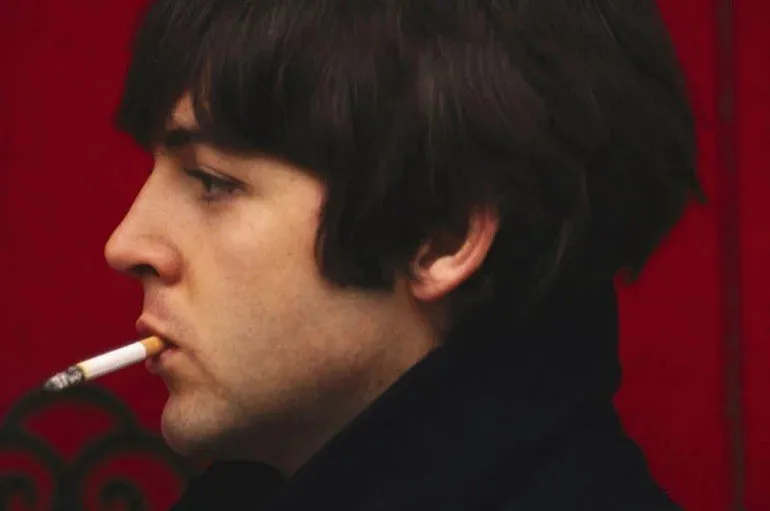
Paul McCartney’s newest creations using history and science fiction


McCartney has always been one to explore new ideas. So it doesn’t surprise me to learn that he used AI to help with a ‘final’ Beatles song. Unlike others who might muck about and try to create something Beatlesque with AI, he argues that there is nothing artificial in the “new” Beatles song. AI was just an additional instrument Paul used to create music.

While he’s been in the realm of science fiction with his AI project, he’s also been going back in time using photographs to produce a new book. He writes about the book, “1964: Eyes of the Storm – Photographs and Reflections” in the Guardian, here and in The Atlantic, here.

Regardless of what he is using, here’s a good essay by Austin Kleon on McCartney’s creative process: McCartney on not knowing and doing it now. McCartney often gets dinged for his creative failures, but I would argue he has been so massively successful because he tries and fails often enough and he does not stop whenever so called failure occurs. (It helps that things that were once considered failures (e.g., McCartney I and II) turn out later to be considered successes.)

Here’s to Paul successfully living to be a 100 and providing us more great creative works.

(Image of McCartney recording McCartney II, via Austin Kleon’s site)

Revisiting McCartney after watching Get Back

For a long time I held the common view that there was two Paul McCartneys: the Beatles one and the solo one. This view also states that once he went solo, he went from making great music to making bad music. Sure there were exceptions (Maybe I’m Amazed, Band on the Run), but that was the view.

That view was supported by many people, starting with John Lennon and many of the music press writing in the 70s and 80s. How could it be wrong? Even a fan of Paul like me thought so.

Well it was wrong and I was wrong too. I came to that conclusion after watching Get Back. Watching Get Back, I was struck by the continuum of the Beatles and their music.  In the documentary you hear snippets of songs that wouldn’t come into their own until later albums. You hear them play old songs as they try and finish the new songs. It’s all sonically fluid and connected. Paul’s music –before and after the breakup — is very much of that continuum. There is no switch that suddenly deprives him of his talent. He does lose the feedback and the guidance of the others, especially John’s, and no doubt that hurt him. But his ability to write a song and perform a song remains strong.

I thought of that some more after spending time relistening to songs from McCartney I.  Songs I had dismissed as bad I gave a relisten to. Listened to the music of the guy who performed so well on Get Back, the music of the guy who  went on to record Abbey Road. The talent is strong and steady on those solo records, despite some ups and downs. 

I’ve often contended that if you combined the best of the Beatles solo work from the 70s and just kept the best and put in on 3 or 4 recordings, you would have music as good as anything they made in the 60s. In some cases even better.

The talent was still there.  The music was still good. For all them. Including Paul.


Four more on McCartney, who is 80 this year

Paul is 80 this year, and a good year he’s been having. People are writing pieces filled with praise. He had a big show at Glastonbury with his buds. Not bad for an octogenarian.

It’s been a long and winding road from the early days of the Beatles to now. Some argue that serendipity had a big part to play in Paul and the Beatles’ Success. I’ll let you read that and be the judge. I think it had a small part.

Finally, think of your favorite McCartney song. Then dive into this and see what others famous and less famous picked as theirs: People’s favorite McCartney song. I was surprised by the frequency of Martha My Dear and Temporary Secretary. I was also surprised that Band on the Run was only picked by one person. Read it and be surprised in your own way.


Not 1 but 2 good pieces on the eve of McCartney 3

Paul McCartney

Here’s two good pieces on Paul McCartney on the eve of his latest album, “McCartney 3”.

The first one is an interview with him. Among other things, it shows the difficulty of him doing interviews, since it’s hard for him to add anything new (he still manages to do so): Paul McCartney Is Still Trying to Figure Out Love – The New York Times

While the New York Times piece is really good, this piece is great: 64 Reasons To Celebrate Paul McCartney – The Ruffian.

I have always been a fan of McCartney, but this second piece made me a greater fan. I’ve read it a few times, and even though it is long, I look forward to reading it again. It really does do a fantastic job of highlighting what a great artist Paul really is and addresses some of the many criticisms of him over the years. McCartney has been pinned down over the years both by some bad musical choices and by some (unfair?) musical criticism.  One thing I liked about the second piece is how it nicely rebuffs some of that (e.g. “Ob-la-di, Ob-la-da, “Another Day”). Highly recommended that piece, but both are worth a read.

P.S. Since I am banging on about him, my two cents on McCartney from the late 60s to the late 70s is that the Beatles were originally Lennon’s band, but as time past, McCartney grew and started to dominate the Beatles more. Meanwhile Harrison also came into his own. At one late point Lennon tried to come up with an arrangement of how they would allocate songs on the future albums (I think 4 for John, 4 for Paul, 2 for George, and 1 for Ringo), but I think things were too far gone by then. They were too big for the band. That’s too bad (what an understatement). If you go through their musical output of the 70s and picked out the best songs of all of them and made 3 or 4 albums, they would have been great albums (just think of taking the best of Imagine + All Things Must Past + Band on the Run, for example). Plus if they were together they would have pushed each other to do more great things.

I’m not sure how well they would have done past then. The birth of hip hop, punk and new wave might have washed them aside. Or they could have become frozen in amber, like some other big bands of that era. (Look at a Rolling Stones concert play list some time.)  Then again, McCartney teamed up with Elvis Costello and made fine music, so they could have turned out to stay great.

Regardless of alternative histories, McCartney went on to make his own timeline  as a creative artist. Here’s to the success of McCartney III and perhaps IV one day as well.