
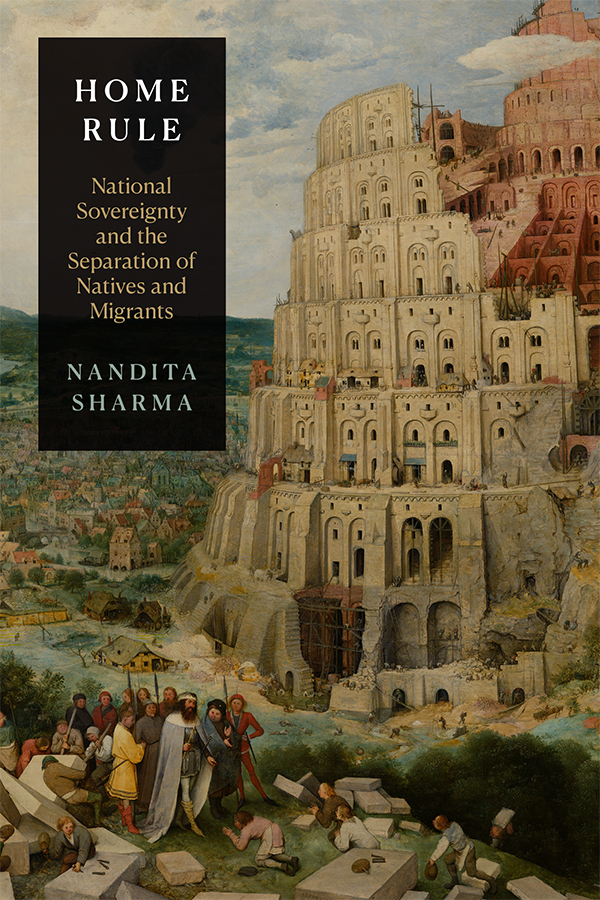
 It’s difficult to not think about migrants and natives. So many problems in the world have their roots in who belongs to a place and when. So I was interested to hear about this book: Home Rule – National Sovereignty and the Separation of Natives and Migrants from Duke University Press. The Duke University Press says:
In Home Rule Nandita Sharma traces the historical formation and political separation of Natives and Migrants from the nineteenth century to the present to theorize the portrayal of Migrants as “colonial invaders.” The imperial-state category of Native, initially a mark of colonized status, has been revitalized in what Sharma terms the Postcolonial New World Order of nation-states. Under postcolonial rule, claims to autochthony—being the Native “people of a place”—are mobilized to define true national belonging. Consequently, Migrants—the quintessential “people out of place”—increasingly face exclusion, expulsion, or even extermination. This turn to autochthony has led to a hardening of nationalism(s). Criteria for political membership have shrunk, immigration controls have intensified, all while practices of expropriation and exploitation have expanded. Such politics exemplify the postcolonial politics of national sovereignty, a politics that Sharma sees as containing our dreams of decolonization. Home Rule rejects nationalisms and calls for the dissolution of the ruling categories of Native and Migrant so we can build a common, worldly place where our fundamental liberty to stay and move is realized.
A lot to consider there. Some questions I considered were: Why start at the 19th century? Why not go back to the age of European exploration? What about before that age? Should it be restricted to the Western nations? What are the differences between the Roma in Europe and Europeans in the Americas? What about other persecuted groups that are native but are never considered as a group that belongs to the native group?
No doubt you have your own questions. To learn more about the book, go here.
 Smart People I Know