
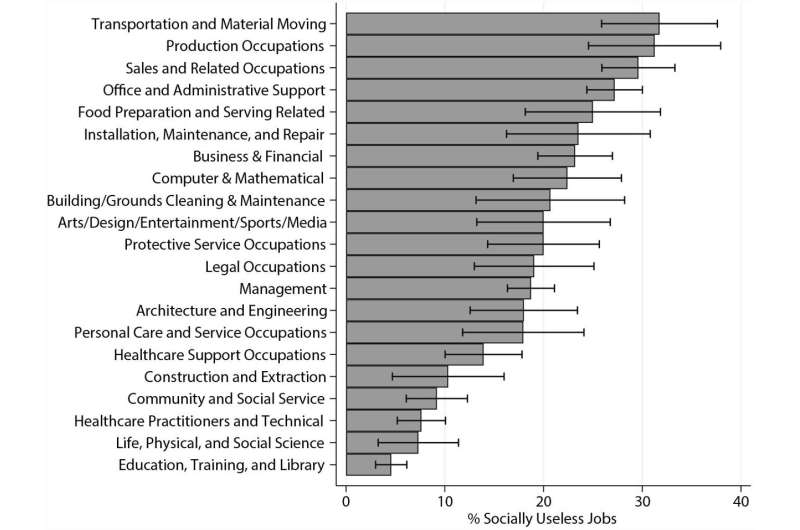
Do you feel like your job is socially useless? If so, you may have a bullshit job. As this piece shows, many people feel they work in pointless, meaningless jobs. Just look at the graph above, taken from the article. People in all sorts of occupations feel like their job is a waste of time. People in office jobs especially so.
What I would like to focus on is the jobs at the bottom of that chart. Many of those jobs center around helping others, be it trainers, librarians, healthcare practitioners, and social service workers. There are also jobs where people make things, be it in construction or engineering and architecture. When you are making something like a building or a road, you know you are doing something useful. Likewise, you know what you are doing is useful if you are helping to educate someone or helping them get healthier. I suspect that is why people in those professions they don’t find their jobs useless.
If you have a job that you feel is useless, see if there are aspects of it that are helpful to someone. Or try and find activities where you make something that others can take and do something with. Or do both. It might feel like you currently don’t do any such things, but if you track what you do in a week or a month, you may find you were doing those things and you just weren’t aware of it.
You can also try and insert more of those activities into your job. Share the things you know with your coworkers. Mentor new people on the job. Create material that others can use to make their own job easier, even if it’s simply a spreadsheet or a Powerpoint template. Look for ways to be useful to others on your job. You may find yourself enjoying your job more in the process of being useful.
Good luck!
 Smart People I Know
Hi Bernie, interesting article. I read the Simon Walo paper – although it generally supports Graber’s article that some jobs are simply not worth doing, it is interesting that of the top five jobs in the figure, only two (sales, office and admin) matched Graeber’s description of BS jobs. Walo does point out that the BS level of jobs depends on a lot of factors (as you point out) aside from the nature of the value delivered. However, it should send a message to companies that creating poor working environments is not the path to employee retention. And perception is a big part of how we perceive work, such as the story about President Kennedy, NASA, and the janitor (https://www.kareneber.com/blog/tothemoon). I hope that was not just another urban myth.
Hi Norbert, thanks for the feedback! I tend to agree that there is more to a BS job than just a category. I also liked your story about Kennedy: I will have to blog about that! I came across a similar story some time ago, I wrote about it, here: https://smartpeopleiknow.com/2010/02/22/its-not-what-you-are-doing-its-what-you-are-doing-it-for-or-the-purpose-driven-life-for-everyone/