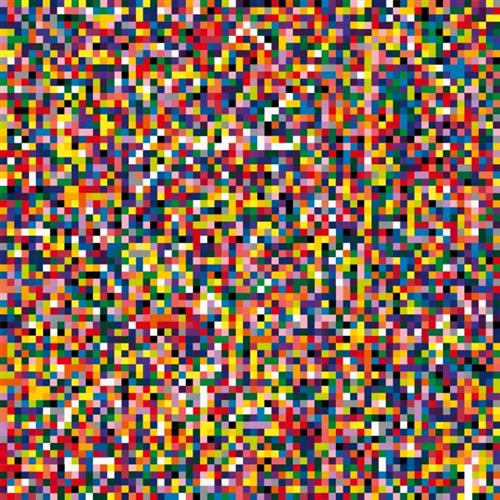
Using technology to make art is not new. Gerhard Richter used special software to make the work you see above (4900 colours). Before computers, artists would use lens and photographs and even craftsmen and women to help them create their final artwork.
What is new now is artists (and non-artists) are using AI to make art. Kevin Kelly talks about how he is using AI in his creative process. David Salle has dived deep into making new work using AI. NYT columnist Farhad Manjoo is using visual tools like Procreate to make AI art.
I have seen Kelly’s work, and Manjoo and Salle’s work are on display in their articles. Kelly experiments with AI to produce images in various styles. Perhaps he has changed, but there is no artist in his work that I can see. With Manjoo, you can see more of him in his drawings. And with Salle the artist’s presence comes in as an editor of the works the AI produces out of his original pieces.
In trying to assess these AI generated works, I think Walter Benjamin and his idea of an artwork having an aura can be useful here. Benjamin was thinking about how original art works have an aura that reproduced images of it do not have. I agree with that: no matter how good a reproduction of a work is, it rarely compares to the original work. There’s that something extra in the original.
I think we can extend out the idea of a work having an aura and also having a humanity. What does a work say about the person who created it? What do I recognize in it that is human and unique to that person? What ideas are there that could only come from that person in that time?
You can argue back that this is irrelevant and that AI generated images are interesting and beautiful and furthermore I cannot distinguish them from human generated images. That might be true. Maybe galleries will be filled with images and sculpture with no human involvement whatsoever, not unlike deep learning software that comes up with ways to be best at playing games like Chess and Go. Such AI artwork may be interesting and even beautiful and may seem to have that aura Benjamin talks about. They just won’t be associated with a human.
Even minimal and conceptual art has a humanity associated with it. Duchamp’s Fountain embodies Duchamp’s intelligence and wit and contrariness. Arp’s “According to the Laws of Chance” likewise shows his interest in pushing the bounds of what is acceptable in a composition of an abstract work. A person is responsible for the work and the work is tied to them. A person is what makes the work relevant to us in a way that a wall covered with children’s collages or a shelf of toilets in a hardware store are not.
We need a new aesthetic philosophy to deal with the firehose of AI art that is coming our way. I propose we tie the art back to our humanity.
P.S. For more on Richter’s 4900 colours, you can see it here on his web site. There’s also a great view of 4900 colors, here,

 Smart People I Know