
Thinking about the non-endorsements of Harris using basic game theory ideas

No Presidential endorsements were provided by the LA Times or the Washington Post this year. This caught people by surprise, since it was expected these two papers would endorse a candidate and that candidate would be Harris. Soon it was revealed the endorsements were held up by the owners of both papers.

One way to assess the choices of the owners of the Times and the Post is to use a payoff matrix found in game theory and apply it to the moves available to them:

Action vs impact Harris Wins Trump Wins
Endorse Harris No Loss Huge Loss
Endorse No one Small loss Small Loss

My payoff assessment is based on an estimate of how much each paper has to lose by endorsing/not endorsing a candidate. If Harris wins, there is very little downside regardless of what they do. Likewise, if Trump wins and they don’t endorse, I suspect they will also lose subscriptions and staff, but overall they can manage that.

The wrinkle in all this is if Trump wins and they endorse Harris. I think the owners of both papers see a huge loss for them — either personal or financial — if that happens.

Both men have different things at stake. We already know that the team from Bezos’s other project, Blue Horizon, has been talking to Trump. No doubt Bezos would not want Trump to come into power and ban Blue Horizon from any future space exploration with NASA. That would explain why Bezos did not want the Post to endore Harris. As for Soon-Shiong, the owner of the LA Times, he tried to get a post in Trump’s first administration. Perhaps he hopes he will be successful the second time around.

If the above payoff matrix had a bigger payoff or a bigger loss regarding Harris, then they might have chosen differently. As it is, they decided to minimize their risk by endorsing no one. They are guaranteed to suffer losses, but not big ones for them personally. It’s a rational choice, but a disappointing one.

I wouldn’t be surprised if both of them got out of the newspaper business in the next four years. They clearly don’t have the appetite for the risk of running such publications.



On Nash equilibrium and game theory

John Nash
I’ve been interested in Game Theory and in particular how to apply the concept of the Nash Equilibrium to work. These were four links I found useful

  1. Examples and exercises on Nash equilibrium in games in which each player has finitely many actions
  2. The Triumph (and Failure) of John Nash’s Game Theory | The New Yorker
  3. Nash equilibrium – Wikipedia
  4. Game theory text (PDF) from UCLA math department.

(Image of the great man himself from Wikipedia)

Wages, Nash equilibrium, and the productivity paradox: a small theory of my own

Economists write a lot about the mystery of why productivity is not increasing, with pieces such as this. There’s even a section on it in Wikipedia.

My own theory is that limited wage increases is also limiting the benefits of productivity aids. How I think this works is so:

  1. Employers wont raise wages for employees.
  2. Employers deploy technology that should result in productivity gains.
  3. Employees take the technology deployed and use them to decrease their efforts.
  4. The employer sees some productivity gains and assumes that is the limit for the technology deployed.

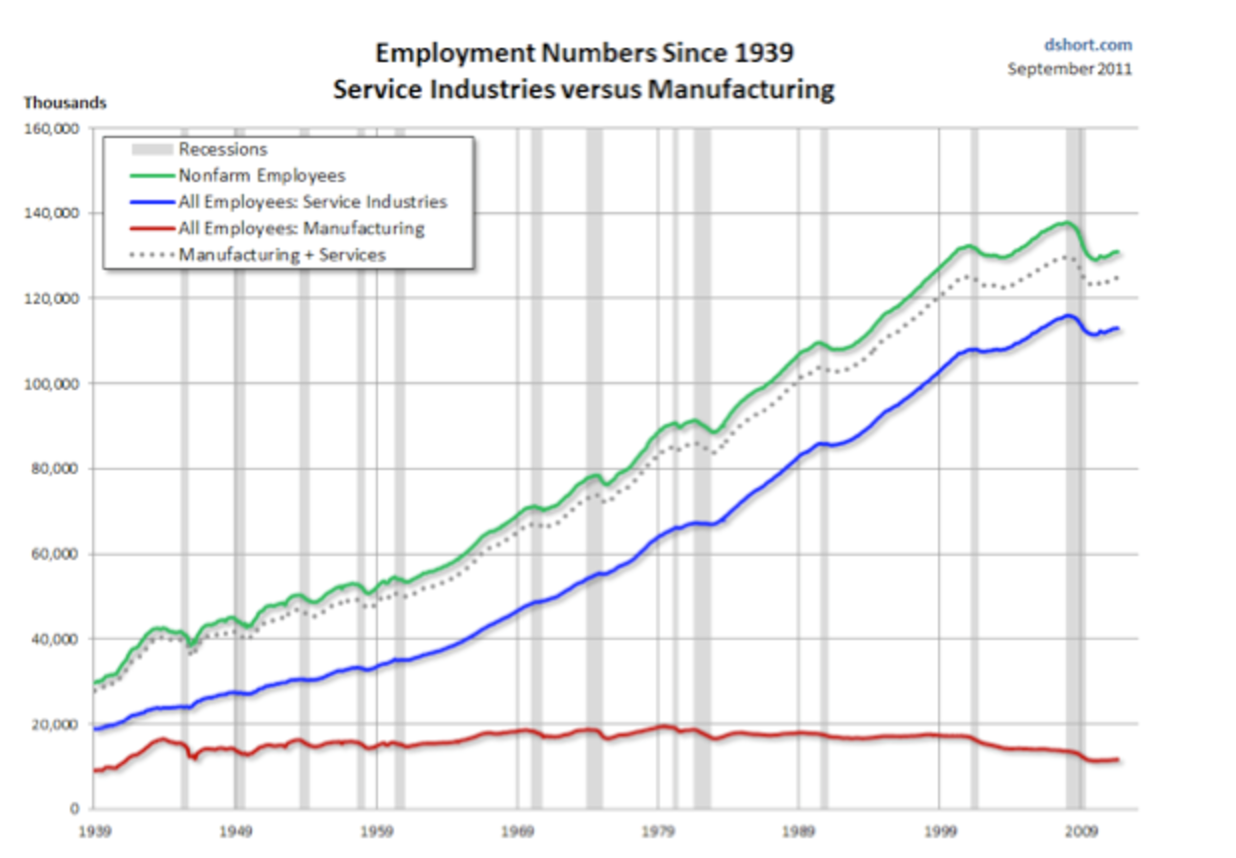
Look at this chart:

In much of the world economy, all the job growth is in the services sector (green line), not the manufacturing sector (red line). Achieving productivity gains in the manufacturing sector is more straightforward: replace people with robots and you are done. It’s not as straightforward as that in the services sector. In some services sector jobs, it is not possible to decrease effort without it being visible. But in many services sector jobs, it is. If employees cannot improve their lives by making more money, they may decide to do so by working less and working right up to the point where they don’t lose their job.

If you look at employment as a game, then we currently have a Nash equilibrium where the employees know that they won’t get paid more working for the same company, because that is the best strategy for the company. Therefore the best strategy for the employee is to minimize their effort without getting fired and while showing little if any productivity gains.

That’s to me is key reason why I think we have the productivity paradox.

I would add that the reason this is a paradox is because no one wants to admit that this is happening. It seems like a failure on both the employers and the employees side. The employee wants to be seen as a good worker and the employer doesn’t want to admit it could be paying more. Instead technology is brought in to solve an organizational problem, which is something technology cannot do.

(Chart from Business Insider).