Talent vs Luck: or how science shows success is due to something other than intelligence, skill, hard work and risk taking.

I came across this good paper, Talent vs Luck: the role of randomness in success and failure, that I think everyone should read. To see why I recommend it,  I want to chop up the abstract for the paper because it is jammed packed with good insights.

According to the abstract, in our culture:

The largely dominant meritocratic paradigm of highly competitive Western cultures is rooted on the belief that success is due mainly, if not exclusively, to personal qualities such as talent, intelligence, skills, efforts or risk taking. Sometimes, we are willing to admit that a certain degree of luck could also play a role in achieving significant material success.

True that. Most successful people would say that luck had some effect, but it was hard work and talent that got them where they are. Despite that…

.. it is rather common to underestimate the importance of external forces in individual successful stories. It is very well known that intelligence or talent exhibit a Gaussian distribution among the population, whereas the distribution of wealth – considered a proxy of success – follows typically a power law (Pareto law).

Hmmm. Why doesn’t success align with intelligence and talent? Could it be a hidden ingredient?

Such a discrepancy between a Normal distribution of inputs, with a typical scale, and the scale invariant distribution of outputs, suggests that some hidden ingredient is at work behind the scenes.

What could that hidden ingredient be?

In this paper, with the help of a very simple agent-based model, we suggest that such an ingredient is just randomness.

Randomness…i.e., luck.

Money quote:

In particular, we show that, if it is true that some degree of talent is necessary to be successful in life, almost never the most talented people reach the highest peaks of success, being overtaken by mediocre but sensibly luckier individuals.

You may have heard it countless times, but….

As to our knowledge, this counterintuitive result – although implicitly suggested between the lines in a vast literature – is quantified here for the first time.

And because of that, their paper….

…sheds new light on the effectiveness of assessing merit on the basis of the reached level of success and underlines the risks of distributing excessive honors or resources to people who, at the end of the day, could have been simply luckier than others.With the help of this model, several policy hypotheses are also addressed and compared to show the most efficient strategies for public funding of research in order to improve meritocracy, diversity and innovation.

I highly recommend you read the abstract here and the full study here.


How to succeed in business: make life better for people by taking advantage of new technology

What drives innovation? If we look at the most innovative companies in the last decade, we see innovation happening in areas such as:

Finance: Square, Venmo, Zelle
Communications: Spotify, Tiktok, Instagram, Slack
Logistics: Uber, Lyft

What underlies all those companies: the mobile phone. While the mobile phone is not synonymous with innovative companies,  those innovative companies I listed were able to capitalize on the capabilities of that device to vault themselves into leadership positions.

Mobile phones are not new on the whole, but the capabilities they provide in the last decade provided these companies with the means to innovate.

What else do all those companies have in common? With one of two exceptions, they all made life better for a large population of people. They made life more entertaining, they made it easier to work, to manage your money, to get in better shape, to cook well, to get around easier.

Companies that find ways to make life better for many people while taking advantage of new technologies will be successful companies. It seems obvious, but too often I see companies focused on the technology and not on making life better for people. You need both things to succeed. Obvious, not easy.

For more on this, see: The 16 most innovative new companies of 2010s.


There are four ways to fail. Here’s how to fix three of them.


In this good piece by James Clear, he talks about three ways we fail and how we can fix it.  The three types of failure are:

.. a Failure of Tactics. These are HOW mistakes. They occur when you fail to build robust systems, forget to measure carefully, and get lazy with the details. A Failure of Tactics is a failure to execute on a good plan and a clear vision.
… Failure of Strategy. These are WHAT mistakes. They occur when you follow a strategy that fails to deliver the results you want. You can know why you do the things you do and you can know how to do the work, but still choose the wrong what to make it happen.
…Failure of Vision. These are WHY mistakes. They occur when you don’t set a clear direction for yourself, follow a vision that doesn’t fulfill you, or otherwise fail to understand why you do the things you do.

Really good piece. I recommend it as something you schedule yourself to read at least once a year to help you do better both at work and elsewhere.

In the piece he doesn’t focus on failure of opportunity, but it is huge. For people living in the right place and born into the right segment of society, success is much easier because opportunities abound.  Sometimes you can change that (e.g. emigrate) and sometimes you cannot.

Despite that, read the piece and reflect on how you can address the things that cause you to fail.


Work sucks. Here 16 things to read and give you some perspective


Ok, work doesn’t always suck, and sometimes it can be really great. But it sucks more often than it should. If you wonder why, these links can help you gain some perspective and insight.

  1. Why Workers Are Losing to Capitalists – Bloomberg– Not promising
  2. How to Maintain Your Sanity (and Be Productive) When You Work Alone • Jocelyn K. Glei– Those who work at home, take note.
  3. Meet the Developer Who Made Games for Three Years While Living on the Streets – Motherboard – If you feel you need motivation in a difficult work situation, read this
  4. Motivation is Overvalued. Environment Often Matters More. | James Clear – on the other hand, there’s this.
  5. Pocket: I Quit My Job to Live in a Tent and Write Code – more on working in difficult situations.
  6. The pursuit of loneliness: how I chose a life of solitude | Society | The Guardian– more for those who would rather work and be alone
  7. You Probably Need a Public Portfolio Even If You’re Not a Freelancer or a “Creative”– good advice, especially for people that think they need no such thing.
  8. I’m Ira Glass, Host of This American Life, and This Is How I Work – Glass provides some inspiration here.
  9. Can a company innovate without working its employees to death? – The Washington Post– You would HOPE so.
  10. A cycle of exploitation: How restaurants get cooks to work 12-hour days for minimum wage (or less) – The Globe and Mail– depressing but essential reading.
  11. The Simple Technique To Fit A 40-Hour Workweek Into 16. | Fast Company– and here is the opposite extreme.
  12. I worked in a video store for 25 years. Here’s what I learned as my industry died. – Vox– good insight for those in a threatened industry.
  13. Working with the Chaos Monkey– help for those dealing with chaos monkeys (I have recently).
  14. The secret to success: take risks, work hard, and get luck– obvs.
  15. The Shame of Work – New Rambler Review– hmmm.
  16. Final Frame: Office Propaganda | Apartment Therapy – Finally, a light link after all that.

(Image from the last link)

A quick reminder of the path to success

Media preview

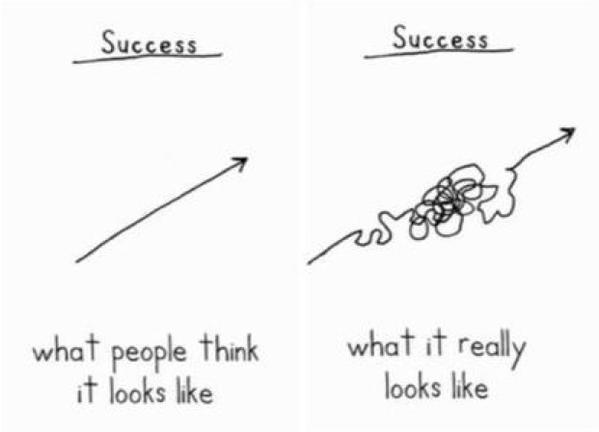
I’ve seen the squiggly versus straight line path to success in many places. It’s a great concept, and a handy reminder to keep close when things seem in a muddle and you wonder if you will ever progress. It’s also a good reminder to keep a log of your progress. A log will remind you that you are succeed, despite those bewildering times when things seem like you are getting nowhere fast.

Success doesn’t come easy for anyone, not even Elon Musk

I admire the work that Elon Musk does, be it Tesla, Space X, or other endeavours he takes on.  I also had an opinion that the success he achieves is as close to a Given as success can be. I held that option until I read this article: Elon Musk Had a Deal to Sell Tesla to Google in 2013 – Bloomberg Business. This article shows just how touch and go it was for Musk and Tesla in 2013. Among other thoughts, it reinforced in me the notion that success in challenging areas is difficult for everyone, whether it be Elon Musk or anyone.

If you are trying to accomplish something difficult, and if you think that others have it easier than you, I recommend you read this article. I also recommend it to anyone who needs to be reminded that success is never a given, but with the right effort and focus and dedication, even the most challenging type of work can be accomplished.