
Check it out here: WoWWiki, the Warcraft wiki

Check it out here: WoWWiki, the Warcraft wiki

Adam Gopnik does a superb job of writing about Philip K. Dick in this week’s New Yorker.
Dick is now in the Library of America ($35), under the excellent editorial care of Jonathan Lethem, a passionate devotee, who also provides an abbreviated chronology of Dick’s tormented life. Four of the sixties novels are neatly packed together in the handsome black covers: “The Man in the High Castle,” “The Three Stigmata of Palmer Eldritch,” “Do Androids Dream of Electric Sheep?” (the original of “Blade Runner”), and his masterpiece, “Ubik.”
As Gopnik notes:
Dick has also become for our time what Edgar Allan Poe was for Gilded Age America: the doomed genius who supplies a style of horrors and frissons.
but also he is right about this:
The trouble is that, much as one would like to place Dick above or alongside Pynchon and Vonnegut—or, for that matter, Chesterton or Tolkien—as a poet of the fantastic parable he was a pretty bad writer.
I loved Dick’s novels when I was both younger and not so well read. Years later, going back to read them, I was still impressed by the imagination and ideas. But the writing kept distracting me with its faults.
So, should you ignore the article or the novelist? On the contrary. Either pick up the latest edition at your favourite newsstand, or see it online here: Blows Against the Empire: Books: The New Yorker.

Over at the nytimes.com, is an article on the success of High School Musical: Move Over Mickey: A New Franchise at Disney – New York Times
One thing that struck me was this silly comment from their TV critic.
Virginia Heffernan, a television critic for The New York Times, wrote that although the sequel had a haphazard charm, “the movie is mediocre, and should be skipped.” But she added, “I can’t wait to buy the soundtrack and do the karaoke.”
I wonder if the critic watched the show with a preteen in attendance. It may be mediocre from an adult viewpoint, but it is simply magical to a preteen (I know).
Take a look at this Foreign Policy chart recently published on the “so called surge” and think about it in terms of the questions I have outlined in boxes.
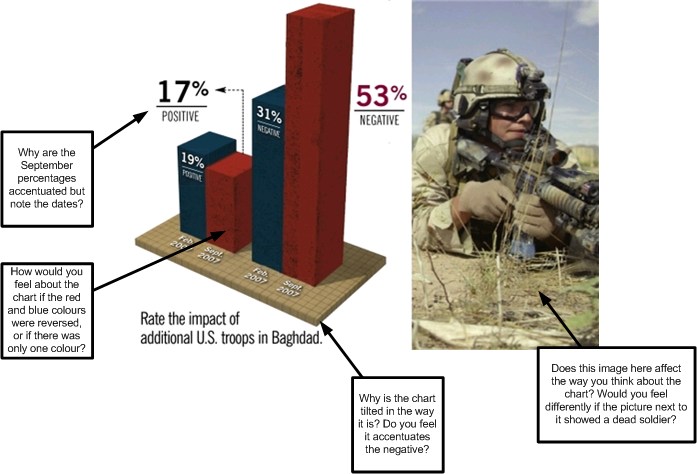
Whatever one things about the surge and FP’s assessment of it, they can do better than just skewing the chart to make the case.
See: Foreign Policy on “The Failing Surge”.
P.S. If you want to see someone better than me take apart such representations, refer to Edward Tufte’s site (for example, here).
P.S.S. I found this at Andrew Sullivan’s site. He has many many good postings on the Surge and the War.

My son loves these toys, but when I read this, I almost fell out of my chair!
The magnets inside these dolls and accessories can fall out — undetected to parents and caregivers. These magnets can be swallowed or aspirated by young children or placed by a child in their nose or ears. When more than one magnet is swallowed, the magnets can attract to each other and cause intestinal perforation, infection or blockage, which can be fatal. Aspiration to the lungs requires immediate surgery. Magnets placed in the nose or ears can cause swelling and be difficult to remove.
From Mattel Consumer Relations Answer Center – Recall.
I think if Mattel is not careful, this Batman (and other such toys) could be fatal to Mattel as well.
 Smart People I Know