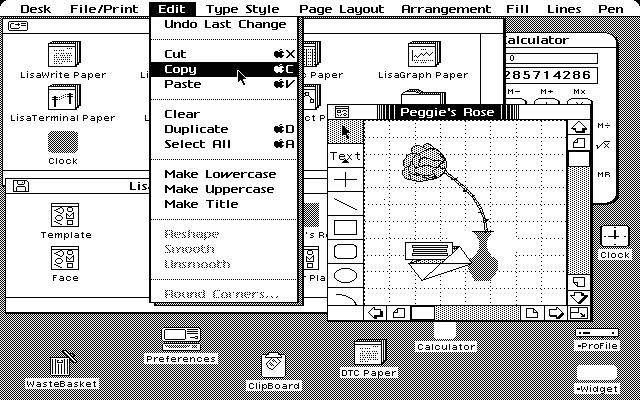
 In reading and writing about The Lisa computer yesterday, I was reminded of the Pascal programming language. As part of the development of the Lisa, one of the engineers (Larry Tesler), who was working on the user interface…
…created an object-oriented variant of Pascal, called “Clascal,” that would be used for the Lisa Toolkit application programming interfaces. Later, by working with Pascal creator Niklaus Wirth, Clascal would evolve into the official Object Pascal.
Likely very few if any devs think about Pascal these days. Even I don’t think about it much. But back in the 70s and 80s it was a big deal. As Wikipedia explains:
Pascal became very successful in the 1970s, notably on the burgeoning minicomputer market. Compilers were also available for many microcomputers as the field emerged in the late 1970s. It was widely used as a teaching language in university-level programming courses in the 1980s, and also used in production settings for writing commercial software during the same period. It was displaced by the C programming language during the late 1980s and early 1990s as UNIX-based systems became popular, and especially with the release of C++.
When I was studying computer science in the early 80s, Pascal was an integral part of the curriculum. Once I started working at IBM, I moved on to develop software in other languages, but I had expected it to become a big deal in the field. Instead, C and then variant languages like C++ and Java went on to dominate computer programming. I’m not sure why. My belief at the time was universities had to pay big bucks for operating systems and Pascal compilers but they did not have to pay anything for Unix and C, and that’s what caused the switch. I can’t believe they switched from Pascal to C because C was a better language.
Forty years later, if you search for the top 20 programming languages, Pascal is towards the bottom of this list from IEEE, somewhere between Lisp and Fortran. It’s very much a niche language in 2022 and it has been for some time.
For more on Pascal, I recommend the Wikipedia article: it’s extensive. If you want to play around with it, there’s a free version of it you can download.
(Image is an Apple Lisa 2 screenshot. Photo Courtesy of David T. Craig. Computer History Museum Object ID 500004666)

 Smart People I Know