
Some thoughts on data centres and the environment

325 Front Street West III

People are worried about data centres.

People are worried about data centres and carbon emissions, especially if they read articles like these: Google’s carbon footprint balloons in its Gemini AI era, or Microsoft’s AI obsession is jeopardizing its climate ambitions or Google’s greenhouse gas emissions are soaring thanks to AI or Exxon Plans to Sell Electricity to Data Centers.

People are also worried about data centres and water usage after they read articles about how much water is used for each ChatGPT query.

And when people read pieces like this, Amid Arizona’s data center boom, many Native Americans live without power, they are no doubt worried about what data centres do to the communities where they reside.

My thoughts on this, as someone who has worked in data centres for 40 years, is that there are valid reasons to be concerned, but there are positive aspects to data centre growth and it’s important to keep those in mind.

Data centres are simply places with a concentration of information technology (IT). One time companies had data centres on a floor of their building, or in special buildings in locations like the one pictured about on 325 Front St in Toronto. These days, many companies are moving from hosting their own technology in their own buildings and moving that tech to cloud computing locations, which are just another form of data centre.

I believe that’s this migration to the cloud is a good thing. As this states:

Research published in 2020 found that the computing output of data centers increased 550% between 2010 and 2018. However, energy consumption from those data centers grew just 6%. As of 2018, data centers consumed about 1% of the world’s electricity output.

Moving workloads from on premise infrastructure to cloud infrastructure hosted in big cloud data centres saves on energy consumption.  One of the reason for the savings is this:

…normally IT infrastructure is used on average at 40%. When we move to cloud providers, the rate of efficiency using servers is 85%. So with the same energy, we are managing double or more than double the workloads.

You might think all this data centre growth is being driven by things like AI and crypto, but according to this IEA report:

Demand for digital services is growing rapidly. Since 2010, the number of internet users worldwide has more than doubled, while global internet traffic has expanded 25-fold. Rapid improvements in energy efficiency have, however, helped moderate growth in energy demand from data centres and data transmission networks, which each account for 1-1.5% of global electricity use.

That’s the key point: the demand for digital services is driving the growth of data centres. Every time you watch a video on your phone or pay your bills on your computer, you are using a data centre. Even things like the smart meter on your house or the computer in your car or the digital signs you see interact with a data centre. You use data centres pretty much all day, sometimes without knowing it.

The good news is that there are innovations to make them greener are happening with them, like this new method for liquid-cooling data centres that could make the waste heat useful. And it’s good that IT professionals are moving towards green cloud computing.  But it’s not good that with the rise of technologies like generative AI, IT companies are having a difficult time keeping up with the demand and sticking to their green targets.

Speaking of gen AI, I think energy costs associated with AI will peak and come down from the initial estimates. Indeed, when I read this article Data centres & networks – IEA, and in particular this…

Early studies focused on the energy and carbon emissions associated with training large ML models, but recent data from Meta and Google indicate that the training phase only accounts for around 20–40% of overall ML-related energy use, with 60–70% for inference (the application or use of AI models) and up to 10% for model development (experimentation). Google estimates that ML accounted for 10-15% of its total energy use in 2019-2021, growing at a rate comparable with overall energy growth (+20-25% per year over the same period).

… then I am optimistic that energy costs will not be as bad as initially estimated when it comes to AI. I am not optimistic that we will not decrease our demand for digital services any time soon. Because of that demand, we need not just more data centres, but better ones. It’s up to companies to build them, and it’s up to citizens to keep the companies accountable. The best way to keep them accountable is to better understand how data centres work. I hope this post went some small way to doing that.

P.S. All the opinions expressed here are my own and do not represent the views of my employer.
(Photo by Jack Landau on Flickr)

On spatial computing and VisionOS

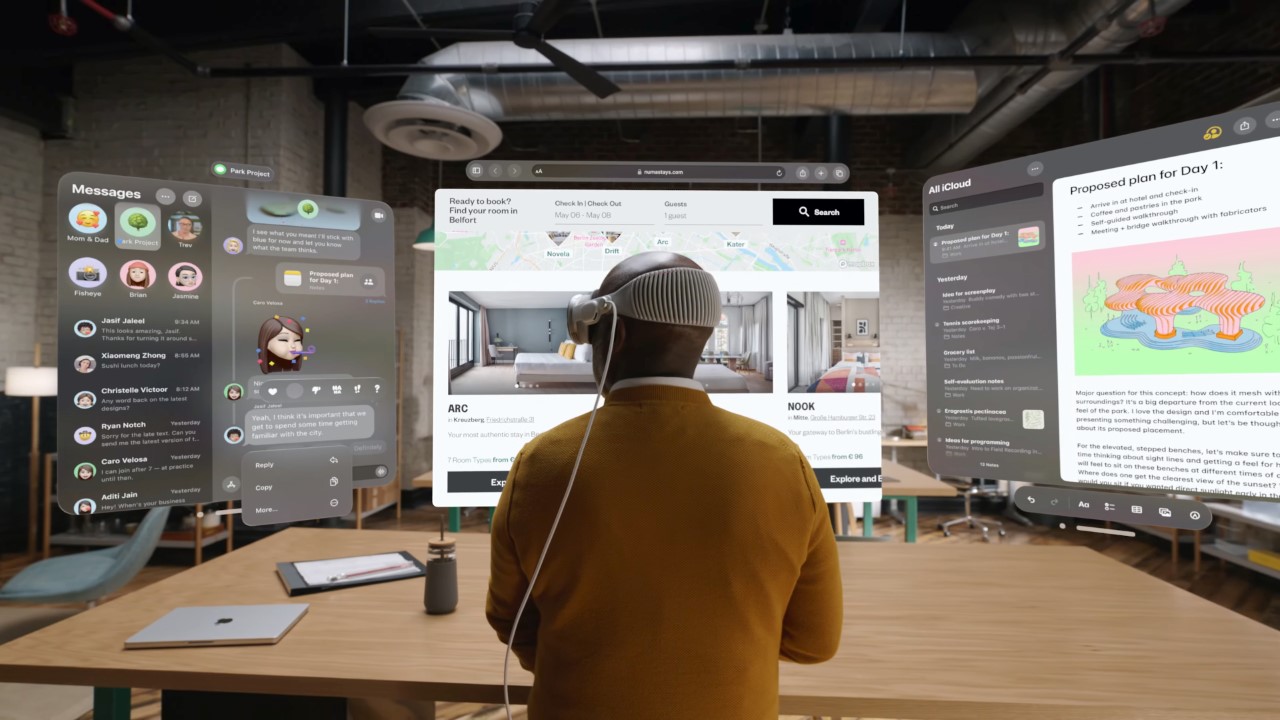
While people talked a lot about the hardware of Apple’s new Vision Pro device launched last week, I’ve thought a lot about Apple’s emphasis on spatial computing. What’s that all about, you might ask? I am going to turn to this piece at Yanko Design to explain:

“Vision Pro is a new kind of Computer,” says Tim Cook as he reveals the mixed reality headset for the very first time. “It’s the first Apple product you look through, and not at,” he adds, marking Apple’s shift to Spatial Computing. What’s Spatial Computing, you ask? Well, the desktop was touted as the world’s first Personal Computer, or PC as we so ubiquitously call it today. The laptop shrank the desktop to a portable format, and the phone shrank it further… all the way down to the watch, that put your personal computer on your wrist. Spatial Computing marks Apple’s first shift away from Personal Computing, in the sense that you’re now no longer limited by a display – big or small. “Instead, your surroundings become a canvas,” Tim summarizes, as he hands the stage to VP of Design, Alan Dye. Spatial Computing marks a new era of computing where the four corners of a traditional display don’t pose any constraints to your working environment. Instead, your real environment becomes your working environment, and just like you’ve got folders, windows, and widgets on a screen, the Vision Pro lets you create folders, windows, and widgets in your 3D space. Dye explains that in Spatial Computing, you don’t have to minimize a window to open a new one. Just simply drag one window to the side and open another one. Apple’s VisionOS turns your room and your visual periphery into an OS, letting you create multiple screens/windows wherever you want, move them around, and resize them. Think Minority Report or Tony Stark’s holographic computer… but with a better, classier interface.

Spatial computing is something bigger than the new hardware from Apple. It’s talking about changing the way we do computing.

You see, since the 1980s we’ve been stuck with the WIMP paradigm in computing: windows, icon, menus, pointer. We have it for so long we don’t even think about it anymore. Even when we went from desktop computing to smartphones and tablets, we more or less kept this paradigm.

With spatial computing, we can think out of the box. Get away from the desktop. You are no longer looking AT a computer: you are IN a computer.

Apple is still kinda stuck with the WIMP in some of the demos they have for Vision Pro. I get that: it’s going to take some time for all of us to make the shift. Even Apple. But the shift will come.

The shift may not even come primarily from Apple the software company. I believe one of the reasons Apple launched the device the way it did — limited and at WWCD — is to get developers excited about it. Already some big name software companies have signed on. And if I read this piece correctly, then there could be a rush of developers from everywhere to come out with software for the device. Perhaps much of that could be non-WIMP software.

Much of this will depend on Vision OS and what it is capable of supporting. But from everything I read, it sound like it provides spatial computing flawlessly with the Vision Pro.

And perhaps spatial computing is not just for the Vision Pro. Currently Apple allows you to do handoffs from one device to another. I could see that happening with the Vision Pro, your Mac, and your phone. You might be working on something on your Mac that you want to take a break from, so you put on your Vision Pro to play a game. Then you get an idea, so you work on it in the Vision Pro, rather than taking off your goggles. Likewise, you may need to take a break from the Vision Pro, so you do a handoff to your Mac or your Apple TV to watch the rest of a movie from that device.

I can also see bits of VisionOS creeping into MacOS and iOS and even WatchOS. If VisionOS breaks the WIMP paradigm virtually, perhaps it could do the same thing physically. All of Apple’s devices could be spatial computing devices.

Spatial computing promises to be a new big thing in computing. I’m excited for this. I hope Apple and others can bring it to fruition. (Pun intended.)

P.S. For more on how impressive the Vision Pro is, I recommend this: Every Single Sensor inside the Apple Vision Pro and What It’s Individually Designed To Do – Yanko Design

Kubernetes Is the Future of Computing?

I hesitate to echo Barron’s here: Kubernetes Is the Future of Computing. Everything You Should Know. – Barron’s because computing is vast, and there is more to computing than Kubernetes. (AI, for one thing.) But Kubernetes is one of the main drivers of change in IT, and more and more people are moving towards it. If you don’t know much about it and you subscribe to Barron’s, I recommend you read their piece. Otherwise Google “kubernetes for business leaders” or “Kubernetes 101” and you’ll find quite a few good pieces on it.