Strategic Voting in 2025 – what you should know

Canada flag on brick wall

I am still a supporter of strategic voting in Canada. My thoughts on it haven’t changed much since I wrote this in 2019: Strategic Voting in Canada – some thoughts.

What has changed is the site you should go to if you  also want to vote that way. It doesn’t look like this site, strategicvoting.ca, is working any more. However this site SmartVoting.ca, seems up to date, at least for the Ontario election this week. And it looks like they are preparing to work on the soon to come Federal election.

It’s good to check out regardless of how you plan to vote.

On voting Against, as opposed to voting For


After an election, people may wonder: how could people vote for that candidate? Many people believe a vote is for a candidate, and someone’s vote means they favor that candidate.

I don’t believe that. I believe that for many voters, the logic they employ is this:

  1. has the incumbent done a good job in their last term in office? If they have, vote FOR them so they win.
  2. has the incumbent done a bad job in their last term in office? If that’s true, vote AGAINST them so they lose.

I believe this is why many incumbents hold on to power for a long period of time. Voters feel they are doing the job well enough and they don’t want to fire them from and take the risk of bringing in someone who can’t do the job.

It also explains why people can vote for someone who others think is a bad candidate. They are voting for the bad candidate because they want to vote against someone they consider a worse candidate. To them, the best way to defeat the worse candidate is to vote for the bad candidate.

The assessment of who is a good, bad or worse candidate will depend on how much information you bring into the equation. For low information voters, they might think candidate A has done a bad job managing the economy, so they will vote against candidate A by voting for a candidate who can cause the defeat of candidate A. If candidate B has the best chance of beating candidate A, they will vote for candidate B. They may dislike candidate B in numerous ways, but that is the candidate most likely to prevent candidate A from remaining in office.

Many high information voters will look at an election results and say most voters voted for candidates running on issues X, Y, and Z. That may be the case for a percentage of voters. Many voters, though, are not voting for a candidate, they are voting against a candidate, and they will vote for someone who can defeat that candidate, regardless of many of the issues.

P.S. I thought of this when I read many such posts like this on social media:

jamelle‬ ‪@jamellebouie.net‬ (on Bluesky -b):

Also, if anyone is looking for someone to blame, it should be focused on the people who looked exactly at what Trump was selling and said “yes.”

No doubt there were some percentage of voters who voted for Trump because they wanted to see him in office. Those voters said “yes”. But I think there were many more voters who wanted to vote against Biden/Harris and thought the best way to remove them from office was to vote for Trump. To them, Harris was the worst candidate to vote for, even if Trump was a bad candidate. I don’t agree with that at all, but I am trying to understand how some voters could vote for Trump without assuming they are simply terrible people.

On the complex process of electing the Doge in 14th century Venice

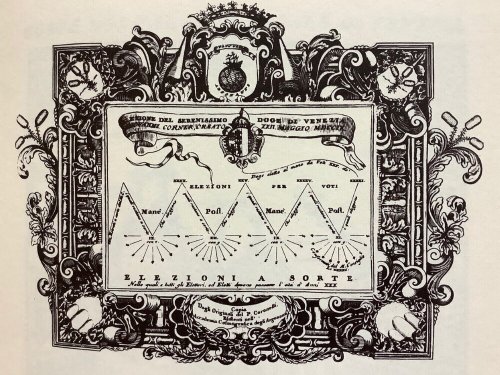
Last week on twitter I came across something that fascinated me: how the Venetians elected the Doge in the 14th century. It was a supremely complex process. At first I couldn’t believe it was real, but then I came across this: Electing the Doge (The Ballot Boy). Not only that, but I came across this academic article explaining why it made sense! And I thought runoff elections of modern states could be complicated.

For more on the city of Venice at that time, I recommend this site: The Ballot Boy – Venice in the 14th century. It provides a superb view of Venice at that time.

(Image link to The Ballot Boy, Diagram of Ducal Election)

On the recent moot election, September 2021. A brief note…

Well that was an odd election. If anyone came out ahead, I can’t see who it was. The Liberals did not get their majority, yet none of the other parties made any significant gains at their expense. Canadians voted to maintain the status quo and maintain it they did.

The one significant thing I noticed was line ups on Election Day. I’ve been voting for decades and I’ve never seen anything like it. As for me, I voted in the advanced poll and while I saw lots of good measures in place to limit the spread of COVID-19 the whole process was still pretty quick. I imagine those good measures slowed things down on Election Day.

It will be interesting to see if there is more voting via mail and via advanced voting in the next election. I expect we will have another one in a few years from now, though I would be surprised if the Liberals will be the ones to bring it on.

The next thing to pay attention to is what happens to the leaders of the various parties. I expect the Greens are going to have to make some difficult decisions. As for the other parties, I have no idea. I thought the leaders all performed well, but members of their parties might think differently. Let’s see.

After that, I’ll be very curious to see what Trudeau and his team do next. I hope they focus on the pandemic and what is needed to get to end of job in that with an eye on the economy and other promises they made.

I tend not to touch on politics on social media: it’s tends to be all downside with little upside. But this election was so odd I had to comment.

How would proportional representation have shaped the last Canadian election’s results?


Changing the way Canadians get to decide who forms the government federally has been a hot topic for some time. Before the last election, the government tried and failed to implement reform. There hasn’t been much talk about it recently, but it is a subject for debate that is not going to go away.

If you have an opinion about this one way or another, I recommend you review this: How would proportional representation have shaped this election’s results? | CBC/Radio-Canada.

The CBC ran the results of the last election through alternative forms of representation and analyzed the results. It is fascinating to see how representation changes, depending on the format followed. Kudos to the CBC for a superb visual representation.

I think reform is needed. I am still in favor of having a local MP and having the ability to have him or her voted out of office by the constituents of the MP’s riding. But I am also in favour of the percentage of each party’s MP aligning with the percentage of national votes that they received. Obviously I need to think about it some more.

In the meantime, take a look at what CBC has done, and decide for yourself.

(Image via Owen Farmer)

Democracy in action – An Introduction to Field Organizing

If you want to do more than vote in an election, especially if you are an American, then read this: THIS ELECTION IS FREAKING ME OUT, WHAT CAN I DO!? (An Introduction to Field Organizing). Obviously this is geared towards Hillary Clinton supporters for president, but read it regardless of you who you plan to vote for and at what level.  It should help you get to the point of at least knowing the right questions to ask and where you might go next to get more involved.

Voting is important, but there is much more to democracy than that. If you step up, your involvement will make a difference, regardless of your role. Good for you for taking that next step.