
Is Mark Zuckerberg’s $45 Billion Facebook donation good or not? Best to consider the alternative

In analysing the donation, Forbes (in The Surprising Math In Mark Zuckerberg’s $45 Billion Facebook Donation) sums it up like this:

Mr. Zuckerberg’s pledge is incredibly generous. But it is also likely to involve some very savvy tax planning.

It’s true, the donation is incredibly generous. You can use all the superlatives you want, and it still amounts to something out of the ordinary. Is the donation financial savvy? Of course, but why shouldn’t it be? Either way, will it be spent well? Possibly, possibly not. For that, we will have to wait and see.

As I read people arguing against the donation, I thought about what the alternatives could be. One alternative is no donation at all. Plenty of very rich people donate only a small fraction of their money to good causes. Young billionaires aspiring to be large benefactors is something that should be encouraged, not discouraged. Another alternative is donations to political causes I disagree with. Quite a few billionaires do that. I prefer to see the billions directed otherwise.

As for people arguing for the donation, I wondered if they considered the alternative of the donation going to taxes or charities. Perhaps Zuckerberg will be very good with directing the money, better than the state or NGOs. I’d like to see a good portion go to them, though. Too little of the wealth of the 1% (or .01%) go to paying taxes that pay for a lot of things like social services and health care and the military and infrastructure. More money to pay for those things would be better. Likewise, well run charities are already up and running and could spend the money in efficient ways that a new organization cannot.

This donation is a positive thing, but you should still be able to think critically of it. Mark Zuckerberg is a smart guy and he’s maturing. Let’s hope he uses his good fortune to do good in the world.
 

On Facebook, the company

Facebook is a company. It’s not Mark Zuckerberg. It’s not an app you use on your phone. It’s a collection of services that is growing rapidly and it may be poised to grow at even crazier rates than it has now, if you believe what is in this piece, Inside Mark Zuckerberg’s Bold Plan For The Future Of Facebook. Key point it raises:

The Facebook of today—and tomorrow—is far more expansive than it was just a few years ago. It’s easy to forget that when the company filed to go public on February 1, 2012, it was just a single website and an app that the experts weren’t sure could ever be profitable. Now, “a billion and a half people use the main, core Facebook service, and that’s growing. But 900 million people use WhatsApp, and that’s an important part of the whole ecosystem now,” Zuckerberg says. “Four hundred million people use Instagram, 700 million people use Messen­ger, and 700 million people use Groups. Increasingly, we’re just going to go more and more in this direction.”

Reading this, you get the sense of a company that is going to bigger in a few years than it is now, which seems incredible to me. Note this article: it will be worth revisiting in a few years.

That said,  there are a few points I’d like to add:

  1. I actually think that Facebook the app/website is declining in active usage. It is very clever showing you things people like, even if people you know aren’t posting things. You get a sense of activity on Facebook the app/website whenever you log in. You never get the sense that it is not being used by people, even if many of the people you follow aren’t actively contributing at all. I suspect if you dropped your Facebook friends down to next to none it would still show you the same amount of information. If Facebook the company is going to remain successful, it needs to diversify from it’s main service.
  2. It is interesting that people continue to compare Twitter to Facebook. To me, there is little to compare. Facebook seems to have a better growth plan and even have a better app. If Facebook the service declines, the diversification into places like WhatsApp and Instagram is strong in a way that is unlikely to be matched by services like Vine or Periscope. While there is some commonality between the two companies, I think the story of their divergence will become a bigger one over time. Contributing to that big difference is Facebook remains a stable company with a stable leadership while Twitter’s leadership remains chaotic and unstable.
  3. The narrative in that story is very optimistic. If the numbers for any of those organizations start to slip, I could see the narrative changing, just like it has for so many IT companies. Right now the narrative is: Facebook is a very successful company and it is going to become more successful with all these promising ideas. The narrative can easily become: Facebook is a very troubled company and it is going to become more troubled with all these ideas doomed to fail. (See Yahoo! for an example of such a narrative.)

Radical Candor is a bad idea with some exceptions

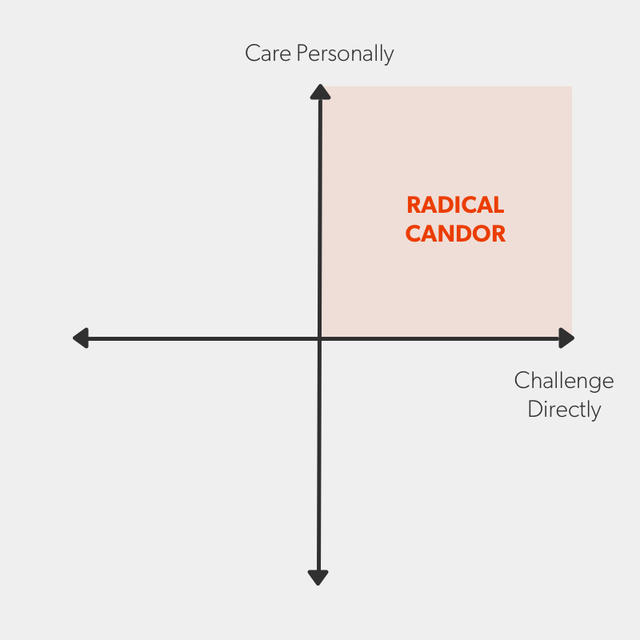
This article, Radical Candor — The Surprising Secret to Being a Good Boss | First Round Review, is making the rounds and is making my nervous. It makes me nervous because it is a terrible concept and it is very hard to do well. Even the example given – being called stupid – is a bad one. Be wary of any boss or any organization adopting this in your workplace.

My long work experience is that the Challenge Directly part takes little effort and energy, but the Care Personally part takes a lot of effort and energy. The result is a drift towards a demoralizing and toxic work environment with lots of criticism and little encouragement.

There is a rare exception where I have seen radical candor work: an elite athlete with an elite coach. Elite athletes sign up for and encourage radical candor because it is the best way to be the best. If you consider your work role similar to an elite athlete and you consider your boss an elite coach, then radical candor could work for you. Likewise if you are in the role of manager. Otherwise, I would recommend you pass on this approach and look for a better way to work.