
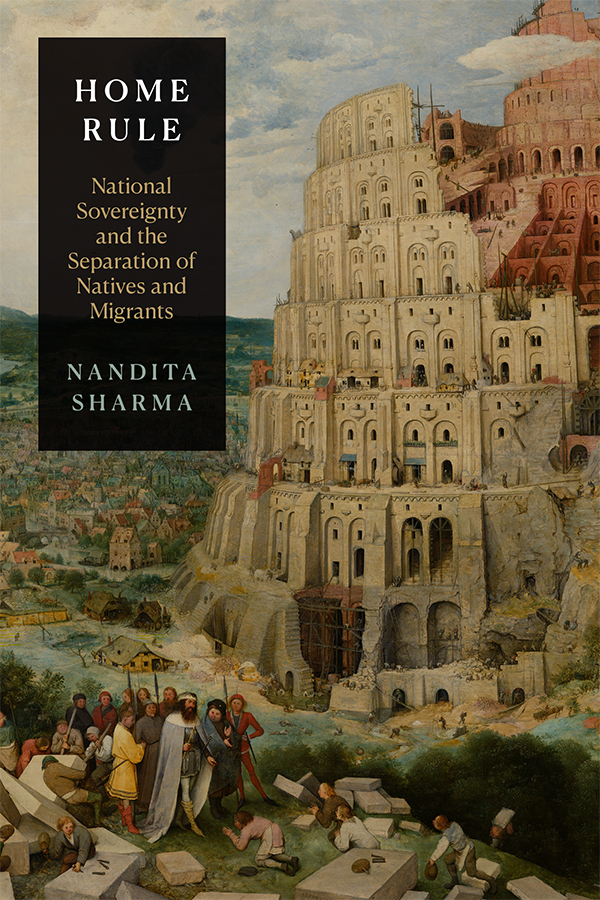
On natives and migrants

It’s difficult to not think about migrants and natives. So many problems in the world have their roots in who belongs to a place and when. So I was interested to hear about this book: Home Rule – National Sovereignty and the Separation of Natives and Migrants from Duke University Press. The Duke University Press says:

In Home Rule Nandita Sharma traces the historical formation and political separation of Natives and Migrants from the nineteenth century to the present to theorize the portrayal of Migrants as “colonial invaders.” The imperial-state category of Native, initially a mark of colonized status, has been revitalized in what Sharma terms the Postcolonial New World Order of nation-states. Under postcolonial rule, claims to autochthony—being the Native “people of a place”—are mobilized to define true national belonging. Consequently, Migrants—the quintessential “people out of place”—increasingly face exclusion, expulsion, or even extermination. This turn to autochthony has led to a hardening of nationalism(s). Criteria for political membership have shrunk, immigration controls have intensified, all while practices of expropriation and exploitation have expanded. Such politics exemplify the postcolonial politics of national sovereignty, a politics that Sharma sees as containing our dreams of decolonization. Home Rule rejects nationalisms and calls for the dissolution of the ruling categories of Native and Migrant so we can build a common, worldly place where our fundamental liberty to stay and move is realized.

A lot to consider there. Some questions I considered were: Why start at the 19th century? Why not go back to the age of European exploration? What about before that age? Should it be restricted to the Western nations? What are the differences between the Roma in Europe and Europeans in the Americas? What about other persecuted groups that are native but are never considered as a group that belongs to the native group?

No doubt you have your own questions. To learn more about the book, go here.

Andor is good for many reasons, and enjoyable for all. You should watch it.

Even if you don’t normally watch Star Wars movies, consider watching Andor. Like the movie it arises from, Rogue One, it stands apart from much that is Star Wars. There’s no light sabre battles, no Force, none of the things you may associate with the franchise. It is still in the Star Wars universe, which is why you will see Storm Troopers in their white uniforms, as well as other such things. But it really is a good dramatic series that’s well written and well acted. For fans of Star Wars, it’s good TV. But people indifferent to Star Wars will find it is good TV too.

I could go on, but Don Moynihan is miles ahead in terms of making a strong and thoughtful case for it, here. Don writes about governance, so he sees the series from that lens. And quite the lens it is. I highly recommend you read his piece.

One thing I noticed that wasn’t in his piece is the colonialism that comes through in the series. The Empire has taken over planets in a way not unlike earthly empires take over countries, and the series explores what that does to both those loyal to the Empire and those fed up with it.

Andor starts up season 2 this month. Go watch season one on Disney+ now. Check out Rogue One too (though you can watch Andor independently of it and the rest of the Star Wars films). Hopefully season 2 will be worthwhile TV too.

On the Fourth Plinth in Trafalgar Square in London

I am fascinated by the Fourth Plinth in Trafalgar Square in London. While there has been many a fine artist and their work displayed there, I am especially glad to see the work Antelope by Samson Kambalu going up next. To see why I think so highly of it, read this: Anticolonial hero statue to occupy Trafalgar Square fourth plinth from September in The Guardian.

The Guardian has been covering the work that has been placed on that plinth for some time. You can read about that, here: Fourth plinth in the Art and Design section of The Guardian. I was recently in London and saw The End by Heather Phillipson and that was good, but I’d love to see this work by Kambulu.

To learn more about The Fourth Plinth, go here. It started off empty due to lack of funds for a sculpture of William IV to fill it. I’m glad that happened. Londoners and tourists have benefitted ever since. (No offense to William IV.)

My belief is that a statue of Elizabeth II will go there once she dies. We shall see. Meanwhile check out the various artists who have had pieces there.


It’s Sunday. Here are nine pieces to mull over this afternoon.

Sure you can make yourself busy on this warm summer weekend. Or you can chill for a bit and read one of these thoughtful pieces. I know which one I am going to do. 🙂

  1. Here’s a piece on the joy of Latin. Really.
  2. 100% this: The Case for Killing the Trolley Problem
  3. Worthwhile: Piketty on equality.
  4. This is a weak piece that tries to link AI to colonialism but fails to make the case:  AI colonialism.
  5. Do you have siblings? Read this:  How Your Siblings Can Make You Happier.
  6. Worth chewing on:The limits of forgiveness.
  7. On one of our oldest technologies: the importance of wood .
  8. Dive into this list of common misconceptions.
  9. Finally, this piece on  Alexa with the voice of dead people will get you thinking.

Colonialism, Churchill, and other things I find interesting in history, February 2022

Recently I’ve been reading more about colonialism, Churchill and more. Here are some links on this.

Recently there was  a controversial article that praised colonialism. This article shows colonialism’s real legacy was ugly. This piece also shows how colonialism was a disaster and the facts prove it.  More dismissal of the idea that colonialism was good: A Quick Reminder of Why Colonialism Was Bad. This argues that: All Britons Benefited From Colonialism, Regardless Of Class. While Britain was a big colonial power, there were others as well. For example, Russia: Empire of the steppe: Russia’s colonial experience on the Eurasian frontier. Finally: 500 years of European colonialism in one animated map.

Related to colonialism, here are some links on Winston Churchill. Here’s two pieces critical of him: The Case Against Winston Churchill and Why can’t Britain handle the truth about Winston Churchill? My thought is anti-Churchillians downplay his role in defeating Hitler, while pro-Churchillians focus mainly on his role in defeating Hitler and downplay everything else. Finally, for a piece that takes into account the complexity of Churchill and his legacy, there is this:  The best books on Winston Churchill.

I disagreed with the monocausal aspect of this piece, The Bomb Didn’t Beat Japan, Stalin Did. Many things led to the defeat of Japan. Russia was one of them, for sure. Still a good read.

I liked this piece by TNC that  talks about Tony Judt: The Man Who Freed Me From Cant. My minor criticism is that Coates has an American centric view and this prevents him to some degree to fairly assessing Judt. But it’s a minor one: I recommend it, as I do for anything Ta-Nehesi Coates writes.