
Below is the Gartner hype cycle curve with it’s famous five phases:

For those not familiar with it, the chart below breaks it down further and helps you see it in action. Let’s examine that.
Chances are if you are not working with emerging IT and you start hearing about a hyped technology (e.g., categories like blockchain, AI), it is in the phase: Peak of Inflated Expectations. At that stage the technology starts going from discussions in places like Silicon Valley to write ups in the New York Times. It’s also in that phase two other things happen: “Activity beyond early adopters” and “Negative press begins”.

That’s where AI — specifically generative AI — is: lots of write ups have occurred, people are playing around with it, and now the negative press occurs.
After that phase technologies like AI start to slide down into my favorite phase of the curve: the Trough of Disillusionment. It’s the place where technology goes to die. It’s the place where technology tries to cross the chasm and fails.

See that gap on Technology Adoption Lifecycle curve? If technology can get past that gap (“The Chasm”) and get adopted by more and more people, then it will move on through the Gartner hype curve, up the Slope of Enlightenment and onto the Plateau of Productivity. As that happens, there is less talking and more doing when it comes to the tech.
That said, my belief is that most technology dies in the Trough. Most technology does not and cannot cross the chasm. Case in point, blockchain. Look at the hype curve for blockchain in 2019:
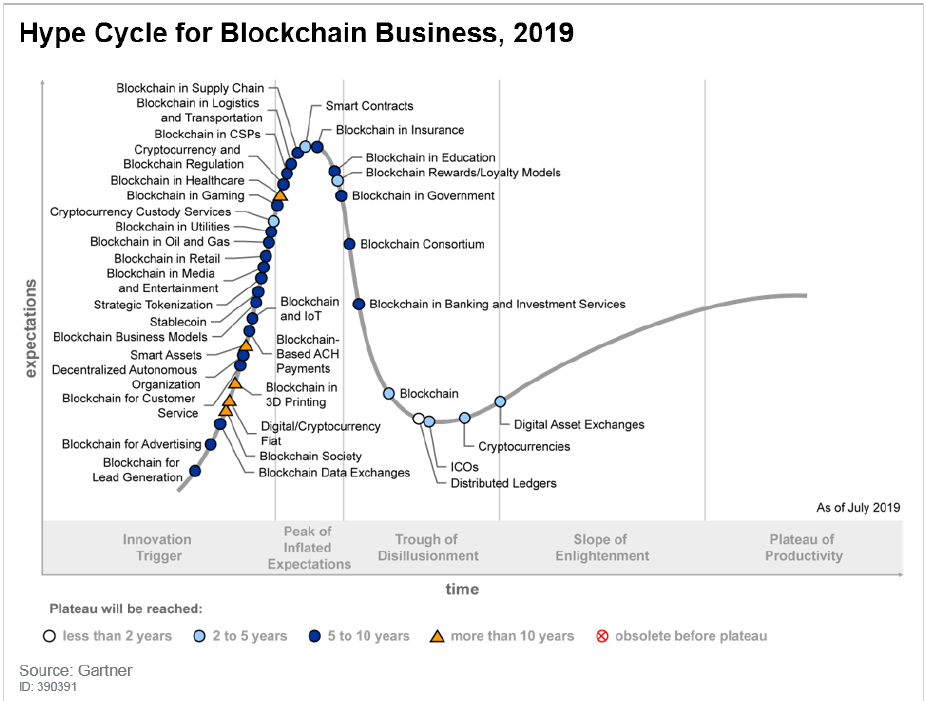
At the time people were imagining blockchain everywhere: in gaming, in government, in supply chain…you name it. Now some of that has moved on to the end of the hype cycle, but most of it is going to die in the Trough.
The Gartner Hype Curve is a useful way to assess technology that is being talked about, as is the Technology Adoption Curve. Another good way of thinking about hype can be found in this piece I wrote here. In that piece I show there are five levels of hype: Marketing Claims, Exaggerated Returns, Utopian Futures, Magical Thinking, and Othering. For companies like Microsoft talking about AI, the hype levels are at the level of Exaggerated Returns. For people writing think pieces on AI, the hype levels go from Utopian Futures to Othering.
In the end, however you assess it, its all just Hype. When a technology comes out, assess it for yourself as best as you can. Take anything being said and assign it a level of hype from 1-5. If you are trying to figure out if something will eventually be adopted, use the curves above.
Good luck!
 Smart People I Know