From Cup of Jo


If you get nothing else from this frightening article, How I’d Hack Your Weak Passwords on Lifehacker, get this: make you password is long (at least 8 characters) and make sure it has upper and lower case letters with some numbers and other characters (e.g. “curse” symbols like #$%@) mixed in.
I knew alot of this stuff, but something I should have guessed was this: if you can’t use a different password for every site you log into, make sure the really important passwords (e.g. for banking) is very good and very different than those sites (e.g. newspaper sites) which may have weaker security.
Hey, it’s your money and your identity. Protect it.
Well, if you are Bill Cunningham (who is 81), you want to continue to be a great photographer. The Lens Blog has a story about Cunningham and a documentary about him. What I love about him, though, is that he is “old” only in the sense of having lived many years. Otherwise, there is little that is old about Bill Cunningham. He is a hard working fashion photographer, a role that needs you to think “new”, not “old”.
So what do you want to be when you are 80? And if you are 80 already, then you should be planning your 100 birthday. Please invite me.
There’s a good review of the new Toronto bistro, Cafe Leopold, in blogTO. I am a big fan of bistros and their well prepared, tasty, unpretentious, (and great value) food. Seeing new bistros open cheers me up, which makes me happy and looking forward to checking out Cafe Leopold. If you are out on St. Clair, just west of Bathurst, and you are feeling hungry, look for this place….

I loved this photo from…well you guess…

Gizmodo has a post on the body language of the two men which is interesting, even if I am skeptical of it, here. What I thought was interesting is that Steve Jobs dresses in a black shirt, jeans and running shoes ALL THE TIME! I thought he just did that for big presentations. I guess he finds it simplifies his life. I also thought it interesting that they are just hanging out in a coffee shop (Starbucks?) just like the rest of us. No big fancy schmantzy board room meeting somewhere. Maybe they accidentally ran into each other! (“Steve?” “Eric!” “Steve! Let’s have a coffee and talk shop!” :))
WTH? In the United States at least, after HCR (Health Care Reform) we are going to see alot of people in the media and politicians talking about FinReg (Financial Regulation Reform). And just like with HCR, Ezra Klein at his Think Tank blog at the Washington Post has alot more good things to say about Finreg, including this. Well worth a read.
…I had a difficult time conveying what makes a Mark Rothko or a Barnett Newman painting great.
However, seeing these three painting from the wonderful blog 2 or 3 things I know might do a better job of explaining it visually than my words did.
Here we have “green”:

and “black”

and “white”

Each image has a different feel to it, and the relationships of the colours to each other affects the way we perceive the works, as well as how the viewer relates to these colours generally. But having an image of a house on a horizon makes that somewhat easier to comprehend somehow than if we remove the house. The house gives us a bridge to appreciating the expressionistic nature of the paintings. Indeed, the paintings are practically abstract, though the iconic nature of a house makes us think otherwise.
At least it seems that way to me. What do you think?
How is this done? Well, Pentagram has done work at the Achievement First Endeavor Middle School in Brooklyn to inspire children and teachers there to work hard and succeed. The work was part of a “refurbishment and expansion of an existing building” and its a powerful example of how something smart and low cost be very effective.
I love this in particular. For kids in middle school at some point must think: why must I continue to go to school and learn all this stuff? And there are lots of reasons. But I think these five, painted here, are essential reasons, and a great thing to constantly remind people of:

I also thought this was a great thing for anyone going up the stairs to see:

Go to Pentagram’s site for more info.
(Thanks to the great blog Sunshine and Design for pointing this out.)
Sinead O’Connor has written a searing editorial in the washingtonpost.com criticizing the Pope for what has happened and what is being done with regards to the sex abuse scandal in the Catholic church. Regardless how you feel about this issue, it is a remarkably well written piece and deserves a reading for many reasons.

One of those reasons is an aside, but a worthwhile one. O’Connor was sent to a Magdalene laundry for 18 months when she was younger. I only had a vague idea what this was. Not only did I learn more about them in this wikipedia article, but that article itself was well worthwhile reading, especially in light of everything.
(Photo of Magdalene Laundry in England, early 20th century, from wikipedia)
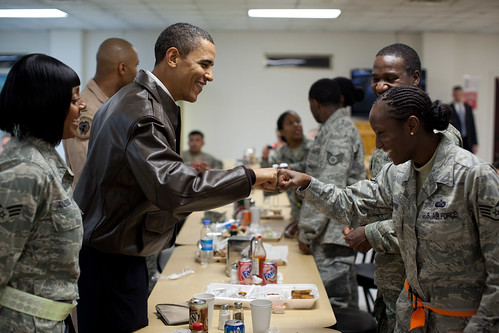
I love this photo:

From the White House photostream on flickr: http://farm3.static.flickr.com/2682/4470941729_f4fdf684ea.jpg
P032810PS-0918 on Flickr – Photo Sharing!
On the sex abuse scandal and what can the Pope do? Rod Dreher at beliefnet offers this advice:
I think the best thing he can do now — indeed, possibly the only sensible thing — is to admit any role he had in transferring priests and failing to do the right thing by sex abuse victims. Explain these decisions in context of the times and the culture, but overall don’t be defensive, but rather be humble. Confess all, and be publicly penitent. Many people will scream condemnation at the pope and the Church, and much of that will have been deserved. But I think men and women of goodwill will appreciate a genuine attempt to come to terms with this evil situation, not by denying and stonewalling, but by admitting and asking forgiveness. The pope already has uttered some extraordinary words of regret, but I think people are looking for something more.
I think this advice makes sense for American public officials. The American people are more expectant and accepting of leaders who go this route.
But the Pope is not an American official. And what might be acceptible for Americans may not be acceptible for European, South American, African or Asian Catholics. I would say that such a confession might wreck more damage to the Catholic church as an institution than stonewalling will. That doesn’t make stonewalling right, but it is something to consider in watching the behavior of the Pope and the Church.
I also believe that people who think the Pope is going to resign are looking at the Pope as a politician — which he is — and not as a Pope in a long line of Popes. Switching Popes is a big deal. Plus I think Benedict has wanted to be Pope for a very long time. Given that, there will be lots of steps that will be taken before resignation occurs.
I am surprised with how little people comment on the timing of Obama’s agenda. It’s not haphazard. The first thing up was financial stabilization. That was a given. But what could have been done, but wasn’t, was the reining in of the financial sector. Instead, what he went after next was health care. That was the toughest item on his agenda, which meant he needed as much time and as much support in Congress as he could get, and that mean he had to do it before elections in Congress come up, because it is almost a given that the Democrats are going to lose seats and it is going to be even tougher to get progressive bills through like health care. I think that’s one of the reasons financial regulation was put on hold. But now, financial regulation is coming up. Given that the banks are stable, it is easier to try and rein them in. Even if the Democrats can’t due to Republican opposition, they can take that opposition and run against the Republicans on that and health care, whose benefits Americans should be seeing in the next year.
Other big items will come after that, including climate change and immigration reform. On immigration reform, opposition from the Republicans may not be as uniform as it was on health care. Running against immigration reform will only help Obama when we runs again for reelection. Likewise with climate control.
Finally, given how depressed the American economy is now, it can only get better, and likely in a dramatic way, before the time Obama has to run again. That will help him most of all.
His biggest challenge will be what major initiatives he wants to tackle in his second term.
Well, this very handy Venn Diagram outlines the qualities that separate them out quite nicely.

Good question. There’s plenty of things to consider when choosing a new wireless carrier, and it helps to get an objective opinion. If you go here:
Wind Mobile vs. Public Mobile – choosing the carrier that’s best for you, IT Business can help you decide. Of course, there are other carriers too. Not only that, but I suspect Wind and Public will be continually upgrading their service. Still, if you are in the market now, consider this IT Business review: it’s good.
Reading this post, A Post-Health Care Realignment? | Cato @ Liberty, and the shifting in priorities as well as the odd alignments of so called left and right wing political groups in the U.S., had me thinking again of the notion of left and right in politics. In the U.S. in particular, there seems to be a shift to the notions of progressives and conservatives, which would be a shift away from the notion of liberals and conservatives. To make it confusing, in Canada we had Liberals (left) and Progressive Conservatives (right) who are now just Conservatives. And of course, from time to time, in any given country, what policies and politics make up left and right shift around.
Given that, it’s worthwhile to go back and look at the origins of the idea of left and right in politics. According to Wikipedia on Left–right politics:
The terms Left and Right have been used to refer to political affiliation since the early part of the French Revolutionary era. They originally referred to the seating arrangements in the various legislative bodies of France, specifically in the French Legislative Assembly of 1791, when the king was still the formal head of state, and the moderate royalist Feuillants sat on the right side of the chamber, while the radical Montagnards sat on the left.[8] This traditional seating arrangement continues to be observed by the Senate and National Assembly of the French Fifth Republic.
Originally, the defining point on the ideological spectrum were the attitudes towards the ancien régime (“old order”). “The Right” thus implied support for aristocratic, royal and clerical interests, while “The Left” implied support for republicanism, secularism and civil liberties.[1] At that time, support for socialism and liberalism were regarded as being on the left. The earlier “left-wing” politicians were advocates of laissez faire capitalism[citation needed] and the “right-wing” politicians opposed it, until the early nineteenth century when anti-capitalism gained favour among the leftists due to the rise of socialism.
However, among the left-wing were not only liberals but also Robespierre, who was a protosocialist, a disciple of Rousseau. When his section of the Jacobin party got the power, left-controlled French National Convention moved to decree numerous economic interventions during the Revolution, including price controls (enforced under penalty of death), forced loans on those with incomes exceeding 1000 livres, and the abolishment of the Paris Stock Exchange and all joint-stock companies.
During the French Revolution, the definition of who was on the left and who on the right shifted greatly within only a few years. Initially, leaders of the Constituent Assembly like Antoine Barnave and Alexandre de Lameth, who supported a very limited monarchy and a unicameral legislature, were seen as being on the left, in opposition to more conservative leaders who hoped for a more British-style constitutional monarchy (the British monarch was a very powerful figure in 18th century British politics, unlike today), and to those who opposed the revolution outright. By the time of the convening of the Legislative Assembly in 1791, their party, now called the Feuillants, had come to be seen as on the right due to its support for any form of monarchy, and for the limited franchise of the 1791 Constitution. By the time of the National Convention only a year later, the semi-liberal Girondins, who had been on the left in the Legislative Assembly due to their support for external war to spread the revolution, and strong dislike for the king, had themselves come to be seen as being on the right due to their ambivalence about the overthrow of the monarchy, their opposition to Louis’s execution, and their dislike for the city of Paris, which had come to see itself as the heart of the Revolution.
Part of the confusion of left-right wing politics in much of the West had to do with the problem with the old order (normally right wing) being associated with progressive politics (left wing), given the amount of change that had been established, especially the New Deal policies of F.D. D.R. Hence, I think this is a reason why people have moved away from those terms. But in a deeper sense, they still hold, for progressive politics are still associated with the masses while conservative politics are still associated with the estates of our current societies. And because of that, I still think the idea of left and right in politics is still worthwhile.
Smart. Melodic. Sparse. Indie in the best sense. A really good song given a really good video to go with it. Watch:
YouTube – Wye Oak – Please Concrete

This one is going for $179,000 in Toronto. It’s small, but it is very nice inside. Check out Little House on the Big Market at Torontoist for the details including lots of great pictures.
The Washington Post has set up a simple but useful calculator web page to tell you what the bill means for your insurance coverage. Enter a few pieces of information and the calculator will tell you. Easy! Truly a worth while page to visit. And while you are there, go to Ezra Klein’s section: you will find a gold mine of information on the topic of health care reform.
Even if I disliked President Obama and the Health Care Reform legislation (which I don’t), I would still be impressed with this speech (in three parts, below). Not just because it is presented so well and seemingly off the cuff, but because of how well he does what he has to do. He has to take the Democratic Caucus and do his part to unite them before the big vote on the next day. He is like the coach coming in to work up the players. To the more liberal members of the caucus, he has to acknowledge that the bill doesn’t have all that they want in it and still get them to support it. To the more conservative member of the caucus he has to get them to step up and vote for the bill despite the difficulties it may put them in come election time in 2010. And he has to do that all in this speech.
The result? I think he does a great job of this in this speech. But see for yourself.
Well, at the bottom of his Op-Ed Contribution, The Real Arithmetic of Health Care Reform, in the NYTimes.com, it says he was “the director of the Congressional Budget Office from 2003 to 2005, is the president of the American Action Forum, a policy institute.” Fairly neutral sounding roles to me, and likely anyone else reading this attack on the current Health Care Reform legislation before the U.S. Congress. However, in this age of the Internet, I can quickly browse his Wikipedia entry, that starts by saying he was “former chief economic policy adviser to U.S. Senator John McCain‘s 2008 presidential campaign“. As well, if you look up the members of the American Action Forum, you see alot of American conservatives, including Norm Coleman, Jeb Bush,Tom Ridge and likely others. Indeed, the Forum states that it is “center-right”. Now there’s nothing wrong with all that, of course, but knowing it helps you take his opinion with a grain of salt.
Either the Times or Holtz-Eakin is downplaying his role working for Senator McCain. Worse, it seems to me that he is downplaying the importance of the CBO, an office that he was head of for a number of years. I wonder if Republicans will start discounting the CBO in general if it makes rulings that, while neutral, are not in it’s favour. That would be a bad thing. I think the CBO is a great idea and I am impressed how quickly it takes legislation and turns around with rulings. It’s an office that should get support from Americans, not something that should be degraded.
For more on the CBO, you can find the director’s blog here. It’s good stuff, especially this post where they take on Uncertainty in Estimates for Health Care Legislation. Maybe Doug Holtz-Eakin should read that. As he should know, the CBO takes it job very seriously, and they take a broad and deep approach to the work before them. Just read that post and see.
 I loved and still love Italian Montepulciano d’Abruzzo: it’s a great low cost wine made from the Montepulciano wine grape, and perfect with so many Italian meals. However, my new love(s) in Italian wines are those made from the Negroamaro varietal. I’ve had a few now and they are all delicious, including one from the big producer Farnese. I love them for the same reasons stated by this blog, NB Wines, in their review of Mezzomondo’s Negroamaro Rosso Salento:
“I love dark, chewy wines made from grape varieties such as Tannat and Negroamaro. This one offers lots and lots of vanilla on the nose, and also blackberries, raspberries, and spices. It is long and lush and mouth-filling on the palate, which adds leather and tar and features firm tannins that end with an “oomph.” I find it a tiny bit sweet, but otherwise it exhibits good varietal typicity (by which I mean that it has characteristics of more expensive Negroamaros I’ve enjoyed). It is excellent value at the price, and a great place to start to explore this grape varietal and style of wine.”
The other negroamaros shared the same qualities: spicy, chewy, dark, and with lots of cherry and other berry flavour. In some ways, they remind me of Spainish wines, or ripassos. (But still alot cheaper.) They would be perfect with roasts, stronger cheeses, duck, and spicy Asian dishes.
In Ontario, Farnese and Mezzomondo is providing negroamaros in the general section of the LCBO. As well, in Vintages there are some winemakers supplying it as well. I highly recommend you get some soon.
From the Lens Blog – NYTimes.com:
“Karina Lau’s bedroom has not changed. A stuffed teddy bear and floppy-eared rabbit sit on top of her floral bedspread. Angel figurines and framed family photos line her bookshelf and dresser.
The only thing missing is her. Private Lau was killed seven years ago when insurgents shot down her helicopter in Falluja, Iraq. She was 20 years old.”
The Lens features the work of Ashley Gilbertson, who has been photographing the bedrooms of young soldiers from the U.S. who died in action and will never return home to their rooms, their parents, or the lives they left behind. It’s a powerful example of the depth behind what can a simple image.
The Lens is always good.
Check out the virtuosity of this guitarist:
Then head over to YouTube and check out lots and lots of guitarists from Botswana. It’s all good, but this way of playing is impressive on all it’s own.
YouTube – Botswana Music Guitar – Ronnie “Happy New Year Luie” !
(Found via the always good pourmecoffee)
Nate Silver at FiveThirtyEight has a well written post on how to whip up votes in a legilative body like the U.S. House of Representative: FiveThirtyEight: Politics Done Right: Time to Start Counting Yes Votes.
From time to time in the news you will hear that so-and-so is the Whip for such-and-such a party, and you may wonder: well, that’s an odd sounding job, what do they do? The obvious answer is they persuade people to vote a certain way on a certain piece of legislation before them. But how they go about it is very likely the way it is described in Silver’s post.
How they hand out carrots and swing sticks is another story. But it is very likely how they get the votes.
Watch until the end…
I am not a big fan of micropayments. So when I saw this article, Micropayments and Subscriptions: How Business Models for Startups are Shifting at ReadWriteStart, I thought: maybe someone has figured it out.
Instead, what I see is a reference to a site called ZooLoo and this:
In January, ZooLoo fundamentally changed their business model by creating a storefront through which customers could pick and choose features on a micropayment level. Now if a user wants to purchase their own domain name, but doesn’t want to pay for ZooLoo’s SEO services, they can do that instead of being forced into picking from a tiered package.
(I added the bold text).
I went over to the ZooLoo site, and unless I am missing something, what they seem to have done is offer month subscription servers from $1.99 a month on. According to wikipedia, that is technically a micropayment, but really, if that all it is, then what’s the big deal about that. Given that’s a micropayment, then the local dollar store is a micropayment cornucopia! Either that, or the concept of a micropayment is a tired one that should take a rest.
It does sound cool, though. I think that’s why techies like it.
It must be fun to write about the end of privacy. People write about it alot. And they like to start off with scary stories like this one in the NYTimes.com:
“If a stranger came up to you on the street, would you give him your name, Social Security number and e-mail address?
Probably not.Yet people often dole out all kinds of personal information on the Internet that allows such identifying data to be deduced. Services like Facebook, Twitter and Flickr are oceans of personal minutiae — birthday greetings sent and received, school and work gossip, photos of family vacations, and movies watched.”
Stop for a second. Did you just think, “wow, people can find out my Social Security number from Facebook, Twitter and Flickr?!” That would be scary!
Now let’s read down some more and cut to the chase.
“Even more unnerving to privacy advocates is the work of two researchers from Carnegie Mellon University. In a paper published last year, Alessandro Acquisti and Ralph Gross reported that they could accurately predict the full, nine-digit Social Security numbers for 8.5 percent of the people born in the United States between 1989 and 2003 — nearly five million individuals.
Social Security numbers are prized by identity thieves because they are used both as identifiers and to authenticate banking, credit card and other transactions.
The Carnegie Mellon researchers used publicly available information from many sources, including profiles on social networks, to narrow their search for two pieces of data crucial to identifying people — birthdates and city or state of birth.
That helped them figure out the first three digits of each Social Security number, which the government had assigned by location. The remaining six digits had been assigned through methods the government didn’t disclose, although they were related to when the person applied for the number. The researchers used projections about those applications as well as other public data, like the Social Security numbers of dead people, and then ran repeated cycles of statistical correlation and inference to partly re-engineer the government’s number-assignment system.
To be sure, the work by Mr. Acquisti and Mr. Gross suggests a potential, not actual, risk. But unpublished research by them explores how criminals could use similar techniques for large-scale identity-theft schemes.
Computer scientists and policy experts say that such seemingly innocuous bits of self-revelation can increasingly be collected and reassembled by computers to help create a picture of a person’s identity, sometimes down to the Social Security number.”
So! Did you see any references to popular sites like Facebook in there? Kinda. Facebook allows you to expose your date of birth and city or state of birth. But I also see references to the SSNs of dead people, as well as references to (what I assume are) complex analysis techniques to find the SSN of people. Is that a risk? For sure, but I would like to see how that risk stacks up with other risks, such as companies not properly handling the capturing and storage of such information. I bet the leakage of your SSN via that way is higher from careless handling then the approach taken in this study. If you are going to worry about something, worry about that first.
Then we have this quote:
“In a class project at the Massachusetts Institute of Technology that received some attention last year, Carter Jernigan and Behram Mistree analyzed more than 4,000 Facebook profiles of students, including links to friends who said they were gay. The pair was able to predict, with 78 percent accuracy, whether a profile belonged to a gay male.”
Sound impressive, yes? Well, it’s hard to conclude the actual numbers, but let’s assume for the sake of argument that of the 4000 students, each had 300 friends, and of those 300 friends, 30 – or 10% – were gay. That means that of the 1,200,000 friends, 120,000 were gay. Now the pair were able to predict which ones were gay with 78% accuracy, which sounds impressive until you realize that they got 26,400 wrong. It’s not possible from the article to tell how they erred. They could have been aggressive in categorizing people as gay and said 26,400 straight friends were gay who weren’t, or maybe they were conservative and said 26,400 gay friends were straight who weren’t. Or maybe it was a mix. Regardless, they got alot wrong. As for the ability to “out” people via social networks, how powerful this is depends on the openness of the campus and the community the study was done. For example, it may not necessarily be difficult to identify at least some of the gay friends (e.g. maybe some male friends listed their interests as “other gay men”, which would tend to clue you in to that person’s sexual orientation). So how much privacy was stripped away is up for debate. If they were able to score 78% on a community or campus that was discriminatory towards gays then that would be impressive and scary. But if it was done at M.I.T., I think they had a better chance of success.
By the way, there was this quote really made me LOL:
“Personal privacy is no longer an individual thing,” said Harold Abelson, the computer science professor at M.I.T. “In today’s online world, what your mother told you is true, only more so: people really can judge you by your friends.”
Really? Does Abelson actually know any young people — or any people — and how they are using social media sites? These are not 20 year old friendships carved in stone on these sites. Alot of times the people associated with people is loose at best. There’s nothing wrong with that, but it’s a bit like saying I can judge who you are based on the last restaurant you dined in!
The article sums things up nicely much further in with this quote. This quote pretty much sets the level of concern for me much lower than the headline:
“So far, this type of powerful data mining, which relies on sophisticated statistical correlations, is mostly in the realm of university researchers, not identity thieves and marketers.”
There you have it: your privacy may vanish online, but not today. Vanishing privacy is still a work in progress. For that matter, technologies that strengthen your privacy are also a work in progress.
Skepticism about this article aide, this doesn’t mean that I think there are not risks to losing control of your privacy due to new technologies. It does mean, however, that I think we need to keep the risk in perspective. Articles like these encourage people to lose that perspective.
The article is here: How Privacy Vanishes Online, a Bit at a Time – NYTimes.com
Like the creator of this tool, I find the Google UI very blah. But with Helvetical » I am Ad Taylor, your calendar can look clean and …well, like this:

Much nicer! It might take a little bit of work to set up. As it is, I had Greasemonkey working on Firefox, so it was a snap!
A very nice piece of software. I really liked Google Calendar before: I love it now.
Why is YouTube great? Because you can find Little Richard & Tom Jones rippin’ up Rip it up here:
And if that isn’t great enough, here they are doing Good Golly Miss Molly
Little Richard is working!!!
Awesome.
And in this article, Telling Friends Where You Are (or Not) in the NYTimes.com, you can get a good introduction to what they are and who the major players are. You should expect to see alot of development in this area: here’s your chance, if you are not already familiar with them, to get an idea what the fuss is all about.
If you have seen photos of the civil rights battles in the U.S. in the 1960s, then you likely know the photographs of Charles Moore. The Lens Blog at the NYTimes.com has a write up of him and some of his photos, but what you really want to do is go here. At that site you will see many of the powerful photographs that he took of that era. That site is called Powerful Days, but it could equally be called Powerful Photographs.
Recognize this?

This is just one of Moore’s photos. You want to see the rest.
I thought “The Green Zone” was terrifically enjoyable. So I am somewhat surprised to see it getting mixed reviews and doing poorly at the box office. It does try to be a political thriller, but if you go for the politics, you will be disappointed. If you go for the thrills, you are in for a treat.
It doesn’t help that the director, Paul Greengrass, directed both the Bourne films as well as “United 93”. It is much closer to the Bourne films, and everything from the use of Matt Damon to, well, this trailer, YouTube – ‘Green Zone’ Trailer, reinforces that. If you liked the Bourne films, or action/adventure films generally, then see the film. If you want the story of the early days of the Iraq war, then you likely want something else.
It’s interesting that a few reviews and commentary referred to The Hurt Locker as being a more realistic portrayal than this. I’ve read at a number of sites that The Hurt Locker isn’t very realistic either. What The Hurt Locker does do well, though, is portray the situation in Iraq using almost a documentary approach to filmmaking. Plus The Hurt Locker removals all the politics from the war. Green Zone, on the other hand, is filmed with more of an action film approach to moving making, and it is very political. Perhaps that’s why it comes across as less realistic. I believe neither film is realistic, but both of them are entertaining and worth seeing.
In Green Zone the press, Special Forces and the government are the antagonists, while the CIA and the military are the protagonists. I thought that was interesting.
Anyway, here’s the trailer for Green Zone.
A.O. Scott from the NYTimes.com has a great review of ‘Aliens’ and what makes it great. I think it is a great film in itself, and if you loved “Avatar”, you should watch or rewatch ‘Aliens’ to see how the two play off of each other. For that matter, watching this clip, I was reminded how much the cinematography reminded me of “Blade Runner”. That in itself is interesting, since the director of that film, Ridley Scott, also directed the first “Alien”.
In this part of the world it is going to be cool and rainy these next few weeks. Perfect weather to watch all three of those films!
Are you having problems with your older dishwasher? Mine was not getting my dishes clean, and I think it has to do with the soap cup not opening properly. I decided to switch to a brand the comes as a solid square and contains three types of detergent (that I am guessing dissolves at various times), and since then my dishes have come out sparkingly clean.
P.S. I’ve blogged about dishwashers before, but I was hesitant to do so again, thinking: what a boring topic. Then I saw that this was a trending topic: When a Cap Full of Soap Is Not a Good Thing in the NYTimes.com. Clearly people love stories about dishwashers! I decided to add my two cents. 🙂
I wrote before about how influential you are: more so than I think you suspect. This post, The Spread of Goodness from The Frontal Cortex, supportsd my belief with the backing of some experiments.
I’d argue that you don’t just influence via social networks, though: I think one’s presence and appearance and how you interact with strangers can be just as influential. (I especially thought this yesterday when I saw a car go out of it’s not to splash me with a big puddle on the road. That as very considerate and I appreciated the driver’s effort.)


 Smart People I Know