Strategic Voting in 2025 – what you should know

Canada flag on brick wall

I am still a supporter of strategic voting in Canada. My thoughts on it haven’t changed much since I wrote this in 2019: Strategic Voting in Canada – some thoughts.

What has changed is the site you should go to if you  also want to vote that way. It doesn’t look like this site, strategicvoting.ca, is working any more. However this site SmartVoting.ca, seems up to date, at least for the Ontario election this week. And it looks like they are preparing to work on the soon to come Federal election.

It’s good to check out regardless of how you plan to vote.

Blackberry: a device once loved, now a film (and a great one)

I loved this film, just like I use to love my Blackberrys. If you loved yours, or the era of the Blackberry, or just want to see a great film, I recommend you see “Blackberry”.

There’s a number of ways you can watch this film. You can watch it just as a story of that weird era from the 90s until the early 2000s. Or as a story about the tech industry in general. Or a story about Canada. It’s all those stories, and more.

To see what I mean, here’s a piece in the CBC with a Canadian angle: New film BlackBerry to explore rise and fall of Canadian smartphone. While this one talks about the tech industry as well as the cultural elements of it: ‘BlackBerry’ Is a Movie That Portrays Tech Dreams Honestly—Finally | WIRED

But besides all that, it’s a great character study of the three main characters: Mike Lazaridis (Jay Baruchel ), Jim Balsillie (Glenn Howerton) and Doug Fregin (Matt Johnson). The arc of Lazaridis in the movie was especially good, as he moves from the influence of Fregin to Balsillie in his quest to make a great device. It’s perhaps appropriate that Balsillie has devil horns in the poster above, because he does tempt Lazaridis with the idea of greatness. And Lazaridis slowly succumbs and physically transforms in the film from a Geek to a Suit.

That’s not to say Balsillie is a caricature. Under all his rage and manipulation, you can see a human also struggling with ambition and is who is aware of the great risks he is taking. His arc might not be as dramatic as Lazaridis in the movie, but it is a rise and fall of significance.

As for Fregin, his character is important but he doesn’t change the way Lazaridis and Balsillie do. But if Balsillie is the devil on the shoulder of Lazaridis, then Fregin is the angel. He provides a reminder throughout the film of what Lazaridis lost in his transformation. (And the description of his life at the end of the film is *chef’s kiss* good.)

The film is a dramatization, but it gets so much right.  Lazaridis and Balsillie were crushed in the end, just like in the film. Balsillie lost his dream of NHL ownership, and Lazaridis lost his claim of making the best smartphone in the world. There’s a part of the film when Balsillie asks: I thought you said these were the best engineers in the world?? and Lazaridis replies: I said they were the best engineers in Canada. That part is a transition in the film, but also sums up the film and the device in many ways.  Their ambition and hubris allowed them to soar, but eventually they met their own nemeses whether they came in the form of Apple or the NHL Board of Directors or the SEC.

As an aside to all that, it’s fascinating to see the depiction of Blackberry defeating Palm/US Robotics. In the early 90s Palm and US Robotics (who later merged) were dominant tech players. Blackberry surpassed them and left them in the dust. Just like Apple left RIM/Blackberry in the dust when they launched the iPhone. (Google also contributed to that with Android.)

Speaking of Apple, it was interesting to see how backdating stock options helped sink Balsillie. He was not alone in such financial maneuvering. Apple and Jobs also got into trouble for backdating options. I assume this practice might have been more common and less black and white than it comes across in the film.

In the film, there is a certain prejudice Lazaridis has about cheap devices, especially those from China.  It’s just that, though: a prejudice. That prejudice was once held against Japan and Korea too, because those countries made cheap devices for Western markets at first. But Japan and Korea went on to produce high end technology and China has too. The Blackberry Storm from China might have been substandard, but Apple has done quite fine sourcing their products from that country. Something to keep in mind.

I suspect I will watch the film many times in my lifetime. Heck, a good part of my life IS in the film as someone involved with the tech industry at the time. That business is my business. That culture is my culture. That country is my country.

None of that has to apply to you, though. If you want to watch a superb film, grab “Blackberry”.


More on the indigenous people in Canada (winter 2023)

Here are a number of good pieces I’ve come across concern indigenous groups in Canada exerting their rights both politically and economically.

First up, on the West Coast there’s this story of the Squamish who are “transforming the land (seen above) into one of the largest Indigenous-led development in Canada’s history, on its own terms — free from the rules that bind most urban developers. But not everyone is happy about the nation’s power and autonomy over its project”. Second, in Central Canada, there’s this story of an Indigenous cannabis shop in London that could be major test for Ontario. I also came across this story on the Innu out East fighting for what’s theirs. It states that although “they’re getting financial compensation, the Innu have yet to receive the rest of what was agreed upon: self-governance.”

I strongly believe that indigenous people of Canada need to have more than political power to succeed: they also need economic power. So I am glad whenever I see stories like this of a Group of First Nations and Metis communities acquiring minority stake in 7 Enbridge pipelines. There’s still much to be done, of course, as this story shows: 25 years after the Delgamuukw case the fight for land is contentious.

Despite setbacks and roadblocks, there’s progress, as this story illustrates, when the federal government and 325 First Nations agree to settle a class-action lawsuit that sought reparations for the loss of language and culture brought on by Indian residential schools, for $2.8 billion.

Not all progress is financial, but it still matters: Residential schools described as genocide by House of Commons.

Some other stories of note:

When Alex Colville appeared on Canadian coin, or what should replace the Queen?

There has been discussion about what should go on Canadian money now that the Queen is dead. For some, the choice is obvious: Charles III. For others like me, the choice is less obvious.

One thought I had was to commission Canadian artists to produce works to go on the front of the coin. We had done something similar for the back of the coin, in 1967. Then Alex Colville produces a series of animal images that graced six of our coins as part of the Centennial celebration. I think now would be a good time to commission one or more artists to produce images for the front of the coins, too.

We would still have our toonies and loonies with consistent images on the back. But now we could have new images on the front. I like the idea a lot.

For more on Colville’s coins, this piece was interesting.

P.S. Relatedly, here’s why the monarch on our coins face the way they do. Fun!

(Image: link to image on mint.ca)

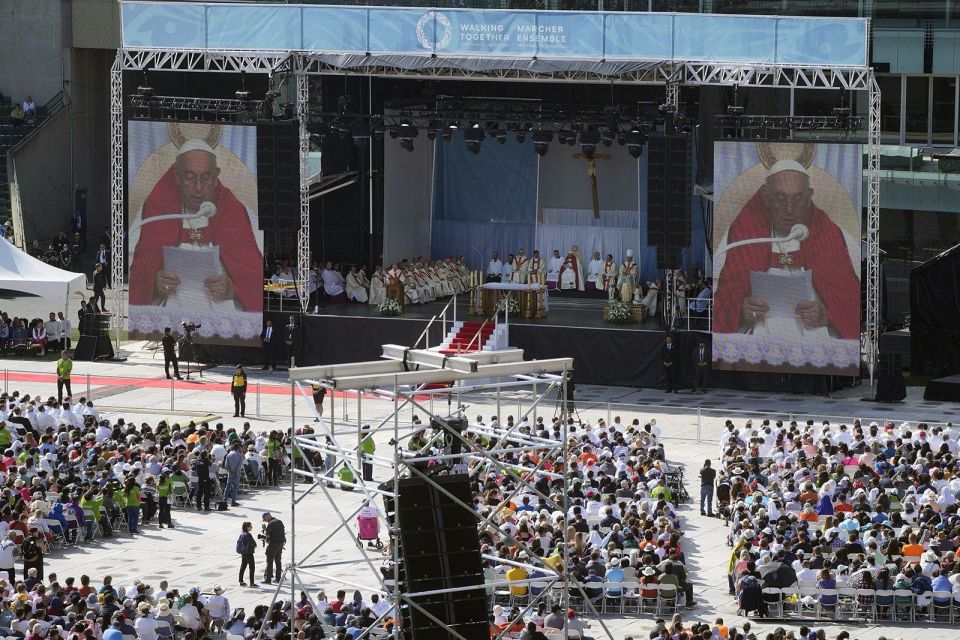
On the Pope’s visit to Canada in 2022, and more

The Pope was recently in Canada to apologize for the role of the Catholic Church in the residential school system and the suffering that was inflicted on indigenous people within Canada. Here’s the  NYTimes on the visit. Here’s NCR onlineEven our Prime Minister weighed in.

When it was over, we got follow up stories from the NYTimes, from America Magazine and from NCR online, each assessing the visit, as well as highlighting statements like: Pope Francis Calling the Abuse of Indigenous People in Canada a “Genocide”.

Overall, many seemed unsatisfied with it, as you can see from this piece, Why Pope Francis’ Canada school apology isn’t enough, and this piece, ‘Indigenous representatives had no voice’ at Quebec City Papal event. Even during the events, some indigenous people expressed their negative feelings towards it all, as this story showed, ‘I couldn’t stay silent ‘ says Cree singer who performed powerful message. It didn’t help that some  bishops seemed to be raising money from it.  Even prominent Catholics did not see it as a success, though for different reasons than indigenous people did: 3 views on pope’s visit to Canada.

During the time he was in Canada, there was much focus on certain Papal Bulls from the 15th century. It came up in this tweet from cblackst. At first I could not figure out why this was an issue. I was ignorant to the fact that indigenous people have been demanding revocation of the 1493 papal bull since at least the year 2000. As far as some Catholics are concerned, the Catholic doctrine of discovery is already null and void.

I am not sure what revoking it would accomplish. Papal Bulls are weird documents. During times of good popes, they could be good. During bad popes, they could be evil. Anti-semitism drives many of them. If you want to read more on them, here’s some links that could be helpful: Papal Bulls – Doctrine of Discovery, and Dum Diversas – Doctrine of Discovery, and finally, Sublimus Dei On the Enslavement and Evangelization of Indians.

While the Papal Bulls got a lot of focus, what seemed to get less focus was money that the church had pledged but failed to deliver. The church failed to provide $25 million in compensation for the victims of residential schools, as this story showed. Despite claiming they could not raise the money for their sins, the Church did manage to raise much more than that amount for their properties. It was maddening to me that the media did not focus enough on that. (Later on they did report on a deal the government made freeing Catholic entities from $25M campaign for residential schools. You can read about that here and here. That would have been useful to know about before the visit.)

I had hoped for more from the Pope, the Church, the media, even activists. I hope at least the victims of the residential school system benefited from the visit and the actions of the Pope.

On a different topic, one thing I think everyone will benefit from is the appointment of Michelle O’Bonsawin to Canada’s Supreme Court. We need more indigenous leadership in the justice system, and she is in one of the key roles to provide that. You can read more about that here and here.

Finally, this New York Times interactive study on Benjamin West’s painting on the death of General Wolfe is relevant in many ways to the topic of this post. I recommend you check it out.

(Image: link to an image from one of the NCR Online pieces)

On June being National Indigenous History Month in Canada (and other links)


June is National Indigenous History Month in Canada. Here are some pieces I’ve been collecting over time that I thought worthwhile sharing.

Drinkable water for indigenous people in Canada is a serious problem that is ongoing and needs more focus from everyone. Here’s how the Government of Canada is investing in sustainable water infrastructure for Iqaluit. That’s some progress. And here’s a story on how one indigenous group solved their own drinking water problems. That’s promising. Also promising is this story on how one community at Shoal Lake that was on water advisories for 24 years now has its own award winning treatment plant. All good. We need more of this.

This piece on 5 Anishinabek First Nations in Ontario who have signed an agreement with Ottawa that would allow them to self-govern is also good to see.

The Pope will be coming to meet some of those who suffered as a result of the Residential School system. Here’s more on that from the CBC. Let’s pray for progress.

Finally, here’s a story on a fine initiative showing how one group of indigenous people are using technology to foster and maintain their culture. More on that here.

(Image link of a worker at the Shoal Lake water treatment facility.)

The one problem with moving to Nova Scotia, especially if you are older

Halifax bridge

I must say, the thought of moving back to Nova Scotia appeals to me. I think of it often. I was born and raised there and still consider myself a Nova Scotian (although I will also say I a Cape Bretoner from Glace Bay. I am proud of all three). It’s a beautiful place and I have family there. I love it.

The one big problem, though, is this one: Nova Scotia doctor wait-list hits record high, topping 81,000 | CBC News.

I realize this problem is not unique to Nova Scotia. Finding a doctor in Toronto, never mind rural parts of Ontario or other parts of the country, is not easy. But it has always seemed to be a problem in Nova Scotia. I use to hear it all the time from my parents. They always felt fortunate when they could get a good doctor.

I also realize I am looking at the problem from a distance. People living in Nova Scotia now may disagree. But if you are thinking of moving (back?) to Nova Scotia, consider that.

(Photo by Harjinder on Unsplash)

On the recent moot election, September 2021. A brief note…

Well that was an odd election. If anyone came out ahead, I can’t see who it was. The Liberals did not get their majority, yet none of the other parties made any significant gains at their expense. Canadians voted to maintain the status quo and maintain it they did.

The one significant thing I noticed was line ups on Election Day. I’ve been voting for decades and I’ve never seen anything like it. As for me, I voted in the advanced poll and while I saw lots of good measures in place to limit the spread of COVID-19 the whole process was still pretty quick. I imagine those good measures slowed things down on Election Day.

It will be interesting to see if there is more voting via mail and via advanced voting in the next election. I expect we will have another one in a few years from now, though I would be surprised if the Liberals will be the ones to bring it on.

The next thing to pay attention to is what happens to the leaders of the various parties. I expect the Greens are going to have to make some difficult decisions. As for the other parties, I have no idea. I thought the leaders all performed well, but members of their parties might think differently. Let’s see.

After that, I’ll be very curious to see what Trudeau and his team do next. I hope they focus on the pandemic and what is needed to get to end of job in that with an eye on the economy and other promises they made.

I tend not to touch on politics on social media: it’s tends to be all downside with little upside. But this election was so odd I had to comment.

What I found worthwhile reading regarding indigenous people in Canada, summer 2021


I am always trying to find ways to better understand the indigenous people of Canada and as a result I try and keep the better things I come across that help me with that understanding. I tend to be haphazard in how I research things: that shows in the almost randomness in what I have collected below. I think these links are worth reading, though.

On Residential schools: Recently there has been a strong focus on Canada’s Residential school system. Some people wrote about how people didn’t know this was happening back then. However this piece gives some important historical context as to what people knew at the time. As well, this piece gives more context as to how TB affected Aboriginal people.

Alot of what has been driving the focus has been the use of technology to find unmarked graves. Here are two good pieces on that ground radar technology. This piece gives a good introduction to it and this piece provides much more detail on how it works. For example, I naively expected the images to be more like an X ray or an ultrasound. It’s not quite that straightforward. Instead the images look like this:

(Image via CBC site)

As the use of the technology spread to other schools, some believed we would find graves at every residential school. However despite a lot of effort, there is no evidence found of unmarked graves related to Shubenacadie Residential School. I suspect this examination of schools will go on for a long time, and we will find more graves, but it will take time and not always come up with clear results.

As for why this is suddenly going forward, this story gives some context on how the search for the missing graves is being funded. Better late than never from the Federal government, but the lateness is still bad.

Finally, this is shameful: How the Catholic Church raised nearly $300M for buildings since promising residential school survivors $25M in 2005 . More on that story here.

History: My knowledge of indigenous history is weak. However, I found this helpful: More history: on the Iroquois as well as this: Military history of the Mi’kmaq people.

I need to go to Indigo bookstore and read more books and get a better sense of indigenous and Canadian history. If you feel the same, here’s a good list of what they have. Libraries are also good to go to and check out these books.

Other items:

Finally, if you want to learn more about Indigenous people in Canada, I’ve seen some indigenous people say that link was worthwhile.

(Top image of Shubenacadie Residential School via Wikipedia. Bottom image is of Her Excellency the Right Honourable Mary May Simon, Governor General and Commander-in-Chief of Canada taken by Sgt Johanie Maheu, Rideau Hall © OSGG-BSGG, 2021)

On clean water, Canada, and the First Nations


We will soon enough have an election in Canada, and I hope this is a major topic during the campaign. No one should have undrinkable water in Canada. We need to do better as a country.

  1. If you want to read more about it, here are three links:What Would It Look Like to Take the First Nations Water Crisis Seriously? | The Walrus
  2. Liberal government will miss drinking water target by years, CBC News survey shows | CBC News
  3. Globe editorial: Since 1977, Ottawa has spent billions trying – and failing – to bring clean water to every reserve – The Globe and Mail

(Photo by manu schwendener on Unsplash )