
I have this Yahoo! widget* running on my desktop:
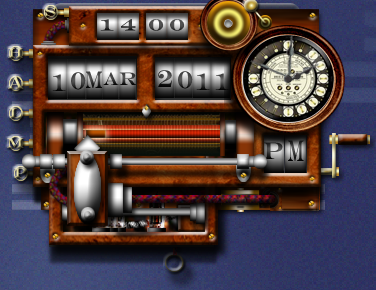
Every 15 minutes it chimes on the quarter hour, and every hour it chimes once for every hour. What I love about this widget, besides the steampunk look of it, is how it is resetting my notion of time back to what it used to be and what I think is better.
I also have this widget on my desk:

It is a timer that allows me to keep focused on a task. With all the distractions that my computer generates, having this timer allows me to focus. (E.g. I will spend 20 minutes on email, and when the timer goes off, I will quit that and work on producing a report for 30 minutes). While this approach is good, I find that time becomes very fluid. It is less fluid than allowing myself get distracted by every pop up that occurs or open tab on my browser, but it is something I control and sometimes let slip by.
What I love about the steampunk clock widget is that it implies that time is independent of me. Time is important. Each hour, each quarter hour is important, and it tells me it is important by announcing it. It makes me appreciate time more as a thing in itself, and not something that I slosh around, 10 minutes here, 20 minutes there. It also makes me appreciate the order of time: there is a quarter hour, and then three more and that takes us to the top of the hour. Time marches on with the first widget. Finally, I think 15 minute intervals of time are best. We are always trying to squeeze more out of time: a quick minute here, a five minute break there. The steampunk widget says: no, 15 minute intervals are best for dividing up the day, and anything worth doing will need 15 minutes at least. It changes the pace of the day.
I like playing around with time. I feel like I am always aware of it, and how it is speeding by. What I like about the steampunk widget is how it is reshaping my approach to time.
* Yes, I still use Yahoo! widgets. In fact, I use quite a few of them. I find them very helpful in making me more productive. I think the tools that Yahoo! provides are underappreciated. I hope that will change and that more and more widgets are developed.
 In Cape Breton these days, you can have a light supper of Italian capocollo, Spanish olives and an radicchio salad washed down with a nice glass of Barolo, before being driven to the theatre to catch a live simulcast of Anna Netrebko performing in the Met’s version of Don Pasquale. In other words, you can have many of the same experiences that someone in the big city like Toronto can have. This is astounding to me in some ways, because when I was younger and living in Cape Breton, that was not the case. What people in big cities enjoyed was something either you could not experience locally or something you got to experience much latter. Now, the people at Loblaws or the Metropolitan Opera didn’t get together and say: those poor Cape Bretoners…we should be nice and give this stuff to them. No, what happened is that first they found ways to be able to distribute these things cost effectively and profitably to areas like Cape Breton via innovations in their supply chain. Once they could do that, they understood that there was a market for these goods and services there just like there was in Toronto or Vancouver or other parts of Canada. And just like in other parts of Canada, not everyone in Cape Breton cared or wanted these things. But many Capers did, and that motivated these companies to distribute these goods and services to Sydney and Glace Bay and other parts of the Island.


 Smart People I Know