On the joy of the Web: from Kleon to Pullman to Rembrandt

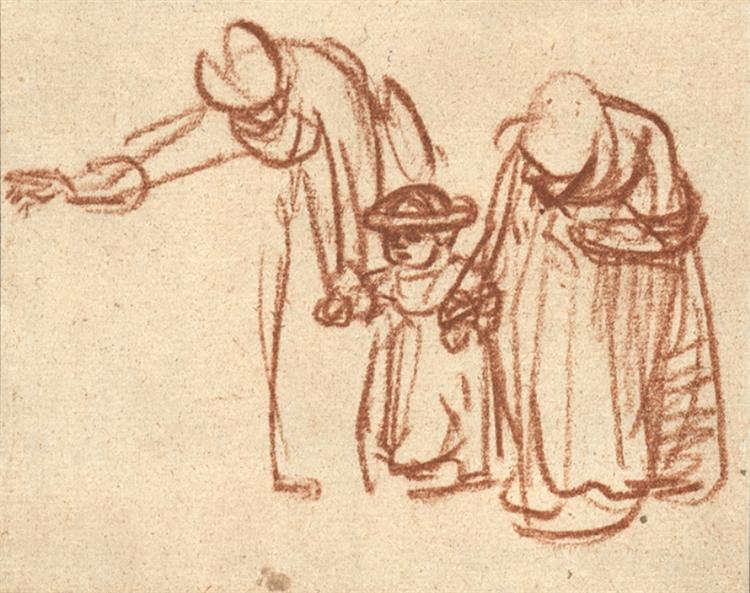
I was reading this piece by Austin Kleon, and there was a reference to a piece by Philip Pullman in which Pullman discussed drawing and spoke of “Rembrandt’s astonishing drawing of the toddler learning to walk”. That led me to the link which all these great Rembrandt drawings, including the one above. What a joy it was to serendipitously see these sketches of the Dutch master.

That experience reminded me of the joy of the Web: you surf from one page to the next, and suddenly you find something unexpected and wonderful. There’s so much bad material on the Web these days, it’s was great to have the kind of experience I used to have when I first started using a browser.

Like in life, try and follow and associate with the better people of the Internet and the World Wide Web. It will pay off with benefits you didn’t know were possible.

Did Rembrandt’s use mirrors for his paintings?


It’s debatable for sure, but there are a number of people who think he did. This piece (from a few years ago) titled The Mirrors Behind Rembrandt’s Self-Portraits in The New York Times  looks into one paper that argues so

In a paper published Wednesday in the Journal of Optics, Mr. O’Neill lays out a theory that Rembrandt set up flat and concave mirrors to project his subjects — including himself — onto surfaces before painting or etching them.

By tracing these projections, the 17th-century painter would have been able to achieve a higher degree of precision, Mr. O’Neill said. His research suggests that some of Rembrandt’s most prominent work may not have been done purely freehand, as many art historians believe.

He is not the first to suggest that old master painters used optics for their famous portraits.

In 2001, David Hockney, a renowned British painter, and Charles Falco, an optical sciences professor at the University of Arizona, published a book in which they argued that master painters secretly used mirrors and lenses to create hyperrealistic paintings, starting in the Renaissance.

Their theory, known as the Hockney-Falco thesis, generated controversy among scientists and art historians, some of whom took the findings as an implication that old master painters had “cheated” to produce their works.

I’ve read Hockney on this and he makes a strong case too. Not everyone agrees though. It’s worth reading the article and get a better picture, pardon the pun.

My thought is it’s likely all artists of the time would have used them to some extent. But Rembrandt is such a remarkable painter that it can only account for some of his greatness, if any.