
The Gartner Hype Cycle: one good way to think about technological hype

Below is the Gartner hype cycle curve with it’s famous five phases:

For those not familiar with it, the chart below breaks it down further and helps you see it in action. Let’s examine that.

Chances are if you are not working with emerging IT and you start hearing about a hyped technology (e.g., categories like blockchain, AI), it is in the phase: Peak of Inflated Expectations. At that stage the technology starts going from discussions in places like Silicon Valley to write ups in the New York Times.  It’s also in that phase two other things happen: “Activity beyond early adopters” and “Negative press begins”.

That’s where AI — specifically generative AI — is: lots of write ups have occurred, people are playing around with it, and now the negative press occurs.

After that phase technologies like AI start to slide down into my favorite phase of the curve: the Trough of Disillusionment. It’s the place where technology goes to die. It’s the place where technology tries to cross the chasm and fails.

See that gap on Technology Adoption Lifecycle curve? If technology can get past  that gap (“The Chasm”) and get adopted by more and more people, then it will move on through the Gartner hype curve, up the Slope of Enlightenment and onto the Plateau of Productivity. As that happens, there is less talking and more doing when it comes to the tech.

That said, my belief is that most technology dies in the Trough. Most technology does not and cannot cross the chasm. Case in point, blockchain. Look at the hype curve for blockchain in 2019:
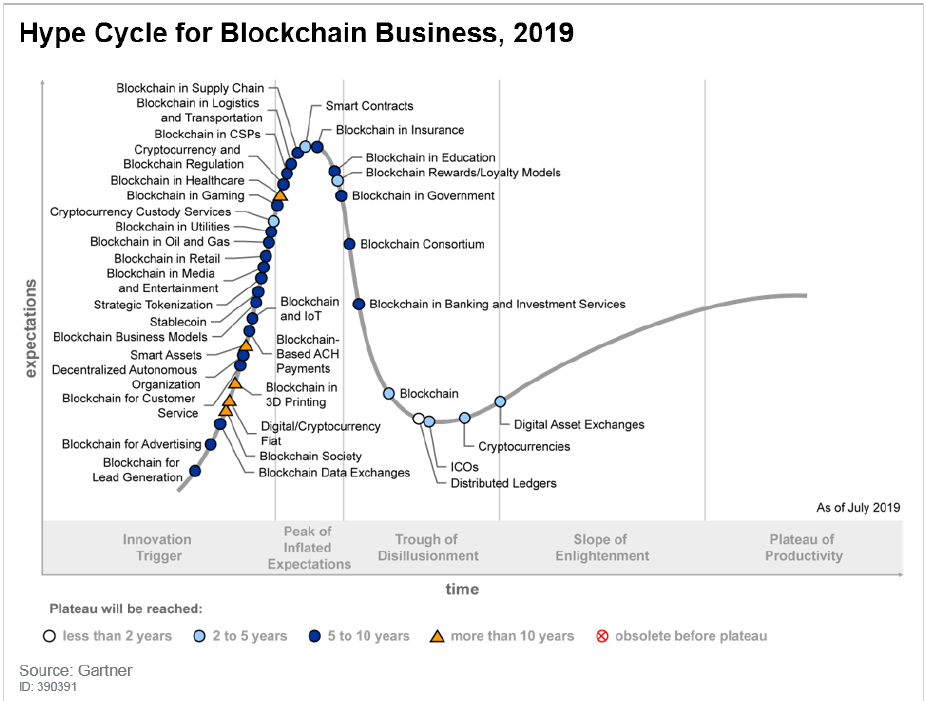
At the time people were imagining blockchain everywhere: in gaming, in government, in supply chain…you name it. Now some of that has moved on to the end of the hype cycle, but most of it is going to die in the Trough.

The Gartner Hype Curve is a useful way to assess technology that is being talked about, as is the Technology Adoption Curve. Another good way of thinking about hype can be found in this piece I wrote here. In that piece I show there are five levels of hype: Marketing Claims, Exaggerated Returns, Utopian Futures, Magical Thinking, and Othering. For companies like Microsoft talking about AI, the hype levels are at the level of Exaggerated Returns. For people writing think pieces on AI, the hype levels go from Utopian Futures to Othering.

In the end, however you assess it, its all just Hype. When a technology comes out, assess it for yourself as best as you can. Take anything being said and assign it a level of hype from 1-5. If you are trying to figure out if something will eventually be adopted, use the curves above.

Good luck!

You are going to be hearing a lot – ALOT! :) about NFTs. Here’s your NFT 101

You may already be sick of hearing about NFTs (Non-Fungible Token). I have bad news: you are going to be hearing a lot about them for the next year. Two reasons for that: techies love them and they are all about money. So there’s going to be a ton of hype regarding them for the next while as people experiment with them. As you can see from the chart above, things regarding blockchain are still making their way up the Gartner Hype Curve, and NFTs are blockchain-based assets.

That aside, here’s Forbes with the info you need: Non-Fungible Tokens 101: A Primer On NFTs For Brands And Business Professionals

P.S. Gartner is very good at assessing technologies and how they play out. That particular Hype curve is from this article.

My mixed bag of IT links for December

Like previous collections of IT links, this collection reflects things I am interested in or found useful recently:

  1. If you want to get started using APIs, I recommend this: Most Popular APIs Used at Hackathons | ProgrammableWeb
  2. If you want to build that web site, consider Using Twitter Bootstrap with Node.js, Express and Jade – Andrea Grandi, and this Building a Website from Scratch with ExpressJS and Bootstrap | Codementor. Also Mastering MEAN: Introducing the MEAN stack and Bluemix Mobile, Part 1: Creating a Store Catalog application – Bluemix Blog
  3. Or develop a mobile app like this: Create Swift mobile apps with IBM Watson services – developerWorks Courses
  4. I am a fan of Bluemix and Eclipse. This article ties them nicely together: IBM Bluemix – Eclipse Package Download – Neon release.
  5. I am also a fan of IoT these days. For fellow IoT fans, these links are good: Intro to Hardware Hacking on the Arduino — Julia H Grace and $10 DIY Wifi Smart Button | SimpleIOThings.
  6. Speaking of IoT, if you have been doing some work with Arduinos, you might be interested in the ESP8266. Some good info on it here ESP8266 Thing Hookup Guide – learn.sparkfun.com and a good thing to do with it, here: SimpleIOThings | Simple Do-It-Yourself Internet-of-Things Projects
  7. More good links related to software and application development work here Migrate an app from Heroku to Bluemix and here A Concise Introduction To Prolog, plus Building without an Ounce of Code – Part 2 – Apps Without Code Blog and this Turning a form element into JSON and submiting it via jQuery – Developer Drive
  8. Some interesting links pertaining to Minecraft: Can Minecraft teach kids how to code? – Safari Blog and Minecraft and Bluemix, Part 1: Running Minecraft servers within Docker.
  9. There’s lots of talk about AI these days, the  Economist explains why artificial intelligence is enjoying a renaissance
  10. If you are interesting in working in IT, you might like this: How to Get a Job In Deep Learning or this: An Unconventional Guide for Getting a Software Engineering Job — Julia H Grace
  11. Or maybe you want start a start-up. If so, check this out: A Free Course from Y Combinator Taught at Stanford | Open Culture
  12. Finally, here are just a number of interesting but mostly unrelated links:
    1. IBM Blockchain 101: Quick-start guide for developers
    2. Building three-tier architectures with security groups | AWS Blog
    3. Performance Tuning Apache and MySQL for Drupal
    4. How to secure an Ubuntu 16.04 LTS server 
    5. Clean Your System and Free Disk Space | BleachBit
    6. Use an iPad as a Raspberry Pi display — Kano OS – YouTube
    7. (Software iSCSI) Configuring SAN boot on Red Hat Enterprise Linux 5 or 6 series