How will you know it is a day when your whole world is about to change? I thought about that often since I read this BBC piece, the life changing day World War Two began for the English. Some at the time knew their world was about to change dramatically. For many, the day seemed like any other.
Something similar is related in the first chapter of the book Stalingrad, by Antony Beevor. Germans in Berlin hearing about the start of their war with Russia likely knew their world was going to change for the worse, though the day of the announcement was a pleasant one.
Did the Viennese at the Funeral of Franz Joseph above know their world was ending on that day? After all, the Emperor considered himself “the last ruler of the old world”, and with his death, the old world and Vienna’s place in it was to go as well? I don’t know.
Maybe our world is changing dramatically now and we are still living like it hasn’t. We are good at that. The Great Recession occurred and governments took drastic action and then went back about our business like it never happened. The same occurred with great COVID-19 pandemic: we all took great steps to deal with it, like a car swerving around a big pothole before regaining its place on the road. Perhaps that will be the case with climate change.
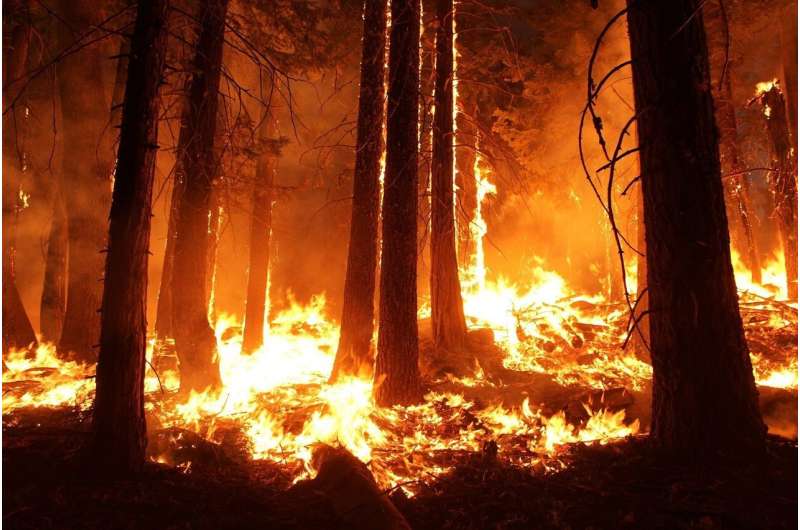
Or perhaps the world is different now, the way it was different on that September 3rd day in England, 1939. Pick your climate change disaster day, be it the Los Angeles fires of January, 2025, or some other day recent day. When you are older, you may look back on that day and think: that’s the day the world changed, and we didn’t really feel it.
(Bottom photo of LA during the fires of January 2025 by Mark Abramson for The New York Times)
It’s hard to find any good news when it comes to climate change. First off, we have extreme weather conditions. That’s bad enough, but it also leads to additional problems, like wildfires. How bad is the problem with wildfires in Canada as temperatures climb? Very bad. To be specific, Canada wildfires have burned over 10 mn hectares this year. And it’s not just the loss of forests or the poisonous air people have to breathe. There is also the tragedy of lost homes and lives.
Climate change damage is not limited to Canada, obviously. It’s so bad in parts of the U.S. that insurers are pulling out of California. Something similar is happening in Florida. I suspect the list of states will not stop there.
Not everything resulting from climate change is bad, though. California’s weather catastrophe has flipped and become something of a miracle, as “gushing waterfalls, swollen lakes and snow-covered mountaintops (have) transformed the state’s arid landscapes”. You can read about it here.
So far that’s a good news story for that state. But the extremes of climate change might eventually overwhelm their infrastructure. Look at Texas, for example. Climate change is wreaking havoc on the Texas power grid transmission lines.
In searching for other good news, I see that the world is finally spending more on solar than oil production. Also, the New York Times reports that scientists at Purdue have created a white paint that, when applied, can reduce the surface temperature on a roof and cool the building beneath it. Every bit helps. Maybe even the new electric Cadillac Escalade iq vehicle is at least a sign of the shift we need to be making, if anything else.
Finally, here’s two more pieces on climate change I thought were worth reading:
Maybe cleaning up the Great Pacific Garbage Patch isn’t a good idea and is causing more harm than good. VOX explains.
Last month I wrote about what’s hot and what’s not. Well it seems like everything is hot this month. Hot and humid. So we are going to gloss over serious subjects like Ukraine and Inflation and get light instead. Let’s go!
Summer Manias: It has seemed like a summer of manias so far. Sure, there was still stories about inflation, the war in Ukraine, and more such serious things. But the focus seemed to be on big time media sensations: Taylor Swift, Beyonce, and Barbenheimer.
Barbenheimer, you ask? Well for those reading this years from now, it was “an Internet phenomenon that began circulating on social media before the simultaneous theatrical release of two blockbuster films, Barbie and Oppenheimer, on July 21, 2023, in the United States and several other countries” (that’s from it’s wikipedia page, no less). The madness was fueled by positive reviews, lots of think pieces, tremendous marketing and then strong ticket sales. Honestly, it was all good fun (at least as much good fun as you could have watching a film about the birth of the atomic bomb and McCarthyism. :))
Swift wasn’t the only one holding big shows. Beyonce has also been wowing audiences with her Renaissance tour, which also seems tremendous. You can read more about it here. Beyonce, Swift, Barbenheimer: it all adds up to people exercising their rights to party and enjoy themselves after too many bleak pandemic summers. I can’t say I blame them. Heck I took in Oppenheimer myself and enjoyed it.
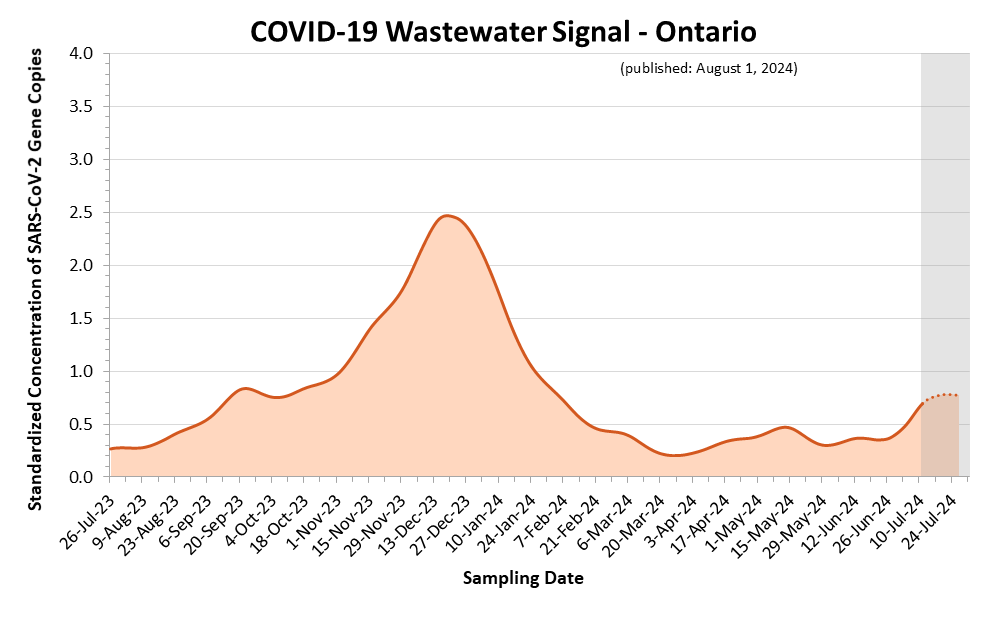
Pandemic: there is nothing light about the pandemic, but there is something positive. It may not seem positive, but it is good news that the total number of Americans dying each day is no longer historically abnormal. So while people are still getting sick from COVID-19, we are back to “normal” in terms of causes of deaths. At least for now. The COVID waste water signal for Ontario is showing a slight increase this month…let’s hope it’s just a blip. And let’s hope that governments continue to fund this monitoring, as this piece argues. We need it.
That said, any good news about that this disease is very good news indeed. There are worse things in the world than having too many tests warehoused because of the decline of this terrible disease.
Social Media: there was a big shakeup in social media this month when Meta announced Threads and it quickly rocketed up to 100 million users (including yours truly). It’s too early to know what this will mean, but if Elon Musk continues his idiotic ways and Jack Dorsey continue with his half assed ways, then Threads could become the dominant company in a place that Twitter once was. (One thing interesting is it seems to be vearing off in a different direction and avoiding politics and news. Could be a wise move. Read more, here.)
Nova Scotia: last month I was writing about people evacuating in N.S. due to fire. This month they had to evacuate due to flooding. Ye gads. I feel sorry for my family, friends and other Nova Scotians suffering through that extreme weather. You can read about it here, here, and here. Awful. Climate change and the terrible effects are starting to overwhelm us.
Donald Trump is still in the news, mainly due to (more and more and more) indictments. Remember, the best way to keep up with all his legal trouble is by signing up to the newsletter indictment.fyi by Dan Sinker. The Times also has a big section on the documents case against him. I still think he will get off, but the legal traps are multiplying rapidly.
To close out, here’s a story on how Adele warns fans about throwing objects at musicians. I’ve seen several musicians hit with phones, including Drake, Harry Styles, and more. It’s insane. Also insane are foot eating competitions. Do you think you have want it takes to win a hot dog competition? Are you sure? After you read this, you may reconsider it.
Thanks for reading, as always. I leave you with this, from Fanny Singer along with mom Alice Waters. They are talking about Fanny’s new cookbook that had come out at the beginning of the pandemic. Just wanted to include it here, as a reminder of how things were.
To tackle climate change, Italy provided what is considered by some a superbonus to homeowners to make specific renovations. That’s right, Italy reimbursed home owners 110% to upgrade their homes in a way that helps the environment. That prompted some to ask: ‘Why so generous?’. One reason? It resulted in a “surge of green home renovations” which is great for Italians and great for the climate.
Look, people know that something has to be done about climate change. People are also motivated mainly by their own self interests. Take advantage of that by offering generous benefits for people to change. We need to use every tool at our disposal, from alternate energy to alternative uses of energy, and more. Now is not the time to quibble about the price: that time is past. Now is the time to hurry things up. Throwing money at a problem can often do that. Italy showed it.
The world is full of extreme events that can wipe us out. Case in point, this: When the Mediterranean Sea Dried Up. If you are not familiar with the story….
About 5.9 million years ago, due to a combination of tectonic movements and changes in climate, the Mediterranean Sea mostly dried up for over 600,000 years. The Messinian salinity crisis may have raised global sea levels by as much as 33 feet and decreased the salinity of the world’s oceans, raising the freezing point. And then, much more suddenly, it was refilled in less than two years in the Zanclean Flood.
The Zanclean Flood, like the Chicxulub meteor that killed off the dinosaurs, are two reminders that the planet we live on can be subjected to extreme events that can kill off many of us without really harming the planet itself. have no doubt that this is going to be true of global warming as well. Perhaps even a nuclear war. We can be removed and the planet will continue to operate without us.
The world is more hostile to us than we let in. We are only making it worse with dangers such as nuclear weaponry and climate change. We need to be striving to increase our chances of survival, not decrease them. There are enough forces in the universe that can destroy us.
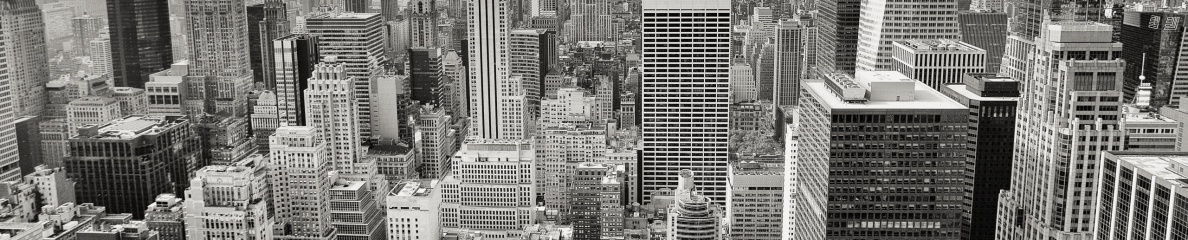
I have to admit that Buffalo is primed for people who will try to escape both the effects of climate change and do so in a way that doesn’t cost them a fortune. Buffalo will offer all of that. But so do other Rust Belt cities. It will be interesting to see which if any of them truly do see a resurgence as climatic problems plague other cities. I’m hopeful for Buffalo that it is one of them.
Yes, nuking a hurricane is a bad idea. (duh.) There are better ideas, but as Vox explains, even those are prone to problems. For example…
In one of the most infamous attempts to slay a hurricane, Nobel laureate Irving Langmuir led a US military experiment in 1947 to seed Hurricane King with ice in hopes of sapping its vigor. The storm at the time was sliding away from the United States and losing strength.
In an excerpt in the Atlantic from his book Caesar’s Last Breath, author Sam Kean explained Langmuir’s idea: Growing ice in the eye of the hurricane would make the eye grow wider and collapse the storm. But Hurricane King didn’t respond as expected. “To everyone’s horror, it then pivoted — taking an impossible 135-degree turn — and began racing into Savannah, Georgia, causing $3 million in damage ($32 million today) and killing one person,” Kean writes.
So yeah, it’s no small thing to stop hurricanes. But given that climate change may make things worse, it could be worth it.
Eating meat is a significant contributor to global warming. I knew this, but the chart above and the article below really drove this home. As the Soviet Union was collapsing, people in that region started eating less meat. The result was a drop in carbon emissions. Now imagine if that was replicated worldwide for many years.
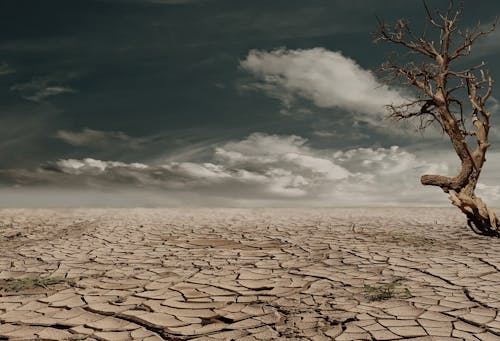
Already we have parts of the world barely inhabitable due to extreme weather. Think of Antartica on one hand, and the Sahara desert on the other. Soon places in India will join them. Other parts will become inhabitable for different reasons: extreme weather and flooding.
There are things you can do in your own day to day to reduce your contribution to climate change. But in the bigger picture, much larger changes have to happen. And soon. You can contribute there too, by supporting politicians and companies and other organizations that are working to make big positive changes.
You can’t do it alone, but every thing you do move us in the right direction. We are cutting out coal. We are getting energy efficient. We are eating more of the right things. Many many things are being done that help, and much more can be done to improve things. Keep up the good work, and work hard to avoid complacency and despair.
I see that leftists are calling for radical measures to fight climate change. I have a few issues with this:
You have to be careful for what you wish for. When they talk about radical measures, they are likely thinking that the line of what is radical is where they get to draw it. I don’t think this is true. To me, radical is things like geoengineering. Or nuclear proliferation. Leftists should not assume they get to draw the line as to what radical is. And leftists should not be surprised if they don’t like what they ask for.
Some of this seems to be a way to score points against centrists and rightists. It may be true that centrists and rightists have bad solutions. They are not bad solutions because they are associated with anyone of a certain political stripe. They are bad because they may not be enough.
Everyone involved with dealing with climate change should
work very hard to promote new and better ideas and solutions for climate change
be as persuasive as possible, especially for those more moderate than themselves
be very humble when it comes to thinking you know what is right
Obviously this is not the easy a thing to solve by any stretch, and the tradeoffs are significant. Worse still, the solutions involve humans and all their flaws as well as science and technology still in development.
I personally believe it is too late already and that:
there is going to be global devastation with many coastal cities being destroyed over the next 20 years, despite any advances in policies or technology.
there is going to be such severe weather in the next two decades that global warming and climate change will be the main political topic affecting everything, and there will be a surge in advances in response to this.
there will be feedback in terms of population decreases, new technologies, new policies, and planetary unknowns. This feedback will result in climate change stabilizing.
there will be positive gains to be had from global warming and climate change but that they will not be known for sometime.
Thanks for reading this. Feel free to disagree. Just not on twitter, or I will block you.






 Smart People I Know