
The mongolian horde approach, or why you don’t have to be a fool to think that Elon Musk is incompetent

Is Elon Musk incompetent? Is he a genius? Or is he something else?

While some think his recent actions at Twitter and in DOGE indicate he is  incompetent, Noah Smith came out and defended Musk in this Substack post: Only fools think Elon is incompetent – by Noah Smith.

Smith starts off by saying that Musk …

is a man of well above average intellect.

Let’s just pass on that, since we don’t know the IQ or any other such measure of the intellect of Musk. Plus, competent people don’t need to have a high IQ.

Indeed Smith gives up on IQ and goes for another measure:

And yet whatever his IQ is, Elon has unquestionably accomplished incredible feats of organization-building in his career. This is from a post I wrote about Musk back in October, in which I described entrepreneurialism as a kind of superpower

So it’s not high IQ that makes Elon Musk more competent than most, it’s his entrepreneurialism. In case you think anyone could have the same ability, Smith goes on the say why Musk is more capable than most of us:

Why would we fail? Even with zero institutional constraints in our way, we would fail to identify the best managers and the best engineers. Even when we did find them, we’d often fail to convince them to come work for us — and even if they did, we might not be able to inspire them to work incredibly hard, week in and week out. We’d also often fail to elevate and promote the best workers and give them more authority and responsibilities, or ruthlessly fire the low performers. We’d fail to raise tens of billions of dollars at favorable rates to fund our companies. We’d fail to negotiate government contracts and create buzz for consumer products. And so on.

Smith then drives home this point by saying:

California is famously one of the hardest states to build in, and yet SpaceX makes most of its rockets — so much better than anything the Chinese can build — in California, almost singlehandedly reviving the Los Angeles region’s aerospace industry. And when Elon wanted to set up a data center for his new AI company xAI — a process that usually takes several years — he reportedly did it in 19 days

And because of all that, Smith concludes:

Elon Musk is, in many important ways, the single most capable man in America, and we deny that fact at our peril.

Reading all that, you might be willing to concede that whatever Musk’s IQ is, not only is he more than competent, but he must be some sort of genius to make his companies do what they do, and that you would be a fool to think otherwise.

But is he some kind of entrepreneurial genius? Let’s turn to Dave Karpf for a different perspective. Karpf, in his Substack post, Elon Musk and the Infinite Rebuy, examines Musk’s approach to being successful by way of example:

There’s a scene in Walter Isaacson’s new biography of Elon Musk that unintentionally captures the essence of the book: [Max] Levchin was at a friend’s bachelor pad hanging out with Musk. Some people were playing a high-stakes game of Texas Hold ‘Em. Although Musk was not a card player, he pulled up to the table. “There were all these nerds and sharpsters who were good at memorizing cards and calculating odds,” Levchin says. “Elon just proceeded to go all in on every hand and lose. Then he would buy more chips and double down. Eventually, after losing many hands, he went all in and won. Then he said “Right, fine, I’m done.” It would be a theme in his life: avoid taking chips off the table; keep risking them. That would turn out to be a good strategy. (page 86) There are a couple ways you can read this scene. One is that Musk is an aggressive risk-taker who defies convention, blazes his own path, and routinely proves his doubters wrong. The other is that Elon Musk sucks at poker. But he has access to so much capital that he can keep rebuying until he scores a win.

So Musk wins at poker not by being the most competent poker player: he wins by overwhelming the other players with his boundless resources. And it’s not just poker where he uses this approach to succeed. Karpf adds:

Musk flipped his first company (Zip2) for a profit back in the early internet boom years, when it was easy to flip your company for a profit. He was ousted as CEO of his second company (PayPal). It succeeded in spite of him. He was still the largest shareholder when it was sold to eBay, which netted him $175 million for a company whose key move was removing him from leadership. He invested the PayPal windfall into SpaceX, and burned through all of SpaceX’s capital without successfully launching a single rocket. The first three rockets all blew up, at least partially because Musk-the-manager insisted on cutting the wrong corners. He only had the budget to try three times. In 2008 SpaceX was spiraling toward bankruptcy. The company was rescued by Peter Thiel’s Founders Fund (which was populated by basically the whole rest of the “PayPal mafia”). These were the same people who had firsthand knowledge of Musk-the-impetuous-and-destructive-CEO. There’s a fascinating scene in the book, where Thiel asks Musk if he can speak with the company’s chief rocket engineer. Elon replies “you’re speaking to him right now.” That’s, uh, not reassuring to Thiel and his crew. They had worked with Musk. They know he isn’t an ACTUAL rocket scientist. They also know he’s a control freak with at-times-awful instincts. SpaceX employs plenty of rocket scientists with Ph.D.’s. But Elon is always gonna Elon. The “real world Tony Stark” vibe is an illusion, but one that he desperately seeks to maintain, even when his company is on the line and his audience knows better. Founders Fund invests $20 million anyway, effectively saving the company. The investment wasn’t because they believed human civilization has to become multiplanetary, or even because they were confident the fourth rocket launch would go better than the first three. It was because they felt guilty about firing Elon back in the PayPal days, and they figured there would be a lot of money in it if the longshot bet paid off. They spotted Elon another buy-in. He went all-in again. And this time the rocket launch was a success. If you want to be hailed as a genius innovator, you don’t actually need next-level brilliance. You just need access to enough money to keep rebuying until you succeed.

It seems that the path to success for Musk is not to be good at something, but to be tenacious and throw massive amounts of resources at a problem until you defeat it.

In IT, there is an approach to solving problems like this called the Mongolian horde approach. In the Mongolian horde approach, you solve a problem by throwing all the resources you can at it. It’s not the smartest or most cost effective approach to problem solving, but if a problem is difficult and important, it can be an effective way to deal with it.

It’s interesting that Smith touches on this approach in his post. He brings up Genghis Khan, the leader of the Mongols:

Note the key example of Genghis (Chinggis) Khan. It wasn’t just his decisions that influenced the course of history, of course; lots of other steppe warlords tried to conquer the world and simply failed. Genghis might have benefited from being in just the right place at just the right time, but he probably had organizational and motivational talents that made him uniquely capable of conquering more territory than any other person in history. The comparison, of course, is not lost on Elon himself

It appears that Musk is familiar with the Mongolian Horde approach as well. Indeed, Karpf illustrates the number of times Musk used this approach in order to be successful, whether it’s playing poker or building rockets.

If you can take this approach, with persistence and some luck, you can be successful. Success might come at a great cost, but it likely will come. And in America, if you are successful, people assume you are intelligent and highly competent regardless of your approach. That’s what Smith seems to assume in his post on Musk.

Even with this approach, you do have to have some degree of competency. If you are using this approach to play poker, you have to know enough about the game to win when the opportunity presents itself. But you don’t have to be the world’s best poker player or even a good poker player.

The same holds true for Musk and his other companies. He’s not incompetent, but he’s not necessarily great or even good at what he does. He just hangs in there and keeps applying overwhelming resources until he eventually wins. His access to resources and his tenacity are impressive: his competency, not so much.

P.S. Like many others, I used to think Musk was highly competent. I stopped thinking that when he took over Twitter and turned it into X. This “Batshit Crazy Story Of The Day Elon Musk Decided To Personally Rip Servers Out Of A Sacramento Data Center” in Techdirt convinced me his IT competency is not much better than his poker competency. Indeed, if success was a metric, then he is incompetent at running tech companies, based on this piece in the Verge: Elon Musk email to X staff: ‘we’re barely breaking even’. I won’t count him out until he abandons X, but if the time comes when X is successful, it will be because of him applying massive amount of resources (time, money, etc) to it, not because he is an IT genius.
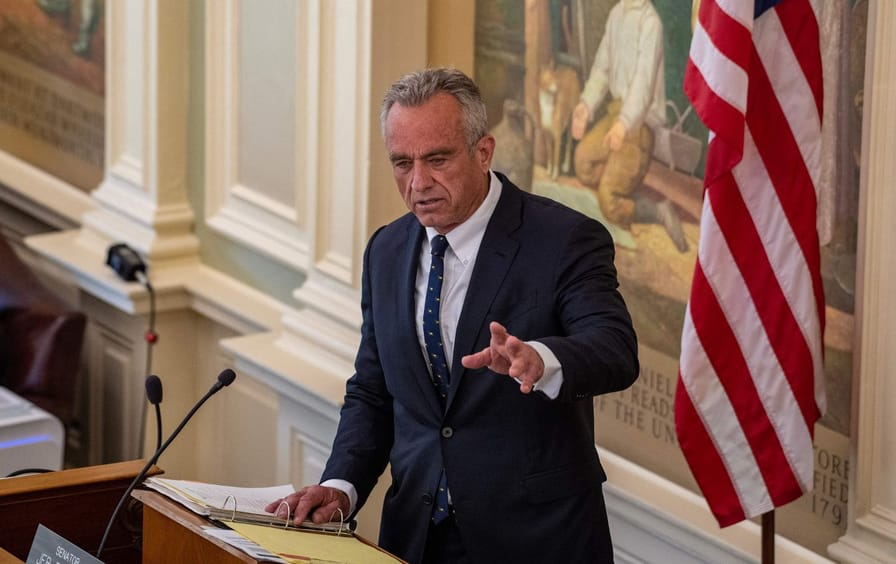
 

On RFK Jr and the people that are supporting him

RFK Jr is in the news a lot recently. One obvious reason is that he is trying to run for President. The other reason is because some of the worst of people are jumping on his bandwagon and amplifying his campaign.

If you are unsure about him, then I recommend this piece on RFK Jr for several reasons. First, it sums up how I think I now think about RFK Jr:

His noxious views on vaccines, the origin of AIDS, the alleged dangers of wi-fi and other forms of junk science deserve no wide hearing. Polls showing he’s favored by 20 percent of likely Democratic voters over President Biden are almost as laughable as Kennedy’s views. It’s early; he’s got iconic American name recognition; and there’s almost always an appetite, among Democrats anyway, for anybody but the incumbent.

Second, it also has a list of articles at the beginning that debunk RFK Jr’s ridiculous claims. And if that’s not enough, here’s more on RFK Jr from the New York Times and People Magazine.

As for the people jumping on his bandwagon and amplifying him, here’s a break down on the horrible harassment of  Dr Peter Hotez by Joe Rogen, Elon Musk and others. As for why you don’t want to debate science on a podcast, here’s a good piece on what it’s like to go on  Joe Rogan and debate anything 

Here’s hoping RFK Jr and the cranks he attracts fade into the background soon.

I started tracking a group of users to see if Twitter usage was declining and twitter was dying… I was surprised by what I found

Like many people, I thought twitter usage was going to decline in 2023 due to all of the shenanigans of Elon Musk. While it seemed like usage was dropping off, I wanted to take some measurements to be certain.
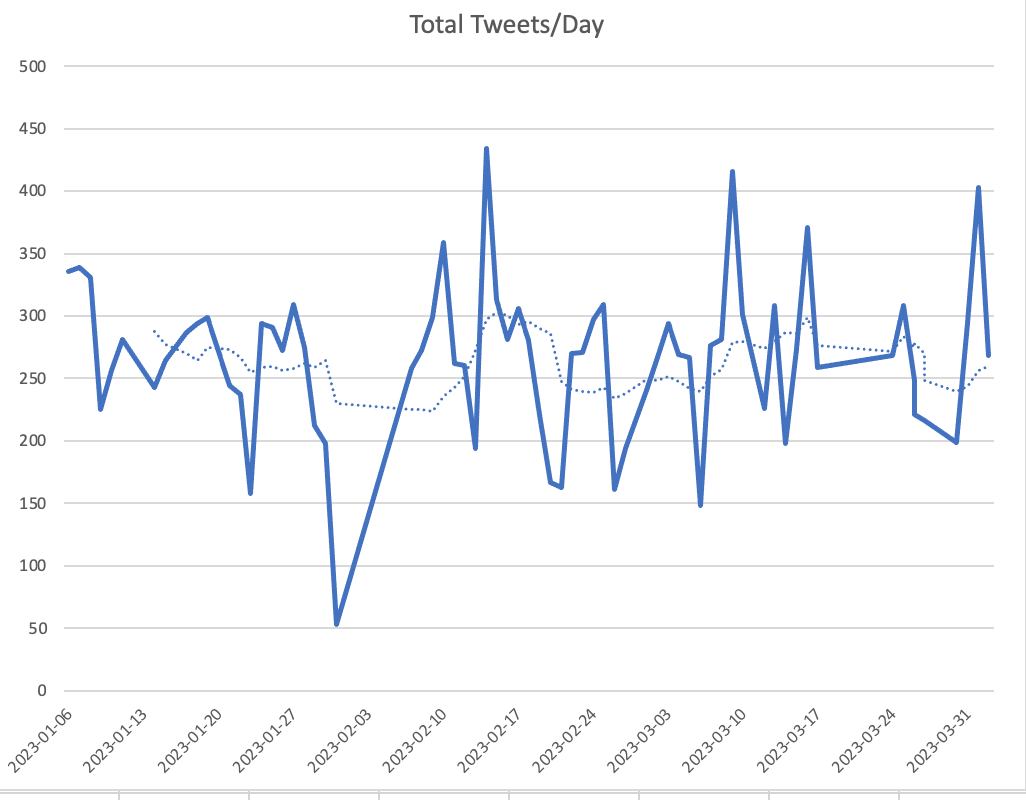
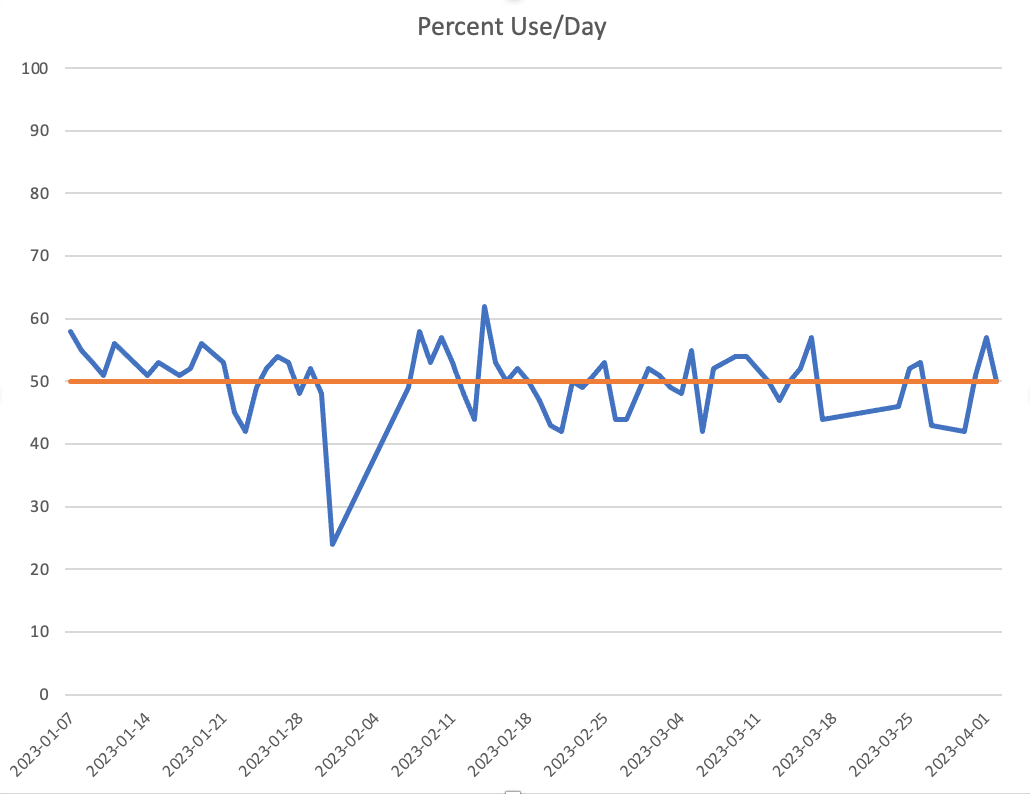
To measure usage, I started by creating a list called good_twitter. It contained 98 accounts. I figured if the users on this list stopped tweeting, I would stop too. Then I wrote some python code to call twitter’s API and count the number of times each person on the list tweeted. I started counting at the beginning of January.

My first thought was that people would tweet less and less each day. However, as you can see from this chart below, on average the people on my list tweet around 250 times / day. Some days it’s over 350, some days it drops to around 150. (And one day my program died and I only counted 50. :)) So people are not tweeting less as time goes by.

My second thought was that some people were dropping off, but other people on the list were tweeting more, and hence the total amount of tweets was not dropping. To measure this, I counted how many people on my list tweeted once or more per day.  The chart below shows approximately 50% of the 98 people on the list tweet at least once a day.

Given these two results, my final thought is that people are not giving up on twitter, even with all the problems we all have with it. I found that surprising. I expected a big decline initially. Then I expected a gradual decline. I don’t see either.

I don’t know why only 50% of users in the good_twitter list tweet while the other 50% does not. I am sure some people have quit twitter. But the hard core — like me — seem to be sticking around.

P.S. A fascinating byproduct of this study is how individuals tweet. I would have thought everyone uses twitter the same way. Wrong! Look at this chart below:

It turns out most people on my good_twitter list (and me) tweet/retweet 0-10 times a day. We are all part of the Long Tail to the right.

However there are two other types of people on the short end of the tail to the left. There are power users who tweet/retweet between 20-50 times a day every day. And there are a number of super users who tweet/retweet 50-100 times a day. (Power and super users are my nicknames.)

Some of the power users are obvious: they are mainly news and government accounts. Less obvious ones tend to be activists. They use twitter as a soapbox, pulpit, what have you. I have a few super users I follow: Shawn Micallef, Anthony DeRosa,  Deray and a couple more. For power and super  users,  retweets make up most of that content.

All that said, it’s been an interesting experiment, but I am not sure if I will continue to track usage. It may not be up to me: I expect Musk and company will turn off my free access to the API, and that will be that. And I am satisfied with my final thought that usage is staying constant for now.

Like any study, YMMV. But besides my good_twitter list, I also measured a few of my shorter lists and I found roughly the same result: at least half of the people on the shorter lists tweeted once a day.

2022 is done. Thoughts and rambling on the last 365 days (i.e. the December 2022 edition)

Another year over. A semi-pandemic year, in a sense. Covid is still with us, but we did not (so far) get slammed with a bad new variant like we did last year with Omicron. Instead the pandemic is lesser than it was, but greater than the flu in terms of the sickness and death it brings. We still get vaccinated, though less than before. Schools are attended (though  affected),  restaurants are dined in, parties and special events are attended.

You could say things look….normal. But then you can look towards China: they seem to be struggling to deal with COVID lately. Who knows what 2023 will bring? More normal or more like China?

But that’s for 2023. As for last year and what was trending, we can look to  Google which has all its data. One place that was trending alot in 2022: China. China is struggling with both Covid and Xi’s approach to it, as this shows. As for the Chinese leader himself, it was a bad year for Xi, as well as Putin and other global bad guys, sez VOX. And it’s not just the Chinese residents that are having to deal with Xi and his government: Canada has been investigating chinese police stations in Canada. More on that here. I expect China will also trend in 2023. Let’s hope for better reasons.

Other trending events in 2022? Crypto. There was lots of talk about it and people like Sam Bankman-Fried after the collapse of his crypto currency exchange and subsequent arrest. We had stories like this: How I turned $15 000 into $1.2m during the pandemic and then lost it all. Tragic. The overall collapse of the industry has lead to things like bans on crypto mining. That’s good. It has lead to questions around the fundamentals, like: Blockchains What Are They Good For? Last, to keep track of all the shenanigans, I recommend this site: Web3 is Going Just Great. I expect crypto to remain a shambles next year. Time and money will tell.

Elon Musk also managed to trend quite often due to his take over of Twitter and more. He still has fans, but many are disillusioned. After all, his campaign to win back Twitter Advertisers isn’t going well. He was outright booed on stage with Dave Chapelle. (No doubt being a jerk contributed to this.) Tesla stock is tanking. Even his  Starlink is losing money. What a year of failure. I can’t see his 2023 improving either. Hard to believe he was Time’s Man of the Year in 2021!

Because of Musk, people are looking to join other networks, like Mastodon. (BTW, here’s some help on How to Make a Mastodon Account and Join the Fediverse). Some are looking to old networks, like this: the case for returning to tumblr. Some are looking at new ways to socialize online, like this.

Musk was not alone in trending this year due to being a bad guy. Let’s not forget that Kanye West trended as well due to his freakish behavior and antisemitism.

AI was another big trend this year, with things like ChatGPT and stable diffusion (here’s how you can set it up on AWS). We also had stories like this: Madison Square Garden Uses Facial Recognition to Ban Its Owner’s Enemies. Not good. What’s next for AI?  This takes a look. I think we may get an AI winter, but we have 12 months to see if that holds true.

For what it’s worth, Newsletters like Matt Yglesias’s are still going strong, though levelling off I think.

Trends and development aside, here’s some other topics I found interesting and worth being up to close the year:

Assisted death was a grim topic in 2022 in Canada. I remain glued to stories like this: We’re all implicated in Michael Fraser;s decision to die, and  this and this. It all seems like a failure, although this argues that assisted dying is working.

Here’s two good pieces on homelessness Did Billions in Spending Make a Dent in Homelessness? And ‘It’s a sin that we all had to leave’: Moving out of Meagher Park.

Need some advice for the new year? Try this: How Much and Where Are You Really Supposed to Tip? Consider this a good approach to  reading. Here’s a good approach to  slowing down, while here’s a good discussion on  Boundaries. Things to avoid:  the biggest wastes of time we regret when we get older.

Things I found interesting in sports this year:

Things I found interesting in general this year:

Finally, here’s some good advice to close out the year: Don’t Treat Your Life as a Project.

Thanks for reading this and anything else you read on this blog in 2022. I appreciate it. I managed to blog about roughly 3000 things on the internet this year. I hope you found some of them useful.

Happy New Year!

On Mark Zuckerberg’s Legs and other stupid things we have to try and ignore

So in Mark Zuckerberg’s hot new remake of Second Life, avatars will soon have legs. Woo. It’s something I’d rather not think about.  Just like I don’t care about Elon Musk and whether or not he spoke with Putin. Or anything to do with Kanye’s opinion on pretty much anything. But that’s the problem with social media these days. Even if you don’t want to know about these things, other people want you to. People whose opinion you’d normally are interested in. I mean, even I am guilty of this right now. So why do this?

What I would hope for is to nudge folks a little so that they find other things to share on social media. Things like stories about themselves. Or good things that they’ve discovered, be it big or little. Maybe facts or ideas about people other than those manic attention seekers that are everywhere on the Internet. That would be great if that could happen.

Will it? Likely not. That’s why I expect to see new forms of social media taking off. Perhaps it will be Discord. Perhaps someplace else. But some place you can go and avoid those that are so hard to avoid currently.

Meanwhile, congrats to Mark Z on growing a pair…of legs. Happy for you.

P.S. Turns. out Mark Z’s legs were a lie. Amazing.

On Elon Musk, 2022

Elon Musk is a hard guy to categorize. Perhaps the easiest thing for me to say is that he is his own worst enemy. He creates companies that are revolutionary and worthy of great praise, but he also goes around posting idiotic memes like a sulky teen to unwittingly draw attention to the worst parts of himself.

Like the man himself, his SpaceX technology is a mixed bag. While it is great that he does this, Elon Musk activates Starlink in Ukraine, the technology itself is going to be damaging to astronomy if not space itself, as this shows: SpaceX’s Starlink Satellites Leave Streaks in Asteroid-Hunting Telescopes.

I have mixed thoughts on the Tesla too. Great car in many ways, though this review is tough: 2021 Tesla Model Y review: Nearly great critically flawed. I also think this feature calls into question “do you really own your Tesla?”: Tesla now monitors how often you adjust your seat position and will disable controls for certain drivers. Finally, I don’t think this is a good development: Tesla opens showroom in region of China associated with genocide allegations.

However problematic Musk seems to me, he is head and shoulders better than other plutocrats, like Peter Thiel. Could he be better still? Sure, he could emulate billionaires like Mark Cuban, who is opening an Online Pharmacy to provide affordable generic drugs.

I know there are plenty of fans of Musk, and I can see why they are. I also know many loathe him, and I get that too. I remain in the middle for now, and I hope he improves over time and I get to be more of a fan.

July 1st update:  As his companies continue to sink, he threatens to fire remote workers. So they all come in and there is not enough space for them. Amazing.

On the flaws of SpaceX’s Starlink technology

I’m not a fan of SpaceX’s Starlink technology. It’s ruining space in a number of ways, like this. I thought its one saving grace would be that it at least provides great Internet service. Yet according to this review in The Verge, it doesn’t even do that! Sad. Garbage in the sky, garbage on the ground.

Here’s hoping it gets better. And that someone finds a way to collect all the garbage circling the earth and do something with it.

Success doesn’t come easy for anyone, not even Elon Musk

I admire the work that Elon Musk does, be it Tesla, Space X, or other endeavours he takes on.  I also had an opinion that the success he achieves is as close to a Given as success can be. I held that option until I read this article: Elon Musk Had a Deal to Sell Tesla to Google in 2013 – Bloomberg Business. This article shows just how touch and go it was for Musk and Tesla in 2013. Among other thoughts, it reinforced in me the notion that success in challenging areas is difficult for everyone, whether it be Elon Musk or anyone.

If you are trying to accomplish something difficult, and if you think that others have it easier than you, I recommend you read this article. I also recommend it to anyone who needs to be reminded that success is never a given, but with the right effort and focus and dedication, even the most challenging type of work can be accomplished.