
On thinking about the U.S. national debt exceeding 100% of the GDP (gross domestic product). Again.

Every so often the debt of a country becomes a political issue and writers start cranking out pieces like this in the Wall Street Journal about how:

“The U.S. national debt now exceeds 100% of gross domestic product, crossing a once-unthinkable threshold, on the way toward breaking the record set in the wake of World War II.”

There’s some interesting choices of words in there, like “once-unthinkable” and “breaking the record”, phrases that seem to indicate danger.

If you feel nervous about the debt, here’s some things to consider. First, remember that personal debt and national debt don’t work the same way. Second, it’s important to take a longer term view when considering national debt.

A good example of a long term view is this chart of the U.K. government debt as a percentage of GDP. You can see the debt to GDP ration rose substantially above 100% at two major events in British history: the battles with France in the 19th century and the battles with Germany in the 20th century. Indeed, the ratio rose as high as 250% in the 20th century, only to subside to below 50% in the postwar era.
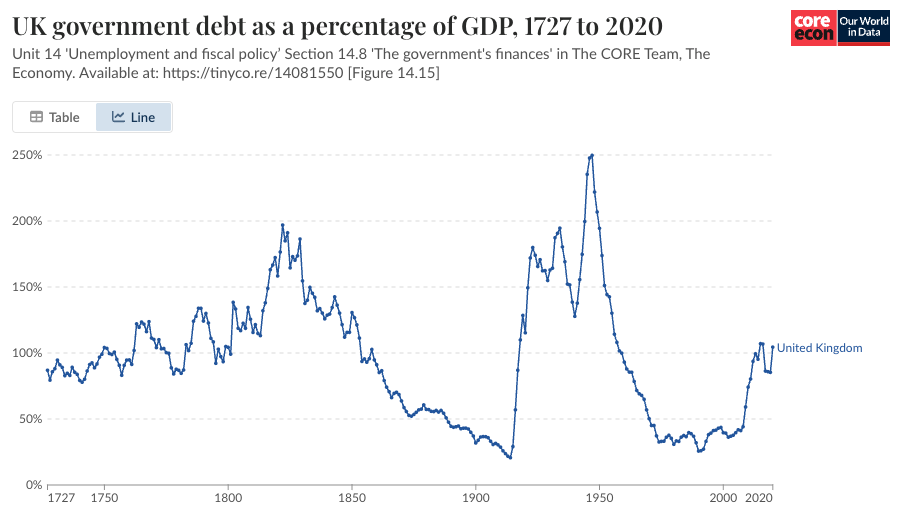
This is not to say that the ratio does not matter. It is to say that there is nothing magical about breaking the 100% ratio. The ratio could go higher. Chances are it will eventually go lower if for reasons of inflation if nothing else.

Writers — usually right wing writers — start bringing up the debt when left wing governments are in power. It’s a way for them to frighten people and pressure the government into spending less. (Such writers rarely bring up debt, especially for things like military expenditures, when the government is right wing.) Don’t be frightened. Governments have an obligation to tax and spend responsibility. They should not be basing their spending on this ratio.

(Image is from here.)
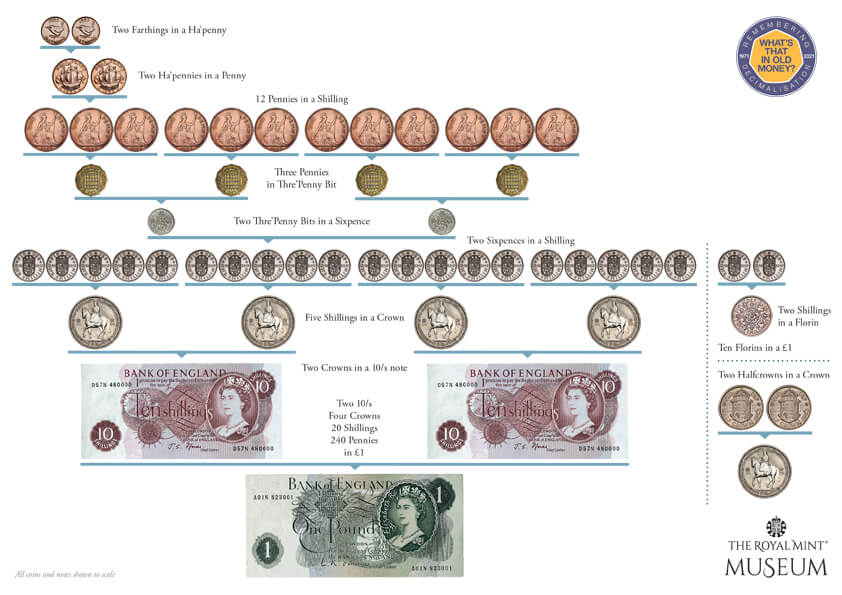
Sixpence none the richer, a half penny will do, and other thoughts on the old English currency

I was in London recently when someone said something was 50p. It got me thinking: do they still have half pence or shillings any more in England? With a bit of research I quickly discovered that a) they do not b) they got rid of all of that currency and went with a decimal system, much like Canadians did when we got rid of imperial measures and moved to the metric system in the second half of the 20th century.

The old money, like the imperial units, had a certain charm that their newer counterparts lack. Charm aside, the new replacements are easier to work with. (Although leave it to Canadians to invent the Loonie and the Twonie as coins!) I’m glad for the decimal units of money when I go to England, and I am believe most Brits must feel the same way.

For more on the old system of English money and how it was upgraded, check out this, Decimalisation, and also this, Pounds, Shillings and Pence.

Assessing the Speaker of the UK House of Commons, John Bercow


This is a good piece: How bad is Bercow? – UnHerd.

Bercow is a controversial figure, and as you can guess, many think he is a bad thing. But the UnHerd piece looks back over numerous Speakers of the House of Commons and gives a kinder assessment. Given that we are going to be reading alot about the House due to Brexit, it might be a good time to become better aware of the man and the role.

Two thoughts on Jamie Oliver’s U.K. Restaurants Declare Bankruptcy

One, It’s always terrible when this type of thing happens: Jamie Oliver’s U.K. Restaurants Declare Bankruptcy – The New York Times.  

But two, I am curious about what has been happening with his businesses based on this:

… his British restaurants ran into financial trouble in 2016 and got into such dire straits that Mr. Oliver had to inject millions from his own savings to salvage the business. Even then, he had to close about 20 restaurants and pizzerias in the months that followed.

What has been happening in the past three years? I remember reading that at the time and it seemed like they had turned the corner at were going to be ok. They turned a corner but they were the opposite of ok.

I’d really like an in depth article of what happened.