Back to Dirac (What I find interesting in math and science, May 2026)


I am not doing as much study in the area of math and science lately and haven’t written on the topic since last May, but I still found time to note these pieces and wanted to share them. A typical smattering of astronomy, physics, math, biology, what have you….


On developing a habit of writing politicians

Over the years I’ve developed a habit of writing politicians. I shared this habit with my friend Norbert and I after that chat I decided to share it here in case you want to develop a similar habit.

If you want to write politicians like me, you need to know how to contact those pols that mean the most to you. For me those three are the mayor, the premier of the province and the prime minister. The mayor is reachable by email so I have that address handy. The other two are reachable via a web form, so I have that info in hand also.

I have a template that I use for letters I write to each of them. When I want to write them about an issue, I pull up the template and fill it in. I usually say what the issue is, then what I would like them to do about the issue. Then I send it.

That’s it! It’s a two step process. Very quick. Occasionally I will follow up, but the purpose is really to register my voice. I don’t expect anything other than a canned response. Only one politician’s team, Mayor John Tory, ever made an effort to respond in a more personal manner.

While I do write about issues, I will also write politicians of all sorts and compliment them if they do something I approve of. Typically these will be constructive actions and often ones where politicians are working together.

I write politicians in a style I use for anyone who works for me, because they do. I don’t insult them or get angry with them: I find that never works when it comes to influencing someone I want to change.

Ideally I would write at least one politician a week but it’s more the case I write one a month.

I hope you can take up this habit. It makes me feel like I am doing something small but important in our democracy. Just like voting is small but also important. Good luck with it.

What are the best novels of all time? What about the best Shakespeare plays?

What are the best novels of all time? What about the best Shakespeare plays? And what do these two lists have in common?

What they have in common is that The Guardian has taken a crack at both of them:

This is smart in a few ways. One, there is nothing that gets people going than someone saying: these are the best. No doubt there will be many people checking them out (and driving traffic to the Guardian web site) just to see if they agree or disagree. Two, it’s really good thoughtful that the contributors have made to come up with such lists.

I grew up with The Book of Lists, so I am always interested in a good list. If you’re similar, or simply a fan of the Bard of a great novel, then check them out.

Restaurants loved and lost: Libertine in New York City, Rodney Scott’s in Charleston

The minute I read this review by Pete Wells, I knew I had to go Libertine. I love a French bistro generally, and this one sounded especially good. On the night we went, everything about it was ideal. We snagged a lovely table near a window and had a waiter that bent over backwards to make sure we had a memorable evening. The food, from the appetizer (oeuf mayonnaise) to the mains (that sausage and potato dish) to the a dessert (a massive chocolate mousse), was delicious. As soon as we were home for the evening, I was already dreaming about when I could go again.

Sadly those dreams are done, for Libertine is closing this month. The same people own the space and plan to turn it into something else which will no doubt be great. But I would have liked another chance to eat at that fine New York City bistro.

Another place I had hoped to return to some day was Rodney Scott’s in Charleston. It too was a place that I heard of through someone famous (Anthony Bourdain) and I had a chance to dine there once at it’s location on King Street. I filled a plate with lots of food that Scott was known for, from the BBQ meats to the tasty sides. Alas there are almost too many great places to dine in Charleston and I never did go again, and now I never will.

I look forward to finding out what goes next in the space where Libertine was. And I hope Rodney Scott can make a comeback.

P.S. For more on Libertine closing, see this. For more on Rodney Scott’s closing, see this.


How to set up a blog that’s just a simple html page

I wanted to go back to the very beginning of blogging, where someone’s blog could consist of just a simple html page with maybe some images to go along with it. But I also wanted to have an easy way to update it. I’ve succeeded in doing just that, with the result visible here: https://berniemichalik.com/simpleblog.html

If you think this is something you want to do, head over to here and check out what I say in that repository. It’s a pretty basic setup. There’s even advice how to host it in a bucket on Amazon, which is what I do.

Let me know if you have any feedback, especially if you think things aren’t clear. Thanks!

On AI generated code and the DevOps Lifecycle


It’s an exciting time to be a software developer.  Exciting and weird.

It’s exciting because of what developers are capable of doing with agentic AI tools from companies like Anthropic. It’s weird because as Clive Thompson writes: “In the era of A.I. agents, many Silicon Valley programmers are now barely programming”. Yet while programmers may be barely programming, they are still producing code.

Indeed, not only are they producing code, they are producing A LOT of it. Take this example in this other piece by Mike Isaac and Erin Griffith:

When a financial services company recently began using Cursor, an artificial intelligence technology that writes computer code, the difference that it made was immediate.

The company went from producing 25,000 lines of code a month to 250,000 lines. That created a backlog of one million lines of code that needed to be reviewed, said Joni Klippert, a co-founder and the chief executive of StackHawk, a security start-up that was working with the financial services firm.

And it’s not limited to senior programmers. As Isaac and Griffith write:

“The blessing and the curse is that now everyone inside your company becomes a coder,” said Michele Catasta, the president and head of A.I. at Replit, an A.I. coding start-up in Foster City, Calif.”

It all sounds great: who wouldn’t want such a productivity gain? Alas, there’s a problem. Isaac and Griffith add:

““The sheer amount of code being delivered, and the increase in vulnerabilities, is something they can’t keep up with,” she said. And as software development moved faster, that forced sales, marketing, customer support and other departments to pick up the pace, Ms. Klippert added, creating “a lot of stress.”

A lot of code means a lot of stress. Not just for sales, marketing and customer support teams, either. I suspect it’s also causing plenty of stress for testing, operations and application support teams in organization that rely on a DevOps lifecycle for software development.

To deal with such stress, any organization that adopts AI technology to write code and also uses DevOps needs to consider their entire software development lifecycle in light of such code.  AI generated code, no matter how fast it is coded, will have limited value if it’s not reviewed and tested properly. It will have limited value if it is not written in a way that it can be supported by applications and operations. Not to mention it will be hard for others to fix and enhance it later if it is not built and deployed using agreed upon processes by the organization.

To avoid creating unsupportable code with problems that will accelerate technical debt, developers of all levels need to know more about their code than “it works on their machine”. If such developers expect others within their organization to use their code, they must write code that doesn’t impact their organization’s DevOps lifecycle. They must take the time to write AI generated code that is supportable. That additional effort by people generating the new AI code is essential if organizations are going to survive the code tsunami that is coming.

The good news, I think, is that everyone that participates in the DevOps lifecycle will be able to devise ways to support AI developers such that their code will fit in nicely.  After all, as this piece by IBM on the DevOps lifecycle explains: “The DevOps process describes how software moves from ideation, through production and feedback, and back to ideation, with development and operations teams working as a single, collaborative unit.” Organizations need the new AI supported developers working with others as a single collaborative unit to succeed. If they do, the new productivity will go from something that causes stress to something that causes success.

(The opinions expressed above are mine only and not necessarily those of my employer.)

Microchanges: or how to get unstuck when you are stuck with the 10 minutes a day principle

I was feeling stuck lately. I thought I needed some goal or purpose to get me going again. But what?

Lately when I’ve been stuck with personal challenges I’ve been turning to my own personal AI (i.e., Ollama running the LLM gpt-oss-120b), for advice. I asked the software: What are 3-5 goals I could set for the month that other people have found worthwhile and that could help me gain momentum to set and achieve other goals?

I got back the following:


Below are five monthly goal ideas that many people swear by because they’re concrete, doable in a single month, and give you a quick win that fuels the next big project. Pick one (or a mix) that feels most relevant to you and turn each into a SMART target (Specific, Measurable, Achievable, Relevant, Time‑bound).

# Goal Why It Works How to Structure It
1 Daily “micro‑habit” – e.g., 10‑minute meditation, 5‑minute journaling, or 30‑sec body‑weight routine Small, consistent action builds a rhythm. Once the habit feels automatic, it’s easier to layer more complex goals on top. Specific: “Meditate at 7:00 a.m. every weekday.”
Measurable: Track days on a habit‑tracker app.
Reward: After 21 consecutive days, treat yourself to something you enjoy.
2 30‑Day “Read a Page a Day” challenge Reading a page a day adds up to ~30 pages a month – enough to finish a short book or digest a chapter of a non‑fiction title. It keeps your mind curious and gives you a tangible end‑product. Specific: “Read 20 pages of Book X each day.”
Accountable: Post your page count on a public calendar or share a weekly summary on social media.
3 Declutter One Area per Week Cleaning a single spot (desk, closet, email inbox) gives an instant sense of order and control, motivating you to tackle the next spot. Specific: “Sort the top shelf of my bookshelf every Sunday.”
Measurable: Log each area with before/after photos.
Result: After 4 weeks you’ll have a noticeably tidier environment.
4 Save/Track a Small Amount of Money A financial win, even a modest one, builds a habit of budgeting and shows that you’re moving toward a bigger financial goal. Specific: “Set aside $25 each week into a savings account.”
Track: Use a budgeting app to see the cumulative total at month‑end.
Celebrate: Use the savings for a fun treat or a future investment.
5 One New Skill Minute a Day Dedicating just 15 minutes daily to a new skill (language, guitar, coding) creates incremental progress that feels fast and keeps you engaged. Specific: “Learn 5 new Spanish words every morning.”
Measure: Keep a vocabulary list; test yourself weekly.
Progress: At month‑end you’ll have a solid foundation to expand.

Quick Tips to Keep Momentum

  1. Track it visually – a wall calendar, habit‑tracking app, or a simple check‑box list. Seeing your streak grow is a powerful motivator.
  2. Start with the first week – often the hardest part is just getting started. Commit to “just 1 minute” or “just one page” to overcome the inertia.
  3. Set micro‑rewards – a favorite coffee after week 2, a new playlist after week 4, etc. Rewards reinforce the positive loop.
  4. Reflect weekly – spend 5 minutes reviewing what worked and what didn’t. Adjust the goal slightly if it’s too easy or too hard.
  5. Share your goal – tell a friend, post on social media, or join a community. External accountability can keep you honest.

Pick a goal that feels both meaningful and achievable for this month. Once you finish it, you’ll have a proven “win” to celebrate, and that confidence will make launching your next big goal a lot easier. Happy goal‑setting!


Wow. That was an actual helpful list. I’ve adopted all five just to see how I can do.

  1. Microhabit: 5 minutes of kettlebell exercises and squats
  2. 10 minutes of reading a day
  3. 10 minutes of declutter a day (vs a week)
  4. 5-10 minutes of financial tracking
  5. 10 minutes of drawing / art practice

What I’m noticing at first:

  • The short time periods allocated for each one makes it hard for me to skip it, so I haven’t been, even on days I am tired or busy.
  • Even short periods of activity add up. I can do much more exercise than I could at first. My reading is making progress.
  • The friction that prevented me from doing things have decreased.
  • I use a physical log book to keep track. This helps reinforce the sense of making progress.
  • It’s better to do things poorly to keep the momentum then to get hung up on poor results for a given day.
  • I was getting bored going into the third week.
  • Cumulative results were good.
  • Switch things up to keep the momentum going.

What I observed towards the end:

  • I was getting stronger but levelling off.
  • Reading is easy to be consistent and if anything I tend to have periods where I read longer (e.g. if the book I am reading is engaging)
  • Some things make me want to go deeper: example on finances.
  • The drawing is more scattered. It is more creative, less rote, unlike the weights or even reading.
  • I wanted to expand this to 6 or 7 microhabits a day but I was running out of time.
  • It was easy to stick to the microhabits when my schedule was light: it got harder when I got busy. No doubt that would be less so if I took on 2 or 3 instead of 5.
  • Doing multiple things made me stick to things more than doing one thing would have.
  • Eventually I want to making things a project. For example, on my decluttering of my room, that took a long time. A complex mix of things there. In places like the kitchen and other spaces, less sentimental items, so easier to declutter.

I stopped doing this once I took a break and went on vacation. It was rewarding, though. And it helped jump start me into doing things I was not. I highly recommend it.

P.S. For more on the importance of doing things 10 minutes a day, read this.

(Image from Valeriia Miller)

If you had to buy only one ebook…

If you had to buy only one ebook, I would recommend this one: 50 Masterpieces You Have to Read Before You Die. Coming in at just over forty thousand pages, it has the following:

  1. Alcott, Louisa May: Little Women
  2. Austen, Jane: Pride and Prejudice
  3. Austen, Jane: Emma
  4. Balzac, Honoré de: Father Goriot
  5. Barbusse, Henri: The Inferno
  6. Brontë, Anne: The Tenant of Wildfell Hall
  7. Brontë, Charlotte: Jane Eyre
  8. Brontë, Emily: Wuthering Heights
  9. Burroughs, Edgar Rice: Tarzan of the Apes
  10. Butler, Samuel: The Way of All Flesh
  11. Carroll, Lewis: Alice’s Adventures in Wonderland
  12. Cather, Willa: My Ántonia
  13. Cervantes, Miguel de: Don Quixote
  14. Chopin, Kate: The Awakening
  15. Cleland, John: Fanny Hill
  16. Collins, Wilkie: The Moonstone
  17. Conrad, Joseph: Heart of Darkness
  18. Conrad, Joseph: Nostromo
  19. Cooper, James Fenimore: The Last of the Mohicans
  20. Crane, Stephen: The Red Badge of Courage
  21. Cummings, E. E.: The Enormous Room
  22. Defoe, Daniel: Robinson Crusoe
  23. Defoe, Daniel: Moll Flanders
  24. Dickens, Charles: Bleak House
  25. Dickens, Charles: Great Expectations
  26. Dostoyevsky, Fyodor: Crime and Punishment
  27. Dostoyevsky, Fyodor: The Idiot
  28. Doyle, Arthur Conan: The Hound of the Baskervilles
  29. Dreiser, Theodore: Sister Carrie
  30. Dumas, Alexandre: The Three Musketeers
  31. Dumas, Alexandre: The Count of Monte Cristo
  32. Eliot, George: Middlemarch
  33. Fielding, Henry: Tom Jones
  34. Flaubert, Gustave: Madame Bovary
  35. Flaubert, Gustave: Sentimental Education
  36. Ford, Ford Madox: The Good Soldier
  37. Forster, E. M.: A Room With a View
  38. Forster, E. M.: Howards End
  39. Gaskell, Elizabeth: North and South
  40. Goethe, Johann Wolfgang von: The Sorrows of Young Werther
  41. Gogol, Nikolai: Dead Souls
  42. Gorky, Maxim: The Mother
  43. Haggard, H. Rider: King Solomon’s Mines
  44. Hardy, Thomas: Tess of the D’Urbervilles
  45. Hawthorne, Nathaniel: The Scarlet Letter
  46. Homer: The Odyssey
  47. Hugo, Victor: The Hunchback of Notre Dame
  48. Hugo, Victor: Les Misérables
  49. Huxley, Aldous: Crome Yellow
  50. James, Henry: The Portrait of a Lady

And it’s not just for Apple ebook readers: there’s a Kindle version too.

Best of all, it costs less than three bucks!

A few thoughts on Palantir as dangerous uncool jokers

Barbara Kruger once slammed some as “a ridiculous clusterfuck of uncool jokers”. I think of that phrase often, and I thought to apply it again when I read about Palantir’s manifesto on a recent thread on X. It’s easy to dismiss it as “the ramblings of a supervillian”, but I think there is something more to it. Reading it, I thought I saw  references to ideas like those espoused by Nazi thinker Carl Schmitt, among others. I mean, Palantir wouldn’t be the first on the American right to do that.

As an experiment, I asked ChatGPT what German writings from the first half of the 20th century this resembles. It came back with this:


That was a good summary of the manifesto. Reading more on Spengler, Jünger and of course Schmitt confirmed that. The Palantir manifesto might not be a Nazi document, but it is aligned with writings of pre-1933 radical conservative thought, much of that which went on to influence Nazi Germany. To me the manifesto shows how dangerous Palantir is at its core.

Now I get it: for some of you, it’s hard to take these jokers at Palantir seriously. I mean:


Not to mention things like the fact that they are taking the time to design their own…chore coat, or that Palantir associate Peter Thiel is saying such crazy things that the Catholic church is mulling burning him at the stake.

So yeah, while they may be a bunch of uncool jokers, as far as jokers go, they are far from harmless. Being a joker and being dangerous aren’t mutually exclusive.


On thinking about the U.S. national debt exceeding 100% of the GDP (gross domestic product). Again.

Every so often the debt of a country becomes a political issue and writers start cranking out pieces like this in the Wall Street Journal about how:

“The U.S. national debt now exceeds 100% of gross domestic product, crossing a once-unthinkable threshold, on the way toward breaking the record set in the wake of World War II.”

There’s some interesting choices of words in there, like “once-unthinkable” and “breaking the record”, phrases that seem to indicate danger.

If you feel nervous about the debt, here’s some things to consider. First, remember that personal debt and national debt don’t work the same way. Second, it’s important to take a longer term view when considering national debt.

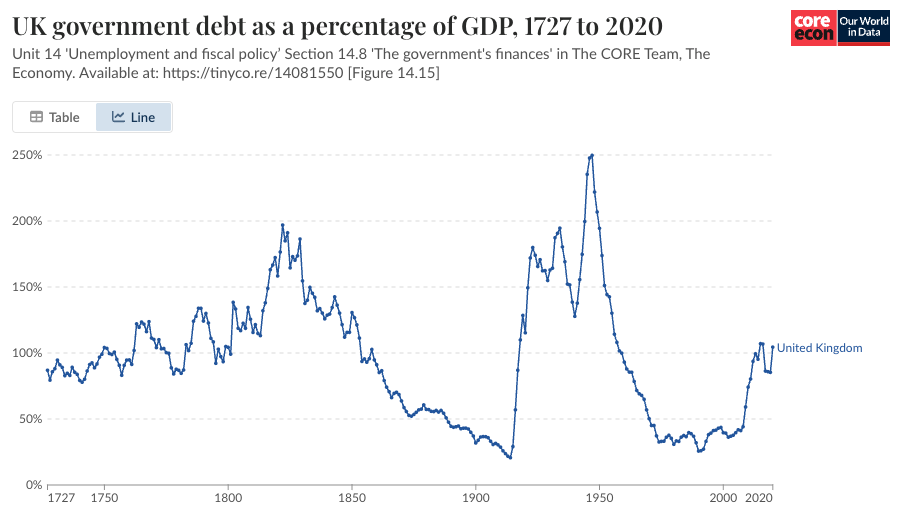
A good example of a long term view is this chart of the U.K. government debt as a percentage of GDP. You can see the debt to GDP ration rose substantially above 100% at two major events in British history: the battles with France in the 19th century and the battles with Germany in the 20th century. Indeed, the ratio rose as high as 250% in the 20th century, only to subside to below 50% in the postwar era.

This is not to say that the ratio does not matter. It is to say that there is nothing magical about breaking the 100% ratio. The ratio could go higher. Chances are it will eventually go lower if for reasons of inflation if nothing else.

Writers — usually right wing writers — start bringing up the debt when left wing governments are in power. It’s a way for them to frighten people and pressure the government into spending less. (Such writers rarely bring up debt, especially for things like military expenditures, when the government is right wing.) Don’t be frightened. Governments have an obligation to tax and spend responsibility. They should not be basing their spending on this ratio.

(Image is from here.)