This looks fantastic:
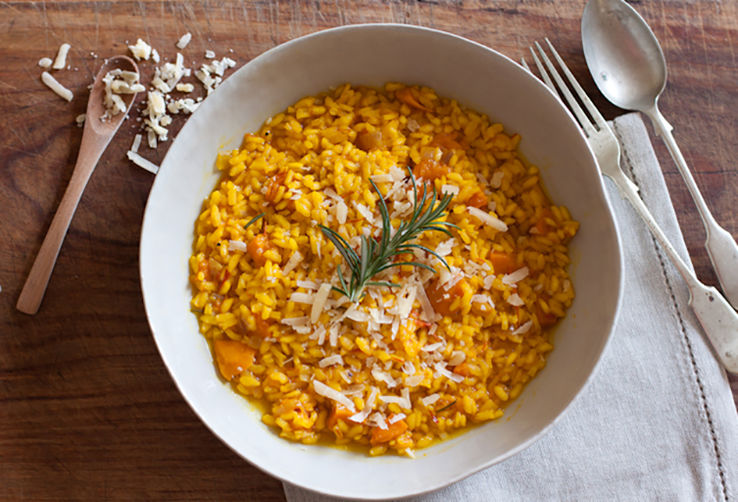
A perfect recipe for Autumn.
The photo is from the Food52 blog. The recipe can be found here:
Butternut Squash and Saffron Risotto – Regional Italian Food.
Thanks, K! 🙂

This looks fantastic:
A perfect recipe for Autumn.
The photo is from the Food52 blog. The recipe can be found here:
Butternut Squash and Saffron Risotto – Regional Italian Food.
Thanks, K! 🙂
Caramelized onions are a great thing to have: many basic dishes can be enhanced by adding these golden beauties. Sound good? If so, consider this: Why recipe writers lie and lie about how long they take to caramelize onions.
I recommend you read this before you try to make caramelized onions, otherwise you might wonder why the burned/undercooked ones you just whipped up don’t have the appeal you expected.
Stuck for a recipe to use them with? Consider this egg dish recipe from Martha Stewart: Caramelized Onion and Gorgonzola Quiche Recipe or this pasta recipe from: A CUP OF JO: Rigatoni with Caramelized Onions and Gorgonzola.

Onions, butter, tomatoes. It doesn’t get much simpler than that. And yet, delicious. Also beats the stuff in a jar, of course.
Once you have a great tomato sauce, then there is a wealth of possibilities for dinner, from pasta to veal to eggplant to….whatever needs a great tomato sauce.
For more on the recipe (and where I got the photo), see: Stacey Snacks.

I honestly don’t have to do more to get you to go to this link than share that photo, do I? I didn’t think so. Recipe from A CUP OF JO (Homemade Nutella Crêpes).

Easy. Flavourful. Broadly appealing. Somewhat messy. 🙂 A good choice for Monday: sticky sesame chicken wings from smitten kitchen.
I love this. Andrew Hyde made a decision. He decided
to cook dinner for people. A year later I’ve hosted 138 dinners. The average dinner had 14 guests which means I’ve made 1932 dinners for friends and strangers.
I highly recommend this post of his describing it: Dinner At My House (How I Hosted 138 Dinners in a Year) by Andrew Hyde. It makes me want to try and do something similar.

I’ve been planning on making bread for…well, years. I made it decades ago, but for various reasons, I never got back into the habit of making it. The last time I tried was after I picked up the book “Artisan Bread in Five Minutes a Day” and hoped to jump on the no knead bandwagon. But the boule I made wasn’t very good and the book and my bread making went back on the shelf.
Two things happened to me recently to give it another go. First, I found a new copy of “The All New Purity Cook Book”. This book is the one I grew up with, and it is heavily oriented towards bread making. An old cook book, but a great one. Second, I wandered into a store and found a Black and Decker refurbished bread maker for a $29. I decided it was time to try making some bread again. You can see my results above. (And yes, the shapes are off, but hey, I am learning, just like you will be!)
Veteran bread makers won’t learn much from my notes below, but new bread makers might. Things I learned:
Good luck making the bread. I am sure you will make nicer looking bread for sure.

Over at Kitchen Daily, they had a feature the use of en papillote (whether that is using parchment, foil, or some other material). Of the recipes there, these are the ones I look forward to trying soon, especially the first one.
Bonus: this sweet potato recipe not only sounds good, but I love the source for it.
The Bacon Eating Jewish Vegetarian: Big Sweet Easy (Roasted Sweet Potatoes with Sumac).
The image is from the last recipe from Verily. If you are new to this way of cooking, go to that recipe: it outlines the simple technique using parchment.
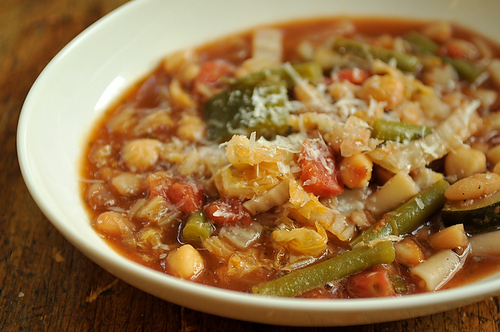
And this one from Food52 could be yours. Once you get in the habit of making minestrone, you can really adopt any set of vegetables and beans you have to make the soup you want. Don’t like cabbage? Don’t use it. Out of chickpeas (garbanzo beans)? Use something else. It may not strickly be minestrone if you do, but who cares: it will still be delicious. Needless to say, this is a great way to use up bits and pieces of vegetables in your crisper.
This Village Voice article has a run down of a number of great restaurants being forced to close due to the price of rent in Manhattan. Restaurants are following bookstores, which are also suffering from the cost of doing business in this part of NYC.
I suspect low margin businesses like this will move to the other parts of NYC and away from the big rent/big money sections. It will be interesting to see the migration both of the businesses and the people. Compared to the way Manhattan used to be in the later part of the 20th century, this is a better problem for them to have.
For more on the bookstores closing, see this piece in the New York Times.

The story of IBM and Bon Appetit is really interesting to me, since I love food and I am proud of the work IBM is doing with Watson. Anyone interested in the topic of innovation in IT or food should find it worth a read.
For people who aren’t interested in the high tech aspect of it, check out the recipes. In particular, these ribs with a range of flavours from bourbon to oyster sauce look fantastic.
According to blogTO, these are the best new cheap eats in Toronto (for 2013, at least) and these are the 10 most expensive restaurants in Toronto
to dine in Hogtown.
Whether you want to go in style or go casually, all these spots should deliver a good meal (and in some cases, much more).
The general belief with regards to making bread is that it is hard work, it requires alot of skills, and it demands alot of your time. These two posts here are out to challenge that assumption:
The first recipe shows you how to prepare the loaf up until the point you need to bake it. The second recipe shows how you can use a slow cooker to do it. I haven’t tried this yet, but I think it would be fascinating to try.
It isn’t it going to be as good as something an experienced baker makes, but it will be much better than most anything that comes from a grocery store (unless you are paying alot of money). And in the summertime you can still make bread without having to turn on the oven, if you follow the slow cooker recipe.
P.S. The Kitchn web site has quite a few posts on breadmaking, including this: Recipe: No-Time Bread | The Kitchn.

Are low-wage workers going to replaced by robots? There are cases to be made for that happening, both here: The Shift From Low-Wage Worker to Robot Worker from FiveThirtyEight and from the recent book, The Second Machine age (pictured above). Indeed, some have argued that fast food restaurants are a form of manufacturing, and this makes the notion of replacing works with machines more plausible to me.
It is important not just to look at the future, but also the past, in particular, the history of the automat.

The automat was once the future too, and there are still vestiges of them around, but mainly they have died off. There were a number of reasons for this (see Automat – Wikipedia, the free encyclopedia), but inflexibility was one of them. Right now fast food establishments thrive on inflexibility and low cost.That is also the way to compete with them. I can see how people can compete with that and win, and the way to do that is portable food (e.g., food trucks, food stalls). Barring bureaucratic costs, portable food is cheaper to deliver than traditional bricks and mortar establishments (even fast food ones). And portable food vendors can be much more flexible than fast food places can ever be.
The other way to compete with them is by being human and offering better service. No robot in the next century will be able to do that.
For more on the book, check out: Amazon.com: The Second Machine Age: Work, Progress, and Prosperity in a Time of Brilliant Technologies (9780393239355): Erik Brynjolfsson, Andrew McAfee: Books
undefined

I am a fan of Michael Ruhlman in general, so I am happy to recommend this recipe of his: Pan-Fried Chicken Thighs. Three comments:
Ruhlman keeps it simple here, but you could easily add dry flavourings (i.e. herbs and spices) to the flour, or wet flavouring (e.g., hot sauces) to the dairy mix. Once you start doing that, you can vary this recipe in all kinds of ways.
Are low-wage workers going to replaced by robots? There are cases being made for that happening, both here: The Shift From Low-Wage Worker to Robot Worker from FiveThirtyEight and from the recent book, The Second Machine age (pictured above). As well, some bloggers like Matt Yglesias have argued that fast food restaurants are a form of manufacturing, and this makes the notion of replacing fast food workers with machines more plausible to me.
However, in considering this, it is important to look not just to the future, but also to look to the past. In particular, the past that contained the automat.
The automat was once the future too. There are still vestiges of them around, but mainly they have died off. They collapsed for a number of reasons (see Automat – Wikipedia, the free encyclopedia), but the chief reason was inflexibility.
Today’s fast food establishments thrive on inflexibility and low cost. One way people can compete with that and win is with portable food (e.g., food trucks, food stalls). Barring bureaucratic costs, portable food is cheaper to deliver than when it is delivered by traditional bricks and mortar establishments (even fast food ones) and portable food vendors can be much more flexible than fast food places can ever be. There might still be robots delivering portable food, just like there are vending machines that provide food. But they won’t have flexibility of humans, and they won’t be as cheap. Additionally, humans can offer human interaction: no robot in the near future will be able to imitate that.
I believe eating is a social act and a human act, and buying and selling food should be a social and human activity. We humans need to think about it in ways to provide it that doesn’t dehumanize ourselves.
For more on the book, check out: Amazon.com: The Second Machine Age: Work, Progress, and Prosperity in a Time of Brilliant Technologies (9780393239355): Erik Brynjolfsson, Andrew McAfee: Books. It’s really great.

I personally think you can make bacon any time of the day, but for many of you bacon lovers, the time to make it is in the morning, not at night. Regardless of when you have it, this guide on How To Make Perfect Bacon in the Oven Cooking Lessons from The Kitchn is something you should review before you break out the frying pan for your next batch.

Some days you just want a simple meal for dinner. This soup with some bread, cheese and a salad could be just the thing. Make it even easier by picking up some roasted peppers and using them instead of roasting your own. You can deepen the flavour with some garlic or make it hotter with pepper sauce or even sriracha added in. Lots of ways to change this up and still make it delicious.
You can find the recipe here: Roasted red pepper and tomato soup recipe, from the good folks at Style At Home
Over at Food52, there’s a nice rundown of dishes you should consider making without following recipes. You may want to refer to some memory aid, but if you like these dishes, chances are you can make them pretty much without the need of a cookbook (or a web site).
They have recipes from Vegetarian or Vegan Chili to Quinoa Salad to Marinara Sauce to Risotto and more.

Well worth a look.
Limburger, that wonderfully (or awfully, depending on your taste) cheese gets the full treatment in this article: The Cheese That Stands Alone by Ben Schwartz – Roundtable | Lapham’s Quarterly.
It’s a great story. It almost — almost! — makes me what to go get some Limburger.
If you want to see how to prepare food in a number of ways, I highly recommend the YouTube channel of Mario Batali. He and his chefs have lots of different techniques there for the beginning cook, including this great one: How to Make Meatballs – YouTube. These are fine looking meatballs.
I think this article should be printed and referred to by anyone who needs to simplify their lives but still needs to grocery shop and prepare meals for the week. And just what are these ingredients?
Chicken breasts (4 boneless)
Bacon (1/2 pound)
Shrimp (1 pound)
Spinach (1 pound)
Tomatoes (6)
Ginger
Onions
Asparagus (2 pounds)
Button mushrooms (1 pound)
Loaf of good country bread
Sound good? Go to The 10-Ingredient Shopping Trip – NYTimes.com and get the details.


The great Mark Bittman has 7 Ways to Make Lentil Soup, and if you want to start out with making any of these, I think you will have a delicious meal when you are done.
An even easier version is this. Take this list of ingredients
Add them all to a slow cooker (4 quart / 4 litre) size or bigger, stir, then cook on low (8-10 hours) or high (4-5 hours). Remove bay leaves before serving. That’s it! Easy.
Now I say seven million ways to make lentil soup because you really can substitute greatly for very different soups. For example:
The lentils and the stock make up the foundation of the soup. The rest is seasoning and vegetables (and possibly non vegetables). Feel free to experiment and make the soup your own (and use up the left overs in your fridge or pantry).

The Awl has a fascinating analysis of the McRib that includes some speculation on why McDonald’s introduces it when it does. The above graph, from the article, plots two lines,
The blue line is the price of hogs in America over the last decade, and the black lines represent approximate times when McDonald’s has reintroduced the McRib
It goes into details on why McDonald’s might introduce the McRib when it does and why. It has other things to say about the sandwich, not all that I agree with, but overall the article is thought provoking and well worth a read.
I would also add that besides price, Marketing cycles have something to do with it. McDonald’s is constantly turning over promotions, and the McRib would likely have to be tied into that campaign cycle as well.

Why brilliant? Because it is simple, easy, and delicious. And looks great! Mark Bittman always has good ideas, and I think this is one of his better ones. See: The Minimalist – Cake, Tart, Frittata – Call It the New Baking – NYTimes.com. Better yet, pick up the ingredients and make this dessert.
(Photo by Evan Sung for the Nytimes.com)
On the weekend I was in Dufflet on Yonge in Toronto having a delicious brownie. This particular Dufflet also has a flower shop in it with gorgeous flowers for sale. While I was enjoying my brownie, a woman walked by with a gorgeous bouquet. As she exited, she exclaimed “I am buying them to cheer me up”.
It may seem extravagant to some to buy flowers. You can’t do much with them. But we pay for movies and attend musicals and watch TV shows on cable TV. If anything, flowers last longer and cost less than these diversions. Even my brownie is not something I have to eat. I enjoy it for much more than the calories it provides (and it does provide alot of those!) It’s a small extravagance.
No, flowers are no more extravagant than any of those. If you want to make yourself better, you could do worse than buy flowers. Even one small one, in a tiny vase. Go ahead!

 Smart People I Know