How the ‘Spicy Boi’ comments on Hillary’s Instagram shows the difficulty of dealing with trolls

To see what I mean, read this piece in NYMag, Everyone Is Commenting ‘Spicy Boi’ on Hillary’s Instagram. Note how the social networks cross over the various platforms. The social organization of this activity goes from platform (iFunny) to platform (Twitter) to platform (Instagram). No doubt at some point it will appear on Reddit, 4chan, and who knows where else. It’s very hard to deal with trolls when you have people on one platform (e.g. Twitter) trying to control things, yet you can have social groups planning raids, etc. on other platforms.

Three thoughts:

  • the comment section for big accounts on Instagram is next to useless. I wonder why it is even enabled for them? I think they should disable it, or give the user the option to disable it.
  • In many cases, the comment sections should be limited to such things as “Likes” or “Thumbs Up” or simple polls.
  • Social media needs to involve either really good AI or (better) really good people to moderate things. It can’t happen soon enough.

Twitter: a former bar you used to love and now visit nostalgically

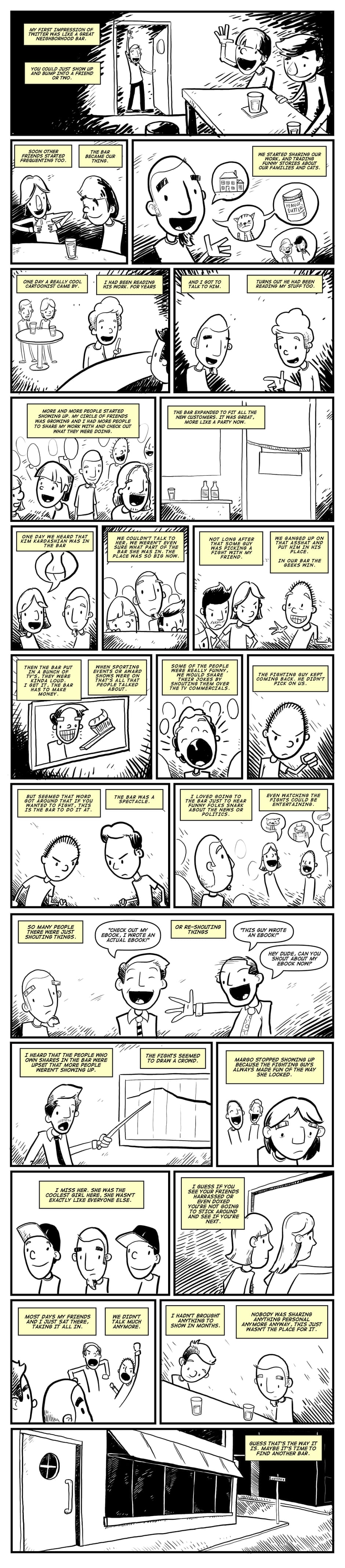
I’ve likely said enough about twitter. So much so, that there doesn’t seem much else to say. I wanted to highlight this comic, though (the long, slow death of Twitter | Technology | The Guardian) because it wonderfully sums up the arc of Twitter over the years. It matches my thoughts and feelings about the platform very well.

I still come to Twitter, the way you go to a bar you used to love. There’s not as many friends there as there was before, but there are still some. It becomes as much a visit to experience nostalgia as anything else. But then the shouters and the fighters show up and you remember why you lost your interest in it.

More on the decline of Twitter from a variety of sources

From the New Yorker and Business Insider. A rebuttal here, on Medium, and also Slate.

My take is a simple one: most people are interacting less on Twitter. This likely leads to people contributing less on Twitter, which leads to a downwards spiral. I see this on other social media as well.

The one exception to those interacting less are active self promoters. Self promoters, whether doing it personally or professionally, are still interacting regularly with social media such as Twitter. After all, it’s free and it’s better than doing nothing.

Overall, though, I expect there to be a decline in use of all kinds of social media, until someone can invent a social media that is more effective than what we have today. That may be a few years off.

On Facebook, the company

Facebook is a company. It’s not Mark Zuckerberg. It’s not an app you use on your phone. It’s a collection of services that is growing rapidly and it may be poised to grow at even crazier rates than it has now, if you believe what is in this piece, Inside Mark Zuckerberg’s Bold Plan For The Future Of Facebook. Key point it raises:

The Facebook of today—and tomorrow—is far more expansive than it was just a few years ago. It’s easy to forget that when the company filed to go public on February 1, 2012, it was just a single website and an app that the experts weren’t sure could ever be profitable. Now, “a billion and a half people use the main, core Facebook service, and that’s growing. But 900 million people use WhatsApp, and that’s an important part of the whole ecosystem now,” Zuckerberg says. “Four hundred million people use Instagram, 700 million people use Messen­ger, and 700 million people use Groups. Increasingly, we’re just going to go more and more in this direction.”

Reading this, you get the sense of a company that is going to bigger in a few years than it is now, which seems incredible to me. Note this article: it will be worth revisiting in a few years.

That said,  there are a few points I’d like to add:

  1. I actually think that Facebook the app/website is declining in active usage. It is very clever showing you things people like, even if people you know aren’t posting things. You get a sense of activity on Facebook the app/website whenever you log in. You never get the sense that it is not being used by people, even if many of the people you follow aren’t actively contributing at all. I suspect if you dropped your Facebook friends down to next to none it would still show you the same amount of information. If Facebook the company is going to remain successful, it needs to diversify from it’s main service.
  2. It is interesting that people continue to compare Twitter to Facebook. To me, there is little to compare. Facebook seems to have a better growth plan and even have a better app. If Facebook the service declines, the diversification into places like WhatsApp and Instagram is strong in a way that is unlikely to be matched by services like Vine or Periscope. While there is some commonality between the two companies, I think the story of their divergence will become a bigger one over time. Contributing to that big difference is Facebook remains a stable company with a stable leadership while Twitter’s leadership remains chaotic and unstable.
  3. The narrative in that story is very optimistic. If the numbers for any of those organizations start to slip, I could see the narrative changing, just like it has for so many IT companies. Right now the narrative is: Facebook is a very successful company and it is going to become more successful with all these promising ideas. The narrative can easily become: Facebook is a very troubled company and it is going to become more troubled with all these ideas doomed to fail. (See Yahoo! for an example of such a narrative.)

Twitter is in trouble! Again!

Since I have been using Twitter, it’s been in trouble. And according to this really good piece, Twitter is in trouble. Here’s why. – Vox, it still is! What is new is the the type of trouble it is in. Previous troubles were technical and then social. Now it’s business trouble.

My take:

  1. they need to be less controlling and make it a platform.
  2. they need new leadership.

Otherwise they are going to become MySpace.


Here comes Yik Yak: a mini primer (plus 2 or 3 — ok, 7– thoughts on it from me)

By now you have heard of Yik Yak (or were curious enough to click through). Here are three links that can tell you more about it:

  1. If you want to get the basics, check out this: You Asked: What Is Yik Yak? | TIME.
  2. If you are a big user of Yik Yak, you most likely are on campus. College students are where it is seems to be taking off. Like any platform, eventually you see people coming out with ways to take advantage of it. Here it was used to have a back channel for a speech Ted Cruz was giving: Ted Cruz Has Skeptics at Liberty, and They Use Yik Yak – Bloomberg Politics.
  3. And here it was used for cheating on exams! Another Use for Yik Yak on Campus? Cheating on Exams – Wired Campus – Blogs – The Chronicle of Higher Education.

My thoughts:

  1. Yik Yak is a platform. Like any platform, people using it will invent new uses for it. I expect to see Yik Yak used in all sorts of innovative ways, and I expect it will grow as a result.
  2. Yik Yak is big on college now. But it likely won’t be limited to that audience. Facebook was also once limited only to colleges. Look how that turned out.
  3. Yik Yak is partially a response to all those Privacy is Dead advocates and those saying young people don’t care about privacy. Yik Yak is anonymous, and I expect there will be more social media going this way. It’s hard to exploit users when your service does not depend so much on identities.
  4. Anonymous social media is also a dangerous thing in the wrong hands, as is illustrated in some of the examples.
  5. Social media needs to mature to a position that is not anonymous but also protects people privacy. Otherwise people will tire of being abused by one or the other and shy away from social media.
  6. I think social media and the people who create it are anywhere near that mature yet.
  7. Privacy lives. Privacy is all about control about information about your life. To say privacy is dead is to say no one has control over information about their life, which just isn’t true. What is true is that new technology will continue to come out and force you and everyone else to think about privacy and what you want to share and what you want to keep to yourself.


Some thoughts on blogging and social media with the news that Dooce is retiring

According to one big name blogger, Jason Kottke, another big name blogger, Dooce, is retiring. How big is big? According to this piece in the NYTimes.com (Heather Armstrong, Queen of the Mommy Bloggers – NYTimes.com), she is hinted at having earned $1M / year. That’s pretty good money. This comes on the heels of Andrew Sullivan, another big name blogger, who recently retired too.  From the sounds of it, Jason Kottke himself is thinking that the days of blogging are numbered. It seems the days of a very limited number of big name bloggers making good money are numbered.

Dooce, Kottke, Sullivan and others rode the wave of the golden age of blogging. Dooce and Kottke kept up the format longer than others. Sullivan, Josh Marshall, and many of the political bloggers I started following years ago, have all but abandoned pure blogging. Marshall’s TPM still retains some elements of his original blog, but his site is more like CNN and less like a traditional blog. Sullivan’s site was chronological, but it was more like a blog on steroids that turned out 30 or more posts a day from a variery of sources. Others, like Nate Silver (538), Matt Yglesias and Ezra Klein (Vox) all went off and start up variations of what Marshall did with TPM. The model of Vox and 538 is more like Buzzfeed and less like a blog.

Kottke and Dooce are good at what they do, but they also were in the right place at the right time. I admired Kottke and modelled my blog off of what he did, but in truth, there was no way my blog would ever catch his. The same goes for Dooce and her mommy blogging. They occupy the left end of the long tail, while most of us occupy the right end. That’s fine: it is great that it is possible for anyone to be able to write and have it published for free. While your writing may not be read widely, it will be read by more people than you expect. That has certainly been the case for me. When I first started, I was thrilled to have anyone read my blog. As of this post, thousands of people have read my posts over 800,000 times. I am still astonished by that.

Like much in IT, blogging hasn’t died so much as it has been displaced. One time blogging was about the only social media out there. Now, all media is social media.  There are so many choices now. Not only that, but as networks get faster, sites like YouTube and Vine and other visual sites attract more attention. Video is the future.

Blogging still exists and likely will continue to exist for some time. The fact you are reading this proves that. As well, blogging platforms like WordPress seem to be doing well. While some platforms like Posterous went away, others like Tumblr continue to attract new writers and new audiences. I expect to see people writing in this format for some time to come.

What I don’t expect to see happen is individuals making the money that Kottke and Dooce and Sullivan made. Those days are done. Perhaps people will make money blogging by doing it in conjunction with sites like Patreon.com. That’s a possibility. Also, people may use blogs as a way to promote other ways they make money.

Blogging, derived from the words “web logging”, was a way to log your thoughts chronologically on the web. It seems  old and trite now. But the need to write and the need to have others read the words that you have written will never get old. We need new and better platforms. Medium.com tried to do that. Other sites, from Google+ to Facebook to Twitter to Ello have all tried to offer some way to do that. Maybe the golden age of online writing via some platform like blogs is over, and people will write less and share less. Or maybe people are waiting for the next great platforms to start creating again.


Some thoughts on Charlie Hebdo, outrage, and social media in general

Well before the end of 2014, I had decided that I was no longer going to participate or contribute to anything outrageous or political on social media generally, and twitter in particular.

This week I let down my guard and did participate and comment on the recent events in France, mainly because I was stunned by the act of violence.
After considering it for over a week, I think that was a mistake and I am writing this partially to insure I don’t make that mistake again. If you are curious, the next few lines explain my thinking around that resolution. The last four paragraphs talk about what I am going to do instead: feel free to skip down to there.
I have been using social media for a long time, relatively speaking. At first it was merely a curious experience. Then it went to being a positive experience. But more and more it has become a negative experience.
Once social media, and twitter in particular, was for people sharing status. It was random: some good, some bad, nothing focused. However, one really good thing about it was that you got to know people. People you might never get to meet before: the famous and the fabulous and the funny and the friendly. It was a great experience. I know from my own experience that my life was greatly improved by this greater network that I got access to.
While my feed of updates  was once rather random, over time people started focusing their use of it. Celebrities used to to promote their work. Politicians did too. Activists started to try and rally people to their cause. Artists tried to make it into a new form of writing. That was still good.
Among people on twitter, a growing belief was that the benefit of twitter over a site like Facebook was that you could hang out with people you liked but didn’t know (as opposed to hanging out with people on Facebook that you knew but didn’t like). I never agreed with that knock against Facebook, but I did like the people I encountered on twitter. They were good people.
Then not so good people came along. People with no other interest in twitter and social media than to cause problems. It was like a pile of aggressive drunks showing up at a party and getting into fist fights with the rest. Twitter, the company, seem to have no plan in dealing with this. Perhaps it was a result of this, or perhaps it was something else, but the level of aggressiveness and negativity rose on twitter as well. It was a variation of Gresham’s Law, where instead of the bad money driving out the good, the antisocial behavior drives out the positive social behavior. Whatever it is, what I found was that the amount of positive sharing seemed to diminish. People tended to communicate with people they had a previous relationship with, and people seemed more likely to share negative things.
I believe as a result of that, we now see these ever increasing outrage storms on twitter. Where once the outrage over events of the day — if you had any at all — would be limited to yourself or your small social circle, now you can share it with hundreds or thousands of people. Those people can take that and share it with the people they know. And then to add to that, there will be people who disagree with you, and they will express their displeasure to you directly in a way they never could or would if you knew them personally.  This all adds up to an enormous cloud of negativity.
Last December, I noticed people saying 2014 was a terrible year. That surprised me. I am older than many people on twitter, but most people on twitter are educated and experienced enough to know that relatively speaking, 2014 was not a particularly terrible year for many people in the world. I could think of many years in recent memory that were much worse economically, that had much more violence, that had much more disease and suffering. There were terrible things that happened in 2014, but terrible things happen every year and 2014 was no exception.
I believe that people thought 2014 was a terrible year because all of the feedback that they constantly get that gives a strong impression that it was terrible. And feedback is the right word. More and more of the things shared on twitter are negative. Either they are personally negative or there is something in the world that we see which is terrible.
I used to think that sharing such information on twitter could make a positive difference, and that by sharing such information, even if it is upsetting, then it was worth it if something good could come from it. I no longer believe that. Topics change so frequently on twitter now that it is easy to miss them if you are not on twitter for a few days.
Instead, I find social media to be more and more upsetting and aggravating with little upside. There are times when people need to be upset and aggravated if it helps them achieve something they want but can’t achieve otherwise. But too much “stick” and not enough “carrot” is just a form of voluntary suffering.
There have been many times when I wanted to give up on twitter. Back in the fail whale days, the lack of availability was frustrating. Then I was angry when twitter started taking over my stream. In both cases there were technical workarounds to those problems. But this is a social and a culture problem, and those are hard if not impossible to fix with technology.
Ultimately I could give up on twitter. But I have come to like a lot of the people on twitter I follow, and I would hate to lose track of them and what they are doing. It would be nice if there were better ways to filter and manage the information that shows up in my feed, but Twitter the company seems to have decided it is not in their interest for me to do that.
Given all that, my own remedy is slight. The one thing I can do is try and change my own contribution to twitter and try to focus on contributing more constructive and positive updates. I’d encourage you to do the same. Enough positivity and constructive updates can make a big difference eventually.
Also, I am going to try and spend less time vegetating in front of twitter much the way other people crash and vegetate in front of TV. I actually read every tweet in my feed. (Hey, the people I follow in India and Australia and Germany tweet later so I have to read it all:)). Instead of vegetativing like that, I hope to spend my time reading more books, making things (from bread to furniture) and generally get out and do things. I would encourage you to do that as well.
Finally, I am going to look for a select group of causes I can contribute time and money to and focus on the little I can do with the limited resources I have at my disposal. I think I can have more of a positive effect on the world that way than I can contributing to the latest outrage storm on twitter. I would heartily encourage you to do that as well.
If you have made it to this point, I want to thank you for reading this. You may not agree with it, but I hope you were able to take away from it something positive and worthwhile.

So is @allypatterson in PR OR A REAL PERSON? What do you think?

So, I am discussing whether or not Ontario should allow stores to sell beer and wine.

One person on twitter arguing against this is @allypatterson. This person represents herself as someone who ‘sells beer and takes back empties’ 40 hours a week. So presumably a real person, working in a beer store.

Now, I think she is a PR person. I could be wrong, but here’s why I think that:

  • I noticed a few odd things about her account. First off, no bio, not even an odd one. But a photo.
  • All here tweets are advocating against stores selling beer and wine. All of them. No silly tweets. No tweets complaining about the weather, her friends or family. No pictures of cats. Indeed, no photos, other than ones arguing against liquor in stores.
  • she is followed by and followed by IPSOS Public Affairs @ipsosreidca and Premium brands @pblbeers
  • she has only a few followers/follows (143/56)

Now, I have seen alot of real people who advocate things. Strong advocates usually have a fake photo but a related bio. Others have a real photo and a limited bio. But they generally share things about themselves. Furthermore, most people have an array of things they tweet about. And frankly the ones who stick on one topic like a broken record tend to be ranty.

And how many people with such limited information about themselves and such a small amount of followers are followed by such a large corporation as Premium Brands AND a large PR firm? How many other beer store employees are both of them following.

Maybe this person is a real person. But to be so on message, to be clear and concise and well argued in their communication, I somehow doubt it.

Thanks for reading this. I’ll Le you decide.

P.S. Anyone doing impersonation on Twitter violates the ToS. A big PR firm like IPSOS would know that.