
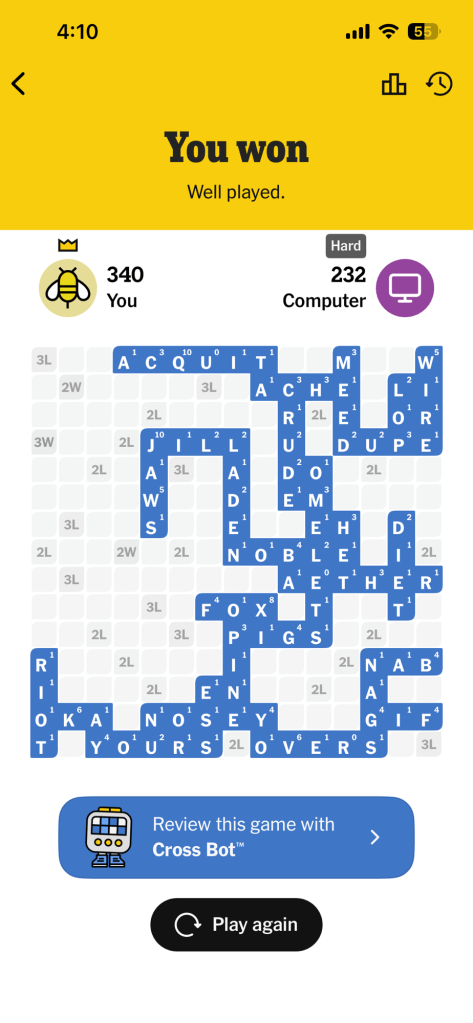
How to win the New York Times Crossplay game against the computer in hard mode (June 2026)

I have been playing the New York Times Crossplay game against the computer in hard mode and most of the times I win. Here’s what I’ve discovered:

  • In hard mode the computer “likes” to play longer words whenever possible. Many times these are uncommon words.
  • The computer will try and play the 2W and 3W tiles, but it seems to “prefer” to play longer words over shorter words, even if a shorter word on a 2W or 3W might gives more points.
  • The computer will stack shorter words but it tends to do that later in the game when it is harder to play longer words. It will stack longer words if it can.

These have been my observations. Give that, to increase my chances of beating the computer, I will:

  • hold back letters with higher values unless I can score at least 20 with them on my current turn.
  • wait for the computer to set me up for 2W and 3W tiles and then play the higher value tiles. I find it will play a long word to maximize it’s length, even if it is easy for me to stack on top of its word and get the 2W or 3W tile. It doesn’t seem to play defensively.
  • My expectation is the computer will do this at least 2 or 3 times a game, so being patient even when I am down is key to beating the computer.
  • if I can’t do anything good with an open 2W or 3W, I will take it if there is a chance the computer can reach it in 5 tiles.
  • I will set myself up for a 2W or 3W in the next move by holding back a tile. Let’s say I can end a word in S, but it means it is possible for the computer to use that S to play a word and to get to a 2W or 3W tile. If I was playing a person, I might be worried they were going to get that in the next round. But if there are open spots on the board where the computer can play a longer word, chance are it will go for the longer word instead, so in the next turn I can lay down the S and hopefully spell out a word to get the 2W or 3W tile.

I say most of the time I will beat the computer in hard mode. Crossplay is a game of chance as much as anything, and some games I will get a bad assortment of letters and the computer will get a great assortment of letters and I will lose. But by adopting the approach I described above, I can frequently beat the computer in hard mode, even though it knows more words than I do.

P.S. My overall general approach is to always aim for the highest score for each play. Often this means stacking words — even small words like “LI” and “OR” — on top of other words to maximize my score rather than playing long words, the way the computer prefers to do. Stacking words gives less openings for my opponent, which is especially effective against the computer, which will often open up the board by playing a long word.
Does all gamification suck? (Why that isn’t necessarily true)

500
Is all gamification bad? If you read this piece, How gamification took over the world published in MIT Technology Review, you might come to the conclusion that it is. I thought the strongest criticism of it came from the game designer, Margaret Robertson. She…

 argued that gamification should really be called “pointsification,” writing: “What we’re currently terming gamification is in fact the process of taking the thing that is least essential to games and representing it as the core of the experience. Points and badges have no closer a relationship to games than they do to websites and fitness apps and loyalty cards.”

I think that’s true. If the whole game is just getting more and more points and levels, after awhile the game gets dull and easy to abandon.

So what should a game be, if it’s not just about keeping score? The article goes on to say:

“A game is about play and disruption and creativity and ambiguity and surprise,” wrote the late Jeff Watson, a game designer, writer, and educator who taught at the University of Southern California’s School of Cinematic Arts. Gamification is about the opposite—the known, the badgeable, the quantifiable.

Ideally that might be the case, but there is a range of game play, and some great games may only have a modicum of creativity and ambiguity and surprise and can still be loads of enjoyment.

Indeed, that’s the thing about games and indeed gamification. Some games can be engaging and great fun. And some games suck. The same can be said for gamification: some of it is fun, and some — alot — isn’t.

This is especially true for gamification that is imposed on us. We all can recall childhood friends who would say “let’s play a game” and the game turned out to be something that would be good for them and not for you. It was no fun then, and it’s no fun later in life where you are working for a company and your employer wants you to play a game in order to get you to behave in a certain way for their benefit.

If imposed games are bad, so are endless games. Games that never come to an end or that are practically impossible to win also suck. Yet for game makers, it is tempting to engineer the game so that you never leave it (and them). I was reminded of people I know who played Duolingo and who found once they got to a certain level, they were just floating there. Now it was no longer a game to them, but merely an activity. Now some activities can be fun, but it’s no longer a game.

Gaming is a structured form of play, and like any type of play, it should be fun and it should come to an end. Too often with gamification, neither of those things are true. That, to me, is the true problem with the practice of turning non-game activities into games.

(Image is linked from the article in MIT Review)

On gamification of my time to get tough things done


I had been using a skillful form of procrastination: I was been doing things I don’t mind doing rather than doing things that are hard or that are important. For awhile this was ok: I still needed to complete the things I don’t mind doing. Eventually, though, I was getting really far behind on the hard and important things. I needed a solution.

My solution so far is to gamify my activities. Its based on achieving so many points per week. I assign a point for every minute of the day. Most minutes get 0 points for now. Some minutes get assigned positive points in the following way:

  1. 5 points for everything important I hate doing
  2. 3 points for important things I don’t hate doing
  3. 2 points for everyday chores I don’t like doing
  4. 1 point for everyday chores I like or don’t mind doing
  5. 1/2 point for staying organized and doing chores or important things I love doing

What I was doing before was spending no time on 1 and 2, some time on 3, and most of my time on 4 and 5. Not to mention fun things, sleeping, eating which I give zero points for. Now if I spent 30 minutes on cooking I get 30 points; 30 minutes shovelling snow is 60 points; 30 minutes helping my kids is 90 points and 30 minutes dealing with financial stuff is 150 points.

Once I had that system, it was pretty easy to measure my points in a day. I have a little spreadsheet to do it but you can use a paper pad or pretty much anything to do so.

The hard part of this is determining what is a win under this system. My first goal was a win would be 1000 points a week. It’s pretty hard to get that doing activities with 1-2 point activities; you need to really focus on 3-5 point activities.

In my first week I got to 1000 points by Thursday. So I decided on a different approach. 1000 points would get my Bronze level. 1500 would be Silver Level. 2000 would be Gold. Platinum would be 2500. The idea is that Bronze should be hard but achievable, Silver should be a stretch, and Gold should be an occasional win. Platinum should be rare.

It’s been successful once I calibrated it that way. The weeks I get the most important things done, they correspond to medals. The weeks I slack off lead me to get a DNF (Did Not Finish). I pledge to do better the next week. (Unless I am vacationing or sick: then a DNF is perfectly fine.)

The next hard thing: what is the benefit of winning? At first I tied physical rewards to point amounts. That might work for some people. It even worked for me for awhile too. Eventually I just found it satisfying to see there were weeks when I was getting important things done. That in itself was a reward, the win.

Overall gamification of my life has resulted in me getting the most important things done. I recommend it for people who like games and/or are stuck.

P.S. you are thinking this is like the idea of putting the big rocks in first, you are right!

For more on gamification and apps that can help you, see this: 9 of the Best Apps to ‘Gamify’ Your Life.

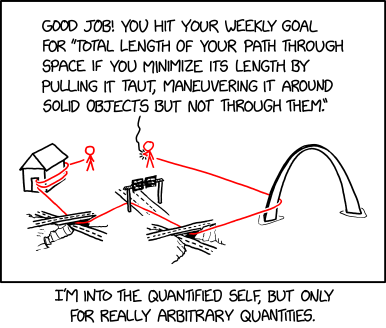
(Image via https://xkcd.com/2679/)

Wordle is fun again. Here’s why that is for me….

Like many of you, I started playing Wordle during the pandemic. It was fun for a long time, then it wasn’t.

I’m not sure what got me playing again, but I think the Wordlebot had something to do with it. Every time I play now, I consult the little bot to see how it did and what it recommends in terms of words. As a result, I have become better at the game. Some of the go to words I use frequently now because of what I’ve learned from Wordlebot are:

  • Crane
  • Slate
  • Sloth
  • Unhip
  • Guilt
  • Croup
  • Alter
  • Chirp
  • Crony
  • Corny

the other day I played CRANE and first and then went with SLOTH and got it in two. If only I had made SLOTH my starting word! Oh well. It’s fun for me again, and that’s what counts.

Also I play it quickly these days. Before I could spent easily 30 minutes on it: now I try and be done in 5.

For more on it, see this good piece: Wordle and the starting word. Adieu!

The Best Websites to Get Your Retro Gaming Fix

For a generation of oldesters like me, arcade games were what we grew up on. They seem quaint next to games on XBOX of PS3 or 4, but compared to games like Animal Crossings or other Nintendo games, they still seem relevant. Anyway, whatever your take, if you are into old games, check this post out: The Best Websites to Get Your Retro Gaming Fix.

I was over at archive.org playing my old favorite, Berzerk! Still fun! And hard! 🙂

Note to Mac users: I had a problem with the Fire button on my Mac. So I followed the advice on this page to map my SPACE bar to the fire button. Then I was fine.