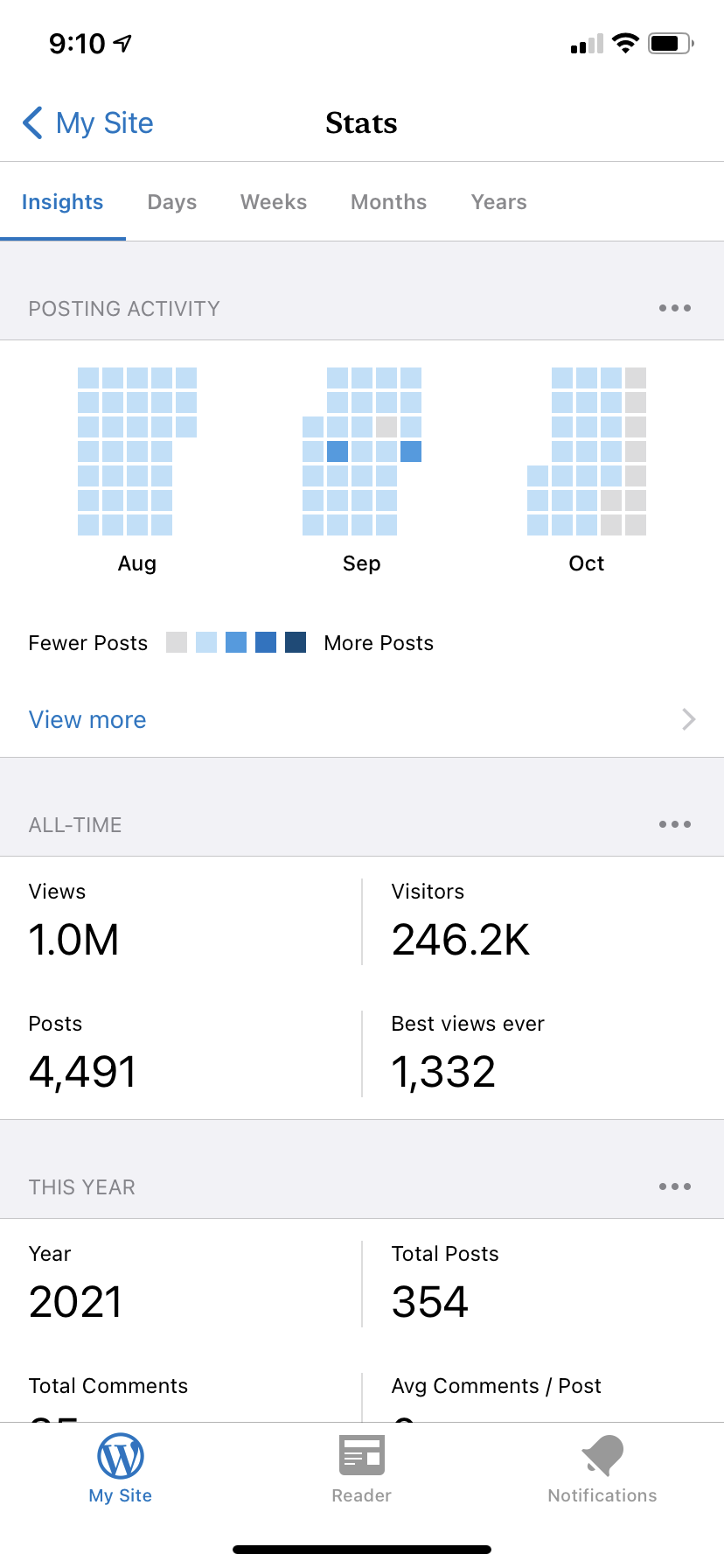
 First up, what is a blog? According to Wikipedia, “A blog (a truncation of “weblog”) is a website whose basic unit is a “post” or “entry”, with posts typically presented in reverse chronological order.” So, a website made up of posts.
Now if you share anything on social media — and you likely do — you are already posting information in reverse chronological order already. Why not blog too? Blogging is just a different form of what you are already doing.
So why should you blog over posting on Instagram or Bluesky or some other places? Well, I have several reasons:
- If you contribute to Instagram or Threads or Bluesky (or god forbid, X) on a regular basis, then you should consider blogging. All those posts will be more or less lost: your blog posts won’t.
- If you discover new ways to do things, blogging is a way for other people to find it.
- If you want to demonstrate your expertise, a blog is a way to do that.
- If you want to keep a record of parts of your life, blogging is a good way to record it.
- If you find good things on the web and you want to comment on them, write that comment up in a blog post.
- If you find yourself sharing the same information with others regularly, write that information on your blog and then point people to it. This is one of my favourite reasons to blog.
- If you want to improve your writing, blogging regularly can help with that.
- If you want to know what you think and improve your thinking, blogging can help with that too.
- If you want to remember what you thought or how you felt 1, 2 or even 10 years ago, your blog posts can remind you.
- If you want to create something, a blog is something! 🙂
Now you don’t need a blog to do all these things. You can simply have a website, or a private journal, or any number of recording devices. But a blog is a good way to do these things.
Some people will say you can still make money blogging in 2026. I dunno. Maybe if you have a large following already, then blogging or newslettering can help you make money. I personally don’t blog for anything other than the 10 reasons listed above.
Do you have to blog every day or every week or what have you? No. You can blog one post and be done! Or you can blog incessantly like Paul Krugman on Substack! It’s up to you. It’s your life and your blog. You can even end it after a month, or a year. It’s all your choice.
As to what to use to host your blog, it depends on how technical you want to be. I have quite a few blogs and websites, some more active than others. Some on Blogger.com, some on Tumblr.com, but mainly I put my blogs on WordPress.com and if I had to recommend one place to put them, I’d go with that.
If you want to start a blog on WordPress, then you can ask DuckDuckGo and it will tell you something like this:
“To create a blog in WordPress, sign up for a free account on WordPress.com, choose a theme, and start writing your posts. You can customize your blog’s appearance and manage it easily without any coding skills.
The Steps to Start a Blog on WordPress. (Steps 1 to 3 are all you really need, though it will help if you do everything on the list below. – blm)
- Step 1: Sign Up for an Account
- Visit WordPress.com and click on Get Started.
- Create a free account by providing your email address and choosing a password.
- Select a domain name for your blog. You can use a free WordPress subdomain or register a custom domain.
- Step 2: Choose a Theme
-
- After signing up, browse through various themes available on WordPress.
- Pick a theme that suits your blog’s style and purpose. You can customize it later.
- (The theme for this blog is https://wordpress.com/theme/colinear – blm)
-
- Step 3: Write Your First Post
- Go to your dashboard and click on Posts.
- Select Add New Post to start writing. Introduce yourself and explain what your blog will cover. (Or just write what ever is on your mind. Remember, it’s your blog. -blm)
- Step 4: Customize Your Blog
- Adjust your blog’s appearance by going to the Appearance section.
- You can modify colors, fonts, and layouts to make your blog unique.
- Step 5: Create Essential Pages
- Add important pages like About, Contact, and Home.
- Use the Navigation Menu to help visitors find these pages easily.
- Step 6: Publish and Promote
- Once your first post is ready, hit Publish.
- Share your blog on social media and invite friends and family to follow it.
- Additional Tips
- Consider using plugins to enhance functionality, such as SEO tools or social media sharing options.
- Regularly update your blog with new content to engage your audience and grow your readership.
- By following these steps, you can successfully start and manage your blog on WordPress without needing any coding skills.”
Now you have your blog. Congrats! So what’s next? Obviously you need to post.
One way I encourage people to come up with new blog posts is to do these things:
- Go over what you’ve posted on other social media. Those posts can be extended to make a good blog post. When I sit down every Saturday morning to write, I look at what I posted on Bluesky. You might do the same thing if you use Threads or Instagram or even Teams or Slack.
- What did you share with others via email last week? Sometimes I go through my email, find something, and copy and edit it into a blog post. (Being respectful of others people’s privacy, of course.)
- What did you learn this week? It could be a new way to get to work, an easier way to cook a meal, a better way to use a particular technology….you name it, it could be a good blog post. Remember: it doesn’t have to be the best way of doing it. It doesn’t even have to be the first time someone learned how to do it. It just has to be something you learned that you think other people might benefit from knowing too. (I wrote this piece on how to better use the NYTimes app and it’s now my #1 post. You never know what information people need. Type in “nytimes app fix” in your search engine: you might see it.)
- What did you think was good this week? Take a photo and post it. Or simply write about it. (You can write about what you thought was bad about something too, but in my experience focusing on writing about good things is a better approach.)
- What was something you know now that you wish you knew 1, 2, 10, 20 years ago that you know now? Write about that. Someone 10 or 20 years younger than you will be looking for that information.
- Write about something you know very well that you wish others knew about. Be very specific. Provide lots of detail. There are lots of things written about the Chrysler building, but this post I wrote gets lots of attention: On appreciating the Chrysler Building (my favorite building in the world). Can I say why? Nope. I can say this though: people often will type in different combination of strings, looking for just the post or page that contains what they are looking for. By being specific and detailed in your post, there’s a better chance they will find it.
Don’t worry if you write something and a week or so later you read it online and think: oh that could be better. Go onto your site and edit it! Blogging isn’t permanent like a book…you can change things or even delete them if you think you are wrong.
Don’t worry if no one will read it. You read it! You can send it to people you know and they will read it. If you’re lucky, people you don’t know will also read it. And if not, that’s fine.
Can you use A.I. to write your blog? You can, but I don’t recommend it. A blog will be better because it came from you, regardless of how well (or not well) you write. Take the opportunity to improve your communications skills as you blog. That alone is a good reason to write it.
Good luck with your blog! Post a link to it in the comments.
P.S. I think the blog / tumblr 52books is a great reason why blogging is never wasted. The blog is a nice snapshot of a project this person had to read 52 books a year. You might be an avid reader who wants to try that yourself: this blog can give you tips on this. You might want to read the best books of that time: this blog can show you them. It’s good this person blogged this, and it would have been great if they had kept it up, but it’s still good it exists.