Hot town, summer in the city! Some cool ramblings for you as summer kicks off (i.e. the June 2024 edition of my not-a-newsletter newsletter)


Hot town indeed! Toronto has recently suffered through a heat wave as we head into the summer of 2024. We had tremendous thunderstorms, crazy wind squalls, and very high temperatures. And yours truly does not generally do well in the heat. Here’s to that heat subsiding somewhat, although, hey it’s summer, why should I expect?

Meanwhile, here’s a seasonal cornucopia of posts and articles I found worthwhile this spring. I hope you find it worth a read. Maybe they can help you cool off. 🙂

COVID/the pandemic: I should be cool about this, but one thing that gets me hot under the collar is the lack of acknowledgement of death that occurred during the pandemic. In Washington there was the temporary memorial of small flags, but it’s gone. I don’t know of any national memorials in Canada. We should have something national like the Covid heart wall in London, England. It is great that we were able to recover so quickly from the pandemic and get back to normal, but we should do more to remember the loss that occurred.

Besides lives, other things were lost. Students of the time suffered especially: the pandemic had a big impact on them during that time, as this shows. Some even created a delayed prom for the “pandemic class of 2020” that they missed out on during that year. Good for them in trying to recoup what was lost.

Other things from the pandemic soon to be lost are the ghost kitchens restaurants that had popped up. Not lost is the belief that COVID was the result of a lab leak. The New York Times had a piece arguing that for that. It’s persuasive, but not conclusive, in my opinion. More of a downsizing than an outright loss is Ontario’s groundbreaking wastewater testing program, which will be replaced by a significantly smaller federal program.

Indeed, most of the stories I’ve seen with regards to COVID seems to be about putting it well into the past. Perhaps the only way we will remember it is through such things as covid 19 related art.


(Image by Tatsuya Tanaka)

Inflation/crypto/work/office space: Meanwhile the ripples of the pandemic continue in the economy. As far as inflation goes, grocery prices are finally falling. Maybe that’s what is inspiring Burger King to offer a $5 value meal. Speaking of offerings, some Toronto office building landlords are offering free rent. Things are grim in New York too. (Some residential landlords might have to do that, as ‘no one’ is buying condos either.) The fact that it’s been proven over and over again that in office mandates do not work may not cheer up holders of said office buildings.

I would be remiss if I did not mention the death world that is crypto, where the hammer is coming down on  Binance’s CZ (Changpeng Zhao). Meanwhile, bankruptcy lawyers for FTX said customers of that cryptocurrency exchange were set to get all their money back, plus interest. At least someone is recovering from the crypto meltdown.

In world news:  The American election drones on with Joe Biden having a narrow path to victory. Speaking of drones, the war in the Ukraine continues with drones playing a big part. In other wars, the War in Gaza goes on, despite massive student protests in the US and elsewhere. The war on women continues in the US as well.

As an aside, one promising thing for American women has been the rise of Caitlin Clark and the related rise of interest in Women’s Basketball. As a basketball fan and a believer that women in sports deserve better, I was glad to see this.

In Canadian news: Some day Canada Post will be no more, based on that article. Some day has come for the Canadian journalist Rex Murphy, who recently died. I used to look up to him a long time ago. Also not doing well is healthcare in Ontario. The Ford government continues to underfund it. Remember when we considered healthcare workers heros? The Ontario government should go back to treating them that way.

The arts: a number of the great artists passed away this spring, Alice Munro being one of the most notable. (The Times has a collection of the  best of her work, here.) Another favorite of mine who passed on was Joe Flaherty. He didn’t get the recognition of some of his SCTV counterparts, but he was equally great and very funny. And I would be remiss if I did not note the death of another great Canadian, Donald Sutherland.

Not Canadian, but truly great, was musician David Sanborn, who is now playing in the great beyond. (Two pieces on him here and here.) Among other things, he was the host of the show “Night Music”, a show I adored and wrote about, here. May they all rest in peace.

Was I glad to see that Daniel Radcliffe won his first Tony award and then went on to a fantastic Tony awards after party? I was.

Finally: We had solar eclipse recently. Did Google searches for eye damage jump after it? Sadly in Ontario they did. Did this woman in Texas build a spa for squirrels to handle the killer heat? Apparently she did. The world is weird.

Let me close off with this link to the Lovin Spoonful’s “Summer in the City”. Enjoy the season! I’ll have another newsletter in the Fall, god willing.


The New Happy: a newsletter about joy

There’s plenty of good newsletters out there. If you want one that can lift you up and add more joy to your life, consider: Weekly: Joy along the way — The New Happy.

I’d add that you should not miss the joy along the way even if you are simply going about your day.


The ridiculously beautiful Talbot-Lago T150 C Lago Spéciale Teardrop Coupe

Even if you don’t care for cars, you have to admire the one above. It is more of a work of art than a vehicle. Even the motor is beautiful! To see what I mean, head over to Uncrate and check out the photos of this beauty.

And hey, it was up for auction. So if you got $8.5 million lying around, it could be yours.

If you are using Google Fonts for your website and they are not working, check your web page for this…..

I was developing a web page for my site berniemichalik.com and I used some Google Fonts to make it look better. When I checked the page on my Mac using my browser, it worked fine. However when I uploaded it to AWS and checked it with my browser, the fonts were not working.

It turned out to be a simple error. The link statement I used looked like this:

<link href=”http://fonts.googleapis.com/css?family=Sedan” rel=”stylesheet” type=”text/css”>

Note the use of “http”. However to access my website, I used “https”. That misalignment caused the font not to work. Once I changed the link to the font to “https” like this:

<link href=”https://fonts.googleapis.com/css?family=Sedan” rel=”stylesheet” type=”text/css”>

It all worked fine.


The 20/20 rule for decluttering

The 20/20 rule for decluttering is simple and good:

First, ask yourself, “Could I replace this item for less than $20?” Then, ask yourself, “Could I replace it in less than 20 minutes?”

If the answer to both of those questions is YES, then toss it without thinking any more about it. Note: replacing it in 20 minutes means can I replace it by ordering it online.

PS: For more decluttering advice I’ve recommended, go  here. In that list is the “Box and Banish” approach, the 90/90 rule, and more.

Speaking of more, if you want to learn more about the 20/20 rule, go here: Ask Yourself These Two Questions Before You Keep Something ‘Just in Case’ at Lifehacker.

On the chocolate cake at Claud and what we can learn from it

The Claud chocolate cake can be a lesson for any restaurant in this day of social media and influencers.

Claud in NYC is a highly respected restaurant with subtle and sophisticated cuisine. Yet if you go to social media sites like Instagram, what you’ll often see is their chocolate cake, shown above. (And yes it is mine and I ordered it.)  Just looking at it and you can see why it is popular: it is an eye catching slice of dessert.

I hesitate to call it a gimmick, for it’s delicious and well made. But it is definitely an attention getter, and in this age of social media, getting attention is key.

There are many ways to attract diners. If you want an easy and low cost way to do that, get yourself a menu item like Claud’s cake.


AI: from the era of talking to the era of doing

AI a year ago was mostly talking about AI. AI today is about what to do with the technology.

There are still good things being said about AI. This in depth piece by Navneet Alang here in the Walrus was the best writing on AI that I’ve read in a long time. And this New York Times piece on the new trend of AI slop got me thinking too. But for the most part I’ve stopped reading pieces on what does AI mean, or gossip pieces on OpenAI.

Instead I’ve been focused on what I can do with AI. Most of the links that follow reflect that.

Tutorials/Introductions: for people just getting started with gen AI, I found these links useful: how generative AI works, what is generative AI, how LLMs work, best practices for prompt engineering with openai api a beginners guide to tokens, a chatGPT cheat sheet, what are generative adversarial networks gans, demystifying tokens: a beginners guide to understanding AI building block, what are tokens and how to count them, how to build an llm rag pipeline with llama 2 pgvector and llamaindex and finally this: azure search openai demo.

Software/Ollama: Ollama is a great tool for experimenting with LLMs. I recommend it to anyone wanting to do more hands on with AI. Here’s where you can get it. This will help you with how to set up and run a local llm with ollama and llama 2. Also this: how to run llms locally on your laptop using ollama. If you want to run it in Docker, read this. Read this if you want to know where Ollama stores it’s models. Read this if you want to customize a model. If you need to uninstall Ollama manually. you want this.

Software/RAG: I tried to get started with RAG fusion here and was frustrated. Fortunately my manager recommended a much better and easier way to get working with RAG by using this no-code/low-code tool, Flowise. Here’s a guide to getting started with it.

Meanwhile, if you want more pieces on RAG, go here, here, here, here, here, here, here, here, here, here, here, here, here, here, here, here, here, here, here, and here. I know: it’s a lot. But I found those all those useful, and yes, each “here” takes you to a different link.

Software/embedding: if you are interested in the above topics, you may want to learn more about vector databases and embeddings. Here are four good links on that: one  two,  three, four.

Software/models: relatedly, here’s four good links on models (mostly mixtral which I like alot): mixtral, dolphin 25 mixtral 8x7b,  dolphin 2 5 mixtral 8x7b uncensored mistral , Mistral 7B Instruct v0.2 GGUF,plus a comparison of models.

Software/OpenAI: while it is great to use Ollama for your LLM work, you may want to do work with a SaaS like OpenAI. I found that when I was doing that, these links came in handy: how OpenAI’s billing works, info on your OpenAI  api keys, how to get an OpenAI key, what are tokens and how to count them, more on tokens, and learn OpenAI on Azure.

Software/Sagemaker: here’s some useful links on AWS’s Sagemaker, including pieces on what is amazon sagemaker, a tutorial on it, how to get started with this quick Amazon SageMaker Autopilot, some amazon sagemaker examples , a number of pieces on sagemaker notebooks such as creating a sagemaker notebook, a notebooks comparison, something on distributed training notebook examples and finally this could be helpful: how to deploy llama 2 on aws sagemaker.

Software in general: these didn’t fit any specific software category, but I liked them. There’s something on python and GANs, on autogen, on FLAMLon python vector search tutorial gpt4 and finally how to use ai to build your own website!

Prompt Engineering: if you want some guidance on how best to write prompts as you work with gen AI, I recommend this, thisthis, this, this, this, this, and this.

IT Companies: companies everywhere are investing in AI. Here’s some pieces on what Apple, IBM, Microsoft and…IKEA…are doing:

Apple Microsoft copilot app is available for the iphone and ipad.

IBM: Here’s pieces on ibm databand with self learning for anomaly detection;  IBM and AI and the EI; IBM’s Granite LLM; WatsonX on AWS; installing watsonX; watsonx-code-assistant-4z; IBM Announces Availability of Open Source Mistral AI Model on watsonx; IBM’s criteria for adopting gen AI ;probable root cause accelerating incident remediation with causal AI; Watsonx on Azure; Watsonx and litellm; and conversational ai use cases for enterprises 

IKEA:  here’s something on the IKEA ai assistant using chatgpt for home design.

Microsoft from vision to value realization –  a closer look at how customers are embracing ai transformation to unlock innovation and deliver business outcomes, plus an OpenAI reference.

Hardware: I tend to think of AI in terms of software, but I found these fun hardware links too. Links such as: how to run chatgpt on raspberry pi; how this maker uses raspberry pi and ai to block noisy neighbors music by hacking nearby bluetooth speakers; raspberry pi smart fridge uses chat gpt4 to keep track of your food. Here’s something on the rabbit r1 ai assistant. Here’s the poem 1 AI poetry clock which is cool.

AI and the arts: AI continues to impact the arts for ways good and bad. For instance, here’s something on how to generate free ai music with suno. Relatedly here’s a piece on gen ai, suno music, the music industry, musicians and copyright. This is agood piece on artists and AI in the Times. Also good:  art that can be easily copied by AI is meaningless, says Ai Weiwei. Over at the Washington Post is something on AI image generation. In the battle with AI, here’s how artists can use glaze and nightshade to stop ai from stealing your art. Regarding fakes, here’s a piece on Taylor Swift and ai generated fake images. Speaking of fake, here’s something on AI and the porn industry. There’s also this  piece on generative ai and copyright violation.

Finally: I was looking into the original Eliza recently and thought these four links on it were good: one, two, three and four. Then there’s these stories: on AI to help seniors with loneliness, the new york times / openai/  microsoft lawsuit, another AI lawsuit involving air canada’s chatbot. stunt AI (bot develop software in 7minutes instead of 4 weeks) and a really good AI hub: chathub.gg.

Whew! That’s a tremendous amount of research I’ve done on AI in the last year. I hope you find some of it useful.

On bank architecture, now and then

Bank architecture is not random. As this critical look at bank architecture explains:

“Bank architecture has conveyed a grandeur and stability essential to an industry that relies as much on public trust and confidence as hard-earned dollars,” says Barry Bergdoll, who has coordinated and installed the exhibition at Columbia. While architecture has played a fundamental role in establishing banks as “august and trusted guardians of wealth,” said Professor Bergdoll, the exhibition also reveals “the complex range of attitudes we hold as individuals and as a society to money.”

Banks used to look like this:

Very grand. Very stable looking.

The TD bank above does the same thing, but it reflects how we expect to see that now: modern, innovative, friendly, but still grand and stable looking.  Their architecture needs to convey qualities you expect in a bank before you invest in their products or take out a loan. Then they did that with concrete pillars and fortress like doors: now it’s with neon and glass. 


On the cost of steak frites in Toronto

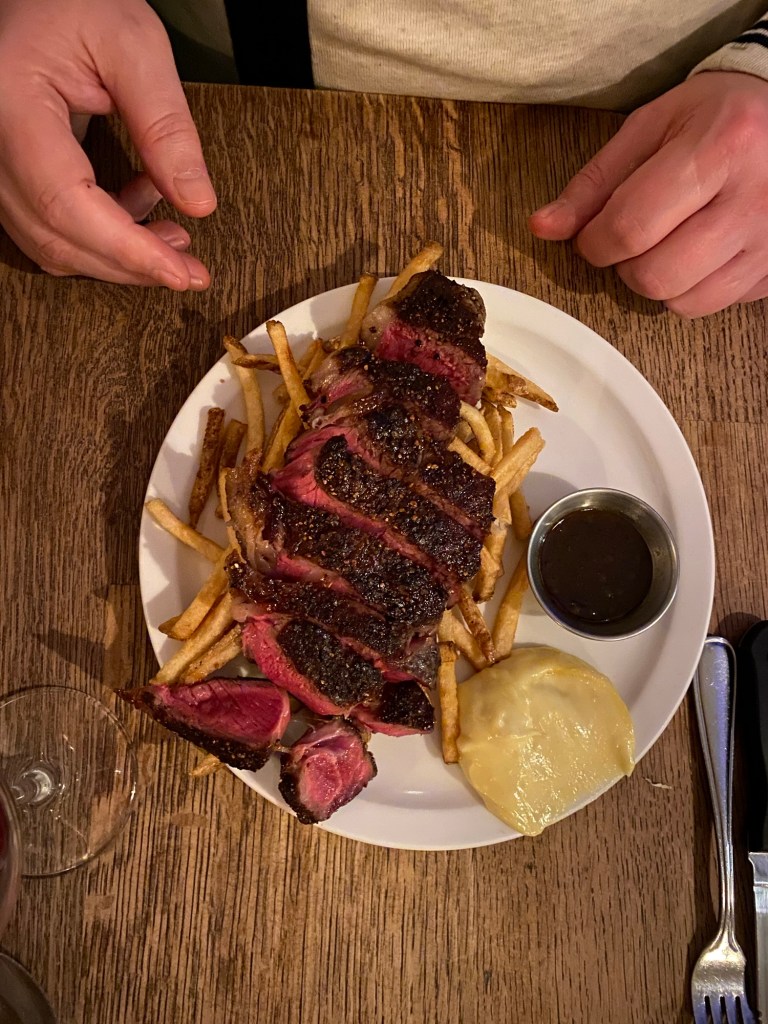
I love steak frites.  While it’s always good wherever I get it, my favorite place to order it from is Cote de Boeuf in Toronto, where it was delicious and affordable.

I was somewhat shocked recently by the price of steak frites there. The Cote de Boeuf menu above was from Nov 27, 2021. A bit pricey but not bad. Two and a half years later, their steak frites will now set you back 47 bucks (up 34%), while the next highest price cut is a 12oz ribeye at 69 (32% increase). The cote de boeuf has gone up to 168 (only 12%). 

At first I wanted to blame influencers for the price increases, since a) I don’t like influencers and b) I have seen many of them posting about how good this place is.  (That it is the best place for steak frites in Toronto is not just my opinion.) My prejudice was confirmed recently when I walked by and there was a lineup even with their patio open. One thing I loved about the place in the past was the relative ease of getting a spot inside even without the patio. I figured this demand was driving up the price.

However I went through the list of places in that blogTO post and I noticed that some of them charge the same if not more than Cote de Boeuf. Now, much depends on the size and cut of meat. Le Select Bistro offers an 8 oz striploin version for $49 and a 12 oz version for $70! Compare that to the current 10 oz striploin at Cote de Boeuf  for $47 and you are getting a better deal. Then again, Jules Bistro offers a 6 oz striploin for only $26.95., and the Ace offers a 10 oz hanger steak for $40. Le Paradis offers a flatiron steak of unknown size for $30.

I know the price of beef is going up and that is no doubt driving some of the cost increases. But I also suspect steak frites has become a more popular dish, and the demand for it is allowing restaurants to make it a more central and more expensive option.

I found another menu of Cote de Boeuf from February 2019 and steak frites was $28 then. No size mentioned, and it was listed as butchers cut (no doubt so the butcher could decide what was best to serve based on availability, etc.). Also there were seven mains then and duck confit was $29 ($1 more then vs $5 less now). Once the pandemic hit, restaurants trimmed back their menu options and no doubt have gone with their most popular items.

The whole trend makes me somewhat sad. I was never a fan of steakhouses with their exorbitant prices. I preferred a simple dish of steak frites preferably made with an unusual cut of beef like hanger or bavette. Good quality and not too expensive. It was like a burger and fries but for older people like me. I suspect those days are over.

Ah well. 

As something of a consolation, I see more and more places slipping good quality pork chops and fries on their menus recently. Mostly priced well below the steak frites. Perhaps that will be my go to the next time I hit up a bistro style restaurant. 

P.S. Here I am enjoying the last steak frites I had at Cote de Boeuf. Pure perfection.

P.S.S. If you want to make your own steak frites at home, here’s a recipe to get you started. If you want a peppercorn sauce to go with it, click here.

On futzing around with code

An example of a Prolog program

I was futzing around with code the other day. I wrote some html/css/javascript and then I wrote some unrelated prolog code. None of it had any value. The code didn’t solve some important problem. Some might consider it a waste of time.

But it wasn’t a waste. In both cases, I learned skills I didn’t have until I wrote the code. Those skills have value for the next time I do have to solve an important problem. Besides that, I enjoyed myself while coding. I was proud of myself for getting the code to work. That enjoyment and pride have value too.

Futzing around is a form of play, and any form of play is good for us as humans. Remember that the next time you consider taking on seemingly useless activities.


Just Be It. Or what the inclusiveness of marathon running taught me about writing, art and other activities

If you train for a marathon and you run it in a big city, chances are you will be in the same race — not run, but race — as world class runners. You will not win of course, but you will be included. That’s what is great about marathon running: you are as much a marathon runner / racer as someone hoping to be in the Olympics. It is inclusive.

Nike is a company that also supports inclusiveness, not just for running but for athleticism in general. They like to say: “if you have a body, you are an athlete”. It doesn’t get more inclusive than that.

I think such inclusiveness should be seen in the art world. If you create, you are an artist. If you write, you are a writer. If you’re writing poetry, you are a poet. Taking photos: a photographer. Thinking about the meaning of life: a philosopher.

Maybe your art is not going to bring you fame or fortune. Your running might not either. But if you are out there running or cycling or skiing or whatever you do, you are an athlete. The same should be true of writing or painting or photographing: you are an artist. Don’t let others exclude you from the group; don’t let others discourage you and get you to stop doing the thing you want to do. You’re as much a part of it as the people up front. Put on those running shoes, pick up that camera, that pen, that brush, and be the thing you are.

The Joy of the Pasture in Downtown Toronto

One of my favorite works of art in Toronto is The Pasture: nine bronze cows lying restfully on a field of grass. If it was located in another section of Toronto,  might be less remarkable. But being in the heart of the financial district and all it represents, there is a superb tension between the cows in their field and the people in their offices. In the offices people are working hard, stressed, standing and walking. The cows are doing none of that. 

If you ever in downtown Toronto near the Toronto Dominion center, I recommend you check out this fine work of art. It is an oasis of calm.

P.S. I remember when this sculpture first went in, for I was working at IBM and this sculpture went in right around when the IBM Tower on Wellington was established.

Instacart recipes have a secret ingredient: AI. What cooks should know.

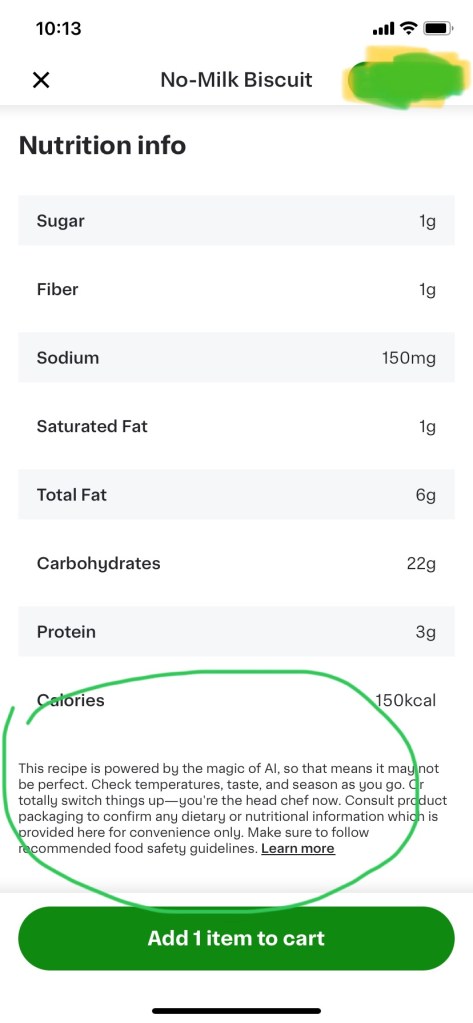
One convenient feature of Instacart is a listing of “Related recipes” it will provide you if you are searching for a product or ingredient. For instance, I was searching for “biscuits” and one of the recipes that appeared to me was no-milk biscuits. Hmmmm, that could be good and simple, I thought. Seemed reasonable too. Then I scrolled down the bottom to the recipe and came across the text: this recipe is powered by the magic of AI.

First off, let me say: AI is not magic. Second, this COULD be a good recipe. Or it could be something where AI hallucinated ingredients or quantities. For this recipe, it is somewhat close to this recipe for dairy free biscuits at allRecipes.com, but it is missing some ingredients and the quantities of some of the ingredients are different. I searched other recipes at other sites, and while it is close to them, it seems…lacking…in comparison.

Simply put: you would be better off getting recipes from either reputable cookbooks or websites where recipes are tested and confirmed. It is convenient to use the recipes in places like Instacart, because you can easily add the ingredients of the recipe to your shopping cart, but the results from the recipes generated by AI could leave you very disappointed. Especially when it comes to baking!

P.S. Not to pick just on Instacart: I suspect we are going to see more and more of this type of AI generated advice on websites. Keep an eye out for it.