Is there any cocktail abused more than the martini?

It must be the glass, because no cocktail is abused more than the martini. If you make up a cocktail and put it in an old fashioned/whisky glass or even a Nick and Nora glass, it will only get so much attention. But that changes when you put it in a martini glass. Suddenly you have the drink du jour.

I thought of that when I read this in the New York Times: How Much Dirtier Can the Dirty Martini Get? I am not a fan of a dirty martini or really any drink with “-tini” added to the end of it. Ugh. I’ve had enough dirty martinis to know that they are a terrible drink. I honestly am happy to let people drink whatever concoction a bartender can make, but I draw the line at those.

As for me, I’d recommend a straightforward wet martini. Other slight variations of that are fine, including the 50/50 martini  and even a freezer martini. But dirty martinis? No thanks.

A simple trick to keep up with pop music culture as you get older

A simple trick to keep up with pop music culture as you get older is to use Spotify Stats. Simply go to Spotify’s Top 100 artists and look for this: their monthly listener stats equals their peak listener stats. If you see that and you don’t recognize who they are, chances are they are an upcoming band/performer. Go learn about them: you are now cool again! 🙂

There is a chance that you will see a well known artist will also have their monthly listener stats equal to their peak listener stats. For example I recently saw Michael Jackson and Lana del Rey do this. I googled them both and found out that Lana del Rey has lots going on (new record, maybe doing James Bond), so it’s not surprising that her numbers are spiking. As for Michael Jackson? Think Halloween.

P.S. This is not serious advice, but it is not totally wrong either. 🙂

On Churchill’s Daily Alcohol Consumption

It’s no secret that Churchill drank a lot of alcohol, both daily and in his lifetime. Based on recent social media videos where young men try to drink like Churchill for a day, I think the latest generation is learning about it.

Despite some Churchill supporters downplaying his consumption, he was an epic drinker. He drank continually throughout the day, from watery scotches in the morning to snifters of cognac at night. A typical day looked like this (according to his supporters no less):

(1) Several whisky and sodas (less than an ounce of whisky) around 11am, teatime and bedtime and occasionally one other during the evening. (He never drank whisky neat.)

(2) An imperial pint (20 oz.) of champagne or wine at a 1pm lunch followed by a brandy, also likely an ounce.

(3) An imperial pint of champagne or wine at dinner followed by a brandy.

This translates into approximately six glasses (1½ 750 ml. bottles) of champagne or wine daily along with 5 to 6 ounces of whisky or brandy spread over a 12 to 15 hour period.

Whew.

It took years and years for Churchill to develop a tolerance for that much alcohol consumption: it’s not surprising that young men who experiment with drinking that much in a day fail to accomplish it. I wouldn’t recommend that for anyone.

P.S. For more on people trying to drink like Churchill, see this. For more on Churchill and his lifestyle, I highly recommend No More Champagne: Churchill and His Money by David Lough. I also recommend that piece from his supporters, The Myth of Churchill and Alcohol: A Distortion of the Record. It’s remarkable the lengths they go to downplay his drinking.

On the recent AWS outage of October 2025

Looks like AWS just published their post-mortem of their big outage this week: you can find it here.

For a lay person, this explanation might suffice.

CNN also has a good synopsis that includes other recent major outages and asks: why does this keep happening?

I think it is safe to say that we will see more of these major outages in this decade. So keep good backups, among other precautions. 🙂

McRib lovers! Here’s how you can have a McRib any time

If you are a McRib lover like me, you know how hard it is to get the McRib. Really really hard. Heck, people have built websites just to track them worldwide! And even when they do show up — finally! —  it’s for a limited time. What’s a person to do if you want to eat them more frequently?

I have a simple suggestion. First, get yourself some pickles, some chopped raw onions, and a sub bun like the one for the McRib (pictures are everywhere on the Internet if you need a reference). Then go to your national grocer (e.g., Loblaws, or my choice Walmart) and look for a box of BBQ pork back ribs. Cook the ribs as recommended on the box. Then take them out of the oven and while it is cooling a bit, assemble your sandwich. For the ribs, chop the meat off the bone and add it to the rest of the sandwich. Voila! You have a very good McRib like sandwich! You might be skeptical, but honestly you’ll feel like you’re sitting in your local McDonald’s eating one of their  McRib sandwiches.

I have not tried it with various boxed BBQ ribs, but Walmart’s Great Value Barbecue Pork Back Ribs resemble the saucy pork meat in the McRib to a very high degree. I say this as someone who has been eating McRibs for years and years. And even if it doesn’t quite match your expectations, you get a good tradeoff in that you can have these every day if you want.

Give it a try. Anytime you want. You’ll be glad you did.

P.S. For more on my McRib writing — hey, I love them! — check these out.

P.S.S. Obviously you need the Barbecue Pork Back Ribs, and not other kinds like the Honey Garlic Ribs if you want to make a sandwich like the McRib. But you could make some pretty amazing sandwiches by playing around with the ingredients and the flavoring of the ribs. Honey Garlic ribs on a bun with cilantro, pickled veg and hot sauce could make something like a bahn mi sandwich. Or the BBQ ribs with ham and pickles and swiss cheese and mustard could make something like a Cuban. Really so many ways to make a great sandwich with these ribs on a bun.

On my recent vibe coding experiences building a web site and a spotify app using Copilot and Claude, October 2025. Here’s what I did and what I learned.

Computer and code

I recently took a vibe coding approach to try and do two things:

  1. build a simple web site / blog using Microsoft Copilot
  2. write an app to extract information from Spotify using Claude from Anthropic.

Why? For some time I had these two projects in mind:

  1. Go back to the days when a blog — web log — was nothing more than a simple html page.
  2. Programatically built Spotify music playlists vs doing it in the Spotify app.

My main constraint was do it quickly: it was meant to be fun. So don’t spend all weekend getting up to speed on APIs and HTML and CSS: just see what I could do aided by A.I.

First up, to build the web site, I started with Microsoft’s A.I. Since I had some requirements of what I wanted the web log to look like, I told them to Copilot and had it built me the one page blog web site. It helps to be clear on your requirements, but I found that I only needed a few of them to start with. As I went along, new requirements would come to me (e.g. the ability to add photos from the Internet) and I would tell Copilot to now incorporate these new requirements and give me a new web site. My experience vibe coding is that there is a lot of back and forth in order to be effective. As well, there were things that I could just manually do by hand, like add a background tile and change the picture on the header, so I eventually I bailed on using Copilot and finished it by hand. You can see the result here. It’s just what I wanted.

What makes things better was that I asked Copilot to write me a python program which would allow me to easily add to the blog and then push it to AWS. That was a great new addition. Now I can just enter a line on the command line and the blog gets updated.

All in all a very successful project.

As for my Second project with Spotify, I switched from Microsoft to Anthropic. At first Claude produced great code: I asked it to build me a UI that allowed me to type in the name of three songs and then take these songs, use Spotify to build me a playlist built around those songs and lo and behold it did. Things went downhill from there. Much of the code, while long, had numerous errors. I would provide the errors to Claude and it would correct things. The code did get better, but after 30 versions, it was time to call it quits. Instead I took small chunks of the code and using VS Code, manually tried to determine why it was not working. I was able to ultimately nail it down to one Spotify API call. And why wasn’t it working? Because Spotify disabled access to it in 2024. Did Claude know that? I don’t know. It certainly didn’t act like it.

All in all a very unsuccessful project.

What did I learn for this? What would I recommend to you?

  • I have been most successful vibe coding when I get the AI to code in small chunks. Give it small requirements and see if it can successfully do them. Then build up the chunks. That was the case in Copilot. With Claude I took the big bang approach, and then spent lots of time debugging. Eventually to discover the problem, I went to the small chunk approach manually.
  • A.I. is great for grunt level coding. Writing python code to loop through input and extract data under complicated conditions is something I hate to do. A.I. does it better and quicker than me. Again, it’s like using a mixer in the kitchen instead of your arm. It’s impressive to do things with your arm, but the mixer is fine.
  • A.I. is great for fussy coding. One thing I like about coding HTML and CSS using A.I. is I do not have to remember how to get the divs done and which CSS code I do for certain colors, etc. I just tell the A.I. and it does it.
  • A.I. has replaced my templates. I used to have a fair amount of code templates, and when I would start a project, I would get out a good template. When I didn’t have a template, I would often times spend hours going through old code trying to find an example to use as a template. Now I just get A.I. to give it to me.
  • Know when to bail on using A.I. and start doing the work yourself. I think of A.I. as a power tool: it let’s you do things fast, but for the detail work, you need to get in there with the hand tools and do things manually.
  • Make LOTS of backups. Backup your prompts too if you can. I have gone down a certain path in vibe coding, forget to do a backup, and it’s been a mess. As well, at times the A.I. will start to produce bad code. If you version control things, you can go back to a copy from an hour ago that did work and start again.
  • Most LLMs do a pretty good job of coding. I’d recommend Copilot because it is easy: it’s integrated into my Microsoft tools. The results from Claude were good too. I suspect as things advance, the code that comes out of all of them will get better and better.
  • I am not afraid of forgetting how to program in python or html any more than I was afraid of forgetting how to program in assembler when I moved on to C. Os using SQL to work with data rather than hand coding PL/1 code to do things. Or using Java and JDBC. The goal for me is to get my results via some form of coding, and if I can achieve that faster with a higher level of code combined with greater abstraction, I am fine with that.
  • The better you already are at coding, the better your chances of success. I have never had A.I. completely build my code. I get to 80-90%, then do the rest by hand. I am fine with that: I literally save hours every time I do this vs my old approach of using templates and old source code. If you have to depend on A.I. to do 100% of the coding, I suspect you will have more chances of failure. Also, if the code runs successfully with some inputs but fails with other inputs, having debugging skills will make a difference.
  • YMMV. These are my experiences based on these projects. Your experience using A.I. to assist with coding your project may be wildly different than mine. I do hope you have a good/better experience.

Thanks for reading this. I hope it helps.

P.S. When I talk of vibe coding, I am using the definition used by my current employer. The opinions expressed above are mine only and not necessarily those of my employer.

 

If your playlists are getting stale and your listening habits are diminishing….


If your playlists are getting stale and your listening habits are diminishing, it’s time for some new things to listen to. Perhaps listening to the best independent and community radio stations in the US could help. If you agree, check out LDial.

Besides being a great source of independent listening pleasure, it’s also a really good web site. Check it out.

P.S. The author of the site writes about the design, here. Smart stuff.

How AI created a new Time Zone for Cape Breton, and other stories of out East

I like to collect stories of where I was born and raised and the surrounding areas, which in this case is Cape Breton, a very special place. Perhaps not as special as Newfoundland, which has it’s own time zone. Or maybe it is as special as Newfoundland. Turns out when you ask Google if Cape Breton has it’s own time zone, it thinks it does! More on that story, here: No, Meta and Google, Cape Breton doesn’t have its own time zone.

Cape Breton may not have it’s own time zone, but it does have it’s own university. Alas, Cape Breton University faces budget cuts up to $20M due to international student cap. That’s grim.

There’s housing crises everywhere these days, and Nova Scotia is no exception. Reading these two statistics from Stats Canada, 1) 3 in 10 residential property buyers in N.S. were investors in 2018-2020: StatsCan and 2) More than 65% of Nova Scotians experienced a housing challenge in the past year: StatsCan, I am reminded that one of the things driving up the cost of housing is investors, which makes it hard for the less well off to afford homes.  The fact that the NSLC has seen a 55% increase in thefts compared to last year tells me also that people are struggling financially in my home province.

Speaking of Maritime crime of a different kind, Bell says a subsea cable from Cape Breton to Newfoundland was deliberately cut — twice. This is the type of Maritime crime story that can only occur in that part of Canada: Father and son face charges in southwest N.S. lobster-buying intimidation case.

I found this story made me laugh and also shake my head: Changes to Glace Bay street will create more downtown parking, says councillor. There is a massive free parking lot behind the shops in downtown Glace Bay. The fact that some people think somehow that street parking will somehow cause people to suddenly shop more is bonkers to me.

In better news, this great maritime TV show has just celebrated 60 Years of being on the air. Yes, I speak of Land & Sea. I love that show.

The great Nova Scotia artist Tom Forrestall died recently at age 88. R.I.P, Tom.

Finally, this was a story about Cape Breton I did not know about: When Japanese vehicles were assembled in Cape Breton.

My dream of working from home started with this ad for IBM and Coppola’s Thinkpad (publish those visions you have)

The computer above, and the ad it is, came out in the mid 90s.

It was possible to work from home then, but it was not easy. I used to have a luggable computer that weighed 40 pounds and which I would …lug… home every day one summer to work from home. What I dreamed for, though, was to work from home with a small laptop like Coppola’s. A laptop where I could work from home daily, be it at a desk or in a beautiful kitchen like the one above.

It eventually happened. The laptops got better, the networks got better, and eventually the work cultures got better and I could do this. My kitchen wasn’t as nice, but everything else was nice.

Creative people, keep putting out your visions for a better world. You never know what dreams people will have. It might be as simple as a dream of working on a laptop in a kitchen. A dream that becomes more achievable once people can envision it.

How to get started with High-Intensity Interval Training (HIIT) by building your own customized workout courtesy of me and the New York Times

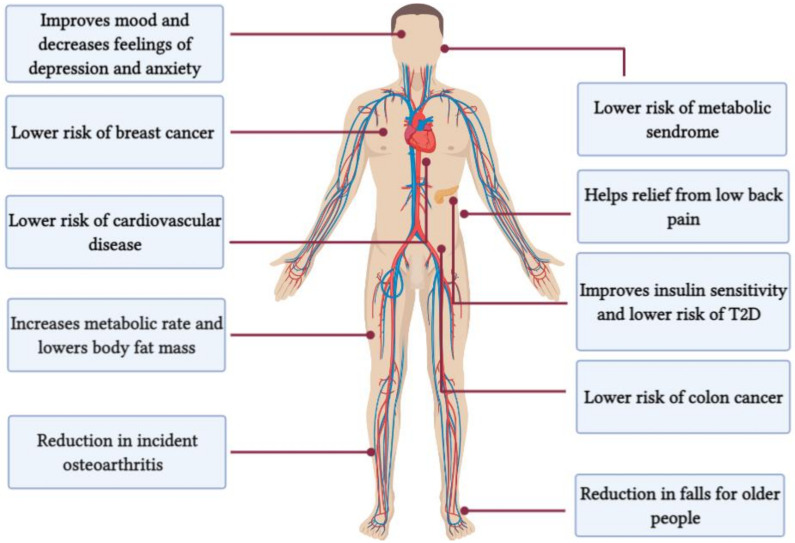
You can find lots of evidence of how HIIT is good for you. Here, for example, which is where the diagram comes from. Or you can search on “HIIT benefits” and find countless examples of how it works and how it helps.

Even if you are convinced (or even curious) about achieving those benefits by doing HIIT, you may be put off by some of the training routines you find online. (I know I was….too difficult, I thought.)

Well, be put off no more. Instead, go to this gift link for the New York Times and learn how you can build your own achievable HIIT routine.

Some of the benefits of building your own routine are:

  • you can pick exercises that focus on certain areas (e.g. your core)
  • you can avoid exercises that might not be suitable for you or that you might hate (e.g. burpees)
  • there are enough different exercises that you should have no problem in putting together your own HIIT routine.
  • You can pick different ways of going hard and taking a break.

Sounds good? I think so. Next step: go to the gift link and find out more.

The Bitter Southerner has the apparel for the times we live in


I’ve written about The Bitter Southerner before and the wonderful apparel they sell. The t shirts I mentioned then were mostly about food. While I love those shirts, I’d be remiss if I didn’t mention their political apparel line too. You can find it, here.

While I may disagree on the idea that everything is political — I wrote about that, here — I do support the message on most of their shirts. Go check them out (and the rest of their merchandise as well).

Remember:

On reducing the idea of wellness down to 3 or 4 principles

On Bluesky someone asked the question:

If you had to reduce your own idea of wellness down to just 3 or 4 principles, what would they be?

One person answered:

1. Stretch 2. Drink Water 3. Squats

A good list.

I had a meta list:

1. Make a list of things that make you feel unwell. 2.List the opposite of those things. 3.Do more of 2 and less of 1.

I think wellness is not necessarily the equivalent of fitness. So you may exercise a lot, but if you may find that not sleeping enough, not resting enough, and too much work is making you feel unwell. If so, I think your wellness list should be: sleep more, get more rest, cut back on work. I’d still recommend you stay fit, but to move from being fit to being well, you need to do more than exercise.


The arts on Wednesday: from VanGogh to Roz Chast, with some Morandi mixed in

I’m always collecting essays and otherwise on artists, and this last three months was no exception. For instance: