Venus if you will (What I find interesting in math and science, May 2025)


Venus

Here’s a number of pieces I’ve gathered in the last few months related to science and math that I found worth sharing. A few of them require deeper knowledge on the topic, but many of them are suitable for anyone to read.

in the area of space and astronomy:

Moving on to biology:

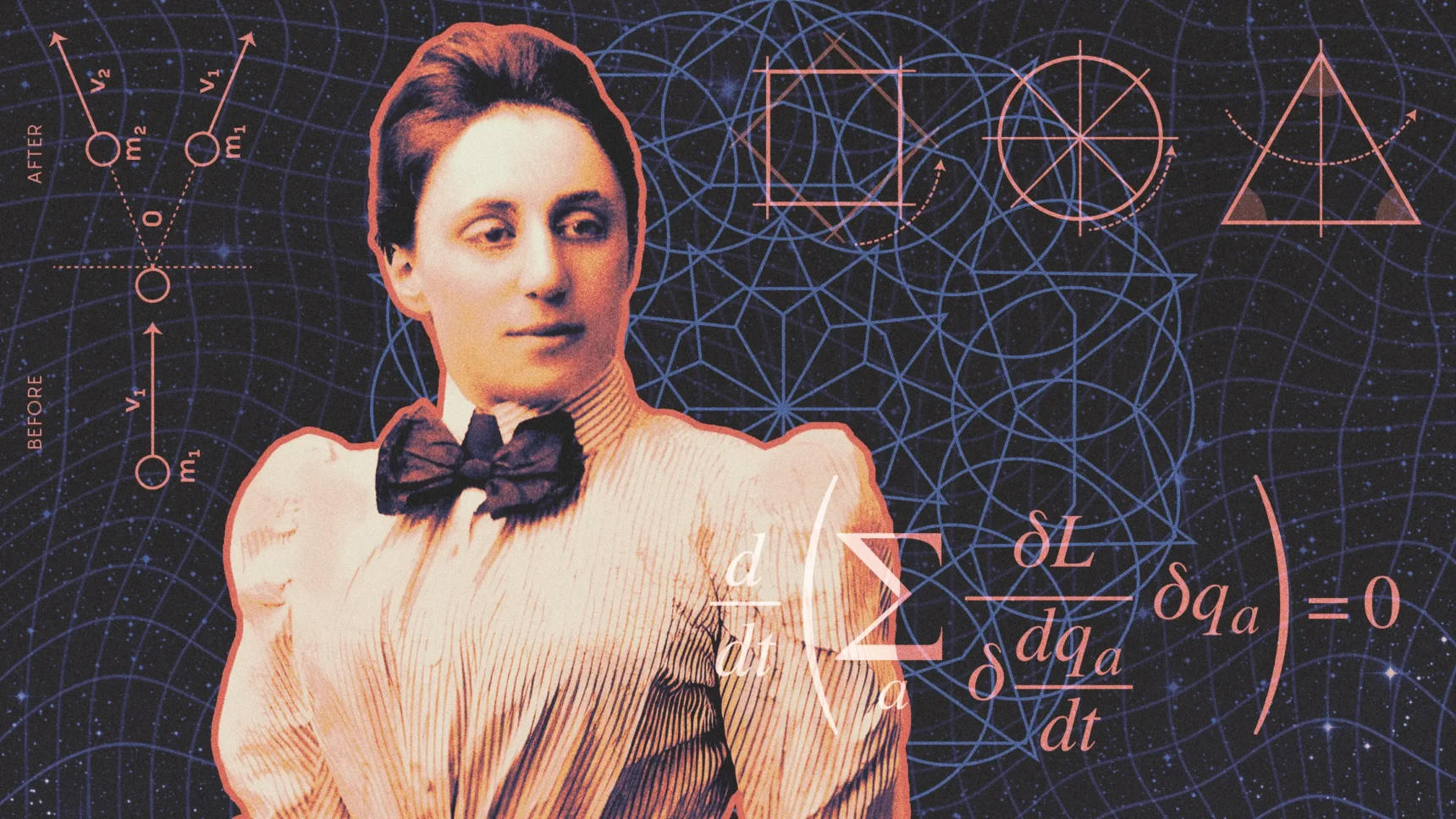
Emmy Noether

Regarding mathematics, physics and more:

(Photos – Venus, seen by NASA’s Mariner 10 spacecraft in 1974.Credit: NASA and Emmy Noether Credit: Kristina Armitage/Quanta Magazine)

Race to the moon! (What I find interesting in math and science, November 2023)

Space: Well there has been plenty of space missions in the last while.

India has made great progress with their space missions, including successfully landing on the moon. The New Times has a piece on their moon launch here. It’s an exciting development! You can read more on it here and here. And India is not just going to the moon: they have mission going to the center of the solar system. Great to see all this activity.

Unlike India, Russia has been less successful, with their spaceship crashing on the moon. More on that, here. Space is hard.

Meanwhile,  Japan is aspiring to be doing work on the moon, too. More on the all the participants in the moon race here.

As for private space exploration, the Times has a piece on an alternative group to SpaceX that are making progress here. Good: we need an alternative to Musk’s company. Speaking of alternatives, here’s more on  Virgin Galatic’s recent progress. And this asks the question: How long will Jeff Bezos continue to subsidize his New Shepard rocket? Maybe if NASA goes with this new way of doing  moon missions with his Blue Origin organization. 

In other space news, here’s something on the new crew for the space station. This is a new theory on galaxy mergers that could shed light on how galaxies evolve.

Other things on space that I loved was this piece:  Our Galaxy Is Home to Trillions of Worlds Gone Rogue. Also this dazzling view of the Milky Way from southern Africa. I love this too:  Microsoft has an introduction to Python programming by taking on assignments inspired by NASA scientists to prepare you for a career in space exploration. A great collaboration.

Here’s some less than loveable space story I read. For instance, this is bad:  Space junk is on the rise, and no one is in charge of cleaning it up. More on that, here. Also not good: what a long term mission in space does to the human body.

Physics: this is a good explainer on quantum entanglement. Relatedly, if you thought quantum mechanics was weird , check out entangled time.

Here’s something on a study combining continuum mechanics with Einstein’s field equations. Worthwhile.

last but not least, if you want to learn or relearn physics, then head over to Susan Rigetti (nee Fowler)’s great site, here.

Math: three good math pieces: 1) a good introduction on lagrangian-mechanics 2) something I liked on Multivariate calculus 3) Also this on mutlivarable calculus.

Biology: I thought this, on our golden age of medicine was good. As was this piece on newly detailed nerve links between brain and other organs  and how it shapes thoughts and memories.

How to use the universe as an instrument to do science experiments

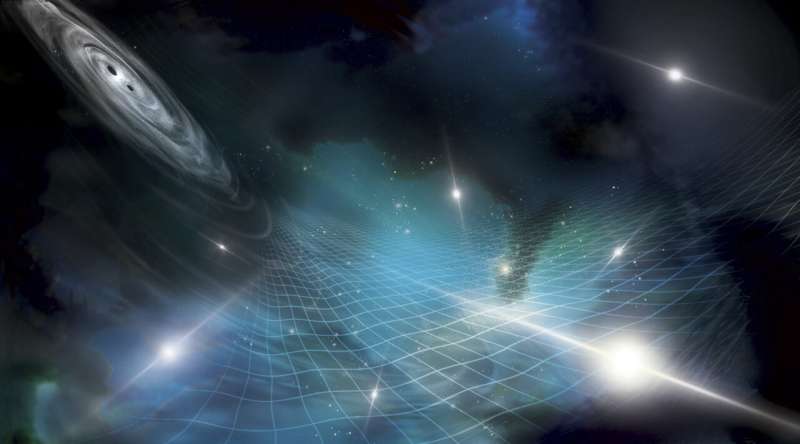
If you’ve been reading the news lately, you may have heard about NANOgrav and the work they were doing. If you missed it or forgot:
Scientists have observed for the first time the faint ripples caused by the motion of black holes that are gently stretching and squeezing everything in the universe.

They reported Wednesday that they were able to “hear” what are called low-frequency gravitational waves—changes in the fabric of the universe that are created by huge objects moving around and colliding in space.

How did they do that? Well:

No instruments on Earth could capture the ripples from these giants. So “we had to build a detector that was roughly the size of the galaxy,” said NANOGrav researcher Michael Lam of the SETI Institute.

The results released this week included 15 years of data from NANOGrav, which has been using telescopes across North America to search for the waves. Other teams of gravitational wave hunters around the world also published studies, including in Europe, India, China and Australia.

The scientists pointed telescopes at dead stars called pulsars, which send out flashes of radio waves as they spin around in space like lighthouses.

These bursts are so regular that scientists know exactly when the radio waves are supposed to arrive on our planet—”like a perfectly regular clock ticking away far out in space,” said NANOGrav member Sarah Vigeland, an astrophysicist at the University of Wisconsin-Milwaukee. But as gravitational waves warp the fabric of spacetime, they actually change the distance between Earth and these pulsars, throwing off that steady beat.

By analyzing tiny changes in the ticking rate across different pulsars—with some pulses coming slightly early and others coming late—scientists could tell that gravitational waves were passing through.

The NANOGrav team monitored 68 pulsars across the sky using the Green Bank Telescope in West Virginia, the Arecibo telescope in Puerto Rico and the Very Large Array in New Mexico. Other teams found similar evidence from dozens of other pulsars, monitored with telescopes across the globe.

I think it’s great science. You can read more about it here (and it’s where the quotes above come from): Scientists have finally ‘heard’ the chorus of gravitational waves that ripple through the universe at phys.org.

Did you know this is not the first time scientists have used distant objects in space to do science? Indeed, as far back as 1676, Ole Rømer used eclipses of the Jovian moon Io to determine just how fast light moves. It was a brilliant experiment that you can read about, here.

Science is as a much a creative process as it is an analytical process, and I think it is brilliantly creative to use the universe as an instrument to add to our scientific knowledge.

P.S. you can actually measure the speed of light using a chocolate bar and a microwave. Really! See this fun video to see how:

Let us go to Enceladus! (What I find interesting in math and science, July 2023)


As always, there’s lots of exciting science things happening! The big news recently was the announcement by a group of science organizations, NANOGrav, about the existence of gravitational waves splashing, so to speak, all across the universe. You can read more about it, here. It’s a big friggin’ deal.

Space: Space exploration in general remains exciting overall. Part of that has to do with the incredible amount of missions on the go! China is a nation in a hurry when it comes to space exploration. Out on Mars, the rover they sent there has found signs of recent water in sand dunes. Closer to home, they’re doing lunar research with the Chang’e project. On top of that, they’ve successfully launched their latest mission to the Tiangong space station on Tuesday. Incredible. And good to see.

Not all space news is good. A private Japanese moon lander went into free-fall while trying to land on the lunar surface recently due to a software issue and a last-minute switch in the touchdown location.  More on that, here. I have no doubt we will see successful Japanese missions soon and on the regular.

In other news, the UAE is sending a mission to explore the debris field between Mars and Jupiter. More on that, here.

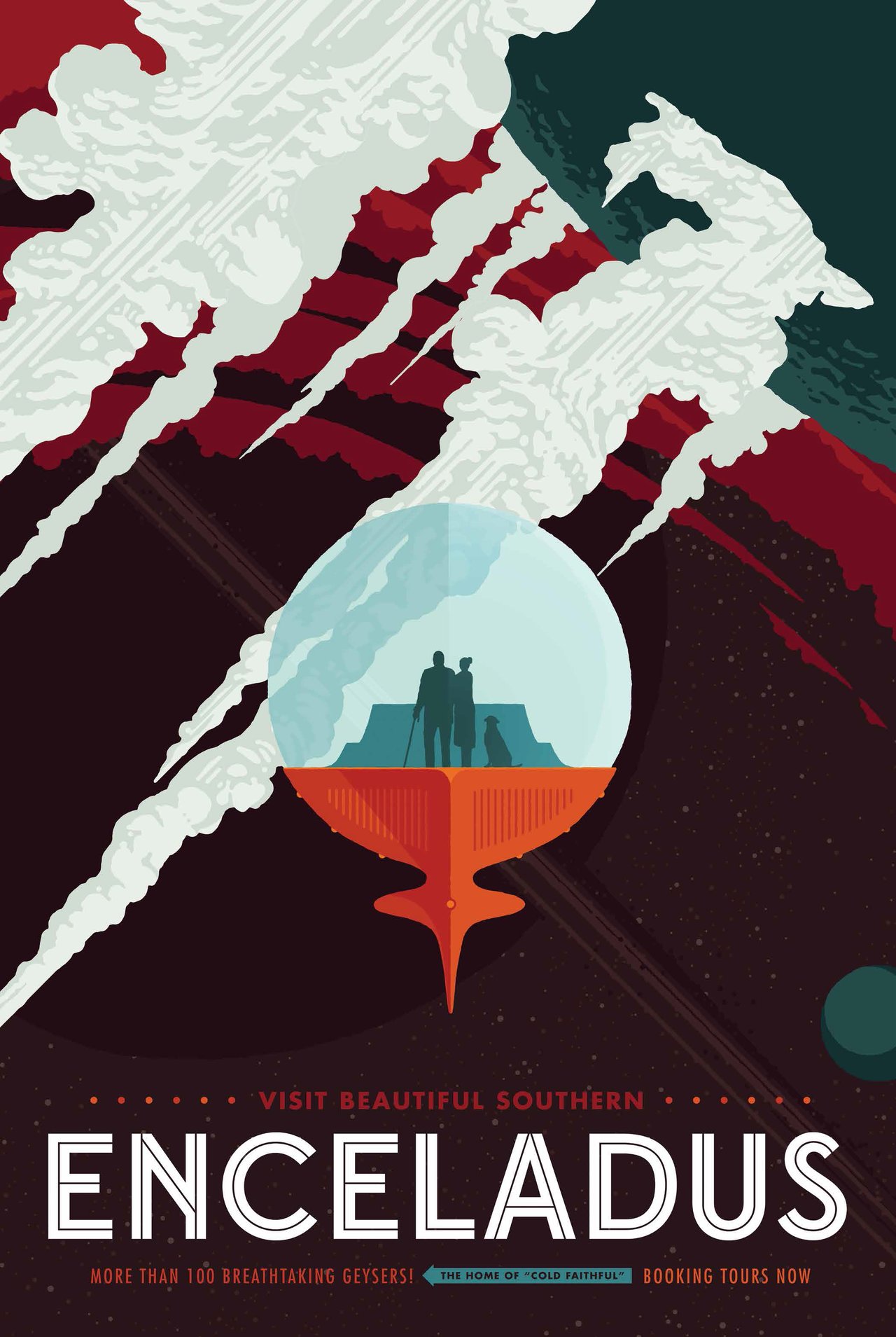
Of course American space work is ongoing. The  James Webb Space Telescope (JWST) spotted a towering plume of water vapor more than 6,000 miles long—roughly the distance from the U.S. to Japan—spewing from the surface of Saturn’s moon, Enceladus.  More on that, here.

Seeing all this space exploration, it may be time to make these  NASA visions of the future posters for real. (An example is the one for Enceladus, above.)

The billionaires are back at it too. Jeff Bezos’ rocket company is taking astronauts to the moon in 2029. Don’t screw it up, Jeff. More here. Not to be left out, Branson’s Virgin Galactic is going back to space after a 2 year hiatus, says this.

If you are feeling left out, know that you can get in on the action,  thanks to a new program launched by astronomers at the University of Arizona Lunar and Planetary Laboratory. You can help science by reading this and getting involved. 

Don’t hesitate. After all,we are all one GRB from being fried out of existence. In fact it almost happened.

Physics:  It was fun coming across the classic E & M text by Purcell and Morin. A great text book I had in university. For quantum fans, this is a good piece on how Einstein Podolsky Rosen paradox scales up.

Wanting to do your own physics experiment? Here’s how to demo special relativity for a $100 or less. Really! More on the science behind it, here and here. Muons are cool and you can be too if you do that.

Miscellany: I thought this on lagrangian mechanics for beginners was good. Relatedly, here’s something on Euler Lagrange.

Think you can’t do math? Read this: are all brains good at math?

This is some weird science: when flies see the corpses of other flies, they get depressed and die soon. Really!

This was a good piece on cancer and the nervous system. I liked how you can make better decisions by using science.

Also cool: what plants are saying about us.

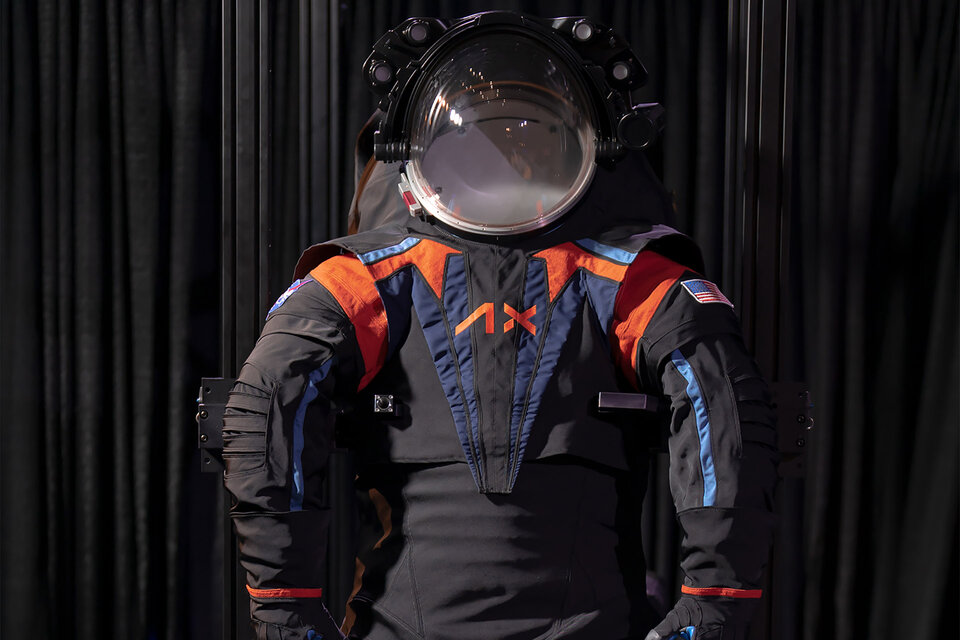
(Shown above, the  NASA artemis III spacesuit. More on it, here)

What’s new in space? Lots!

While space is very old, some things happening in space are very new. For example, the James Webb Telescope. After much planning, it was recently made operational and started to send back amazing photos (like the one above). You can see more of them at Colossal and the official site of the James Webb telescope. To give you a sense of how great the new telescope is, here’s a piece showing side by side images of the Hubble telescope with those from the James Webb . A dramatic improvement (and the Hubble images were still great).

In other good news, NASA is going back to the moon. I am very excited about this. In not so good news, Russia says it will quit the International Space Station after 2024. Let’s hope the Space Station can survive this form of fracture.

P.S. Not news at all, but here’s a “fun” study of asteroids hitting earth. Hey, it’s space related! 🙂

(Image: link to image in Collossal)


The occulation of Saturn is worth it

Someone posted this occultation of Saturn and I am taking a chance and sharing it on the blog because it’s too cool not to. (An occultation is an event that occurs when one object is hidden by another object that passes between it and the observer.)

I say “take a chance” because I have so many broken Youtube links on my blog, rendering many posts useless as a result. (Word of advice: don’t post Youtube links of songs or movies.) I’m hopeful this one will stay up.

On stopping the next Chelyabinsk Meteor

If you think of meteors hitting the Earth, you might be thinking of ones like the Chicxulub impactor that killed off the dinosaurs. Good news: scientists have been tracking meteors of that size and we are safe for at least the next few centuries.

But what about smaller ones, like the one that hit Chelyabinsk and caused significant damage? Those we may not be so safe from. Indeed, if they hit a major city, the destruction could be catastrophic.

That’s why NASA has launched the DART mission. It’s goal is to see if it could stop an asteroid and prevent an asteroid apocalypse. That piece in Scientific American on what is involved is fascinating. It’s not merely a matter of putting a major explosive on an asteroid and blowing it to bits. Go read the article and you’ll see what I mean.

For more on the. Chelyabinsk Meteor, click here.

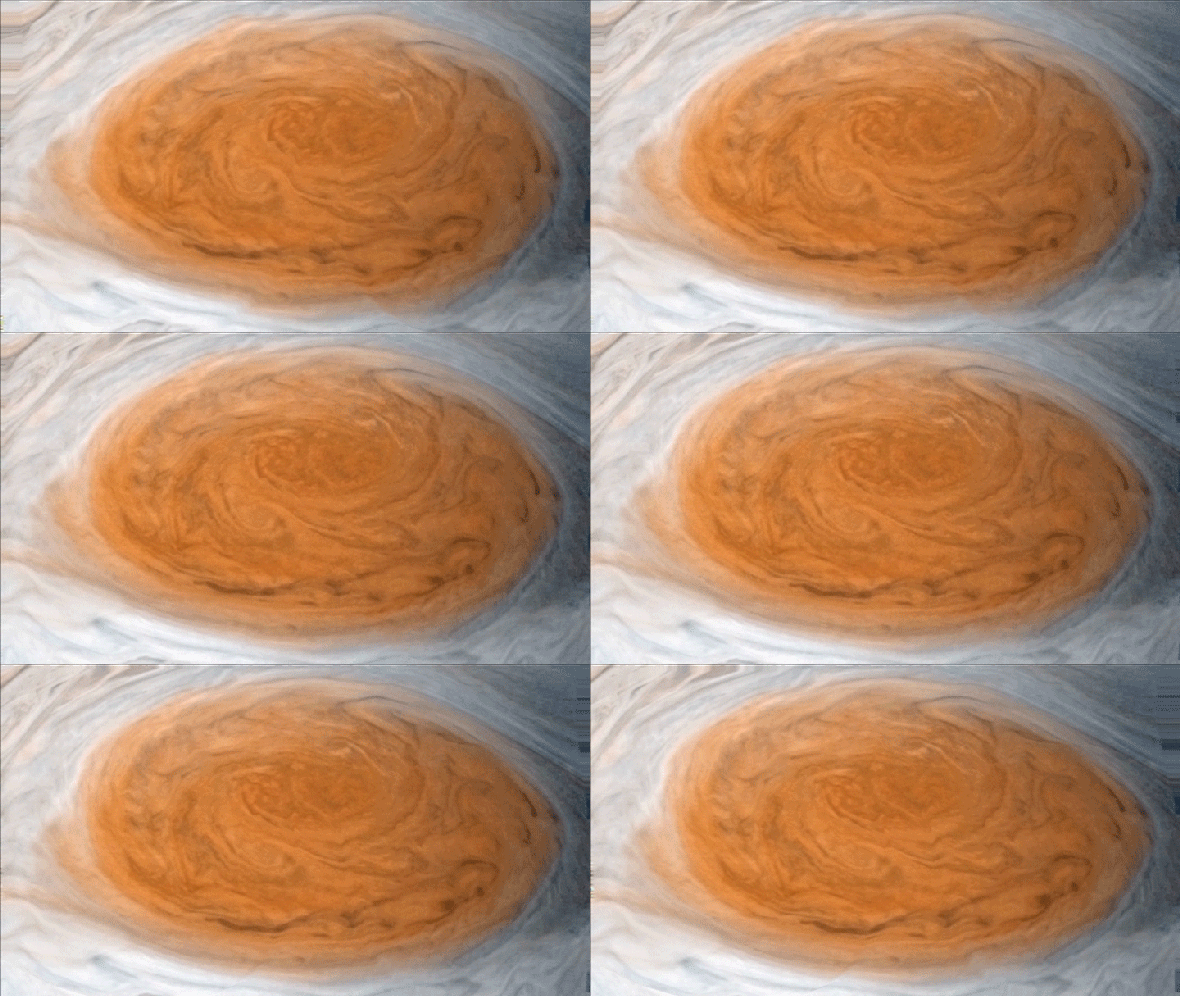
On exploring Jupiter’s Red Spot

Despite having telescopes being able to observe it, there’s still much to learn about the Great Red Spot of Jupiter. To do that, NASA sent a space craft to the giant planet to learn more about it. The story of that can be found here: Jupiter’s Great Red Spot Is Surprisingly Deep in Scientific American. It’s one of the many awesome things NASA has on the go in our solar system and beyond.


This is fascinating: maybe we can’t even land on Mars, never mind go there


It’s well known that Mars is going to be difficult for humans to get there. If you are like me, I figured once we got there, then we land just like we land on Earth or the moon. But what if we can’t? This article fom BBC Sky at Night Magazine raises a number of difficulties that arise from dropping things from space onto the Red Planet. Things that seem to be recently considered.

Going to Mars is not going to be a matter of jumping in a big rocket ship and blasting into space. It’s going to take a lot of time to figure everything out, including landing there. Read that piece and see why.

(Photo by Mike Kiev on Unsplash )

On the planet about to visit our solar system!

It’s true! A planet is going to make a fly by.  According to Kottke, the minor planet 2014 UN271  is about to visit our solar system. By 2031 it should be about as close to the sun as Saturn is!

I hope we can get some good views of it while it is in the area.

For more on it, see the Kottke article. He also has links to more pieces on it.

(Photo by Guillermo Ferla on Unsplash )

Solutions to the Fermi Paradox?

Fermi’s Paradox in a nutshell:

‘We’d estimate that there are 1 billion Earth-like planets and 100,000 intelligent civilizations in our galaxy.’ So there must be aliens. Why haven’t we heard from them?

If this fascinates you, check out this list of solutions to the Fermi Paradox.

You may not be convinced there is an answer to this problem, but for some, they will be.

(Image of Enrico Fermi from Wikimedia)

Three great pieces on Venus, the Milky Way, and black hole visualization

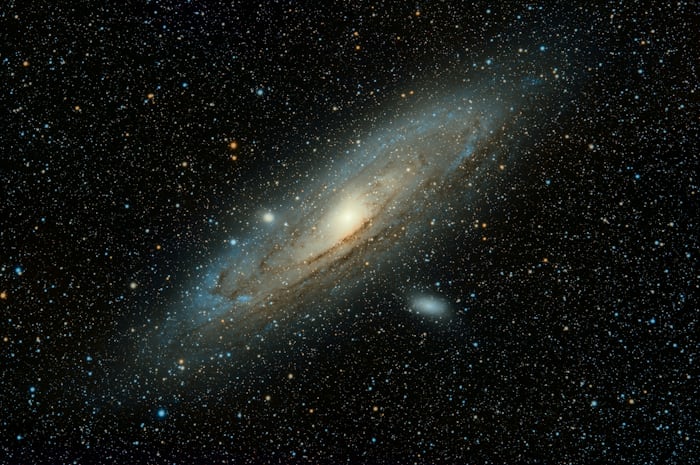
This piece on the Milky Way photographer of the year is filled with amazing photos of…well, you can guess. (One of the photos is above).
This is a good piece on the efforts to study Venus. It won’t be easy to do, but it will be rewarding.
Finally, this piece on how black holes are visualized is excellent.

In praise of amateurs, young and old

Are you an amateur? Do you sometimes feel you can never accomplish anything doing something you love? Then here’s three good stories on amateurs doing great things you want to read:

  1. High school students discover exoplanets during mentoring program 
  2. Decades-Old Graph Problem Yields to Amateur Mathematician
  3. How older amateur athletes are staying fit through the pandemic

Not all amateurs can accomplish great things, but never let anyone tell you that amateurs are incapable of great things. Because surely they are. Go on, pursue the thing you love. Great things may result.

(Photo by Jamie Street on Unsplash)

The worst technology failures of 2020, including one not considered a failure but could be the worst of all

This piece (Worst technology failures of 2020) by MIT Technology Review has a list of the bigger technology failures of 2020. Some of them, like Quibi and facial recognition abuses, are well known.

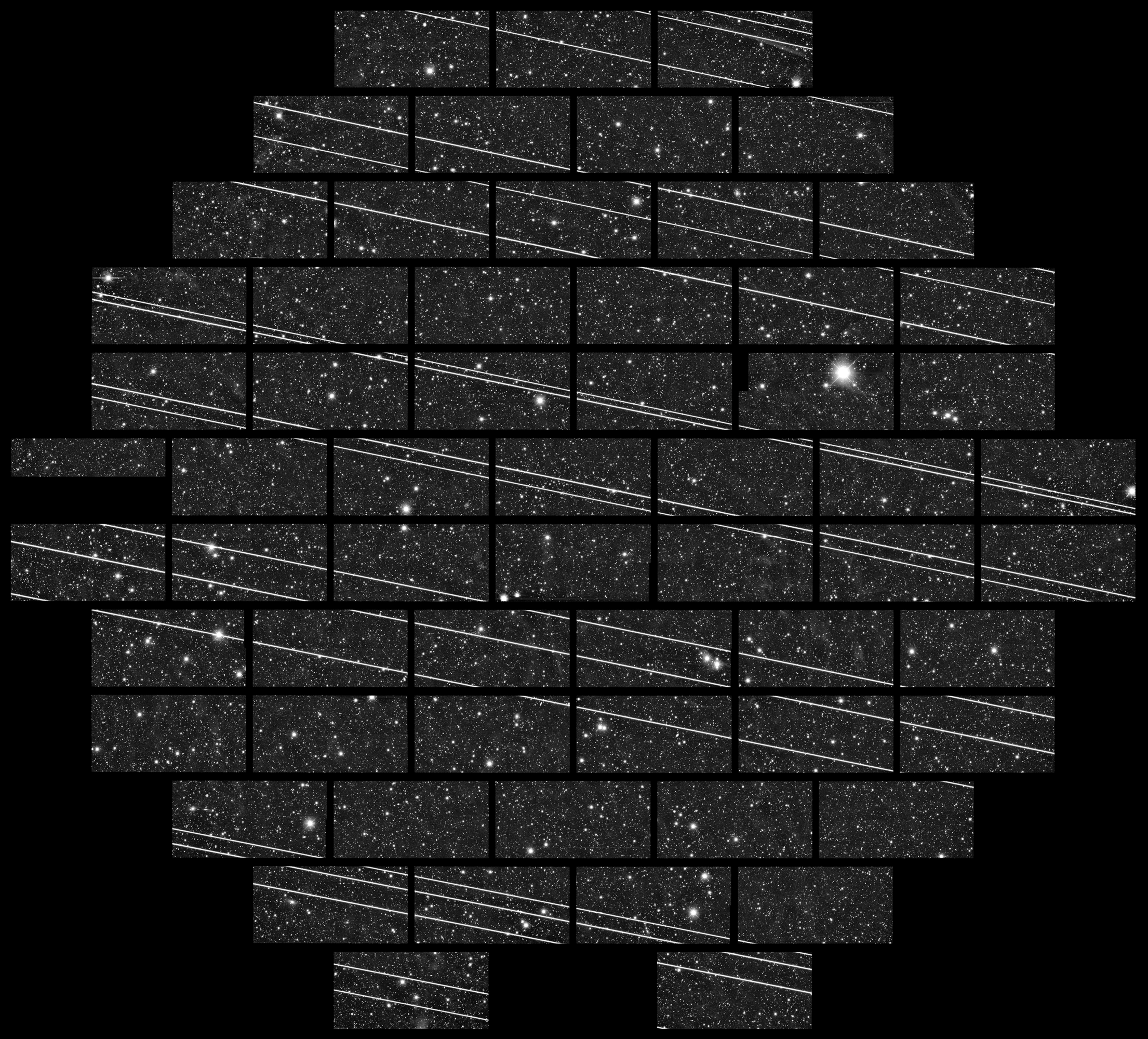
One listed here may be the greatest technology failure of them all, though for many it is not considered a failure at all. That is the unregulated pollution of space with tiny satellites. As the article states:

Since prehistory, humankind has looked upwards for awe and inspiration, to imagine what forces created the world—and which might end it. But now, that cosmic view is being contaminated with the reflections of thousands of inexpensive commercial satellites put aloft by companies like Amazon, OneWeb, and SpaceX, who want to cover the Earth with internet connections. Sixty satellites can swarm out of a single rocket.

To see what I mean, check out this picture from the article:

Telescope views from earth are being marred with the light of all these satellites. This is today’s problem. Tomorrow’s problem is going to be all the other pollution, light or otherwise, which is going to result from the rush to put things in space. Science is getting wrecked by this.

Already astronomers are thinking of putting telescopes on the dark side of the moon to escape such problems. But without regulation, who knows if even this will be successful? To hear Elon Musk yammer on, he’s just going to be throwing who knows what into space. He’s already launched one of his stupid cars into the atmosphere. Hardly the guy you can trust to be responsible when it comes to deciding what should go into space.

Here’s hoping that in the rush to do more and more space development (a good thing)  there is also an effort to make sure it is well thought and regulated (also a good thing).

The problem with colonizing other worlds…

The problems with colonizing other worlds can be read here:  Humans Will Never Colonize Mars.

It’s a bucket of ice water to dump on the head of anyone who optimistically thinks it will happen. It may happen, centuries from now.  More likely places like Mars will be colonized by robots that will do a lot of the activities we once expected humans to do.

A fine appreciation for Stephen Hawking can be found…


… here: Stephen Hawking Is Still Underrated – The Atlantic. 

I like this piece because it takes you into his science and what makes his work great without having you be an expert in the field yourself. You might still struggle with it, but it is a worthwhile struggle.

Rest in peace, Stephen Hawking. You may be gone, but the work you did lives on and will lead to more great work being done by other scientists that come after you.

SpaceX tries to disrupt and partner with NASA at the same time

It’s not explicitly stated, but if you read this: If you think NASA is frustrated with SpaceX, you’re probably right in Ars Technica, then you may draw the same conclusion. It seems SpaceX is taking advantage of its partnership with NASA to position itself to get the point where it can get by without it and eventually compete with the space agency.

If that was not the case, then I would expect SpaceX to stick to missions that were separate from NASA and supportive of NASA. Instead they seem to be trying to compete with NASA for the same missions.

It’s a tricky call for SpaceX: if they are not careful, they could ruin their partnership and find themselves without a steady source of income to fund their ambitions. I’m all for both NASA and SpaceX both being viable for the long term. Let’s hope that happens.

You too can be like Elon Musk (@elonmusk) and fund a lunar mission

Really. There is a kickstarter going on right now you can contribute to: LUNAR MISSION ONE: A new lunar mission for everyone. by Lunar Missions Ltd 

The team there says….

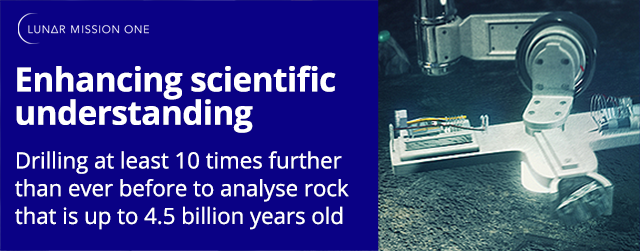
We plan to send an unmanned robotic landing module to the South Pole of the Moon – an area unexplored by previous missions.

We’re going to use pioneering technology to drill down to a depth of at least 20m – 10 times deeper than has ever been drilled before – and potentially as deep as 100m. By doing this, we will access lunar rock dating back up to 4.5 billion years to discover the geological composition of the Moon, the ancient relationship it shares with our planet and the effects of asteroid bombardment. Ultimately, the project will improve scientific understanding of the early solar system, the formation of our planet and the Moon, and the conditions that initiated life on Earth.

I think this is the most fantastic Internet project I have seen yet. I highly recommend you check it out.

Thanks to Kottke for pointing it out.