On Gilbert and George, their Southbank Centre show, and conservative artists

Untitled

Following up after the Richter, I also got to head over to London and see Gilbert and George: 21st Century Pictures at the Southbank Centre. You can get a sense of the show by reading what the Centre says here, but you really have to see their work in person to appreciate both the scale of it and the detail of it. (No matter if I got close or far back from a work, I was always losing something in my photographs, as you can see above.) So see it before it leaves on January 11th.

One thing the exhibit had me look into was the prominence of conservative or right wing artists. These two definitely qualify for that label. But other than someone like Clint Eastwood, I couldn’t think of other right wing artists who were influential.

It seems I just wasn’t paying attention. Reactionary artists are everywhere, based on this list here and here. Of all of them, though, these two English sculpturers (as they refer to themselves) are my favorite.

For more on Gilbert and George, I’ve found a number of other good pieces here and here and here and here. They’re living legends. I’m glad I got to see a major portion of their work at this Southbank Centre exhibit.

My guide on how to use Michelin Guides to causally dine

You may think of Michelin guides in terms of deciding the best places to dine in a particular city or place. That is one way to think of them. If you aim to eat in the finest of establishments, their guides to 2 and 3 star restaurants can help you there.

On the other hand, if you want have a relaxing meal that doesn’t cost too much, you can still use their guides. Here’s two ways to do that:

  1. Go to restaurants with Bib Gourmand awards. As Michelin says, these are places with good quality, good value cooking. That’s how I ended up eating recently at Bao in London. It was delicious and super inexpensive. Same goes for Brutto, which I stopped at on my previous visit. If you were visiting Toronto, you would do well to eat at such places as Sunny’s Chinese or Bar Raval, all places with Bib Gourmands. Same goes for Russ and Daughters and Katz’s in New York, to name just a few more places.
  2. Go with restaurants with a price point rating of $ or $$. You likely won’t get fancy tablecloths or candlelight, but you will get really good food. Two examples of that in Toronto are PAI and CÀ PHÊ RANG, while in New York you get great meals at place like Via Carota and Momofuku Noodle Bar. Are you in London? Check out Barrafina or the Pig and Butcher.

Now, you can still causally dine in places that don’t meet the criteria above. I had a fantastic meal at Parcelles in Paris, but it is €€€, even though it feels casual there. Likewise I love St. JOHN in London, and it too feels like a casual place, but again, it is £££. But over all my guide holds, especially if you have no idea how to proceed and you don’t want to spend too much while still eating well.

Michelin is not the be all and end of all of where to dine in a city. Anyone who knows a city well can tell you that they pass over places that should be included, and underrate places you should check out. But you would do well to lean into their guides if you are aiming to eat well and eat causally in a city.

What do Paris and London and Detroit have in common?

What they all have in common is they are included in the links below (plus something on Venice and Budapest too).

Here’s a story on the secret vineyard in the middle of Paris where the wine has ‘an air of mystery’.

Fans of Parisian cafes will want to read this: Parisian cafés are a cherished part of French culture. Here’s why they might be in trouble.

I once wanted to go here very badly, but I no longer do. For those that feel otherwise, here’s an old piece in Vanity Fair on L’Ami Louis.

I would not mind checking out Paris’ Hôtel Balzac, which has reopened its doors following a 1930s-inspired renovation.

For the less rich – of which I am one – here’s a good piece on where to eat in Paris on a budget.

Finally, as a Torontonian, my first thought was, “was that all it costs??”: Karl Lagerfeld’s futuristic paris apartment sells for 10m euros.

Swtiching from Paris to London, here’s a good run down on London’s Smithfield meat market which will close after 850 years in operation.

Meanwhile, over in Milan, we have this detailed story on the famed La scala opera opening night.

As for Venice, Budapest and Detroit, here’s three guides from the New York Times on….

What will get lost if activists continue to vandalize paintings

Untitled

The above is a painting by Francis Bacon that I saw in 2022 in London at the Royal Academy. I am a huge fan of Bacon, and this show not only allowed me to see many of the works of this great artist, but it also allowed me to get up close and examine the paintings, like this:

Untitled

If you click on this link you can do so yourself.

I love being able to do that. You can see the brush strokes, the markings on the surface. You can better understand how the painting was made. You gain a different appreciation of the work up close.

That’s why it continues to bother me when people vandalize these paintings. I fear exhibits of paintings could end up looking like this:

Mona Lisa behind glass

Sure it’s fine if you want to send a selfie to your friends, but as far as looking at the painting, you might as well resort to a book.

The next time you go and look at art, look at it from all angles and all distances. You will gain an appreciation of it you won’t get any other way. And do it soon: someday you might not be able to.

(Top two flickr images by me. The bottom one from Valerie.)

On gaining an appreciation for London

Over that The New York Times, Joshua Bell speaks of London:

“The first time I came to London, I was 17,” the violinist Joshua Bell, now 54, told me. We were at dinner together following a recent performance of his at Wigmore Hall, a small but renowned concert hall. “I came with my parents to make my first album,” he continued. “This was in the ’80s, and I remember thinking there wasn’t a lot of variety in food. Now, of course, it’s great.”

Like Bell, I first went to London in the 80s and did not appreciate it. I thought the food was limited, the hotels were terrible, and concluded it was historically wonderful but not a place I’d visit again.

But I’ve returned in the last year thanks to people I love and I’ve gained a whole new appreciation for the city. Like Bell, I agree: the food now is great. The hotels are great, too. And the things that always made London worthwhile are still there. Plus, it’s relatively cheap compared to what it used to be. (Thanks, Brexit, I guess).

I highly recommend reading his appreciation of London. Better still, go there and appreciate it for yourself.

As for me, if I was going again, I’d make sure I revisited St. JOHN, Brutto’s, and Noble Rot. In between going to the British Museum, The Tate, the National Gallery and of course Flying Tiger Copenhagen. 🙂

(Photo by Gabriel Isserlis of Fidelio Cafe: a link to the image in the story)


The fine photography of Jared Bramblett, London and elsewhere


My friend Jared Bramblett was recently in London, and as he does, he took some fantastic photographs of his visit, which you can see here:  5 Days in London – Jared Bramblett.

Once you check that out — and you should — take some time to look at the rest of his site. It’s wonderful.

(Image: link to image on his site.It looks so much better on his site.)

On the Fourth Plinth in Trafalgar Square in London

I am fascinated by the Fourth Plinth in Trafalgar Square in London. While there has been many a fine artist and their work displayed there, I am especially glad to see the work Antelope by Samson Kambalu going up next. To see why I think so highly of it, read this: Anticolonial hero statue to occupy Trafalgar Square fourth plinth from September in The Guardian.

The Guardian has been covering the work that has been placed on that plinth for some time. You can read about that, here: Fourth plinth in the Art and Design section of The Guardian. I was recently in London and saw The End by Heather Phillipson and that was good, but I’d love to see this work by Kambulu.

To learn more about The Fourth Plinth, go here. It started off empty due to lack of funds for a sculpture of William IV to fill it. I’m glad that happened. Londoners and tourists have benefitted ever since. (No offense to William IV.)

My belief is that a statue of Elizabeth II will go there once she dies. We shall see. Meanwhile check out the various artists who have had pieces there.


On Fountain, and the power of Duchamp, a century later

I witnessed the power of Duchamp recently when I came across the above piece at Tate Modern in London. There was an show of surrealism with dozens of works, but that work, Fountain, had people stopping and talking as they came across it. The talk was a mix of shock and humour and admiration of the chutzpah of it.

Fountain is coming up on its centenary. Despite a century of art, this readymade still has the power to have people talk about art and aesthetics in a way few other pieces can do. It’s remarkable to me that an object so low in everyday status has such a high place in the history of art. Perhaps that’s part of its power. I think Duchamp would smile at that.

For more in the history of the piece, see this.

The High Line, or why it is important to push for improvements in your city


There are lots of reasons to push for improvements in your city but one of them is it can have a cascading effect elsewhere. Case in point is New York’s High Line.

As this article Manhattan makeover for London with floating green walkway plan | London | The Guardian), shows:

New York was revitalised by the High Line, a ribbon of parkland floating above Manhattan on a disused elevated railway that has become one of the city’s biggest tourist attractions. Now the High Line’s designer hopes to give London its own green thread, after being chosen to create the Camden Highline.

James Corner was picked last week as the lead landscape architect for the structure, a linear park on three-quarters of a mile of railway viaducts running from Camden to Kings Cross, which he believes will give London a similar boost after the trials of Covid and Brexit.

For more on the Camden highline, go here. More on the New York version here.

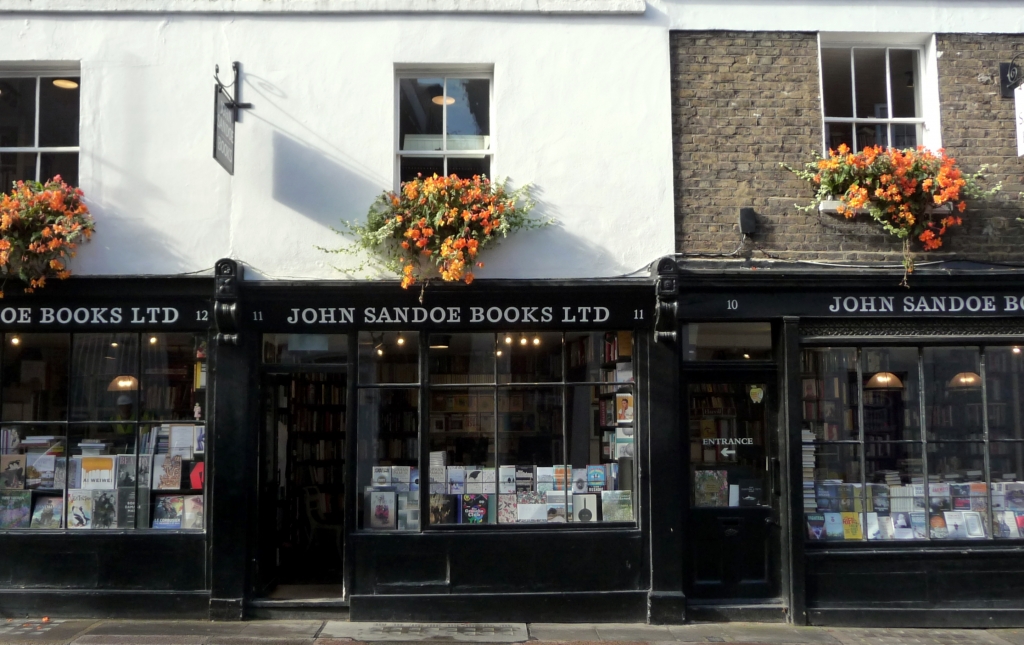
Cecil Court: a book lover’s delight

What is Cecil Court, you might ask? According to the website, Secret London it is…

packed with twenty-odd secondhand bookshops and antiquarian booksellers, it truly is a paradise for literature lovers. Just moments away from the hustle and bustle of Leicester Square, you’ll be surprised to stumble across such a peaceful gem. The shop fronts haven’t changed for over a century, so a walk through Cecil Court is like a trip back in time

When I can travel again and go to London, I think I will make a beeline to here.

For more information on it, click on the Secret London link, or visit their web site here.

On that London coffee shop charging $64 for its premium coffee

Kudos to Queen’s of Mayfair for getting CNN to write up the $64 “cup” of coffee they are serving. You might think it is the most posh and ridiculously expensive place in the world to visit. Well it is posh, but as this blog post shows, it’s also charming and affordable. I won’t be travelling soon, but when I do, I’d like to go there. But not for the $64 coffee. Anything else on their menu, though. (Image is a link to the blog post).
Houses aren’t homes: they’re capital

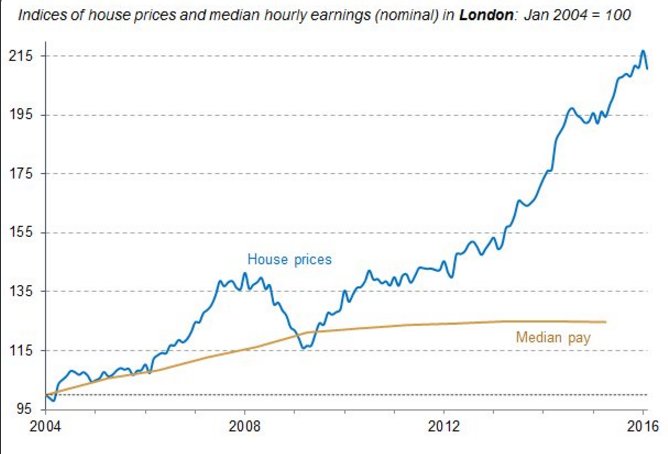
And in the richest cities, like London, they are greatly appreciating capital, as this shows:
Media preview

With some reflection, this makes sense, if you take as a given that:

  •   Stocks and bonds and even wages are fairly stagnant in terms of return on investment
  • Urbanization means homes in cities that are desirable to live in are becoming more scarce

The result is homes becoming one of the forms of capital that can has the means to greatly appreciate in value.

To reverse this will require a greater supply of homes on the market, either through greater density in desirable cities or through more cities becoming desirable to live in. I can see both of these occurring. What I don’t see occurring is other forms of capital becoming more capable of great growth.

It will be interesting to see what happens in 10 years. But right now, bet on homes in key cities to continue to do this.