On Canadian conceptual art

When you think of Canadian Art, it’s likely you might think of artists like the Group of Seven or Alex Colville or other representational artists. But Canada also has some very good conceptual artists. I came to that conclusion after do some research on the late great Kelly Mark and all the artists in her sphere. Here’s some links highlighting the work of Mark and more:


I would be remiss if I didn’t point out one of my favorite Canadian artists, Micah Lexier, whose work can be seen on tumblr and who also has a good Instagram account. And if you live in Toronto, you no doubt have seen his work without even knowing it is his. Check out his tumblr and you’ll see what I mean by that.

The arts on Wednesday: more VanGogh plus graphic design masters, Futurists and more

I’m always reading about artists in such places as the New Times, the Guardian, Wallpaper and more. These 2 dozen pieces below capture just some of the good things I’ve found in those publications since my last post on the arts in October.

First up, some good pieces from the Times. I highly recommend the first two, on Van Gogh and David.

Each Friday the Guardian posts a newsletter on the arts, and I have to say, it is consistently rich and full of good things to check out. We are lucky to have such art coverage in such a major publication. Here’s just a small sample of things I found there:

Wallpaper also has good arts coverage. It tends to be contemporary artists, like these pieces:


While I love good painters and sculptures, I have a fondness for artists who work in collage and other forms that involve graphic design. Kalman, Heartfield and Kruger are just three examples found below, with some other artists mixed in:

The following don’t have any particular idea tying them together: I just thought they were interesting and worth a look:

(Top image from the piece on Van Gogh, middle image from the work Kalman did for the restaurant Florent in the 1980s).

To deal with aspirational clutter, aspire to something better (think Japanese minimalism)

As someone who struggles with a lot of clutter, I find some of it easier to deal with than others. Anything that can go in the recycling or the garbage I find easy to toss out. But even when I do that, I still have too much stuff lying around.

The stuff I find hard to get rid of is stuff I find useful and that will make my life better somehow. So I was happy when I found this article touch on that: What is aspirational clutter, and how do I get rid of it? It’s a particularly difficult form of clutter to banish from your home because you have to adjust how you think about yourself in the decluttering process.

You probably have lots of aspirational clutter at your home now: those art supplies you never use, those books you will never read, those tools you never pick up, those clothes you will never get to wear. And much more. The usefulness of things and the hope you can become better means they are especially hard to get rid of.

One way to do so is to aspire to something better than also helps you get rid of things. For me, I am inspired by these designs found here: 13 Productive Japanese Home Office Designs – Edward George – edwardgeorgelondon.com. As something of a maximalist, I doubt I will ever get that disciplined in redesigning my work space. But having a goal to become more like that could help me banish so many of the things I have lying around now that someday — SOME DAY — I will get to (but probably won’t).

If you find you still have clutter around your house even after big declutter sessions, ask yourself: is this aspiration clutter? And if it is, ask what do you have to change to be able to deal with it? Perhaps aspiring to live simpler is a way to do that.

For more on Japanese minimalist, check this out: How to Embrace ‘Ma’ (間) and Japanese Minimalism In Your Home – theartofzen.org

A really good AI prompt to help you get the most out of AI

If you do anything with AI, then knowing how to write a good prompt is essential. It doesn’t matter if you’re doing complex vibe coding or merely sending a question to ChatGPT or Google Gemini or Microsoft CoPilot, the prompt you use is the key to getting good responses.

Recently I was happy to come across this post on swiss-miss.com on the perfect AI prompt. I took the liberty of copying it below so I could add my own comments in parentheses. A good/perfect AI prompt should have:

  1. Goal – Define what you want clearly. (Use action oriented verbs and imperative sentences when you send a prompt to AI systems. Limit your goal to one thing. If you want several things, specify it in such a way that it seems unified. Or ask for one thing, and then put more details in the context dump).
  2. Return Format – Specify exactly how you want the response structured. (Do you want your output in list form, ask for it. But be creative and expansive. Do you want it in PDF format? Or an XLSX file or a CSV file? Maybe you need a markdown file or a Word document? Then ask. Also specify length, like “provide a one page markdown document” or “produce a list of 10 items”).
  3. Warnings – Highlight any important details the AI should double-check (e.g. if you are asking for resources, specify you don’t want out of date resources)
  4. Context Dump – Provide background info to improve the response (this is a good one. The more additional information you can provide, the more likely the AI system will provide the answer you want. Warnings and the context dump help frame things for the AI system. Never assume it knows what you know or that it even remembers what you asked it just recently.)

Prompt specs will continue to change as generative AI systems change. For now, this is a good guide to get better results from your AI queries. You can still specify the role you want the AI to take on, though I see people doing less of that. Regardless, detail is important in your query.

P.S. Thank to the blog swiss-miss.com for this. You need to go there: it has decades of goodness you should know about.

From vibe coding to no-code / low-code AI generated coding


People are beginning to stop writing code, though lots of code is still being written. The reason for this is “vibe coding”, or more accurately, AI generated code.

I’m seeing examples of AI generated code frequently now. For instance, Spotify says its best developers haven’t written a line of code since December, thanks to AI. Over at a company named StrongDM, they’re going pure AI and the humans don’t even look at the code. Claude Code has plenty of references. I’ve even seen Reels on Instagram showing this in action.

I am finding this is happening with me as well. I can write code so well now using AI tools like Roo Code and IBM Bob that I am focused more on the prompts I need to come up with in order to generate the working code, the documentation, and the test code that insures the working code is of sufficient quality (which it usually is). Code that would have taken me a day to write I can get done in less than an hour, and software efforts that would have taken me a week I can get done in half a day. (As always, YMMV.) I’ve written about my experiences here and here.

Given these recent developments , I think we are approaching a new stage of software abstraction. Just as we went from machine code to assembler to third generation languages (3GL) like Fortran and C, we are now at the stage of abstraction: AI generated code. Developers like me are shifting from a coding role to a governing/controlling role. The coding role of generating code is now done by the AI tool: the human role is insuring the code is correct.

In some ways this is not unlike no-code / low-code. But instead of using a tool that provides “visual building blocks like drag-and-drop and pull-down menu interfaces” to write code, the developer uses AI to do it.

We all depend on software every day, from the apps we use to the online systems we work with. What’s changing is who will write that software. Going forward, less and less of that code will be written by people.

P.S. here are some links to pieces on writing software using AI I recently came across that were good:

For more on low-code and no-code, see this. For more on cybernetics, see this.

P.S.S. As an aside, I think it’s easy to imagine going from having a human developer using AI to no human at all, just AI. Easy or not, I think we always need humans in the loop. We still need humans to direct the AI. More importantly, we need humans to govern and control AI, now and in the future. Think of the cybernetic loop above. Replace the Sensor with AI. Now think of the other system. If humans ultimately depend on the other system, then a human should be the controller. Imagine the catastrophes that can occur otherwise (think of a spiralling downward feedback loop).

Disclaimer: As always, these are my opinions and not necessarily those of my employer.

 

The Webcam of downtown St. John’s is a delight

I love this webcam so much I decided to post it here so more people can know about it. It’s a camera provided by the CBC that focuses on downtown St. John’s in Newfoundland, Canada.

(Link here)

It’s a perfect webcam if you ask me. The setting is as picturesque as anything. There is just enough activity happening to make it seem real (as opposed to a still photo): cars go around constantly, birds fly by, and occasionally you’ll see a boat in the harbour.

CBC has other webcams, but this seems by far the best. Check it out if you have a minute. It’s perfect especially for anyone from Newfoundland feeling homesick.

On exercise for the mind instead of the body

I often talk about exercise from a physical point of view, but not from a mental point of view. I thought I should expand my idea of exercise when I came across this quote from G.K. Chesterton:

It is a good exercise, in empty or ugly hours of the day, to look at anything, the coal-scuttle or the book-case, and think how happy one could be to have brought it out of the sinking ship on to the solitary island. But it is a better exercise still to remember how all things have had this hair-breadth escape: everything has been saved from a wreck.

It is an exercise not of the body but of the mind. Mindfulness is an exercise of the mind too. In both cases we are training our brains to do something different than it normally does, and by doing so, we become more fit and up for the challenges life can throw at us.

Athletes do mental exercises all the time, especially in the area of visualization. We should all do such workouts on the regular.

Quote via this piece which I found on Austin Kleon’s newsletter. Image of Chesterton from Wikipedia.

Apple is marching to the beat of a different drummer

Apple is going in a different direction than many of the other big players in IT. I thought of that when I saw this news:

AmazonAMZN $210.05 (-5.56%), AlphabetGOOGL $323.78 (-2.51%), MetaMETA $663.95 (-1.32%), and MicrosoftMSFT $403.00 (1.82%) all spent record sums last quarter on purchases of property and equipment — largely tied AI chips and data centers. And for the companies that offered forward-looking guidance, their capex plans for the year blew analysts’ already generous estimates out of the water.

Amazon expects its 2026 capex to surge to $200 billion. Google is aiming for $175 billion to $185 billion. Meta estimates it will spend between $115 billion and $135 billion. All of those figures came in well above expectations and, for the most part, have weighed on their stocks. Microsoft didn’t give a formal 2026 capex outlook, but if its peers are any indication, spending will likely exceed the roughly $114 billion Wall Street expects for the calendar year.

Of the Big Tech companies, just one stands apart this earnings season. Apple’sAAPL $277.08 (0.77%) capital expenditure, already just a fraction of its peers, actually declined in the December quarter from a year earlier.

All those other companies have capex increases rising like a hockey stick: Apple’s has been relatively flat in the last 10 years.

So what is Apple doing in the way of AI?

Apple has struck its own path with AI…  it’s embracing AI but is not an AI company… Apple’s decision to use Google’s Gemini, rather than an in-house model, to power the next generation of Siri and Apple Intelligence. The Google deal, reportedly worth about $1 billion a year, gives Apple access to a top-tier AI model for pennies on the dollar compared to what other Big Tech companies are spending to build their own.

It makes sense to me. Apple is not going to be an AI company any more than it will be a search engine company. It’s betting if anything that AI will become a software/SaaS commodity locked in to one company due to network effects and it will just be part of the overall solution that Apple’s products offers it’s customers.

Speaking of going in a different direction, I’ve recently updated my OS on both my Mac and iPhone and was surprised by the introduction of Liquid Glass and removal of  the flat (bland?) UI I’ve become accustomed to. It reminds me of the skeuomorphism of the older versions of the UI I once liked. Sure it ain’t Aqua, but it does make the screen more lively. I like it, but not all do. As the French say: plus ça change, plus c’est la même chose. For a thoughtful analysis of this new UI and what’s good and not so good about it, I recommend this piece.


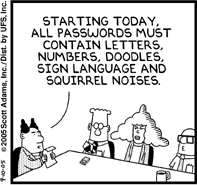
On the rise and fall of Scott Adams, cartoonist of Dilbert

There were two Scott Adams: the one known for being the creator of Dilbert, and the one who recently passed away who was beloved by right wingers in America. People like me who knew the first Scott Adams and who loved his Dilbert comic in the 90s were dismayed when he morphed into the second Scott Adams.

If you ever wondered about him as I often did then I recommend this piece by Andrew Farago. It does a really good job covering the two Scott Adams and explaining the transformation. If you were bewildered as to how the transformation could even occur, Farago helps with that bewilderment.

For more on Dilbert, see the Wikipedia page (which is where this image resides).

On lawgivers

In the House Chamber of the U.S. Capitol are 23 marble relief portraits depicting historical figures noted for their work in establishing the principles that underlie American law. This website shows the portraits and has a short description of each of the men displayed. It’s a great place to get learn more about historic law givers, and a good reminder that the law is not static and should not be presumed.

It’s February 2nd. Happy Candlemas to you!

February 2nd is Candlemas and if you are a devout Christian you likely know about it and celebrate it. For most, however, it is likely a forgotten event, unlike Christmas or Easter.

I think that’s too bad. I like the idea of a ceremony that creates blessed candles “to be lighted at times of stress – during storms, in sickrooms and at the bedside of the dying” (as this piece explains). We could all use such candles, whatever our beliefs, to get us through hard times. Even to get us through winter.

If you are struggling to get through this difficult winter and this difficult month, might I suggest you acquire your own blessed candles — even if you have to bless them yourself — and get them out and light them when the time arises. You deserve no less.

P.S. When it comes to February, Austin Kleon provides plenty of ways to look at the month in a positive way. I’ve written about that here and here. I also recommend you check out this post he made in 2023.

P.S.S. If you are wondering if there are other -mas holidays you’d like to know about, I’ll direct you to this. There are ALOT, including Michaelmas, Marymas, Hallowmas, and many more.

Image is of the painting “Candles” by Gerhard Richter.