Restaurants loved and living: Côte de Boeuf


I love casual French restaurants. And my favourite thing to order in causal French restaurants is steak frites. That’s why  Côte De Boeuf is one of my Loved and Living restaurants. Ever since I left the sidewalks of Ossington Street to step inside, I’ve been a huge fan. I’ve lost track of how many times I’ve been there since that first time many years ago.

It’s a perfect little restaurant/grocer. You can stop and just purchase some of the beautiful meats they have in the window. During the pandemic, I would at least do that. But my preference is to go and grab one of their tiny tables along the wall with barely enough room for a plate and a glass and a single votive.

And what good plates and glasses of wines they have! While they do many things well, from oyster to charc’ to dessert,  I cannot resist ordering their steak frites. The fries are wonderfully prepared, and their steak is top notch.  Even when their steak prices leapt up, I still kept going, it was that good and worth the trip. Their wines? French, of course, and a perfect accompaniment for any thing you order.

If I lived nearby I’d go once a week. Alas, in recent years I have not  gone at all, due to it being overwhelmed with guests. Even in summer when they have a patio, it can take a long time to get in, if you can get in at all. And no they don’t have reservations. There’s nothing causal about that, I am sad to say.

This week my sadness turned to delight when I heard that they are creating a sister restaurant in my favorite neighbourhood in Toronto, the Annex. Even better, they’ll be taking over the space left by the closing of the By the Way cafe. That means more seating and more chances for me to go. I don’t think it will be once a week, but it will be with some frequency, that’s for sure.

Here’s hoping the new sister restaurant will be open come December. I can’t wait to go, no matter how big or small their table tops are. All I need is enough room from a plate, a glass, and a single votive.

"Steak

Restaurants loved and living: L’Express

L’Express restaurant: just the thought of being there again makes me happy. I’ve gone countless times in the last few decades. Whenever I am in Montreal, even if just for a day, I dine there. Everything about it is great: the bistro food, the great value French wine, the superb waiters, the classic decor, and especially the big jars of cornichons. I love the ravioli and the hanger steak, followed by one scoop of ice cream (preferably maple),  but I have never been disappointed with whatever is served.

I was worried about it during the pandemic, but they seem to have muscled through those lean times. No doubt because of its many fans who have been there since 1980, and who no doubt will still be going in 2080.

I suspect they will have even more fans now that Michelin has arrived in Quebec and awarded it a Bib Gourmand. While I am agree with Leslie Chesterman that Michelin got things wrong on their first swing at Quebec, the tire people did right awarding a Bib to L’Express. It truly is “good quality, good value cooking”.

So the next time you are in Montreal strolling the great street of St. Denis, pop in to L’Express, either to have some wine (it’s also a great wine bar) or better yet find a table, scan the wonderfully printed menu, and settle into a plate of savoury bistro food. You won’t be sorry.

For more on L’Express and it’s history, check out this piece in the New York Times.

(Photos here from the Times piece. For more restaurants loved and living, see here.)

What’s both new and old in Toronto (random updates from the Big Smoke, March 2025)

Toronto: a city where what’s old and what’s new are often bundled up in the same topic. Take the topic of bike lanes. The mayor and the premier have been fighting over this for some time, yet it stays in the news. Having recently been reelected in a landslide win, Premier Ford is expected to soon rip some of them out. Meanwhile, Mayor Chow now is planning to expand them in other ways.

There are plenty advocating for more bike lanes. Meanwhile, there are a handful of toronto businessmen and more advocating the other way. Personally I think we need more bike infrastructure, if for the food delivery people on bikes alone. Is ripping up bike lanes a good look for the city? No it is not.

Another old thing in the news is the Santa Claus parade. It has fallen on such bad times that there was a a “go fund me” set up for it. At least for 2024 it was saved, thanks to funding from the Federal government. Here’s hoping it gets more funding for 2025 and beyond.

Another old thing getting new life is the TTC. In this case, the TTC is getting some newness in the form of a $2.3 billion fleet of modern subway trains. That’s a welcome injection of goodness into transit. As for other transit developments, it looks the Eglinton LRT may open in July. Amazing. Not so amazing is the ripped up streets at Yonge and Eglinton. Looking forward to the day that type of activity in my neighborhood is old news. It’s just one thing after another in midtown Toronto.

The restaurant scene in Toronto is a great mixture of old and new. I started thinking about that when I read this piece on the favorite old restos of Toronto chefs. From that I went down a rabbithole and checked out the 10 oldest restaurants in Toronto, then I read this piece on old school Toronto restaurants. Followed up with this, on the oldest restaurants in toronto you can still visit. And since I couldn’t get enough, I watched this entire blogTO slideshow on old school restaurants in Toronto.

Of cours there’s lots of great new places to dine. Check out thislist of  the best new Toronto restos for 2024. I’ve been to General Public, and it’s great, and I want to get to Linny’s soon. There’s also a number of places on this best of  Winterlicious 2025 that I need to see. You should go to see them too, if you can.

In other developments over the last 6 months:

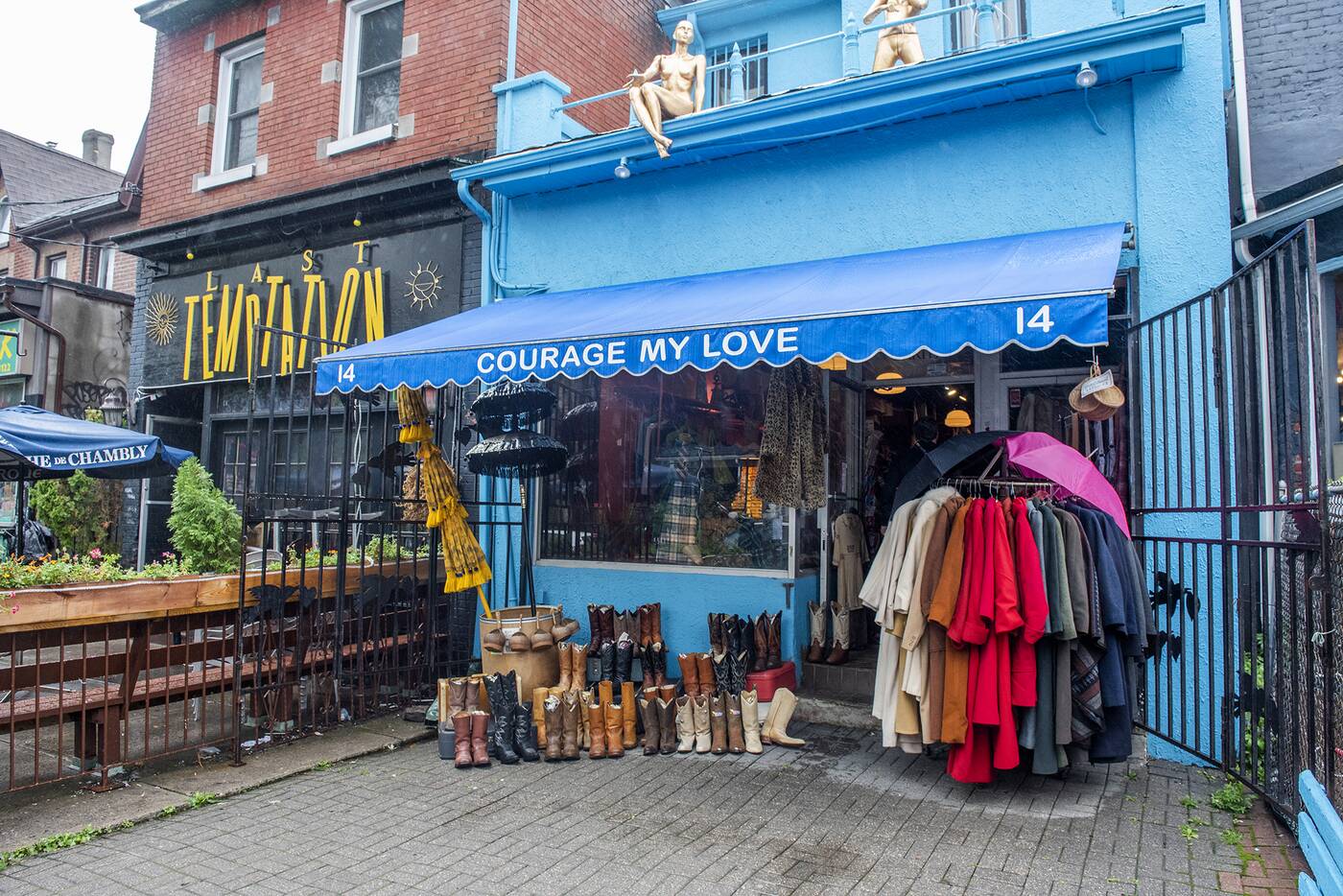
Finally, happy 50th anniversary to courage my love in Kensington. It’s not just a store name: it’s also a good commandment. Have courage! Thanks for reading my random Toronto notes. I’ll pen another one in September.


Restaurants loved and living: The Senator

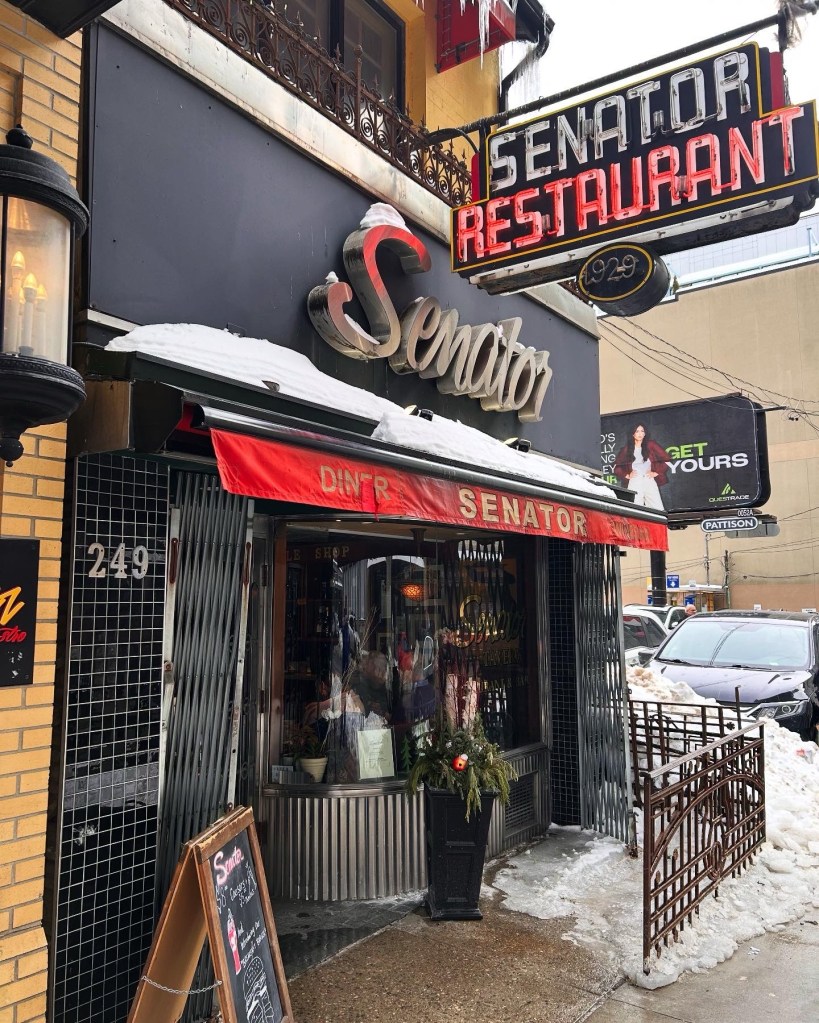
Like Okonomi House and Le Paradis, the Senator restaurant is a much loved restaurant I’ve been going to for a long time (the 1980s), though it predates that era by many years. It has the same 1930s ambiance of Le Swan and The Lakeview, two other Toronto restaurants I love. And while it has many fine things on the menu, the one reason I go there for is the breakfast.

The last time I went I splurged and got the steak and eggs (seen above), as opposed to the bacon and eggs, which was my Usual. Either dish is excellent. Also excellent: their coffee. Make sure when you go there to get some of their excellent brew: it’s hot and tasty and endless and served up in an old school diner mug.

When the pandemic hit I feared it would be one of the places to go under. Fortunately it held on, and the last time I went for brunch on a Sunday, it was packed with theatre people who planned to go to the Ed Mirvish show next door once they had their fill. That busyness was great to see.

When I was younger I would make my birthday a vacation day and I would start it with a trip to the Senator. I did that for decades. In all that time, the food and coffee and decor has been consistent and great. While they seem to no longer offer breakfast dishes on the week days, you can still get that and more if you hit them up for brunch on the weekend.

Whenever you go to the Senator, by all means go and soak up all that 1930s diner goodness. Get some coffee too. You’ll be glad you did.

Tipping is dead (and some other thoughts about restaurants)

Two things killed tipping: the pandemic and the handheld payment device (show in the picture above).

For decades before the pandemic, the standard tip was 15%. It was something you figured out yourself, and you either added it to the amount on your credit card or you might even pay in cash.

During the pandemic, patrons were asked to contribute more the usual 15% because everyone was struggling during the pandemic and this was especially true of restaurant workers. So people would tip sometimes 20% or more.

Also around this time the handheld payment devices became ubiquitous with default payment amounts. Unlike the one shown above, 18% became the lowest amount in many places, although I’ve seen some places have 20% and some with the audacity to make the lowest 22%. The pandemic ended, but rarely do I see 15% any more.

It’s true, for some places the device provides you an option to put in another amount. But you have to press several buttons and do your own calculation of the tip. And I am sure people do that and it’s fine. Most people I dine with, though, just go with one of the preselected picks of 18% or more.

This got me to conclude that the tip is no longer a tip. It’s just a service fee. Indeed I’ve seen some restaurants recently come out and say that on their bills. We are becoming more like Europe, where service is included but you throw in a bit more if the service is really good. I am not a fan of this.

This forced tipping is part of what I don’t like about restaurants and fine dining any more. I dislike the rushed service where they bring out all your food within 20 or 30 minutes of sitting down (if I want fast food I’ll go to a fast food restaurant).  Or bringing out the first food while I am enjoying a pre-dinner cocktail (I’ve pretty much given up on ordering them because of that). Or the smaller menus. Or surly and inflexible front of house who insist you sit in the table they’ve assigned you because that’s what’s on the iPad at their station. Or the waiters telling you that you have to be done by a certain time as soon as you sit down. And finally the payment device with a hardcoded 20% coded in handed to you by a hovering waiter. Bah humbug to all of that. I feel like I am renting a table, as opposed to being a guest.

I’m not the only one who is unhappy about it. Before he retired from the New York Times, Pete Wells wrote about how restaurants have changed and not for the better. I have to agree with him.

Maybe there are too many places chasing the fine dining experience but unable to provide it. I understand that: it’s hard to do. I mean, even the the French Laundry hasn’t aged well, according to Melissa Clark (also of the Times).

Perhaps we need to go back in time to when chefs (according to Jacques Pepin) were more like labourers and less like the rock stars you see in the bear season 3 with it’s chef cameos. I’m not sure that’s even possible any more. Everyone in the kitchen want to be Thomas Keller or Gordon Ramsey or Matty Matheson. No one wants to be Anthony Bourdain before he was famous.

I still love going out to restaurants, and there are a few places that offer great service, delicious food and fine ambience. It’s never a given you will get all three though, no matter what the prices on the menu say.

P.S. For more on how tipping has gotten out of control, check out these pieces: Tip-flation has some restaurants asking for up to 30% in tips and More and more places are asking for tips. Hidden cameras reveal who is and isn’t getting them and finally  Tipping Isn’t about Service – It’s a Psychological Con Job and Waymo may let you tip — but there’s a catch in The Verge.


Restaurants loved and lost: the places that Greg Couillard cooked

Reading this piece by Greg Couillard in Toronto Life (from 2018) brought back tons of memories of dining in the 80s and 90s. Back then fine dining went from being French-centric to representing a diverse range of cultures and flavours. Greg Couillard was at the center of all of that in this city, and the restaurants he and others cooked in drove that change. Whenever he joined a new place, I would grab a table and eat his Jump Up Soup and anything else he was plating. He didn’t stay at places long, but while he was there, the food was great. (In fact the soup was so great the Loblaws bottled it up and sold it in stores.)

It was a treat to read his piece and to recall places like Avec and Emilio’s. A treat to read those old clippings from NOW (shown above). It got me thinking about his soup, too. I’ll have to try and make it some day and relive old times and tastes. It won’t be as good as eating it at his places, but it’s the best I can do these days.


Restaurants loved and lost?: Prune

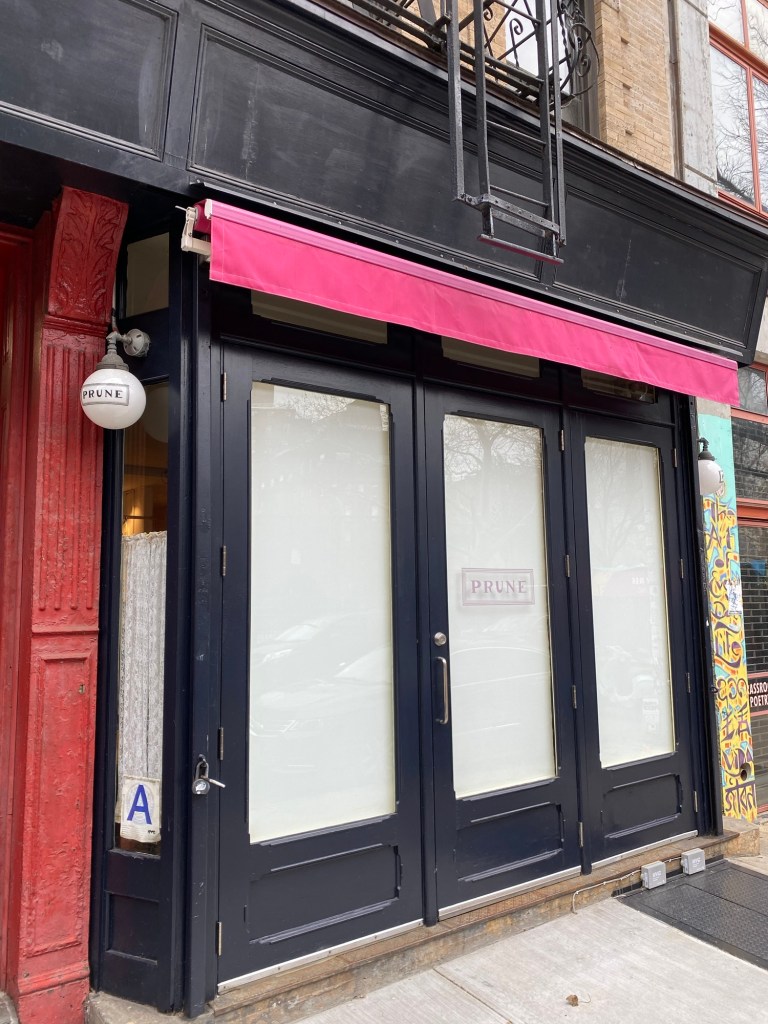
Like many restaurants, Prune was shuttered during the pandemic. Unlike other restaurateurs who quietly left, the head of Prune wrote a brilliant essay on its passing: My Restaurant Was My Life for 20 Years. Does the World Need It Anymore?

Like many of the other noted restaurants loved and lost, this one hurt. Especially so. I had only just started to make it a destination whenever I was in New York and suddenly it was gone. Or was it?

As this piece noted in 2023, the restaurant was being renovated and private events were being held there. Heck, Alison Roman and her beau had celebrated part of their wedding there. I was hopeful that it eventually would go from being private to being public. But as of March 2024, at least, it still looked like it did in the photo I took above. Indeed this article in The New Yorker at the same time said it is only available for private parties at the owner’s discretion. Sigh.

There was something magical about Prune. It was a world class restaurant that was also a small neighborhood restaurant. I remember the first time I went: I wandered by it while in NY’s Lower East Side and I popped in to see if they had any tables available for the evening. To my surprise they said I could sit at the bar at 7:30. I had a fabulous meal that day. I thought: I want to come back here often and for ever.

And maybe I will someday. Maybe Gabrielle Hamilton will throw open her doors to the public once again. But for now, I am including this among the restaurants loved and lost. I’ll miss your snack plate, Prune, and your duck breast over beans, and all the other great meals there. I’ll miss your small, perfect space. I may walk by you from time to time, but I doubt I’ll leave the sidewalk and cross your threshold any more.

Restaurants loved and living: Okonomi House

I’ve been going to Okonomi House since the 1980s. And what has changed over the years is…nothing. It was great then and it’s great now. They still serve pretty much the same food now that they served then, with the crown jewel being the okonomi style pancakes like the one below.

They serve other things too, but for me that’s what I go for when I go in. It’s sweet, it’s savory, it’s delicious. Just spread that mayo dollop all over the pancake and dig in!

There have been changes, but they are very minor. Young people seem to run the restaurant now, and they have tweaked the menu and added new things. Gone is the cup of soup that I loved even though it was literally Cup of Soup! In its place is a classier miso soup option. They have a nicer bathroom also: no longer are boxes piled up in it. Otherwise, the place is timeless. I hope it never leaves.

For more on it, BlogTo has a review, here. Read that, then go. I went a few Fridays ago and it was packed at around 7:30 pm. The good news is table turnover is fast (and service is great), so if you can’t get a seat right away, just wait for a few minutes and you’ll be soon eating okonomi in no time. 


A new form of hostile architecture: the chairless cafe / restaurant

According to wikipedia, “hostile architecture is an urban-design strategy that uses elements of the built environment to purposefully guide behavior. It often targets people who use or rely on public space more than others, such as youth, poor people, and homeless people, by restricting the physical behaviours they can engage in”.  Examples of this are ledges in cities with spikes or bumps on them so people cannot sit on them, or benches with extra dividers so people can’t sleep on them.

There’s a new form of hostile architecture that is subtler. I’ve noticed it has occurred after the pandemic. It comes in the form of fast food restaurants and cafes that make it impossible to sit and stay. As I noted in the photo taken above, Starbucks has returned to my area after closing up during the pandemic, but they have set up so it is next to impossible to sit and stay. They used to have similar places nearby that did have seating, but they’re all gone.

And it not just limited to Starbucks. A nearby McDonald’s had a place with seating and they stripped it all out and limited it to just a few stools. Likewise with the new Popeyes in the area.

What all these places want is take your money and move you along. While this may be good for them, the result is less places to get out and take a break in the neighborhood. Cities need more of these places, not less. Just like cities need benches to sit down on, cities need cafes and low cost restaurants that people can use to get out and see people and get a change in their environment.

I would advise you to patronize places that provide that experience and avoid places that do not. We need less hostile architecture in our cities, not more.


Restaurants loved and living: Le Paradis

Starting during the pandemic, I wrote a series of posts on restaurants loved and lost, inspired by a piece in the New York Times on places that vanished due to the pandemic.

I’d like to go in a different direction and talk about restaurants loved and living. These are places I’ve loved long before the pandemic that are still going strong. First up is Le Paradis.

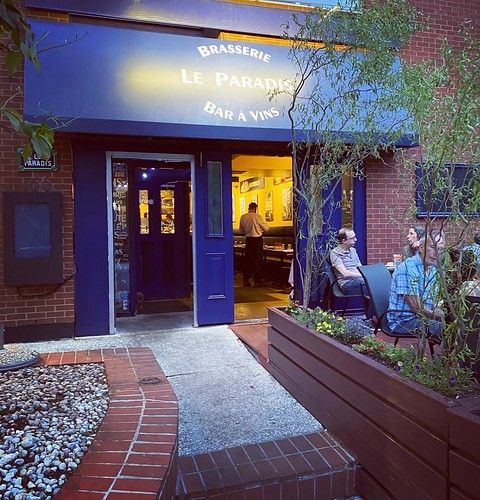
I’ve been going to Le Paradis since the 1980s. Back then it was known for reliable French bistro style food and great prices. Jump forward 40 years and…it’s still the same.  If anything, I’d say the cooking in the last year has improved greatly. Before you could excuse the so-so cooking because it was so inexpensive. Now you don’t need an excuse, because the cooking is really good. And still inexpensive.

I was worried about it during the pandemic, and even went and dined in the alley near the restaurant just to give them a chance to stay in business. Lucky for me they made it. Lucky for you, too.

So ignore reviews like this and go and have a $12 cocktail, a $45 bottle of wine, and a steak frites dinner almost half as expensive as other places in the city.  If you’re by yourself, take advantage of the zinc bar up front. Or sit at the banquettes near the kitchen (my favourite spot).  There’s plenty of places to sit — it’s a fairly big place — though a reservation is still a good idea. Especially if you want to sit outside when the weather is warm.

Did I forget to mention that the service is great? Well, it is. So tip well. You’ll have no excuse after all the money you save.


The City Harvest lunch at Le Bernardin is still a good deal


One of the best meals I’ve had around 7 years ago this month was also one of the greatest value meals I’ve ever had. It was the lunch in the lounge at Le Bernardin and back then it was $55, with $5 of that going to the charity City Harvest. Even four years later, Eater NY said it was only $60. Still a steal.

So I was somewhat shocked when I heard it was now $127! That’s quite a jump from $55. Alas, I got that wrong. $127 is for the lunch. The City Harvest lunch in the lounge is $94, of which $5 still goes to the charity.

I still think it is worthwhile at that price. I know between 2019 and now the restaurant was dealing with the pandemic like everyone else and spent a lot on upgrades to keep the place going. And going it still is. You should go, too.

For more information to help you to decide, here’s the Lounge Menu (and more). The wines by the glass are also good value. To get a lunch at one of the best restaurants in New York with 3 Michelin stars for under $100 is still worth stopping for, I believe.

Back to New York – a tale of eating and walking

After being away for awhile, I recently spent a long weekend in New York. Not surprising, it was great! I stayed in the Lower East Side and as usual, I went and ate at a number of good places. If that sounds like your idea of a good time, this is a good intro to eating well in the Lower East Side (LES). P.S. I would add Wildair to this list.

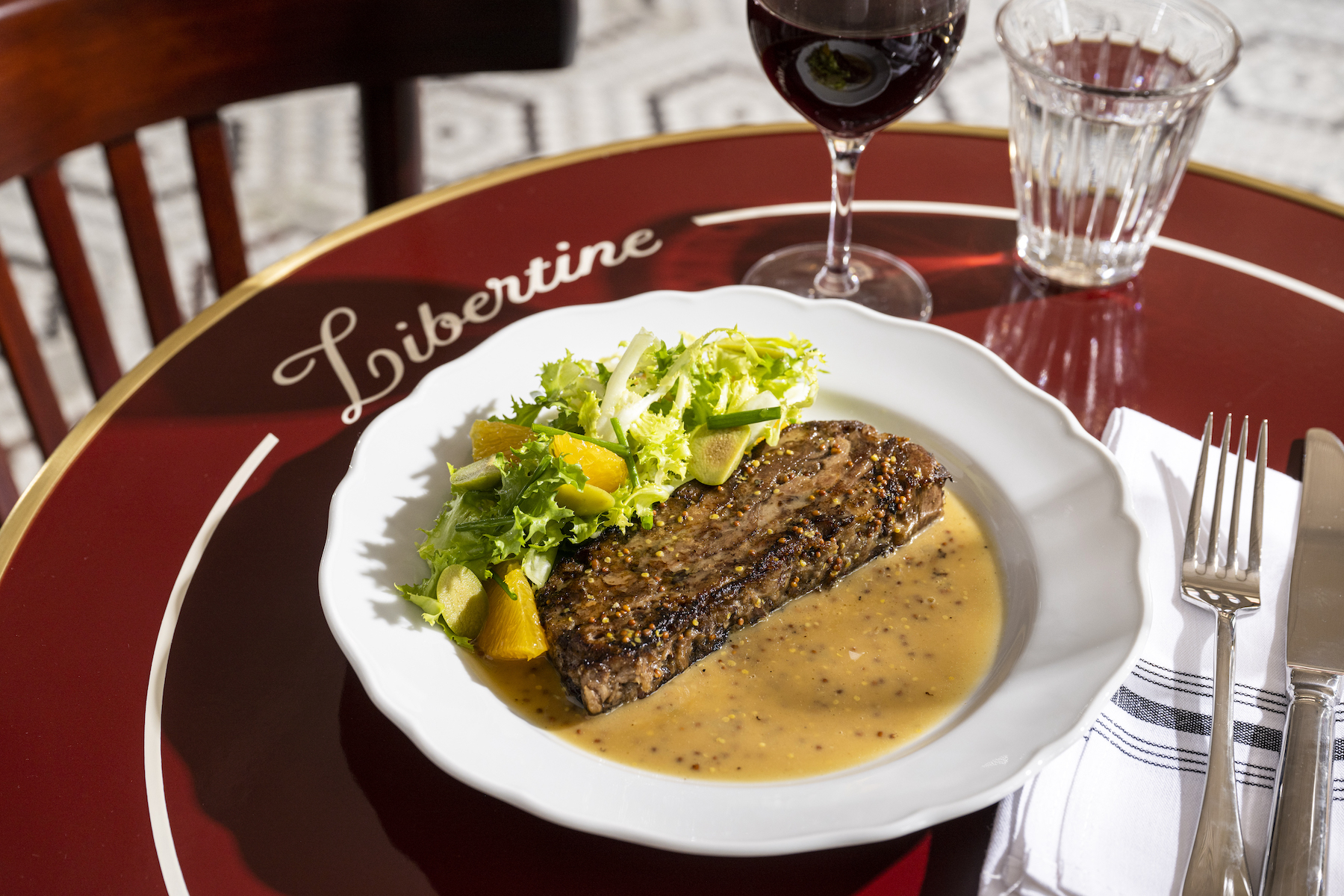
I had gone to many of the places on that list, so this time I branched out. I went to Freeman’s Alley, Lafayette, and Claud. All good. But the best place I went to was Libertine. More on it here. (Photo of it, above.)

But hey, that’s just me. If you would prefer to know where others dine in NY…for example…Taylor Swift…then you want to read this.

It wasn’t all just eating. I got to walk around a fair bit because Manhattan in particular is good for that. While I walked all over, on one walk downtown, I crossed over Great Jones Street to where Basquiat lived in the 80s. Since then, Angelina Jolie has taken it over. You can read about all that, here.

I’ve loved so many parts of this great city over the years, but the Lower East Side has always been one of my favorite parts. This is a fascinating story on how the city and that area has changed over the years. It has everything, as they used to say on SNL.

Speaking of good NY stories, this is a good one of how working for a dog shelter did a world of good for one New Yorker. Another good story, this time on old New York, is this: The Luncheonette Serving New York’s Best Egg Creams. Finally, this is a fascinating story on the Crown Heights Tunnels at the Tzfat Chabad Lubavitch synagogue. I’ve seen a number of stories on it, but this one in the Guardian was the best.

In NYC news, Flaco the owl has died after the year of freedom in Central Park and elsewhere. Sad. More on Flaco here. Also, this was no surprise: after a brief tour of duty, the NYPD subway robot has retired. It’s spring now, but this winter the city tried to have a remote school snow day at short notice. It did not go well, according to this.

Finally, how is the mayor of NYC doing? Not great, according to this. People in the city are not doing well either, according to this. That’s too bad. New York has made great strides to recover since it was hammered by COVID at the start of the decade. I hope it can pick its chin up, soon.


The New York Times whips down to Charleston, S.C. again for 36 hours

I love the the New York Times,  I love Charleston, and I love their 36 hours travel series, so I was keen to read this: 36 Hours in Charleston, South Carolina: Things to Do and See. I was also curious to see how it compare it their 2016 version: 36 Hours in Charleston, S.C. and their somewhat 2008 version, Visiting Charleston, S.C., on a Budget.

Overall it’s a good guide, but some of the restaurants they recommend are not necessarily the best of the city. While I don’t recommend you read the comments section, one person had good advice: “Go to FIG, go to 167 Raw, The Ordinary, Maison, Melfi, The Grocery, Doar Brothers for a cocktail, Sorelle, Verns, Edmunds Oast, Lewis BBQ, Rodneys BBQ….there are probably 30-40 restaurants in this town I would go to instead of Fleet. Sullivans has beautiful beaches and OD is good for brunch. But just good. Also, go see Folly Beach. Funky and boho. The Gaillard is our large concert hall but also look to see who’s playing at Music Hall or Music Farm. Go out to some of the Breweries on Upper Morrison and Spruill. ” Well said. I’d add Chubbyfish (if you can get in), and Santis. Butcher & Bee used to be good: now it’s gone. If you want some cool stuff to take home, head over to J. Stark: their bags are fantastic, and their store is beautiful.

Charleston is a great city, and I’m glad the Times is featuring it. But if you are looking for places to eat, either talk to a local or check out Eater for the Carolinas. You’ll be glad you did.

Restaurants loved and lost: Country Style


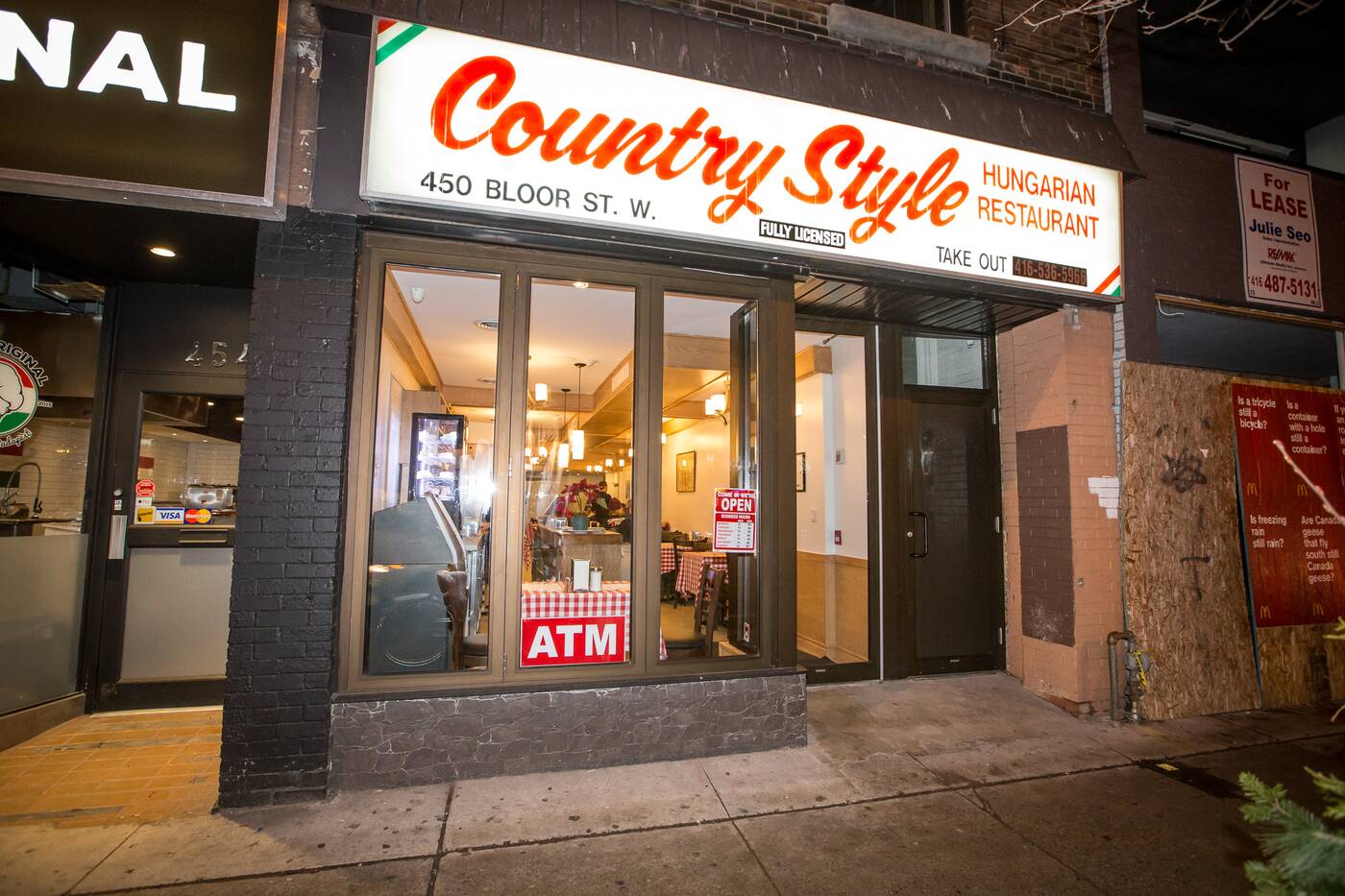
Sadly, the last of the great Hungarian restaurants in the Annex closed at the end of July. Unlike so many restaurants that have closed recently, this wasn’t due to the pandemic. The owners had been running it for many many years and decided it was time to retire. Sad for us, but good for them.

I’ve written about Country Style and the other schitnzel slinging places that occupied Bloor West between Brunswick and Bathurst. You can see that here: Chicken Schnitzel and other great Hungarian food at Country Style Hungarian Restaurant in Toronto’s Annex and here: Memory, space and time and the redrawing of a line. Lots of good memories from eating in those places, for sure.

Speaking of memories, this review from the blog jamiebradburnwriting.wordpress.com really brings back many of them:

Image above from blogto. You can read their review and get a better sense for the place, here.


On restaurants in 2023, post-pandemic and in general

For much of this decade restaurants have suffered for many reasons, the pandemic being the main one. I am actually surprised how many made it through those years of illness and closures. But make it through they did, mostly.

Mostly, but not all. Some big name places like Noma closed, but that was for several reasons. Some tried something radical, only for it to come out all wrong. See: What Went Wrong With Eleven Madison Park’s Vegan Menu (still got 3 Stars!). Others stuck to what was tried and true and came out the other side intact (albeit with higher prices): Le Bernardin Holds On to Its Four Stars.

Speaking of higher prices, read:  Why *are* Restaurants Are Charging $12 for Fancy Butter, and find out. Don’t fret, however, for not everyone is changing more. Some have a problem with that: Tacos Should Cost More Here’s Why.

Here’s some other reads regarding restaurants post-pandemic that I thought were worthwhile:

The 100 best restaurants in NYC in 2023 (plus the best places to eat and drink outside)


Yesterday I wrote about restaurants in Paris, today I want to point out the list of the 100 Best Restaurants in NYC, according to The New York Times food critic, Pete Wells

It’s a great list. There are restaurants for all the different boroughs and at all different price points. There are fancy French restaurants and there are casual night markets and more. You can find old school places like Barney Greengrass and Le Bernardin. You can find hot new places like Atomix and King. Whatever you need, the list can help you with.

If you live in NYC or plan to visit, you owe it to yourself to check out the list and start making reservations. Or just drop by.

P.S. If you are going to be in New York in the warmer parts of the year, you also owe it to yourself to check out the Vogue editors guide to outdoor dining in NYC. Some days you just want to get a cocktail and sit outside and enjoy all the city has to offer. The folks from Vogue can help.

(Photo is from the website for King.)


Happy Canada Day! Celebrate by eating in one of the “Best Places to Eat in Canada”

It’s Canada Day! So what better way to celebrate than dining at one of “The Best Places to Eat in Canada”. That’s according to Chris Nuttall-Smith, writing in that quintessentially Canadian magazine, Macleans.

It’s true: those are great places to eat. You’d be lucky to be able to dine in the highly expensive but amazing Prime Seafood Palace (shown above)). Can you get a table at places like Edulis? Good question! I sure can’t! 🙂 But if you can, I am sure it will be good.

So Canada, if you are looking for a good place to go, you can’t go wrong with any of the ones listed. Regardless of where you dine this evening, have a happy Canada Day!

On the eel pie and mash houses of England


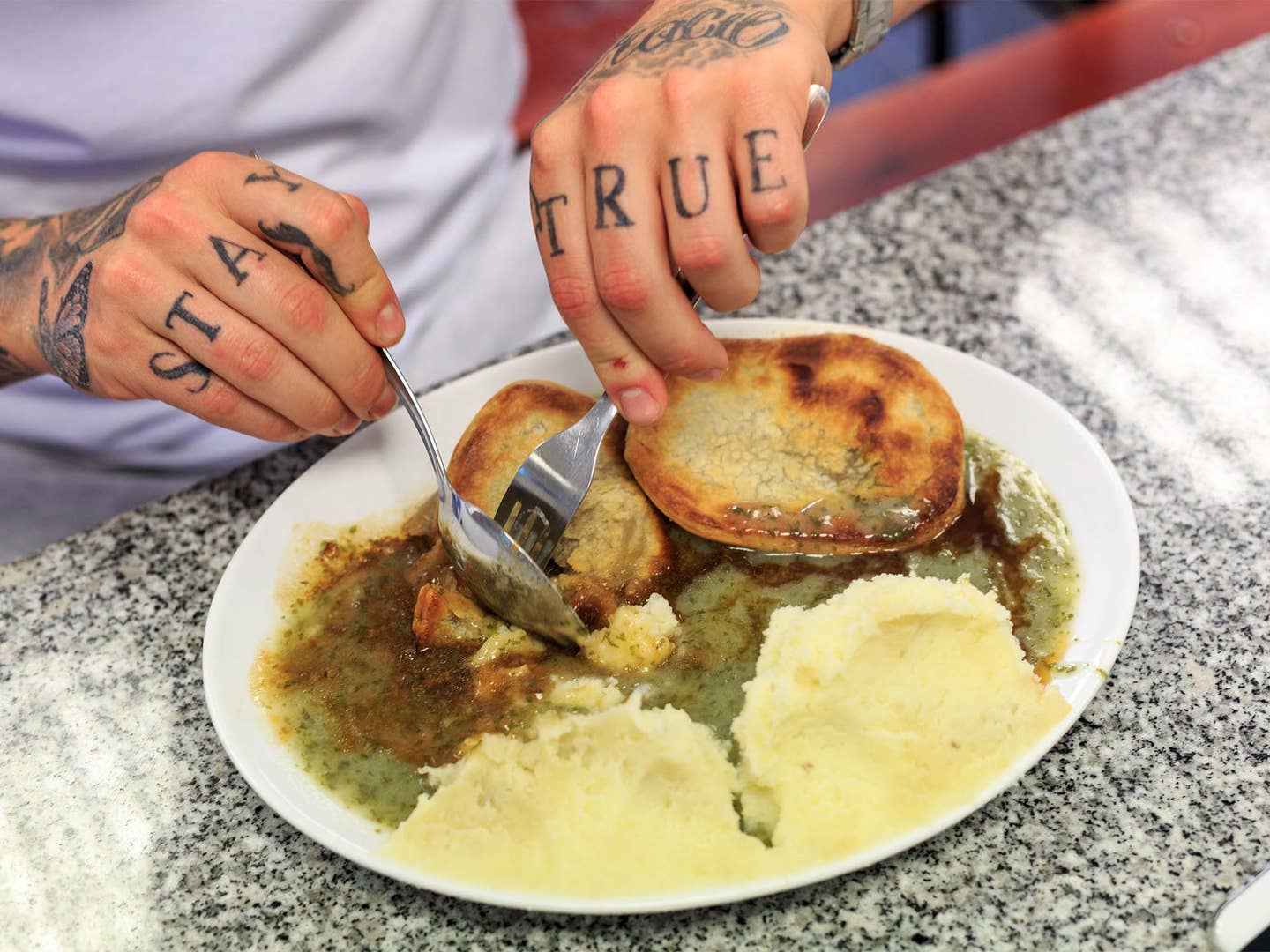
The English have been eating eel for a long time. Not only was it common to eat, in medieval times it was not unheard of to pay the rent in eels.  A preference for the snaky fish eventually led to the creation of a special type of restaurant in Victorian England: the eel pie and mash house.


I fell down a rabbit hole reading about these places and had the urge to get to one of them before they are all gone. Indeed, Sauveur has this piece on london eel pie shops and how they are on the decline. Here’s a story of one such place closing, L Manze in walthamstow.

For anyone who feels the same, here is a list of the top 10 places to eat eel in London (L Manze still exists in other parts). Plenty of places to dine yet. And I saw a food influencer posting about stopping in F. Cooke’s and how special it was. Perhaps there is hope for eel dining in England after all.

What’s old is news in Toronto (May 2023 edition)

In February I wrote of Mayor Tory’s resignation and a brouhaha around Premier Ford’s involvement with developers and the Greenbelt.  That’s the old news. The new news is we have a race on to see who will be next mayor, and it seems like 8000 people are running. (Not quite, but it’s a lot.) The Toronto Star has a rundown on them, here. Election date? June 26th. If you want to vote early or find out more information, go to toronto.ca.

As for the Premier, he continues to muck about in municipal issues. Nothing new there. First he offered up Ontario Place to private developers. Now he wants to move the Science Center there. I am sure other cities and towns in Ontario wonder if he wants to be their Premier or just the Premier of Toronto.

Premier of Toronto aside, the city has received some accolades as of late. That’s good news. Toronto General Hospital was just ranked 5th best in the entire world. And Billy Bishop Airport was named one of best in world too. Even the TTC managed to win an award, as one of the world’s most efficient transit systems in North America.

Lord knows the TTC could use some praise. It’s suffering lately. There was a fire erupting on TTC subway tracks at Bloor and Yonge station. There continues to be problems with violence. I suspect ridership is still down as Torontonians continue to work from home. And while it is good that it is being upgraded on places like Queen Street, that doesn’t make it easier for us to love it.

The TTC is still great, though. Not only it relatively efficient, it also has some great architecture, as this slideshow illustrates. (One of my favs is Rosedale, below.)

Other good news about Toronto: the Taste of the Danforth is set to return this summer for first time since 2019. There’s also this to look forward to: a major Keith Haring exhibition is coming to the AGO in Toronto. Awesome.

Not so awesome: Indigo was hit with a ransomware attack that not only affected their business, but employees’ personal information was leaked. Also not good: the recent Toronto Marathon sounds like it was a shambles. And of course no one seems to know when the  Eglinton Crosstown line will be done. This did not stop Marcus Gee from praising the Ford government for all his is  “doing right” in tearing up the area of midtown Toronto. Good grief.

If you can make it to midtown Toronto despite our woes, try and get some coffee from DeMello. It’s great! Turns out they are expanding downtown. That’s great too.

Foodwise, a new place in Bloordale has opened and looks really good: 1211. It joins a list of restaurants best categorized as eclectic. Here’s to more new eclectic places.

While new restaurants are good, so too are the olds. You can find many of those old school restaurants listed here. One that is both eclectic and old school is Gale’s Snack Bar. When it opened in Leslieville more than 50 years ago nothing cost more than $10 today that remains true. Amazing. Speaking of old restaurants, Country Style hungarian restaurant turns 60 this year and plans on serving schnitzel for years to come. That something I am happy to hear about, since so many of my favorite Hungarian places are gone. (You can read about them here  and here.)

Finally, here’s a blast from the Toronto past: the rise and fall of MuchMusic. And I discovered that the Health Center that I pass almost daily on Yonge used to be a police station (no 53). I always thought it was a hospital. Instead it was the home of the police, right next door to the fire department. (The fire fighters haven’t moved but the police have a newer and bigger place on Eglinton and Duplex.).

On restaurants now, and then

500

I like that Josh Barro stepped in (on?) the pseudo-controversy that arose when Joe and Jill Biden ordered the same meal by saying, yes, it’s fine to order the same dish as your spouse. I mean, of course it is, but that didn’t stop people from arguing otherwise.

Once he was on the topic, he had a number of other recommendations such as “Consider the restaurant’s specialty”  and “Try to be ready to order by the time your server asks if you know what you want.” So much of it is common sense, but as we all know, so much common sense like this is ignored by people. Maybe even you. I recommend you go read that and adopt those recommendations.

Speaking of restaurants, this is a very interesting walk down memory lane or history, depending how old you are: The 40 Most (American) Important Restaurants of the Past 40 Years. Some of them are well known: Chez Panisse, Spago, The French Laundry. Others are more obscure. Regardless, it’s a great article. (I slipped in American, because it is only American restaurants.)

On restaurants (deeply) loved and lost: Grano’s

Grano’s was not just a restaurant to me. For much of my adult life it was my second home. When I walked in, I felt like I lived there. Like I belonged there.

Starting from the late 80s (when I was in my 20s) until just before the pandemic, it was the restaurant I frequented the most. I celebrated some of my most cherished moments there. I ate often by myself there too. When I did not know where to go, I went to Grano’s.

When I first came to Toronto in mid 80s, I started to learn how to eat proper Italian food in places like Masianello’s downtown in Little Italy. Toronto is a great Italian city, and to live in such a place, you should learn to eat proper Italian food. I did, and I loved it. This love led me uptown to Grano’s, which was then a simple one room place. Over the years it expanded in width and depth, filling up with its maximalist Italian style and food as well as patrons wanting to devour it all. I was always one of those people.

Grano’s was as much a feast for the eyes as it was for the belly. Bright Mediterranean colored walls, prints of classic artwork, vintage ads and plenty of pieces from the Spoleto festivals could be seen everywhere. It paid to walk around slowly (or to sit quietly) and take it all in. It never got tiring to behold.

If you wanted — though why would you? — you could rush in and buy some bread or some Italian delicacies and go home. You could stay briefly and have a glass of Italian white and some grilled calamari (one of my favorites). Best of all, you could invite dozens of friends and loved ones and have the servers bring you bottles of Italian wines and plates and plates of antipasti and pasta that was always on hand for you and your guests. Whatever you needed, Grano’s would provide. And when it was finally time to end the meal, you could savour a plate of biscotti and a perfect cappuccino before you went home happy.

As you can see, Grano’s the place was great. But what made it especially great to me was Roberto Martella, the host. No matter when I came, he always treated me like I was his favorite customer. No doubt he made everyone feel that way, but it was still appreciated by me. I even took Italian classes there once, and years afterwards he would speak to me a little in Italian and I would try my best to reply back with the little I knew.

After going there for decades, I had hoped Grano’s would last as long as I would. But sadly Roberto had a stroke, and the restaurant limped along without him for awhile before closing in 2018. You can still see the remnants of Grano’s today in 2022, though it’s been divided up into new places that lack what I loved about it.

It’s sad to lose your home, especially one you loved for so long. That’s how I felt, and continue to feel, about Grano’s. I live nearby to where it was, and I often have a pang to wander over for a plate with the ease I used to. I don’t know if I ever will get over that feeling. Sure, I can get great wine and bread in others places, but “non si vive di solo pane”. Mille grazie, Roberto. Mille grazie, Grano’s. Thank you for everything.

P.S. For lots of good photos of it when it was at its best, see here: Foto. The photos I have linked here are from there.

This is their old home page on weebly. It has a short history of Grano’s, here: 1986. 

There’s only a few images, but this is their IG account.

Finally two pieces on them: The culinary influence of midtown’s Roberto Martella – Streets Of Toronto, contains a good history. This is also good: The fall and rise of Roberto Martella, Toronto’s ‘vibrant’ don of dialogue in The Globe and Mail.


On restaurants loved and lost of my youth (Woolworth’s in Glace Bay and Midtown in Halifax)

It doesn’t look like much in this black and white photo: just another store with an awning in downtown Glace Bay. For me though, it was the first place I got to go that was a restaurant. Inside was a food counter, and my mom (Ma) would take me there as a kid and she might get a club sandwich and I would likely get a coke float. The idea of going someplace to eat felt special to me and I learned to love that feeling from going there.

It may seem underwhelming to you as an adult, but as a kid, pulling up in one of those seats, being given a menu to choose what you want, and then having one of the ladies (it was always women) get it for you was amazing. Plus I never got to have coke floats outside of there, at least not for a long time, so that made it a special treat.

The Woolworth’s of Glace Bay is long gone. Later when I moved to Toronto there was one on Bloor near Bathurst and I used to go and get taken back home for a spell. Just like having a coke float takes me back to when I was a kid, sitting at that counter, sipping my drink with a straw, being happy.

This string of posts on restaurants loved and lost will be ending soon for me. But before I do, I wanted to mention another place of my youth: the Midtown Tavern in Halifax. It still exists, but the version I loved and lost was in downtown Halifax (see below). When I was in university, I would go there the few times I had some cash and get some draught beer and steak. The meat was thin and well done, but it was cheap, and the combo of the beef and the beer made me feel wealthy. It was unlike any other place in Halifax for students drinking beer. You could be a fool in other establishments, but act that way in the Midtown and their no nonsense waiters would toss you out on your ear. We were well behaved in the Midtown. In some ways it was a rite of passage where we learned to behave as much as anything else.

I loved both those places when I was young, just like I loved Mike’s Lunch in Glace Bay. They may have seemed like everyday places to some, but they left an indelible mark on me and think of them often, and with great affection.

All images you see are links. The top image is from Commercial Street_Glace Bay_Cape Breton_1965_Black Diamond Pharmacy_F.W. Woolworths. There’s also a great story in the piece I found the second image: Debbie Travels – Reviews and more: Midtown Tavern Halifax – End of an Era! A great story plus it has lots more photos of the Midtown.

P.S. I wanted to write about one other restaurant loved and lost from my youth: Fat Frank’s. When I was going to university I never had much money. I would constantly see the same ad for Fat Frank’s restaurant, and each time I saw it I thought: when I have money, I am going to eat there. It was my dream. For Fat Frank’s was one of the finest places to eat in all of the Maritimes.

Alas, it closed before I ever got to go. I never got to go inside nor eat any of its fine food. Even now it is elusive: I have a hard time finding images and stories of it on the Internet. The closest I can get is this 1976 review Craig Claiborne in the New York Times. And this blog has a shot of Spring Garden Road: Fat Frank’s would have been in one of those brick buildings on the right, I believe.

I never got to live the dream, but I dreamt about it for a long time…. an unrequited love, for a place now long gone.


On restaurants loved and lost: Brasserie in midtown Manhattan

It was fairly nondescript from the outside: a simple awning, some signs stating its name, and a revolving door. You might not think much of it walking along East 53rd.

Once you walked in, though, your impression immediately changed. Especially if you were there early in the morning, the way I often was in the 80s and 90s. You would be at the top of the stairs looking over the whole place, and it was packed with people there for power breakfasts. The sound of people talking just washed over you, and if you managed to find a seat, you would hear what was on the mind of Manhattan men and women of that era.

It could be intimidating, especially walking down those stairs into the middle of it all. Everyone seemed so confident, so polished, so put together. The fact Mike Bloomberg would often dine here to start his day gives you an idea of what it was like. While I felt shy on my first visit,  I quickly found the place thrilling and energizing. No doubt the other diners did too.

Among other things, it was a convenient place to go. I would be in the city for business and the offices we worked in and the hotels we stayed in were nearby. I could wander over to the Brasserie and have delicious croissants or a proper egg and sausage breakfast before I went to work. The coffee and orange juice? Also great. As was the service.  Convenient yes, but excellent too.

I don’t ever recall it changing that much over the years, which is one of the things about it that appealed to me. It gave me that constant connection to midtown Manhattan over the decades. It was my spot. After a long period of not visiting, I went back to NYC around 2018 and I wanted to hit it up, only to discover it had closed. Sad.

I’m glad I got to go all those years. If you visit a city often, I hope you can find such a place that allows you to fit in and belong and be part of something. It won’t be Brasserie, but I hope you find the next best thing.

For more on it, see this piece in Eater on it’s closing. Looks like they went out with a bang. Nice. More on it, here. (Images from those two places.) Finally this piece is in Japanese but you can get Google to translate it and there are some good images of Brasserie in it too. One thing I like about the Japanese post is you can see some of the food but you can also get a sense for what the stairs were like.

From Michelin to Peter Oliver: thinking about how Toronto has changed in the last 40 years


Two noteworthy events in Toronto dining happened this month: one was the start of an era and one was an end. The start was Michelin came to town and tossed out stars and Bibs and otherwise paid attention to Hogtown dining. The end was the death of restaurateur Peter Oliver.

Decades ago if Michelin had come in and gave out stars, it would have been incredible. Not now. What I loved about the Michelin event this month was how many people could not give a hoot. Toronto’s food scene is excellent, and we don’t really need Michelin to come in and tell us. That can be seen in critiques like this the Star . Sure the places highlighted are great, but there is more to good food in Toronto than the places starred. Many great restaurants were passed over, as this piece showed, because we are a city wealthy in good places to go.

To be fair to Michelin, they did highlight quite a number of restaurants in Toronto, even ones that did not get an award. One of those was Canoe. Canoe is just one of the many restaurants that are part of the Oliver and Bonacini (O&B)  Hospitality group. The Oliver in the name belongs to Peter Oliver.

I have been eating in Peter Oliver’s restaurants since the 80s. Back then he had a cozy place on Yonge north of Eglinton that was a great place to meet up for brunch with friends. From that place he went on to open and close many places, some of which were truly great.

While he has a career of four decades, this piece from 2000 in the Globe really shows his career as he was becoming ascendent. He had a knack at making restaurants, even though some of them (Bofinger/Paramount on Yonge near St. Clair) were too ambitious. While the buildings themselves seem to spare no expense, the food was sometimes lacking, and leading critics at the time like Joanne Kates dismissed some of it as “tourist all the way.”

What really made a difference for Oliver was when he hooked up with Michael Bonacini in 1993 to open Jump, Then Canoe. And many more. The combined talents of the two of them lead to an entire string of successful restaurants in Toronto and elsewhere.

Over the next few years I expect Michelin will be handing out more stars in Toronto. I expect the some of them will go to O&B restaurants.

The food scene has evolved significantly since the 1980s. Peter Oliver and O&B has been a big part of that evolution. Over at their web site they have a warm  Tribute to Peter Oliver. It’s worthy of consideration, just like the man himself. RIP, and thanks.

P.S. Here’s all the Michelin star restaurants of Toronto. The Globe has more on the Michelin awards. So does BlogTO. Not surprising, here’s how hard it is to get a  table at these places. Here’s a story on the one place /chef that got  two stars: rich readers, take note. 🙂

On restaurants loved and lost: Mike’s Lunch in Glace Bay

It doesn’t look like much. Only that Teem sign on the right tells you that this is the location of the famous Mike’s Lunch of Glace Bay. It had a good run of 109 years in various locations in my hometown before closing in 2019.  It was one of my favorite restaurants in the whole world, and it was the first place I went and dined by myself as a young man.

Back when I was young, it was located on Commercial Street in a little galley type restaurant. It had a counter in the middle where you ate, while pinball machines lined the walls behind you and the cooking was done in front of you. In the summer I would sit next to the open door and look out at the beautiful house across the street (the only house left on Commercial Street). I can remember the sunshine and the warmth and the joy of sitting there while I waited for my food. While many diners had the famous fish and chips, my meal of choice was the Club Sandwich. Toasty bread and toothpicks held together chunks of turkey, crispy bacon, lettuce and mayo. Mine was completed with hot french fries coated with gravy and ketchup and accompanied by an ice cold Coca-Cola. To this day it is still one of the best meals I ever had.

Years later Mike’s Lunch moved to a nicer space in the Sterling. The pinball machines never made the transition, but it still had a counter. It also had nice tables and booths and friendly waitresses. I never failed to go any time I visited Glace Bay, often more than once a visit. I don’t know how, but no matter how long I had been away, when I returned they always remembered me. And the club sandwiches were as good when I was 50 as they were when I was 15. No wonder we all loved it.

I miss Glace Bay for many reasons: the Chip Wagon, Venice Pizzeria, and Colette’s, to name a few great places. But of all the places I miss, I miss Mike’s Lunch the most. Thank you Mike’s Lunch for all the great meals and great times I’ve had there. I have been to many great restaurants over the years, but if I could walk through the doors of any one of them one last time, it would be yours.

Bonus: footage of Commercial St in 1988. The town changed over time, but this is how I remember it growing up. By this point Mike’s Lunch had already moved to the Sterling. Teddy’s (or as this video called it, The Greasy Spoon, and a similar restaurant to Mike’s) was still there.

In praise of non-fancy French restaurants

When I used to think of French restaurants, I used to think “fancy”. Restaurants  with nice table cloths, great lighting, complex dishes, and high prices. Places like  Le Bernardin, Bouillon Bilk, Place Carmen, Maison (S.C.) and more. All fancy, all great and I love them.

While fancy French restaurants are good, I am here to praise non-fancy French restaurants. Restaurants  with basic settings, everyday lighting, simple dishes (often bistro style), and relatively low prices. Sure, the cooking might not be as fancy, but it is still good and it satisfies the need I have for steak frites, moules, pate, croque monsieur, duck confit and inexpensive French wines.

I’ve been fortunate to go to many such places and have loved them. In London last week, I had charcuterie (shown above) at Le Beaujolais. A few weeks earlier I devoured a fine lunch at Fast and French in Charleston. Whenever I am in  Montreal I try and dine at the justifiably famous L’Express. Closer to home, I’m a decade long diner of  Le Paradis and for good reason. Finally, one of my all time favorite places to dine in Toronto is Cote du Boeuf. I was delighted this weekend to savour their oysters, pate, steak frites and duck confit. Fantastic.

There are lots of inexpensive restaurants that serve great Italian and Indian and Chinese and Vietnamese cooking. I love them. I wish there were as many places as those serving everyday French cooking. That would be heaven for me.

Let me know your favorite non-fancy French restaurants. I will add them to my list.

P.S. If you go to Le Beaujolais, get that charcuterie. You will need at least 3 hungry diners. At Fast and French, get the soup and sandwich and wine combo: it’s incredible value. L’express has too many good dishes to mention, but I love the ravioli, though many are big fans of the bone marrow. Le Paradis has great shellfish. Also cheap cocktails: I love their sazerac. The meat at Cote du Boeuf is incredibly good. I try to order many things there, but the steak frites is irresistable.


On pop-up restaurants

During the pandemic there was a number of great pop-up restaurants that appeared in my neighborhood. Perhaps yours too. It was one of the few good things during all the lockdowns. I was especially glad to wander down to the Dai-lo popup on Yonge near Davisville that served a small menu (4-6 items) of delicious Asian food in a coffee shop that was available for them in the evenings. Sadly, it’s gone now, but it was great while it lasted.

A good story on what it’s like to run such a place is here:  The Promise and Perils of Running a Pop Up Restaurant | Bon Appétit

Well worth reading, especially if you love pop-ups or thought of running your own. My naive self thinks: oh, it would be fun to have such a place. I have just enough sense to know it might be fun, but it would not be a lark and it would definitely be a lot of hard work to be successful.

(Photo by Toa Heftiba on Unsplash who is available for hire)

On restaurants loved and lost: Cafe Cancan


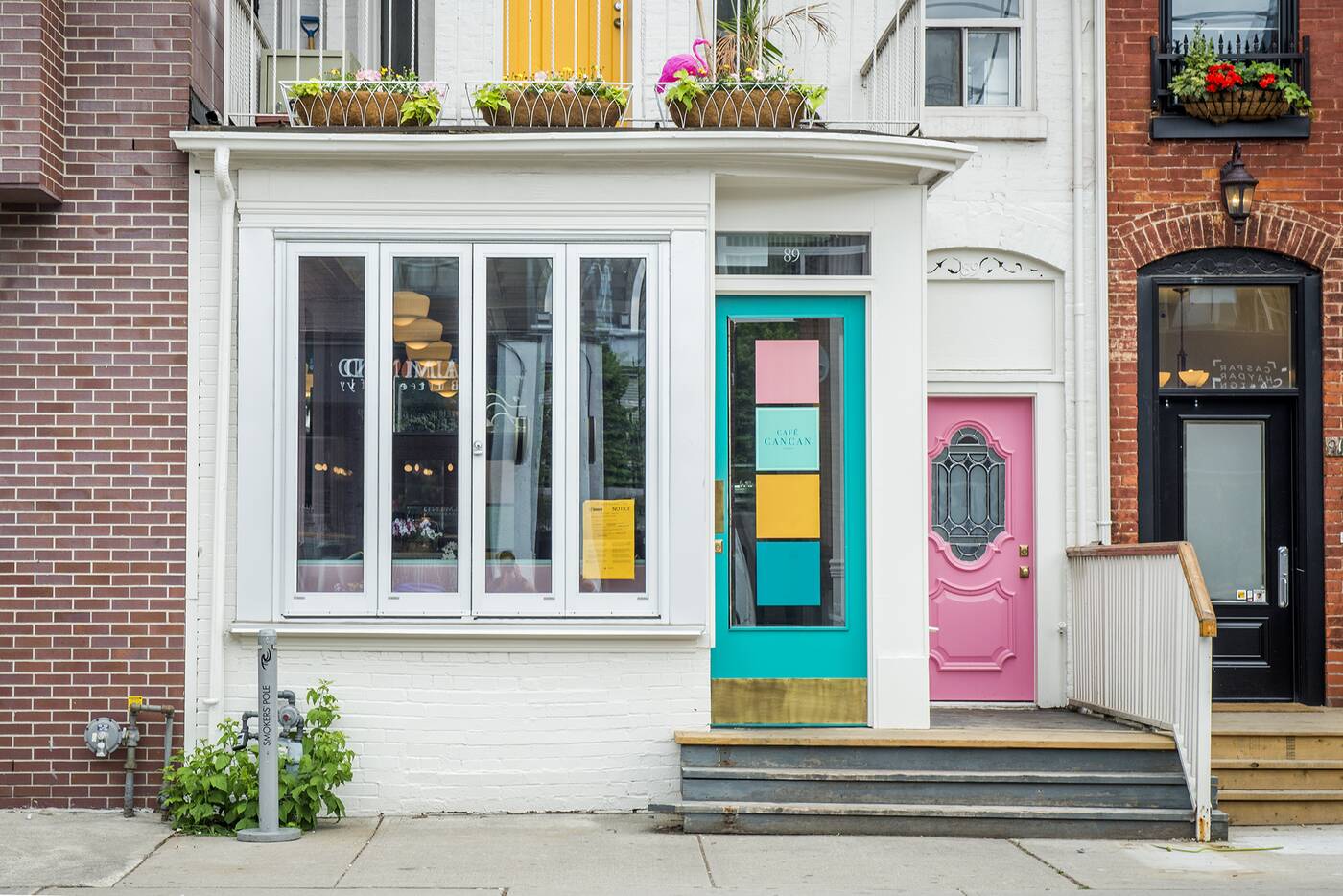
I can’t remember how I came across Cafe Cancan on Harbord Street, Toronto, but once I did, I couldn’t wait to go back. I love French food, and their menu was full on French. They had classic dishes, but there were also innovative ways of cooking that felt both new and traditional at the same time. I wanted it all.

One of the things great about Cancan was their prix fixe. It was reasonably priced and extensive. You’d order and sit back while the servers brought out dish after dish of delicious food. Even better were all the extras. You might believe you would get five dishes with the prix fixe and you would end up with 7 or 8. Plus you would get an amuse bouche when you sat down and once while settled in at the bar they brought me a little additional sweet at the end of the meal. I felt pampered everytime.

The restaurant itself was a gem. The tables were fine, but it was equally fun to sit at the bar. What was especially great was sitting on the back patio during the warmer months. Whenever I was sitting there I wanted to stay all night.

The wine was always good, and they had Tawse rose on tap for cheap. Oysters were plentiful too, but even here they would come up with innovative mignonettes to make them extra special.

Sadly the pandemic hit it hard, as it hit other restaurants. In the first summer they opened but the menu was very different. Now they are gone.

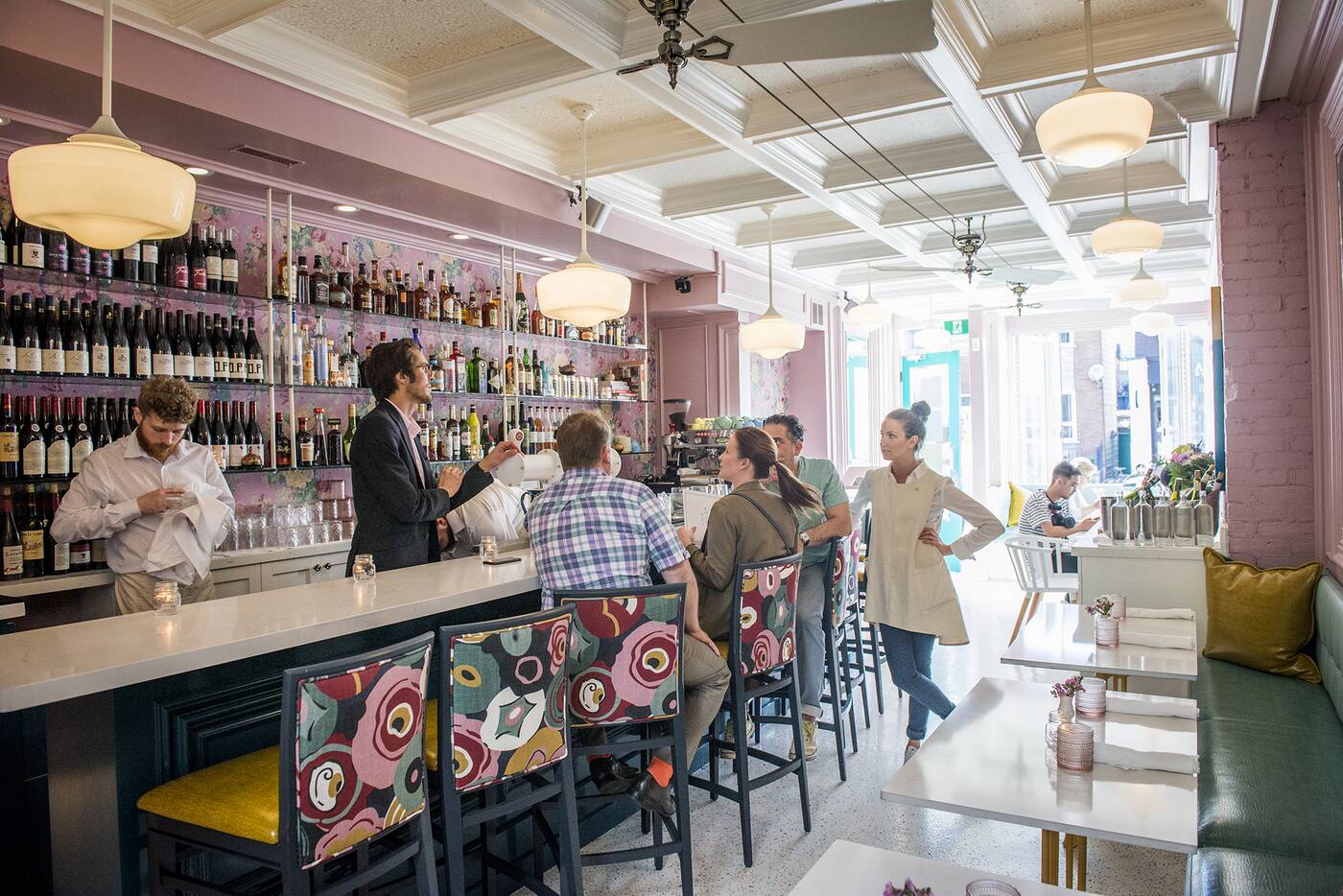
It seems like a new place that is going to open that is related to Piano Piano. I am sure it is going to be good. But I am going to really miss that lovely pastel French restaurant on Harbord. I had so many lovely meals with lovely people on one of my favorite streets of this city of mine.

(Images from the articles in BlogTo linked to here).

On restaurants loved and lost: Florent (and Odeon)

Here are a number of pieces on two great downtown Manhattan restaurants: Florent and Odeon. Florent has been closed for a number of years. But Odeon lives on, happily. What I love about both restaurants is how the embodied that era and how they both set a stage. You can see that in the pieces below about them. Florent in particular was a radical place that was like no other, right down to their menus and promotional material (like the one above). When they both opened the lower part of Manhattan had nothing like them. There was no gentrification down there like there is now. They were an oasis of good food, good design, and good times. To really get a sense of that, read Restaurant Florent Takes Its Final Bows – The New York Times. For more on the design ideas around Florent, see: Restaurant Florent | Restaurant Design in New York, NY — Memo Productions A short history of the space Florent occupied is written about here: What remains of a Gansevoort Street restaurant | Ephemeral New York Lastly, here is it’s Wikipedia write-up: Florent (restaurant). It’s a good source of other links on the place. Before I forget, this is a fun piece on The Odeon: A Retro Haven That Defined New York 1980s Nightlife | Vanity Fair. Also worth reading. Now go and eat at The Odeon.  

On fonts, old and new, and other design choices of St. JOHN

I’ve been thinking about fonts recently. Mainly I’ve been thinking why I love the font used by the restaurant St. JOHN so much.  I came to a conclusion after I read this piece, 60 free sans serif fonts to give your designs a modern touch, and came across this opening:

It is universally acknowledged that most contemporary designs require a versatile sans serif font. Sans serif fonts, as you might already know, are the fonts with no projecting lines at the ends. While serif fonts are known to be more traditional, sans serif fonts bring that much needed modernistic touch to the design.

That was it! When I think of modern and new, I think of thin sans serif fonts. And I am tired of modern and new for everything. Sometimes I want substantial, classic, traditional. The font for St. JOHN embodies that. It’s a chunky fat Serif font. The name itself is almost all capital letters. It is very different than the modern in that regard.

While their font is very traditional, in other ways, St. JOHN is very modern. There is a minimalism to the rest of their design, a minimalism of their design and decor is very modern indeed. To see what I mean, visit their web site (or better still, their establishments) and you will see what I mean.

And that’s perhaps what I love best about them: they mix in the best of what is old and traditional with what is new and modern and stride both worlds. It’s no easy feat, and yet they do it so well.

On restaurants loved and lost: Harvey’s on Bloor Street in Toronto

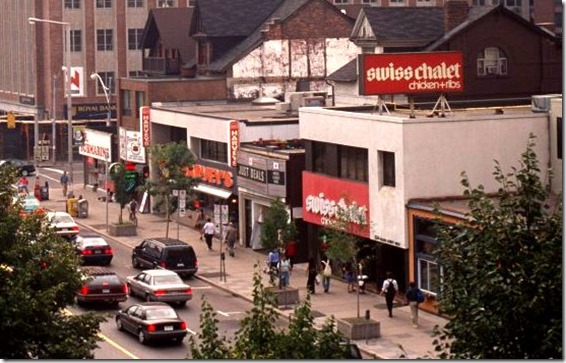
Can you be abandoned by a restaurant? If it is me, it’s the Harvey’s that was on Bloor in the 1980s.  I used to go there and get my favourite, a charbroiled chicken sandwich with mayo and pickle on the side. (Still my favourite thing to get at Harvey’s). I loved sitting in the front window and look over U of T’s Varsity Field.  When I was in my 20s I used to joke with my gf that when I was in my 60s I would still be coming here and eating the same sandwich and sitting in the same spot.

Times change and streets change, especially in Toronto. That area is now filled with condos. It’s nice and I still like the area, but I miss that Harvey’s. I’m much closer to my 60s than my 20s and I would love to be able to fulfill the need. Guess I will have to go to Okonomi House instead. 🙂

(Image via a link to this good piece on the History of Toronto’s Swiss Chalet (also in the image above, from the blog Historic Toronto)

P.S. Okonomi House is the same as it was in the 1980s. I hope it never closes. Click on the link and order from it if you can.

On restaurants loved and lost: Brothers

Brothers Restaurant Toronto

It’s Valentine’s Day, a good day to write a love letter to one of my favorite restaurants of all time, Brothers.

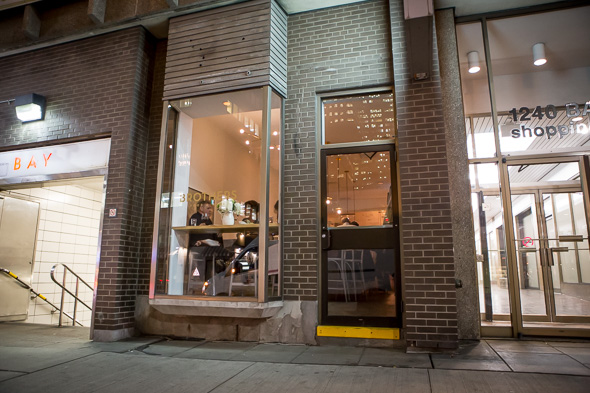
Brothers is a restaurant that should not have worked. Crowded between the entrance of the Bay Street subway and a downtown mall, there was barely room for anyone. One table in the window, a midsized bar, and a few tables in the back. Amongst all that a kitchen the size of a big closet nestled in a corner. It should not have worked, but in the short time it was around, it worked wonderfully.

You realized it was special when you first walked in, and I walked in often. I worked nearby, and whenever I needed a treat, I would wander over and sit at the bar and have lunch. I went so often that Chris who ran the front of place would warmly greet me after a time. (Later, as the place became extremely popular, Chris would sadly greet me after a time to tell me there was no room. It got so bad — for me, not them —  that I ended up scheduling lunch at 2ish just in the hopes of  getting a spot.)

While the service, atmosphere, and location were all great, what had me come back again and again was the food. The food was superb. I would take the hearty bread they offered and wipe down the plate to get every bit of it. The cooking was precise, simple and stellar. I loved to get something like sausage served with beans or vegetables and accompanied by a well chosen sauce. I’d take my time to slowly eat it, trying to appreciate and understand why it was so good. It was as much a cerebral as it was a sensory experience.
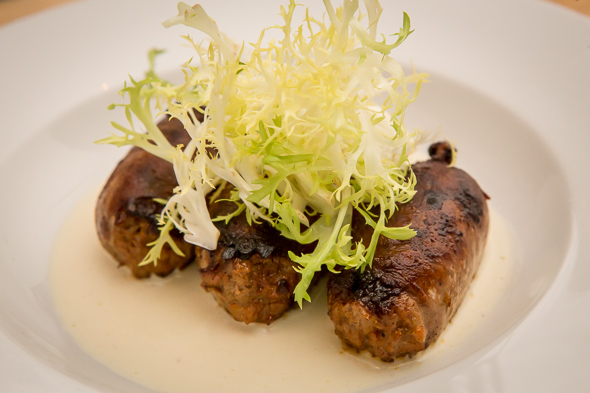
I would ask Chris about their tomato sauce or their green sauce, and he would tell me how they experimented with the amount of dairy or herb or whatever ingredient was in it to make the dish just right. And just right it was.

Most of the time I would get their sausage dish. The meat would change in the sausage, but it was always expertly balanced with seasoning. At first they may have been traditionally shaped, but later they were puck shaped. I loved that, and I loved them.

Sausage was not the only thing they excelled at. Pastas were always handmade, cooked to just the right texture, then served with a sauce better than any pasta sauce I ever had. Carpaccio was thin slices of whatever was appropriate for the season and accompanied with a light, lively dressing. The beef carpaccio was one of my favorite. They once said they could teach anyone to make it, but I doubt that. Fish, salad, dessert: whatever they made, they made well, listed it on their minimal menus, and I was happy and lucky to have it.

Brothers wasn’t around long, and in the time it was around, it lived three lives. The first was before the New York Times wrote about it, the second was after that article, and the third was the pandemic. Before the Times article, it was not too hard to get a seat there. They didn’t even take reservations. After the Times article, it was very hard to get in. There were weeks when I could not get a spot at the bar.  It got so busy they went with a reservation system. It slowed down a bit, but it was always popular.

Until the pandemic occurred. That was their last life. They tried to pivot to take out, and I did a curbside pickup of a wonderful meal from them. In the end they decided they didn’t want to be that kind of place and closed it down.

Lots of places have gone due to the pandemic. Some of them would have gone regardless. Not Brothers. If there was no pandemic, I am sure it would still be running, still sliding plates of that chewy soft bread and warm mixed olives and perfectly cooked food for me and you to delight in. I am going to miss many places because of the pandemic, but I think I will miss Brothers most of all.

(From more on it, see the New York Times article, or this blogTO piece. Images from the blogTO piece.

Check out their old web site. It’s simple but smart, just the way it used to be.

Finally this Google link will show you a wealth of photos for the place.)

 

On restaurants loved and lost: the Boulevard Cafe

On Harbord Street in the 1980s I fell in love with the Boulevard Cafe. My life was just starting, and my girlfriend and I were living just up the street from it, on Brunswick Avenue. We would stroll down and line up with the other people in the area for the wonderful Peruvian style food they had there.

It was the first time I learned to love fish. I come from Nova Scotia, but the fish was prepared terribly when I was growing up. Plus fish was associated with poor people food, unlike all the packaged food I wanted. I hated it.

Or I did until I had the Boulevard’s sea bass. (Sea bass was big in the 80s.) They would gently cook it and serve it with a perfect combo of delicious salad and fragrant rice.  I was instantly transformed into a fish lover after that first meal. Many a fish meal I had after that, and all were great.

And their soups. Their soups were incredible. I once had a garlic soup there that was so good that I still recall it decades later. It was simple, and yet I have often had garlic soup elsewhere and it never compared. They had many great dishes there, but the soup and the fish kept me coming back.

When we first started going, it was popular but not too busy. There was seating on both floors, and half of the upstairs was just a seating area where you could sip your drink and enjoy their  fireplace. I remember one night we were sitting there next to the fire, looking out over Harbord Street as a nice snowfall floated down covering everything. I could have stayed all night.

Later on the word got out and it got busier. The lovely seating area was replaced with more tables. The patio area in the summer was jammed with everyone enjoying the wonderful flavours that came out of the small kitchen in the back.

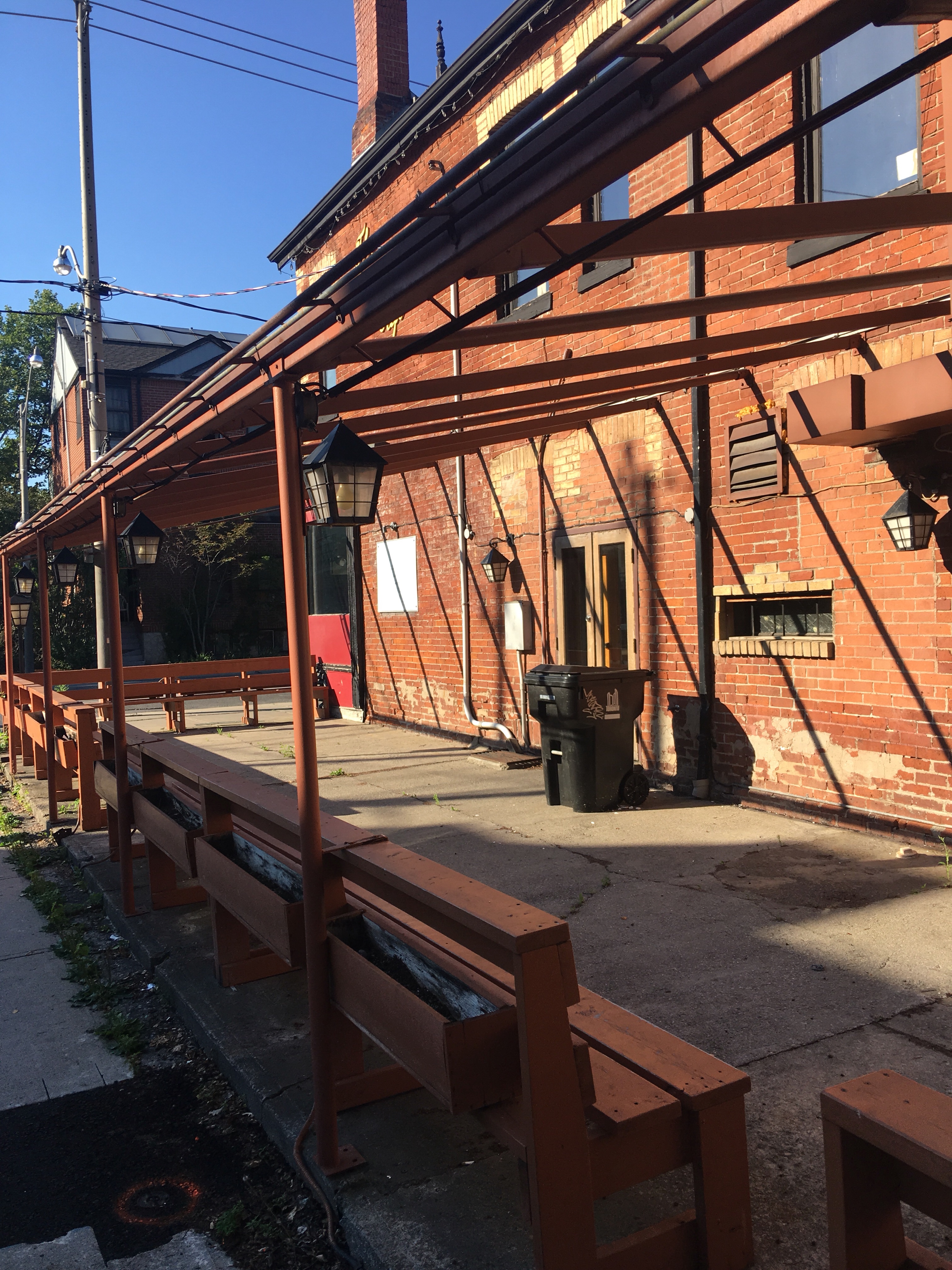
I was shocked to be riding my bicycle across Harbord Street a few summers ago and seeing it all closed up. It was then I took those photos. It was so good, I thought it would last forever. I stood there for quite awhile and remembered all the wonderful times of my youth sitting outside under the awning and living the good life with great friends and great food. I am lucky to have had such a time.

(In the top photo you can see the chimney where the fireplace was. In the bottom photo you can see the main doors that led to the dining room on the lower floor. The bulletin board would list all the specials. There would be tables put in front of the benches, and you either sat on the benches or chairs opposite. In the evening the lights would come on and it would seem magical.)

P.S. Over at Zomato there is still a copy of the menu and some other photos.


On restaurants loved and lost

The pandemic has been hard on people and hard on businesses. One type of business it has been especially hard on is the restaurant business. So many has closed that it is hard to recall them all. Partially to remedy this, the Times did a piece on them: Remembering the Restaurants America Lost in 2020 – The New York Times

If you read it, you will likely see some you loved. One I always wanted to go to but never got to and now never will was Lucky Strike. Here’s how Julia Moskin recalled it:

Lucky Strike was for us. That’s how it felt in the early 1990s, when I lived in downtown Manhattan and my restaurant priorities were cheap red wine, good lighting and a potent steak au poivre. Lucky Strike was Keith McNally’s first restaurant of his own, and a looser, more fun sibling of the polished, magnetic Odeon in TriBeCa, which he had opened with partners in 1980.

At the time, Lucky Strike’s location was most accurately described not as “in SoHo,” but “near the mouth of the Holland Tunnel,” and its strip of Grand Street was desolate at night. The warmth and noise that it spilled onto the street made it a beacon for locals. We liked that the food was never quite good enough to draw a crowd. We liked that the rough floors and wine tumblers repelled the people who came looking for lychee martinis and tuna tartare. Mr. McNally went on to open bigger, glossier joints that are still with us — like Balthazar, Minetta Tavern and Pastis — and has closed almost as many, but Lucky Strike was the only one that was a neighborhood restaurant, and the only one I’ll mourn.

I was going to NYC a fair bit in the 80s and 90s, and I remember the buzz around Lucky Strike. I thought: that’s my kinda place. That’s the kind of place I want to hit when I get to Manhattan. But while I went to New York a fair bit, the times there were always short, and I never made it.

There are many great restaurants  I have gone to in my lifetime. Some like Lucky Strike were killed off in the pandemic, some closed long before that. Some of them are still on some form of life support, hoping to make it through to the bright side of this dreadful era. I want to write about those places before I forget them, for my own sake if nothing else. Although perhaps you will have the same thoughts reading them that I had when reading about Lucky Strike. If so, that will be good too.

Restaurant reside in the best parts of my better memories. It’s a good time to recall them, write about them here, and group them with the tag #restoslovedandlost

(Images from the New York Times article)

Are meal kits the future of restaurants?

I don’t know, but I do know this is a good piece to read for anyone interested in establishments having some degree of success with them: Meal kits were dying. Covid-19 brought them back to life. | The Counter.

I am not sure what the future of restaurants will be. Or any places that depend on having many people close together for periods of time.  If COVID-19 sticks around for months and years, we are going to be forced to find out. Whatever that future is, it will be substantially different to the time before the arrival of this disease.

On David McMillan’s Love Letter to Toronto

David McMillan, who is responsible for some of the great restaurants in Montreal, wrote this love letter to Toronto and it’s restaurants a few years ago. It’s wonderful. Reading it over again, it has a bittersweetness as I read the names of some of the wonderful Toronto food establishments he mentions. I wonder if many of them will still exist after this pandemic. I want to hope that most will and I want to hope that the Toronto food scene will still be great. Just like I want the Montreal food scene to recover and thrive. I will say a prayer that both those things come true.

On Prune, and restaurants in general

Many many people were blown away by this piece written by Gabrielle Hamilton of Prune fame: My Restaurant Was My Life for 20 Years. Does the World Need It Anymore? in The New York Times. 

She’s a great writer, and a great restaurateur, writing about a time of peril for all restaurants.

During the pandemic I’ve thought about it often, as well as the future of restaurants. I don’t know a fraction about the business Hamilton excels in, other than to recognize that even for someone good at it, it’s a hard business. It was a hard business before when places were jammed with hungry eaters. It may well be impossible now.

My hope is that knowing that  restaurateurs are smart, hard working and passionate people.  They have managed in difficult situations before. They will find a way to make the foods that they love and feed them to us. And we will find a way to get out and support them.

I have had a number of meals at Prune, and they have been some of the finest of times for me. Here’s to it and many more places coming back soon and giving us meals and memories that make life worthwhile.

(Image is a link to the Village Voice.)

On appreciating established restaurants


A thought provoking piece on how we spend too much time on new restaurants and not enough on established ones: Why we should ignore the buzz surrounding new restaurants and give proper due to the ones that have lasted | National Post.

I think this is true. I pay attention to new places and hot places and places closing, but places that are great day in and day out I pay less attention to. I suspect many people are like that.

It would be great if publications that write on restaurants periodically round up places that are consistently great would write about them.

How to travel back in time in NYC


One way would be to go to this place: Barbetta. The New York Times has a fine story on it, here: The Elegant Relic of Restaurant Row. Even if you don’t intend to go, you’d be rewarded just reading the piece.

Love that photo by Dina Litovsky for The New York Times. The sign is “made of opal glass. A forerunner of neon, it is the last of its kind in the city…”.  Fantastic.

Sara restaurant in Toronto has a cool way to deal with cell phones at restaurants

According to blogTO, the tables are of a ….

…Design by ODAMI and MiiM (that) incorporates innovative tabletop cubbies with heavy, spill-proof lids designed to stow your phone at the beginning of the meal. Servers remove the lid at the end to remind you to return to your phone, and emerge from the period of serenity Sara offers diners.

Nice restaurant, great idea. For more on it, see:  Sara – blogTO – Toronto