What is it? Well
Snitter is “Snook’s Twitter”: an Adobe AIR-powered application for twittering
It is really COOL….lots of nice features. You can find it here: Snitter: Snook’s Twitter – Snook.ca

What is it? Well
Snitter is “Snook’s Twitter”: an Adobe AIR-powered application for twittering
It is really COOL….lots of nice features. You can find it here: Snitter: Snook’s Twitter – Snook.ca

chumby is just one of latest low cost computing platforms coming on the market, like OLPC. Plus, they are darn cute! Check it out.
I was sending someone an email tonight, and I was discussing one of my favourite books, The Brothers Karamazov. I noticed that Microsoft Word underlined “Karamozov”. Oh oh, I thought, better fix that.
Now if you type in “Karamozov” instead of “Karamazov” in ScribeFire, and then right click on it, it will tell you to replace it with “Karamazov”. But if you do this in Microsoft Word, you get “Kalamazoo”.
Now the first thought I had was: what, Word has been around since at least the early Dostoevsky novels, and it certainly ain’t small, so you think it would be smart enough to at least know leaders of major world literature? My Cyrillic is non-existent, but I am willing to bet money that the Cyrillic spelling of Karamazov NEVER translates into Kalamazoo.
My second thought was: maybe it’s me. So I right clicked on “Karamozov” and “Karamazov” and changed the language to “Russian” and the spell check error went away! Hmmm, I thought, Word IS smart! You just have to tell it the word is Russian! And it is smart enough to know that there are two ways to spell Karamazov!
But then I thought: I wonder if that is true. So I quickly typed in the another “Russian” word:
“Wwwwwwwwwwwwwwwwwwwwwww” and did the same test, and lo and behold, “Wwwwwwwwwwwwwwwwwwwwwww” is also the name of someone is Russia! (Perhaps this was a minor character the Dostoevsky later dropped to get the book under a 1000 pages.)
So, if you are a developer, and you are providing multilanguage support for your product, and you are asked to specify what standard you will be supporting, I recommend you say: the same one used by Microsoft Word! 🙂
When I first saw the name of this blog, Chocolate Porn du Jour — Chocolate Chipped I thought, yeah, yeah, another person using the “p” word to get attention. Then I looked at the site. Wow. It is one decadent site! Not sure if I cheapen the site by using the “p” word…this is beauty in the form of chocolate! See:

and lots more!
A great flash presentation on The Life and Work of Gustav Klimt can be found at this site. Lots of his work here, from the famous like “Judith with the Head of Holofernes” to early portraits. A visually stunning site, which is most appropriate for this great painter.

At the NICHOLAS METIVIER GALLERY is Edward Burtyhsky’s Quarries. As he says:
“The concept of the landscape as architecture has become, for me, an act of imagination. I remember looking at buildings made of stone, and thinking, there has to be an interesting landscape somewhere out there because these stones had to have been taken out of the quarry one block at a time. I had never seen a dimensional quarry, but I envisioned an inverted cubed architecture on the side of a hill. I went in search of it, and when I had it on my ground glass I knew that I had arrived.”
It is on for a few more days: check it out if you can.
There is a fascinating article Silent Minds: The New Yorker on how brain scans on vegetative patients are showing more activities than was expected. Here’s the lede into the article, but I recommend you read the whole thing:
Ten years ago, Adrian Owen, a young British neuroscientist, was working at a brain-imaging center at Addenbrooke’s Hospital, at the University of Cambridge. He had recently returned from the Montreal Neurological Institute, where he used advanced scanning technology to map areas of the brain, including those involved in recognizing human faces, and he was eager to continue his research. The imaging center was next to the hospital’s neurological intensive-care unit, and Owen heard about a patient there named Kate Bainbridge, a twenty-six-year-old schoolteacher who had become comatose after a flulike illness, and was eventually diagnosed as being in what neurologists call a vegetative state. Owen decided to scan Bainbridge’s brain. “We were looking for interesting patients to study,” he told me. “She was the first vegetative patient I came across.”For four months, Bainbridge had not spoken or responded to her family or her doctors, although her eyes were often open and roving. (A person in a coma appears to be asleep and is unaware of even painful stimulation; a person in a vegetative state has periods of wakefulness but shows no awareness of her environment and does not make purposeful movements.) Owen placed Bainbridge in a PET scanner, a machine that records changes in metabolism and blood flow in the brain, and, on a screen in front of her, projected photographs of faces belonging to members of her family, as well as digitally distorted images, in which the faces were unrecognizable. Whenever pictures of Bainbridge’s family flashed on the screen, an area of her brain called the fusiform gyrus, which neuroscientists had identified as playing a central role in face recognition, lit up on the scan. “We were stunned,” Owen told me. “The fusiform-gyrus activation in her brain was not simply similar to normal; it was exactly the same as normal volunteers’.”
Among other things, Paul Smith shows how to pull off the difficult task of mixing horizontal and vertical stripes by in his upcoming spring/summer collection shown in this video. (Look for the Harry Potteresque model):
Thanks for coming to this blog. If you like my blog, please come and see my new blog at:
http://smartpeopleIknow.blogspot.com
Different domain name, same good contents.

Over at the excellent food blog, Jaden’s Steamy Kitchen, is a review of the No Knead Bread recipe that was featured in the nytimes.com a while ago. Better still, Jaden provides instructions so simple to follow, even a 4 year old can do it (and she has photos to prove it). If nothing else, have a good read of the recipe:
P.S. This article: How to Turn Cheap “Choice” Steaks into Gucci “Prime” Steaks is also highly recommended. Heck, just sample the entire blog. 🙂
Amazon has quite a good collection of Richter books, including this one, which I quite like:

and this one, which is a fine little collection:

and this one, which covered the MoMA’s retrospective of Richter.

For this entire list, go here:
lifehack.org had a pointer to this great collection of people who failed or were considered failures: They Did Not Give Up
Anyone suffering from one of life’s many setbacks can take comfort from this.
WiReD’s compiler blog has the story here
The music is poppy, the lyrics are anything but. Transbuddha has Kate Nash singing Foundations here
Jim Jaramusch’s “Coffee an Cigarettes” has alot of great scenes, but this one of Iggy Pop and Tom Waits is my favourite. It helps to know something of the two singers, but it is still funny.
I really enjoy Pavorotti and James Brown’s singing. While not everyone will like the idea of singing together, I do, and if you do too, check this out:

The Addiction Research Unit from the University of Buffalo has a fascinating page on how
The prohibition of psychoactive substances has evolved gradually in the United States and in Europe. The opium-containing preparation laudanum had been widely available since the 18th century. Morphine, cocaine, and even heroin were seen as miracle cures when they were first discovered. During the mid to late 19th century, many manufacturers proudly proclaimed that their products contained cocaine or opium. A few, like Mrs. Winslow’s Soothing Syrup for infants which contained morphine, were more guarded in divulging their principal ingredients. By the beginning of the 20th century, problems with habitual use of cocaine and opiates was becoming increasingly apparent. This led to the removal of these substances from some products (e.g., Coca Cola) and to the introduction of the Pure Food and Drug Act (1906) in the United States which required the listing of ingredients on product labels. Nonetheless, standard narcotic remedies like paregoric remained readily available into the early 20th century, and Benzedrine inhalers were marketed without prescription until the early 1950s. Codeine wasn’t removed from most over-the-counter cough suppressants until the early 1980s.
Before Prohibition: Images from the preprohibition era
Thanks to Jean-Francois for this one!
Stephen Hawking – who appeared on the Simpsons – talks about being on the Simpsons.
First Star Trek, then the Simpsons: Hawking gets on all the best shows. 🙂
Over at lifehack.org is a good article on how to fail and why it is important. Some of the points are:
Go see How to Fail at Practically Anything and start failing today!
CNN has cribbed some material from Real Simple and the FlyLady to help you get your home cleaned in a flash. I don’t know if you can do it in 19 minutes, but it can be close. 🙂
How to clean your home in 19 minutes – CNN.com
Also, if you have kids (or a sloppy spouse/roommate who won’t clean up), get some baskets and keep them nearby. Then go around the house, scoop up some stuff and put it in their room. Time = 1-2 minutes.
Hey, smart people don’t spend all day cleaning…they have better things to do! 🙂

Image: James Worrell at realsimple.com

If you are looking for the very best (or at least the most expensive), then you must visit Delud Luxury Blog. For example, the truffle you see in the photo is the Knipschildt’s “La Madeline au Truffe” with a price of $250 for a dark chocolate.
Me, I’ll be happy to eat the wonderful truffles at Simone Marie Belgian Chocolate here in Toronto. 🙂

Over at The Morning News – Still Life
is a feature on an amazing artist, Martin Klimas, who as the artlcle says,
destroys a lot of clay to make his art. Combining the silence of Eadweard Muybridge’s horse pictures with the association-rich composition of a still life, Klimas breaks recognizable objects so they become something else, and stops us just at the moment of transformation.
(Thanks to andrewsullivan.com for this one)
There seems to be a common idea going around, at least in North America. People who may have once been interested in hacking computers are looking past them to other areas. MAKE magazine is just one example of this need being addressed. Then there is this article in nytimes.com about people hacking IKEA. As the article puts it:
Ms. Lam, Mr. Csiky and Ms. Domanic have never met but they are nonetheless related, connected by a global (and totally unofficial) collective known as the Ikea Hackers. Do-it-yourselfers and technogeeks, tinkerers, artists, crafters and product and furniture designers, the hackers are united only by their perspective, which looks upon an Ikea Billy bookcase or Lack table and sees not a finished object but raw material: a clean palette yearning to be embellished or repurposed. They make a subset of an expanding global D.I.Y. movement, itself a huge tent of philosophies and manifestoes including but not confined to anticonsumerism, antiglobalism, environmentalism and all-purpose iconoclasm.
For the article, surf over to Romancing the Flat Pack: Ikea, Repurposed – New York Times

If you are serious about cooking, or want to know the definitive way to cook something, I highly recommend Cook’s Illustrated.
It’s a great magazine about cooking as opposed to a collection of recipes. You will get recipes, too, but you will discover a whole lot more about the process of transforming food.
Plus they have reviews of cooking tools, premade sauces, menus, and much more.

When I first saw that URL, I thought: what?! I am happy to say the site is not about hacking in charities. Instead, it is:
about proving that hackers have amazing skills that can transform charitable organizations.
So if you know of some budding hackers who want to save the world and come up with some worthwhile hacks, send them
here.
For vegans looking for some creative cooking ideas, check out VeganYumYum
And for those non-vegans who may have preconceived ideas of a vegan diet being bland, you really should check this out. Does this look bland? 🙂


This is such a simple and smart idea: if you want to fix someone’s coffee for them, let them pick out the right colour on the mug before hand (“I prefer mine milky” for example). See Color + Design Blog / Color Inspiraton from Coffee and Tea by COLOURlovers
for this and a spectrum (pun intended) of colour ideas. 🙂
In 2008, The Art Institute of Chicago will be putting on an exhibit of Edward Hopper (with a bonus exhibit of Winslow Homer going on as well). Here’s an idea of what you will see regarding Hopper:
The exhibition will be arranged chronologically and thematically, focusing on the work he executed in Gloucester and Truro, Massachusetts, Maine, and New York. Approximately 50 oils and 30 watercolors, together with literature and history of the artist’s own time, will show Hopper’s place in the tradition of American realism and modernism. Edward Hopper and its companion exhibition, Watercolors by Winslow Homer: The Color of Light, will provide a survey of the American realist tradition and chart the growth of modern subject matter—from Homer, America’s first modernist, to Hopper, the nation’s best known 20th-century realist.
The blog Your Daily Awesome often has some great posting. A recent one is The World’s Most Beautiful Libraries
The libraries are stunning. You have to go see.
 The globeandmail.com has been good enough to set up a searchable database of wine recommendations based on Beppi Crossariol’s wine columns found regularly in their paper. You can search the database in a number of ways, including wines under $10 (you will find around 20 bottles). Some of them are wines I mentioned earlier (like Corten from Moldova) but others are new to me (including some tetra pak ones, no less).
The other nice thing about this is that you can find the wine, and then go to the article. Beppi’s a good writer with good and varied taste: the articles are worth a read, too.
Check outThe Wine Butler
You can find it here
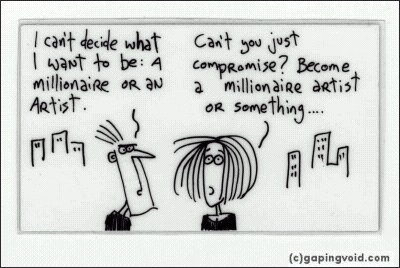
There are lots of great ideas and fantastic drawings over at gapingvoid. I really liked this section: how to be creative
Touchgraph can do a very interesting visual representation of your social network ala Facebook. For example:

To try this yourself, go their web site TouchGraph | Products: Facebook Browser
The good folks @  do a great job of presenting information on Web 2.0. They have presentations on RSS, wikis, blogs, social networking, and other topics. If you want a nice example of how to explain this information, go to their site:
Common Craft – In Plain English
P.S. Here is a YouTube version of one of their presentations.
James Fallows over at the Atlantic.com reviews and recommends: “A Flat World, A Level Playing Field, a Small World After All, or None of the Above?” by Edward Leamer of UCLA. There is a link to the article, as well as a summation of it, as well as a critique of Friedman. Quote:
* When I asked Friedman on the show why he said on virtually every page of the book that the world was “flat,” when he knew very well all the reasons it wasn’t, he disarmingly said: In the columnist game, you don’t sell things 51-49. You decide what you think is right, and you push that all the way. So, he could have more accurately said that the world is “flattening,” but that wouldn’t have had the ooomph.
For more, see James Fallows (September 07, 2007) – Golden Oldies: the world is not flat
This page CSS from the Ground Up | Web Page Design for Designers © is a great tutorial on CSS for people like me: new-to-the-topic (I hate the terms “dummies” or “noobies”…ugh.)
If you are going to make web pages and blogs and wikis, now you can make them attractive and easy to read. 🙂

Some of them don’t seem so bad now, while others are STILL ugly. Actually, the comments make you realize that the cars weren’t just ugly, but dangerous and deficient. Perhaps the article should be titled: The World’s Worst Cars.
It’s a fun read, and if you had one of these cars, you might cringe a little. 🙂
I blogged about this site before: HassleMe
It’s a great idea, but I think they need to make it more timely. Until then, based on my experience, I would recommend others ways to be reminded to do things.


