Some amazing work here: Glitched Sculptures of Greek Gods by Zachary Eastwood-Bloom Reimagine Classicism in the Digital Age.
From the good people at Colossal. Go to their site to see more of Eastwood-Bloom’s work.

Some amazing work here: Glitched Sculptures of Greek Gods by Zachary Eastwood-Bloom Reimagine Classicism in the Digital Age.
From the good people at Colossal. Go to their site to see more of Eastwood-Bloom’s work.
By Blake Gopnik, Andy Warhol Inc.: How He Made Business His Art – The New York Times.
By Jerry Saltz, on the Whitney retrospective of Warhol.
P.S. I think Andy would approve of being used on a skateboard.

From this superb piece, Jerry Saltz: How to Be an Artist, come this:
Step One: You Are a Total Amateur
Lesson 1: Don’t Be Embarrassed
Lesson 2: “Tell your own story and you will be interesting.” — Louise Bourgeois
Lesson 3: Feel Free to Imitate
Lesson 4: Art Is Not About Understanding. Or Mastery. (It is about doing and experience)
Lesson 5: Work, Work, Work
Step Two: How to Actually Begin
Lesson 6: Start With a Pencil
Lesson 7: Develop Forms of Practice
Lesson 8: Now, Redefine Skill
Lesson 9: “Embed thought in material.” — Roberta Smith
Lesson 10: Find Your Own Voice (then exaggerate it)
Lesson 11: Listen to the Crazy Voices in Your Head
Lesson 12: Know What You Hate
Lesson 13: Scavenge
Step Three: Learn How to Think Like an Artist
Lesson 14: Compare Cats and Dogs
Lesson 15: Understand That Art Is Not Just for Looking At
Lesson 16: Learn the Difference Between Subject Matter and Content
Lesson 17: See As Much As You Can
Lesson 18: All Art Is Identity Art!
Lesson 19: All Art Was Once Contemporary Art
Step Four: Enter the Art World
Lesson 20: Accept That You Will Likely Be Poor
Lesson 21: Define Success
Lesson 22: It Takes Only a Few People to Make a Career
Lesson 23: Learn to Write
Step Five: Survive the Art World
Lesson 24: Artists Must Be Vampires
Lesson 25: Learn to Deal With Rejection
Lesson 26: Make an Enemy of Envy
Lesson 27: Having a Family Is Fine
Step Six: Attain Galactic Brain
Lesson 28: What You Don’t Like Is As Important As What You Do Like
Lesson 29: Art Is a Form of Knowing Yourself
Lesson 30: “Artists do not own the meaning of their work.” — Roberta Smith
Lesson 31: All Art Is Subjective
Lesson 32: You Must Prize Vulnerability
Lesson 33: Be Delusional
But read the piece: the comments he provides are what gets to the heart of it.

Two worthwhile pieces on Jeff Koons: this Stop Hating Jeff Koons – The New York Times, and in a way, this.
I used to have great disdain for Koons, but the more I think about his work, the better appreciation I have for it. There is a ceiling to that appreciation: the emptiness of it imposes that. But Koons and his work gets me to think about art and the art world and the meaning of art and culture, and for that his work appeals to me.
However you think about him, those pieces are worth reading.
(Image via link to the NYTimes.com piece)
Not just for people who know little about art. Thanks Sister Wendy: you are missed. As are you, Francis Bacon, the painter of the image above.

Here are two good pieces full of advice for artists.
One big: Advice to Young Aspiring Artists from Patti Smith, David Byrne & Marina Abramović | Open Culture
One small: None of us know what will happen – Austin Kleon
Key quote from the Austin Kleon piece is this, from Laurie Anderson:
The world may end. You’re right. But that’s not a reason to be scared. None of us know what will happen. Don’t spend time worrying about it. Make the most beautiful thing you can. Try to do that every day. That’s it. You know? What are you working for, posterity? We don’t know if there is any posterity.
(Image from pexels.com)

That photo above is just one of the many photos over at Via Colossal of Venice at night. Far removed from the tourist busy city of day. Well worth visiting Colossal to see the rest.
Your city should be so lucky as to have Jim Bachor filling your potholes with amazing mosaics such as this:

For more on it, see: Mosaic Vermin Invade New York City as Part of Jim Bachor’s Latest Pothole Interventions at Colossal. Also, search from him on Instagram: he posts regularly and he does a wide range of mosaics. And he travels, so maybe your city is next.

A good item to add to your bucket list, if you are a fan of Basquiat: travel the world and see all the places where his works are displayed. To do that, you will need this list: Where to See Basquiat Around the World – Barron’s. And money. And time.
After you do that, you can go see all the Vermeers in the world!
(Image: Wikiart.org)
Sounds impossible, but if you go here and watch the enclosed video, you will feel confident you can watercolor too: How to watercolor: In under 3 mins.
That particular post comes from Danny Gregory , who has a great blog for all of us artists. (That’s you too). Well worth reading.

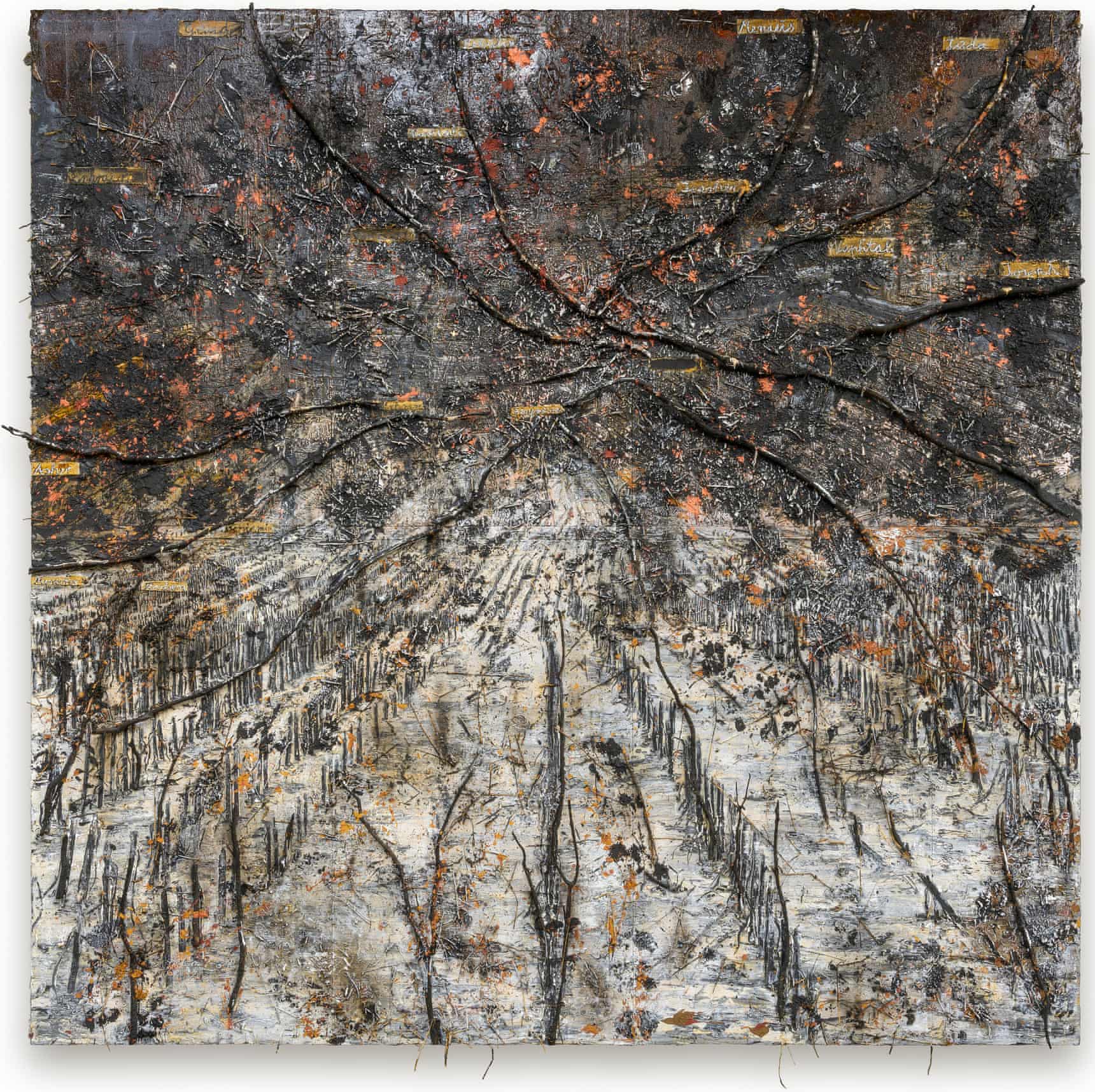
For fans of Anselm Kiefer, there is an in depth discussion of this particular work, here:
Heroic Symbols 1969 by Anselm Kiefer – In Focus | Tate
If you are Philip Glass you can. And likely anyone who has the capacity to make art can as well. It may take you longer, but you can do it. To see how he did it, see this piece: How Philip Glass Went From Driving Taxis to Composing – The Atlantic

What if your goal was to see all the Vermeer paintings in the world? There are not that many: you just need to travel a lot to do it. One person set out to do that. See Vermeer Goals for details.
This is a terrible title for a good article of the women that Francis Bacon painted: Sex Scenes: Francis Bacon’s Bohemian Muse, Lesbian Bartender and Artist/Model – GARAGE
Besides the article, the close up photos are worth viewing: you can really get an appreciation for Bacon’s brush work in the photos.

According to this, art can make us more confident by providing us with stories and representations of people with characteristics we share that overcome similar obstacles that we run up against. After all….
Confidence isn’t the belief that we won’t meet obstacles. It is the recognition that difficulties are an inescapable part of all worthwhile contributions. We need to ensure we have to hand plenty of narratives that normalise the role of pain, anxiety and disappointment in even the best and most successful lives.
I agree.
The image is an extended version of the work highlighted in the article. Like the Stations of the Cross and other works, they illustrate the difficulties of a way of life, and by making us aware of them, allow us to best prepare to meet them and overcome them.
These sculptures by John Peralta are beautiful. Here’s one

You can see more here: Machinations: Historical Machines Exploded into Individual Components in Sculptures by John A. Peralta | Colossal
They’re as basic as notebooks get, and cheap to boot. But as you can see from
via Austin Kleon’s Tumblr, some great artists have done fine things with them.
Go to a stationery shop or dollar store and get yourself one or two or more and get creating.

Sadly, I don’t know enough women artists. If this is you as well, then you want to check out this piece: You know Monet and Manet. This female Impressionist deserves your attention, too. – The Washington Post. I agree: Morisot is one artist you should know better.
As well as doing a good job of summarizing this great artist, hey highlight the travelling show that is currently running and highlighting her work. If you can, it would be well worth visiting it if it coming near you. (Currently it is Quebec City.)
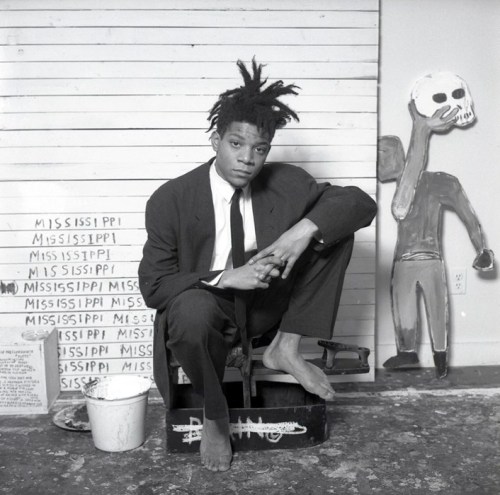
I hadn’t seen this before, but for fans of the artist, this is a must view: The Unknown Notebooks of Jean-Michel Basquiat – The New York Times.
I love everything about NYC in the 80s, and I especially like this.

Someone made a reference to outsider art this week and it sent me researching some links on it. Like Dada, outsider art is one of the most interesting things about 20th century art, though of course it has no specific time period. It challenges everything about the art world, even as the art world tries to incorporate it.
If you don’t know much outsider art, here are some places you can start to learn more:
From there, Google as much as you can.
(Image of Jean Dubuffet via the Guggenheim)

Despite being burned too many times by Kickstarter projects, this one seems so worthwhile I feel I must promote it: Color Problems – A Book by Emily Noyes Vanderpoel by The Circadian Press with Sacred Bones — Kickstarter. It’s a great project to recreate a classic book, and it will be a boon to many people if it gets off the ground. Anyone interested in the visual arts should check it out and contribute some way if you can.
I hope it’s successful, that the project initiators have 1) their act together 2) actually release something tangible and 3) in a timely manner that is high quality. (Many of my recent Kickstarter projects have failed at 1, 2 and 3.)
Good luck to them.

First off, I think the quilts by Elizabeth Elliott are beautiful. Besides their beauty, I found it remarkable how she goes about making them. According to this piece, Quilts Made of Code by Elizabeth Elliott – Design Milk, the quilts are designed…
using a programming language called Processing. Through Processing, Elliott edits coding and generates random formations of geometric and traditional quilt block shapes. Afterward, she plays and edits the configuration until it becomes a quilt design she likes.
Here’s one more:
.
Go see the Design Milk article to see more and get more information.
I love the ceramics of Hewitt, especially for the way she works in digits as part of the overall work. Such as this piece

and this:

Now here’s what’s great. First, you can see more of her work here, at Colossal:
Kernel Panic: New Binary Ceramics Punctuated with Typewriter Keys by Laura C. Hewitt
Second, you can buy her work here, at her Etsy store!
It’s rare I can share work that is not only beautiful but that you can acquire. Glad I can do that here.
Now, you might think: ugh, painting is alot of work. But as this piece shows, there’s some good paint jobs you can do in a weekend that still leaves you time to do other things.
For example, you can paint a door:
Or even just part of a wall, like the moulding:
The piece in Apartment Therapy is worth looking at to get ideas. If you’ve been tired of looking at the same old space and you don’t want to get new furnishings, a splash of paint can do the trick of improving the space.
Another option: do a painting (or buy a painting if shopping vs doing is your thing). This article has lots of examples, such as this:
And if you think: I suck at art, then read this piece in Hypoallergic about how making art, no matter how bad, can reduce stress.
Now head to the paint store and start your next project.
(See the articles for credits for the pictures.)

The wire tree sculptures by Clive Maddison are worth a look. Amazing transformation of simple wire into a complex sculpture. From Colossal. Link here: Dense Wire Tree Sculptures by Clive Maddison

Sure, to make a great film, great equipment helps. But as these links (and that photo of Zach Snyder shows), you can also make a good film using the latest smart phone technology. And not just Snyder: Gondry does it too. All the links below can help you get started making films using the technology in your pocket. Your films may not be as good as those, but the sooner you start making films with what you have on hand, the better your later films will be.

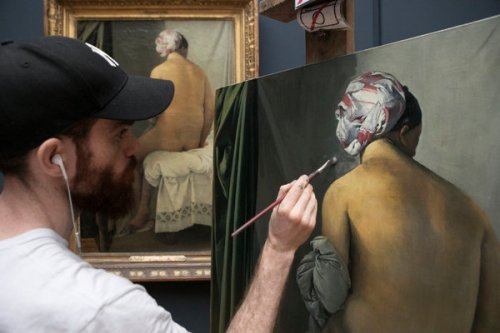
Easy! Just follow these three simple steps:
Ok, it’s not quite that easy. Even if you can perfectly reproduce the work you stand before, the staff of the Louvre take steps to insure no one mistakes your work for the original, as this NYTimes article points out. For example, in this article, they made sure that the copyists used
canvases that were one-fifth smaller or larger than the original, and that the original artists’ signatures were not reproduced on the copies. Then (the staff) stamped the backs of the canvases with a Louvre seal, added (the staff’s) own signature and escorted (the copyists) from the museum.
It’s a fine article highlighting a great tradition of the Louvre: well worth reading.
(Photo by IVAN GUILBERT / COSMOS and linked to in the article)

Over at Colossal they have a gorgeous collection of images by Visarute Angkatavanich of Siamese Fighting Fish in all their glory. Beautiful fish, captured beautifully in the photographs of Angkatavanich.
I’ve loved the work of Robert Montgomery for some time. One of my favorite works of his is this:

You can see many more of his work at his site, here: ROBERT MONTGOMERY.
Worth a visit.

This is just one example of the stunningly intricate and beautiful multi-layered laser-cut wood artworks by Martin Tomsky featured over at Colossal. If you look carefully at the image you can see the layers of overlaid wood pieces.
I highly recommend you go to the site and see the rest of his work. Fantastic.

Or at least a high resolution image of Vermeer by going here:
Open Culture has lots of great links, including at the bottom of the Vermeer one, mentioned above. Open Source is good; so is Open Culture.
(Image linked to on the Open Culture page)

And the NYTimes has an update on where he is in his life and his career, here: David Hockney, Contrarian, Shifts Perspectives – NYTimes.com.
I have always admired Hockney both for the wonderful lushness of his paintings and for the way he speaks about art. Both of those admirable qualities are on display in the piece in the Times. He’s in his 80s now: I hope he continues to work and speak for some time to come.
(Image linked to in the NYTimes and taken by Nathanael Turner)
And the New York Times has a good analysis of here work so far. I really enjoyed the analysis. As for me, I found it interesting that she has transitioned the account from a basic one that recorded events the way most of us do into something that extends her art in a way few of us can do. I also like that great artists like Sherman can take new media and incorporate it into their work but also extend it. David Hockney did something similar with the Brushes app. Here's hoping more artists do such things.

The big art news this week was a record sale for one of Jean-Michel Basquiat’s paintings. Right after reading about that, I saw this tweet by Will Black: “Painting by street artist Basquiat, who lived in a cardboard box, sells for $110.5m in New York. Value PEOPLE while they are ALIVE”.
A few thoughts on that tweet. First, while Basquiat may have been poor starting out, by the time he died too young at the age of 27, he had a net worth of $10 million dollars. Second, that transition from poverty and obscurity to wealth and fame was fast. We should value people while they are alive, but there are better people to use as an example than Jean-Michel Basquiat.
As for my own thoughts, I have always loved Basquiat’s paintings since the 80s. Their greatness was there from the beginning. If we knew nothing else about the artist than his work, we would still think he was great.
But Basquiat was not just a painter: he was more like a rock star. Like Keith Haring, he had a public persona more akin to music superstars much in the same way that Andy Warhol did. It’s no surprise that Basquiat was influenced by Warhol in more ways than one. And now, at least in the world of the art market, he has surpassed Warhol. It’s good to see that too. For many reasons.
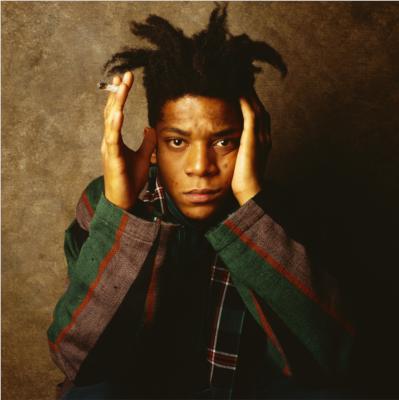
Jean-Michel Basquiat had something else that was great, and that was his sense of style. There’s a good piece in Dazed on the importance of clothing to him. They correctly note that:
Jean-Michel Basquiat was a fashionable man. He walked the Comme des Garçons runway for their SS87 collection and favoured the long, slim cut, slightly militaristic jackets of Issey Miyake. Biographers and friends recall the stories of Basquiat setting up tabs at his favorite clothing boutiques, trading canvasses for clothes.
Jean-Michel Basquiat was a legend for his time, and a star. It’s good to see that star is getting brighter.
For more on his fashion, see: The meaning and magic of Basquiat’s clothes | Dazed. It’s a strong piece.

Whatever you think of George W. Bush as a president, most agree he is not bad painter. There are two reasons for the latter: one, he had good teachers, and two, he is a good student. How do I know he had good teachers? According to this, Art critics alarmed to discover that George W. Bush is actually a pretty good painter, Bush…
… didn’t have to sign up for classes at a local art school or the museum, of course. Instead, he took private lessons from a prominent Dallas artist named Gail Norfleet. Norfleet wrought a change in Bush’s worldview. He began to see the colors even in shadows, the subtle shifts of palette in a clear blue sky. “I was getting comfortable with the concepts of values and tones,” Bush writes in the introduction to his book. Norfleet also thoughtfully introduced the once monochromatic president to her mentor, another well-known Dallas artist named Roger Winter, and it was he who gave Bush the idea to paint world leaders. Bush also consulted a landscape painter, Jim Woodson, whose visions of the vast, untouched terrain of New Mexico are nothing like the conventional bluebonnet vistas many still associate with Texas art. It was Woodson who introduced Bush to, among other things, larger canvases and thicker paint, and guided him toward a more complex view of the world about him. (Underlying by me for emphasis).
Bush took the lessons from these teachers to heart. But he was fortunate to have access to good teachers. A lesson for us all.
Artist Karina Puente is illustrating Italo Calvino’s ‘Invisible Cities’ and the web site ArchDaily has a sample of some of her work, including the image you see above.
I hadn’t expected to like illustrations of this book. The writing itself is so evocative, I would have thought that illustration would limit it. I make an exception for these works: they complement rather than reduce the writing.
I’d love to see an edition of Invisible Cities filled with Puente’s illustrations. For now, we can enjoy what we see at Archdaily.com.

Colossal has some gorgeous paper sculptures on exhibit on their site. Created by Matthew Shlian, they are well worth seeing. Click the link to see.
If you love art, but believe you have to have tons of money or an art history degree to have an art collection, then take a few minutes and watch the above videos from the good people at art interiors (two of whom are in the video). After watching it, you’ll feel it’s something you can achieve, I’m sure.
Next step? I recommend a visit to their site and store to see what they have that suits you.
Good luck!
I am always on the lookout for links to Gerhard Richter, one of my favorite artists. Here are two good ones:
Michael Massaia spends his sleepless hours haunting NYC and Central Park, taking incredible photos. This is just a sliver and doesn’t do his photos justice:

If you can’t sleep and want to see what one person can do in the sleepless hours, see, Haunting images of New York City’s Central Park from Michael Massaia. His photos are great.