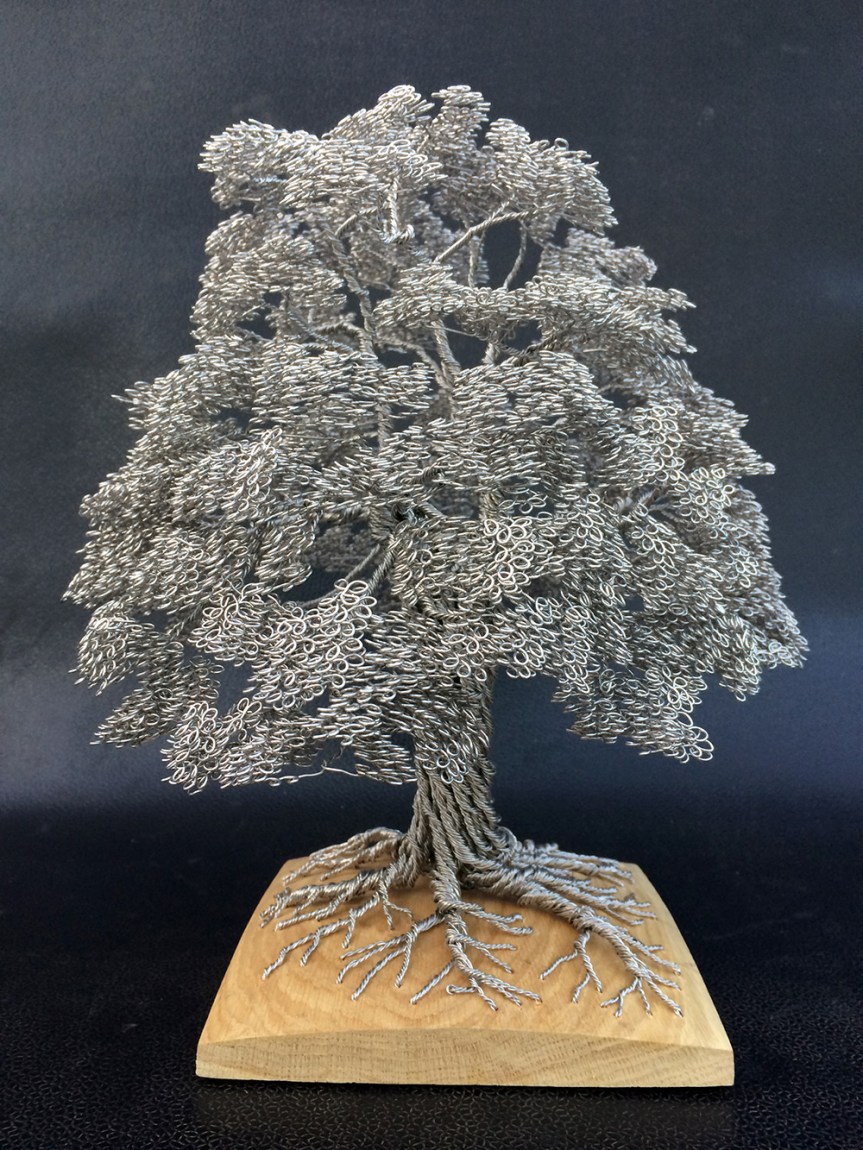
The wire tree sculptures by Clive Maddison are worth a look. Amazing transformation of simple wire into a complex sculpture. From Colossal. Link here: Dense Wire Tree Sculptures by Clive Maddison
The wire tree sculptures by Clive Maddison are worth a look. Amazing transformation of simple wire into a complex sculpture. From Colossal. Link here: Dense Wire Tree Sculptures by Clive Maddison

Sure, to make a great film, great equipment helps. But as these links (and that photo of Zach Snyder shows), you can also make a good film using the latest smart phone technology. And not just Snyder: Gondry does it too. All the links below can help you get started making films using the technology in your pocket. Your films may not be as good as those, but the sooner you start making films with what you have on hand, the better your later films will be.
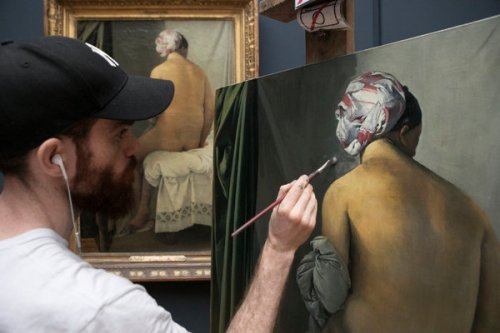
Easy! Just follow these three simple steps:
Ok, it’s not quite that easy. Even if you can perfectly reproduce the work you stand before, the staff of the Louvre take steps to insure no one mistakes your work for the original, as this NYTimes article points out. For example, in this article, they made sure that the copyists used
canvases that were one-fifth smaller or larger than the original, and that the original artists’ signatures were not reproduced on the copies. Then (the staff) stamped the backs of the canvases with a Louvre seal, added (the staff’s) own signature and escorted (the copyists) from the museum.
It’s a fine article highlighting a great tradition of the Louvre: well worth reading.
(Photo by IVAN GUILBERT / COSMOS and linked to in the article)

Over at Colossal they have a gorgeous collection of images by Visarute Angkatavanich of Siamese Fighting Fish in all their glory. Beautiful fish, captured beautifully in the photographs of Angkatavanich.
I’ve loved the work of Robert Montgomery for some time. One of my favorite works of his is this:

You can see many more of his work at his site, here: ROBERT MONTGOMERY.
Worth a visit.

This is just one example of the stunningly intricate and beautiful multi-layered laser-cut wood artworks by Martin Tomsky featured over at Colossal. If you look carefully at the image you can see the layers of overlaid wood pieces.
I highly recommend you go to the site and see the rest of his work. Fantastic.

Or at least a high resolution image of Vermeer by going here:
Open Culture has lots of great links, including at the bottom of the Vermeer one, mentioned above. Open Source is good; so is Open Culture.
(Image linked to on the Open Culture page)

And the NYTimes has an update on where he is in his life and his career, here: David Hockney, Contrarian, Shifts Perspectives – NYTimes.com.
I have always admired Hockney both for the wonderful lushness of his paintings and for the way he speaks about art. Both of those admirable qualities are on display in the piece in the Times. He’s in his 80s now: I hope he continues to work and speak for some time to come.
(Image linked to in the NYTimes and taken by Nathanael Turner)
And the New York Times has a good analysis of here work so far. I really enjoyed the analysis. As for me, I found it interesting that she has transitioned the account from a basic one that recorded events the way most of us do into something that extends her art in a way few of us can do. I also like that great artists like Sherman can take new media and incorporate it into their work but also extend it. David Hockney did something similar with the Brushes app. Here's hoping more artists do such things.
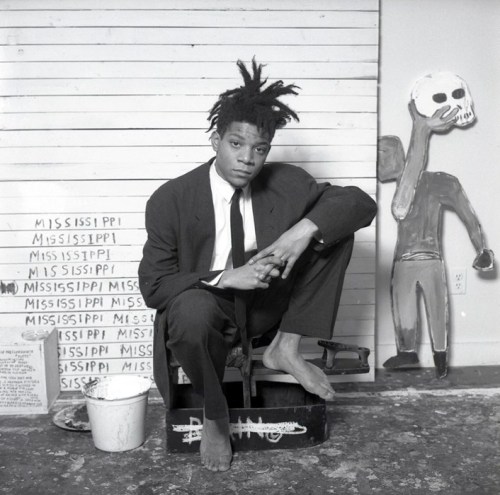
The big art news this week was a record sale for one of Jean-Michel Basquiat’s paintings. Right after reading about that, I saw this tweet by Will Black: “Painting by street artist Basquiat, who lived in a cardboard box, sells for $110.5m in New York. Value PEOPLE while they are ALIVE”.
A few thoughts on that tweet. First, while Basquiat may have been poor starting out, by the time he died too young at the age of 27, he had a net worth of $10 million dollars. Second, that transition from poverty and obscurity to wealth and fame was fast. We should value people while they are alive, but there are better people to use as an example than Jean-Michel Basquiat.
As for my own thoughts, I have always loved Basquiat’s paintings since the 80s. Their greatness was there from the beginning. If we knew nothing else about the artist than his work, we would still think he was great.
But Basquiat was not just a painter: he was more like a rock star. Like Keith Haring, he had a public persona more akin to music superstars much in the same way that Andy Warhol did. It’s no surprise that Basquiat was influenced by Warhol in more ways than one. And now, at least in the world of the art market, he has surpassed Warhol. It’s good to see that too. For many reasons.
Jean-Michel Basquiat had something else that was great, and that was his sense of style. There’s a good piece in Dazed on the importance of clothing to him. They correctly note that:
Jean-Michel Basquiat was a fashionable man. He walked the Comme des Garçons runway for their SS87 collection and favoured the long, slim cut, slightly militaristic jackets of Issey Miyake. Biographers and friends recall the stories of Basquiat setting up tabs at his favorite clothing boutiques, trading canvasses for clothes.
Jean-Michel Basquiat was a legend for his time, and a star. It’s good to see that star is getting brighter.
For more on his fashion, see: The meaning and magic of Basquiat’s clothes | Dazed. It’s a strong piece.
Whatever you think of George W. Bush as a president, most agree he is not bad painter. There are two reasons for the latter: one, he had good teachers, and two, he is a good student. How do I know he had good teachers? According to this, Art critics alarmed to discover that George W. Bush is actually a pretty good painter, Bush…
… didn’t have to sign up for classes at a local art school or the museum, of course. Instead, he took private lessons from a prominent Dallas artist named Gail Norfleet. Norfleet wrought a change in Bush’s worldview. He began to see the colors even in shadows, the subtle shifts of palette in a clear blue sky. “I was getting comfortable with the concepts of values and tones,” Bush writes in the introduction to his book. Norfleet also thoughtfully introduced the once monochromatic president to her mentor, another well-known Dallas artist named Roger Winter, and it was he who gave Bush the idea to paint world leaders. Bush also consulted a landscape painter, Jim Woodson, whose visions of the vast, untouched terrain of New Mexico are nothing like the conventional bluebonnet vistas many still associate with Texas art. It was Woodson who introduced Bush to, among other things, larger canvases and thicker paint, and guided him toward a more complex view of the world about him. (Underlying by me for emphasis).
Bush took the lessons from these teachers to heart. But he was fortunate to have access to good teachers. A lesson for us all.
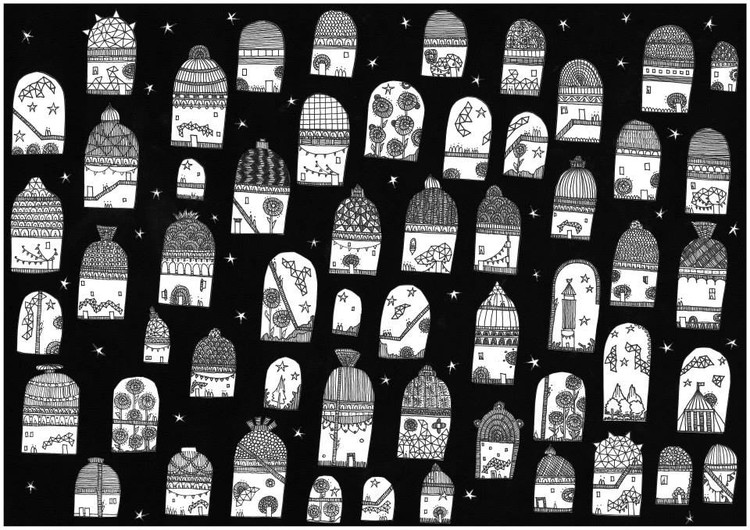
Artist Karina Puente is illustrating Italo Calvino’s ‘Invisible Cities’ and the web site ArchDaily has a sample of some of her work, including the image you see above.
I hadn’t expected to like illustrations of this book. The writing itself is so evocative, I would have thought that illustration would limit it. I make an exception for these works: they complement rather than reduce the writing.
I’d love to see an edition of Invisible Cities filled with Puente’s illustrations. For now, we can enjoy what we see at Archdaily.com.

Colossal has some gorgeous paper sculptures on exhibit on their site. Created by Matthew Shlian, they are well worth seeing. Click the link to see.
If you love art, but believe you have to have tons of money or an art history degree to have an art collection, then take a few minutes and watch the above videos from the good people at art interiors (two of whom are in the video). After watching it, you’ll feel it’s something you can achieve, I’m sure.
Next step? I recommend a visit to their site and store to see what they have that suits you.
Good luck!
I am always on the lookout for links to Gerhard Richter, one of my favorite artists. Here are two good ones:
Michael Massaia spends his sleepless hours haunting NYC and Central Park, taking incredible photos. This is just a sliver and doesn’t do his photos justice:

If you can’t sleep and want to see what one person can do in the sleepless hours, see, Haunting images of New York City’s Central Park from Michael Massaia. His photos are great.
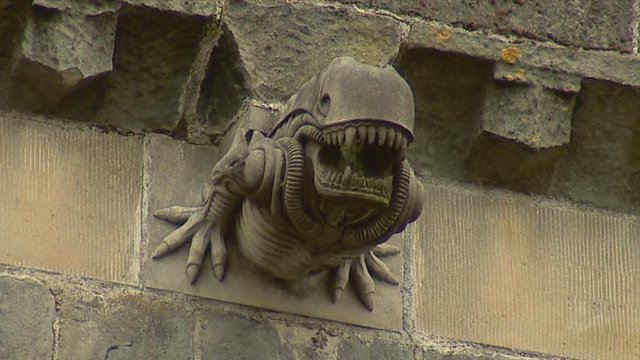 It’s not a hoax: there is a gargoyle on a 13th century abbey that looks like something out of Alien. Seems the old gargoyles were falling apart and artisans were recently brought in to make new ones…and well, someone took a few liberties.
All of the new beasts attached to the abbey are excellent. You can see more of them, and more of the story, here: ‘Alien’ gargoyle on ancient abbey from BBC News
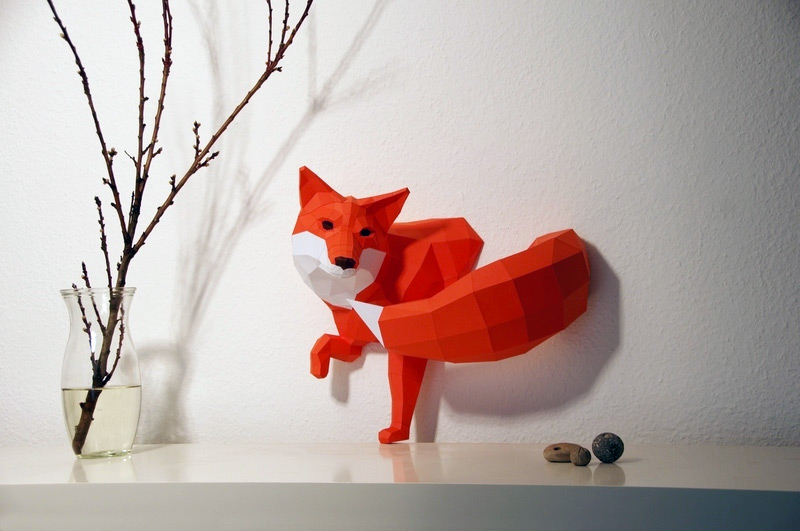 These paper sculptures by Wolfram Kampffmeyer (aka Paperwolf) are gorgeous. You buy them and make them yourself. Simply go to Etsy, here, and order a from a range of different animals, sizes, and prices. Great gift idea, too.
If you want to see more of them, you can also check them out here: DIY Geometric Paper Animal Sculptures by Paperwolf. Not surprisingly, from Colossal.
Cartoons! Well, there’s more to it than that, as this fascinating post shows: The secret to great Renaissance art: tracing (Vox).
I knew Renaissance artists did sketches: I didn’t know that they used them as stencils. In hindsight, it makes sense: to make such great paintings, it is best to work them out in detail first and then focus on paint.
This 1966 interview, in the Paris Review, is a must read for fan of the writer Jorge Luis Borges.

Just from a technical point of view, these Incredible Peacocks Constructed from Beauty Supplies over at Colossal are amazing. However, they are not just technically amazing, but aesthetically quite striking, too.
Collosal has more photos showing this work. Well worth seeing.
The first one is a summary of his new show in L.A.: David Hockney unveils new works on perspective created in Los Angeles | Art and design | The Guardian.
The second one is a meaty interview: David Hockney: ‘Just because I’m cheeky, doesn’t mean I’m not serious’ | Art and design | The Guardian.
I enjoyed the interview alot: it is a great review of his career, plus it talks about many other great artists of the second part of the 20th century.
Anyone interested in modern art would enjoy both of these.
It is easy to think of Kickstarter as mainly a platform for massive projects. One example of that is the insane success of the recent Kickstarter project, Exploding Kittens (it raised the money it needed in 20 minutes and now is raking in millions of dollars), but it is only one example of many over the last few years. I started to associate Kickstarter solely with such projects.
But Kickstarter is for lots and lots of people, many of them raising modest sums to do something worthwhile but on a much much smaller scale than “Kittens”. A good example of that is this project, Naked by Betty — Kickstarter.
The project is “A series of (self portrait) photographs capturing the beauty of the human body beneath the skin.” (The image above is from the project description.) The artist was looking to raise $680 to pay for material needed to complete the work. It’s a reasonable amount, and the ability for projects like this to be successful is what made Kickstarter great to me.
I highly recommend this project. (I also backed it.) And there are lots and lots of projects like that out there. I recommend you look past the high profile projects on Kickstarter and other such sites and look to the smaller projects instead. You (as a project sponsor) and the project owners will both benefit.
It’s Wednesday. You are feeling stressed. Maybe you should go out on your lunch break and get some crayons and do some art work. According to this,
Coloring ….Can Actually Help Adults Combat Stress.
And if you think, “who does that?”, you should know that in France, the UK and Spain, coloring books for adults are very popular.
There are worse ways to deal with stress than adding some color to a blank book. Might be worth a try.
Then send them over to this really smart post by Sarah McIntyre: i want to make cartoons & comics but i have no idea where to start!. It’s packed with great advice and plenty of links for anyone who would love to do this but is stuck on how to start.

Superb. (Image is a link to her post.)
Looking to do something different this weekend? Consider these projects:
Making Pop Art – Apartment Therapy.
In the zone: Organized home storage solutions
The Food Lab: Make Your Own Just-Add-Hot-Water Instant Noodles (and Make Your Coworkers Jealous)

Why? Because it is their annual festival of the smalls. As you can see from the JPEG above, they have art from $55-$250. Great pieces too. Perfect for the Holidays.
Want more info? Go here: Affordable Artwork / Art Interiors / Toronto Art Gallery. Bonus: lots of the work is viewable online.
Highly recommended. Make it a holiday tradition.

More great images here, at Fubiz.

There was a lot of talk when Cory Archangel published the book above. Essentially it is a collection of tweets from others tweeting about…well, working on their novel! It’s clever, but it made me think that it is just the beginning of works of arts that could be mined from the colossal amount of tweets each day. There’s gold in there amongst all the twitter rage and minutiae about people’s day. It deserves better.
Meanwhile, more about that book, here: A Novel Compiled From Crowd Sourced Tweets About Writing A Novel | MAKE.
This campaign, Better by Bike, for the city of Buenos Aires is excellent. Here’s just one of the posters for it.

I recommend you click on the link in this post to see more great posters.

This porcelain is not just amazing, it is something you can buy. And not just robots, but sea monsters and flying monkeys too. Perfect for anyone needing a house warming. 🙂
I love the detail: the robot is in the middle of the plate and also all around the edge.
Via the always interesting Colossal blog.

Not your everyday Lego project, to be sure. And yes, this is just as amazing as you might think. Hell is no less scary when done using blocks.
For the entire series, see: The nine circles of hell from Dante’s Inferno recreated in Lego by Mihai Mihu – Telegraph
It nicely highlights the sculptural aspect of Lego is only limited by the imagination of the builder-artist.
Whatever you think of the veil( be it banning or embracing it ), you owe it to yourself to read this article at the site, Free Arabs: Beauty and the Veil. There’s a good review of a show by the Moraccan artist Majida Khattari called “Orientalismes.” After you have seen that, head over to her site for more great work, like this:

Check out the rest of the Free Arabs site: it’s packed with good content.
If you go to galleries occasionally, you may pick up reading material that is written in art-speak. There’s a reason for it, and a guide to how to deal with it, here: A user’s guide to art-speak (The Guardian).
You can ignore the guides and the reading material, but often times it helps to at least take a stab at gaining an expert’s thoughts on the exhibit before you. If it is art-speak, this guide can help.
Over at Somewhere Prints are these great Geometric Art Prints by Gary Andrew Clarke, including this one: American Gothic Remixed (2009).

Lots of great images from Clarke and others, too.
There are many ways to do this, of course: go to galleries, talk to knowledgeable friends, read through magazines, or check out this part of Saatchi Online called One to Watch.
The entire Saatchi Online site is good, but I thought this one section especially so.
 Smart People I Know