What you should have with you if you are in the hospital for a few days (and other tips)

Untitled

Based on my experience of being in the main part of the hospital as well as the ICU, I recommend that if you are going to be there a few days, ask someone to bring you the following:

Phone and phone charger: this is a must. You need to be able to keep in touch with people, and your phone is the best way to do that. Plus it can be a source of other information and entertainment.

(If you are conscious and not in too much pain, you will find the hospital very boring. Also the one time I did not have my phone I was left in a hallway and unable to move for over an hour until a porter came and got me. It sucked big time. You want to avoid that.)

Earplugs / noise reduction headphones / headphones: it is hard to get rest in the hospital. Even in the middle of the night it is a busy place, and staff are always about and not quiet. Earplugs and noise reducing headphones can help you defeat that noise.

Also, headphones (noise reducing or no) mean you can listen to your phone for entertainment and news.

Sleep mask: it can be hard to sleep in the hospital. Especially in the ICU, nurses are waking you all the time for checks and tests, which means you need to grab some sleep any time you can. Sometimes the best time to sleep is between breakfast and lunch. A mask can help you sleep any time of day.

Toothbrush, hairbrush and grooming supplies: unless you don’t care how you look, being able to take care of yourself can make you feel a bit better. I was able to have a shower after 5 days in the ICU and being able to clean up and brush my hair and look better made me feel better about my current state.

Blanket and pillows: if you can, have someone bring you a comforting pillow and blanket…maybe a nice sweater. Such things can make you feel good and even help you sleep and get more rest. You’ll need that, and you aren’t going to get too much comfort from the bedclothes the hospital provides. (Also if you are cold, you can ask the nurses for more blankets.)

Water bottle: it can be dry in the hospital. Having a source of water you can drink any time helps with that (assuming you can drink water). It can also help with coughing and if you have meds to swallow, having water can help with that.

Snacks: Often you may not want to eat the hospital food. Having acceptable snacks to eat mean you won’t have to deal with being hungry on top of everything else.

Other tips:

  • Go vegetarian: while I am not a vegetarian, I found going with a vegetarian diet helped. The food tended to be more flavourful and less disgusting than the meat dishes I was initially eating.
  • Move around: if you can, move around. Even getting out of the bed and walking around the room was a big lift for me. Have someone accompany you as you got down the hallway. I got to go to the shopping area in Sunnybrook after being in the ICU and ward for seven days, and it was delightful. Don’t let the bed trap you.
  • Always ask for more: don’t settle for what is provided. Ask if you can move around. Ask if people can bring you food. Ask the nurses for more food if you are hungry. Ask if you can go to the bathroom by yourself. Ask to see the doctor. Ask when you can go home. Don’t accept the status quo. Everyone in the hospital is busy or preoccupied. If you don’t ask, you may be unnecessarily making things worse for yourself.
  • Ask different nurses for advice: Once I was lucky to get a nurse who offered me different treatment than the other nurses and that improved my condition and my stay immensely. Don’t forget: every nurse is different. Some have a better bed side manner, others are technically better…occasionally you may get one who should take up a different profession. Regardless, don’t assume they are all the same.
  • Know your medication schedule and track it: a few times in the hospital I didn’t get the medication I needed when I needed it and I was too unsure to ask, and that led to needless suffering. Know when you should get your meds, especially those for pain relief, and ring the nurses if they are late. (They may be late because they are busy but they just may have lost track of time.)
  • If the medication doesn’t seem to be working, say so: don’t assume you don’t have options. If the medication isn’t helping you, ask if there alternatives and ask for the pros and cons of them.
  • Be appreciative of those who are helping you: it is difficult for them too, even if you are the one who is ill. Do what you can to make it easier for them and make sure they know how thankful you are for what they are doing for you, whatever it is. This also goes for the staff. Healthcare can be a hard job: you can make it easier for the people working in the hospital by being kind.

Boxing day advice, recycled

Rather than write something new for Boxing Day, I thought I would recycle some of my old posts, such as:

Ten good pieces of good advice

Untitled

  1. Here’s some simple advice for personal finance.
  2. Something to think about after the holidays: Paul Graham on Work.
  3. For small home lovers:  How to downsize before you move into a small home.
  4. Relatedly, here’s the difference between Peter Walsh and Marie Kondo’s decluttering methods.
  5. Here’s Martha on things that make your home look messy.
  6. For those feeling hopeless: the joy was leaking out of my life… talking to a friend saved me.
  7. In case you are feeling down, here’s a mental health wellbeing check in.
  8. A good list: 50 things I know.
  9. Also good: to lead a meaningful life become your own hero, perhaps.
  10. I don’t agree with this, but it’s interesting: saving seconds is better than hours.

The Christmas Trees of NYC

peninsula hotel xmas tree

There are many reasons why Christmas in New York is special. One reason is that New Yorkers go all out when it comes to decorations. Especially when it comes to Christmas trees. Sure, the Christmas tree in Rockefeller Center is great, but you’d be missing out if you went to Manhattan and only saw that one. There are at least 15 Christmas Trees in NYC that are great and not in Rockefeller Center, as that link will prove. Check some/all of them out. You’ll be glad you did.

On the value of keeping a Christmas list (and why you might want to do so)

Back in 2005 I created a Microsoft Word document titled Christmas 2005. I did this because it seemed like Christmas was becoming a project in itself, with milestones and deliverables, and having such a document helped me keep on top of things. The document had a calendar, breakdown of things to do (e.g. get gifts for A and B, prepare food Y on date Z), and eventually it had lessons learned. (Hey, I’ve done a fair bit of project planning over my career…it’s a skill you tend to apply to everything.) Every year since 2005, I would take the previous year’s list, duplicate it, and modify the duplicate for the new year. Voila: new list!

But I kept the old lists, and I’m glad I did. I can see my life change year over year. People come and go. The gifts you buy for people change, especially kids.  Technologies change (no more need to buy VCR tapes to record the kids). Traditions evolve. Even details like the price of Christmas trees over the years makes an impression viewed over time. The list remains the same, but the content changes, sometimes dramatically.

I encourage you to keep your own such records for Christmas and other special events over the years. At first it might not seem like much, but if you keep at it, you will have a special journal of an event that meant much to you over time.

Everyone has their own way of planning special events, from structured plans like me to having it all in their head. However you do it, try keeping a record of it. This year. And next year. And the next.

Merry Christmas. Did you get all those things done you said you were going to? No? Better write it down and get to it. 🙂

Lessons learned from working on my Raspberry Pi devices (and Raspberry Picos too)

This week I successfully set up five Raspberry Pi devices at home: 3 Pi Zeros, 1 Pi 400, and 1 Pi original. Plus I have two old C.H.I.P. computers that work. I had struggled with using them in the past, but this time it was a breeze due to the lessons I’ve learned. Here’s some of these lessons:

Get wireless ones: I originally had Pi Zeros and Picos without wireless capability. And that can be fine if you know you don’t need it. But it is helpful to be able to have them communicate wirelessly and it gives you more flexibility, even if it costs a few more bucks.

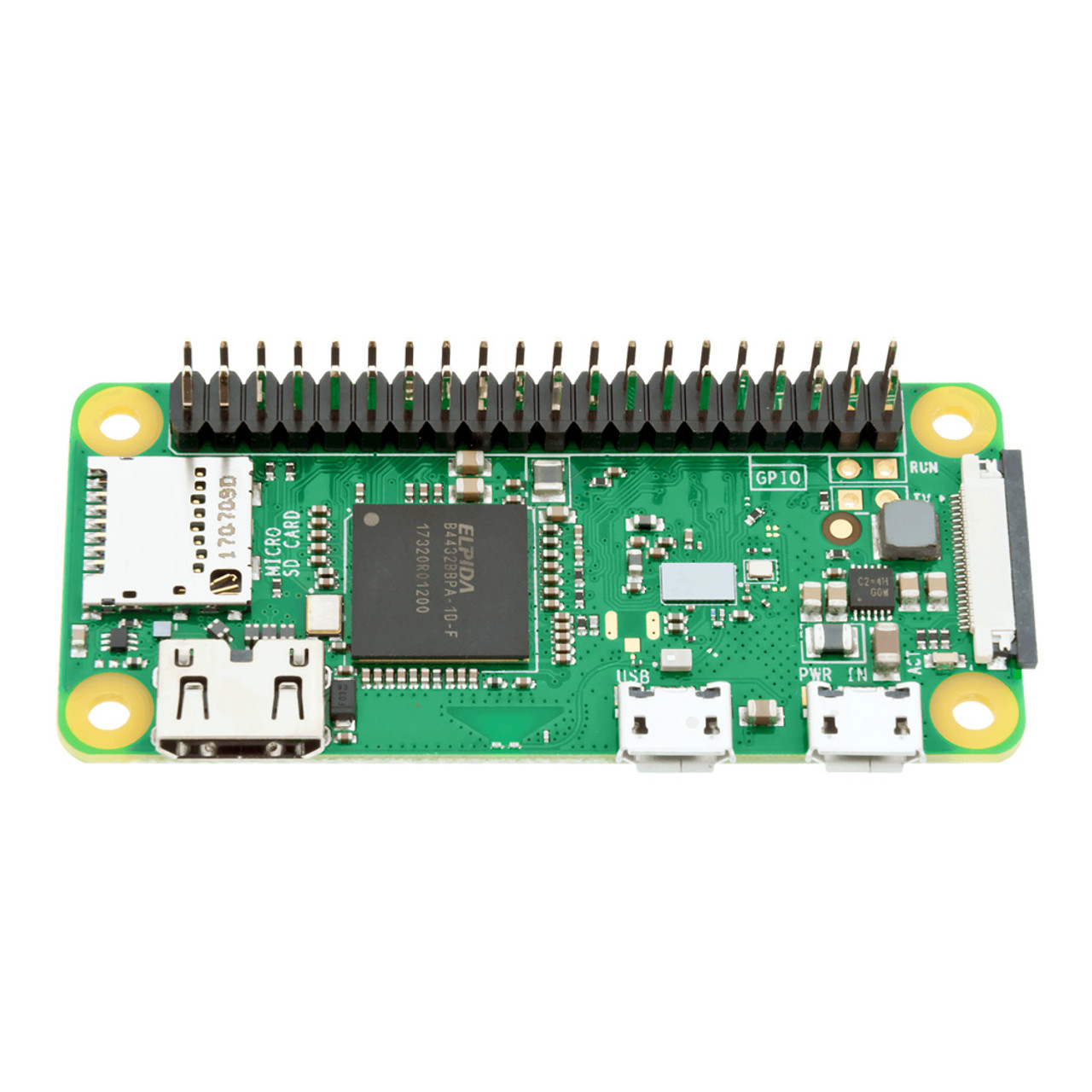
Get headers: again, I had some Pi Zeros and Picos without headers. Unless you are good with soldering, get the ones with headers. It just makes it easier physically  connect them to other technology. The Pi Zero above has no headers, the one below does.

Keep track of all the connectors you need and kept them handy: With the Pi Zeroes, I have a set of adapters that allow me to connect it to power, USB and HDMI. Once I have it set up, I just need a cable to provide power and I run it in headless mode (which I can do because of wireless). I have a special box for all that stuff so I can easily find it.

Give your Pis unique hostnames: if you are going to be connecting to them via ssh or scp, then give them a unique host name. You can do this when you set them up. What’s nice about that is once they connect to the wireless network, I can easily identify them. For example, I can ping pizero1 or I can ssh myuserid@pizero2 versus trying to find out their IP address of 192.168.0.??

Designate a machine for setting up the Pis: for me, I have a Pi 400 that I use to program the Picos. And I have a Ubuntu machine to format the SD cards. But you do what works best for you.Having a consistent environment means when you run into problems, the problem is likely not with your environment but with the SD card or the Pico.

Avoid obsolete or tricky technology: in the past I got discouraged by trying to get old or tricky technology to work. I had old dongles that gave me errors when trying to build the SD cards properly; I had old unsupported Digispark devices that would not work at all; and I had some Adafruit devices that were cool but the path to success with them was challenging. In the future, I am sticking with tried and true technology from Arduino and Pi. Don’t make working with such devices any harder than it has to be.

Get cases for your Pis: if you are going to use them on the regular, get a case. Even a cheap case make it look like a finished and working device and not some hack. Not only does it look better, but it will likely work better (i.e. the cables will not move around and lose a connection). And make sure the case you get is made for your device so it will fit properly.

Document as you go: keep some log of what worked and what didn’t. Take photos of successful set ups. Save all the good web sites that helped out. Better still, blog about it. (If you search this blog for “raspberrypi” you will find the things I have found and written about.)

Good luck with your projects. May they go smoothly.

In praise of the Philips Hue lighting

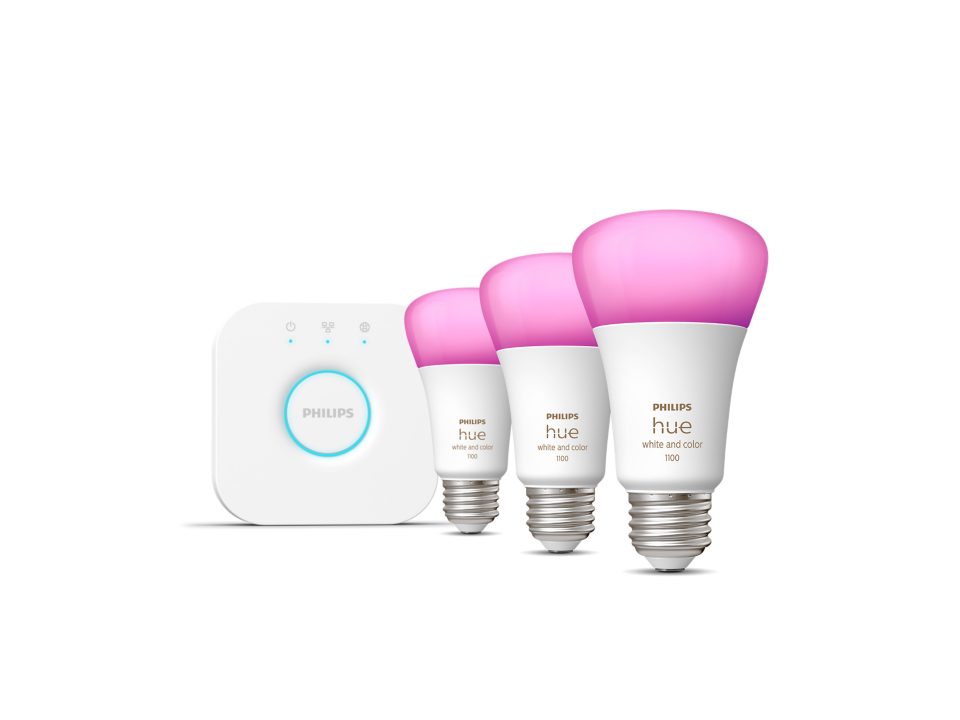
If you are curious about the Philips Hue lighting system, I highly recommend it. I have two white bulbs, four coloured bulbs, two Go lights, a switch, a smart plug and a bridge. I’ve had them for over seven years now and they are still going strong. The white bulbs are in the basement where I just need basic light, while the coloured ones are on the main floor and give me lots of lighting options. The Go lights are great because once charged you can move them around to give you just the lighting you want where you want it. Finally the smart plug is for a lamp that doesn’t take their bulbs.

The technology is easy to set up. I bought the plug just last week and plugged it into the wall and plugged the lamp into it. Then I opened the app, told it to find the plug (which it did), then I added it as a light in that room. (By doing that, I can turn out all lights in the room easily.) You have a lot of control using the Hue app, and it’s easy to use.

Besides being easy to set up and use, they also integrate with the web site IFTTT.com. That allows me to do things like turn on at dusk, or have them turn a certain colour if the weather is going to suddenly change. I even have it so a raspberry pi flicker them when an event it is monitoring occurs, so I don’t forget about it.

Some people find the bulbs expensive, which I get. But they do last a very long time, and they provide me with capabilities not found with other lights (although I know other manufacturers are out there).

You can find out more about it, here. I’d recommend one of the starter kits and then go from there. You need to have a bridge, so if you just buy the bulbs separately, it won’t work.

When was the last time you refreshed your router? It could be time to do that

How long have you had your router in your house? Is it relatively new? If so, that’s good. However you might be like me and have a router that’s 3 or 4 years old. If that’s the case, it’s time to replace your router. Contact your internet provider and ask them if they can refresh your router with a newer one. (And if they can’t or won’t, consider switching internet providers.)

You might think: I don’t want to go through the hassle of that. That’s what I thought too. It turns out it was a very easy thing to do in my case. I suspect that will hold true for you.

Hassle aside, what I also noticed is that I started getting much better upload and download speeds with the newer router without having to upgrade my plan. You might find the same thing, and that’s a good thing indeed.

So if you haven’t refreshed your router in a number of years, consider getting a newer one.

PS it doesn’t have to be a new device. In fact, the upgrade cost might be free if it’s slightly older than new but more recent than your current router.

The importance of the Great Good Place

Cities need third places and citizens who live there need to fight for them. A book that makes the case for them is this one: The Great Good Place. As the blurb for the book explains:

In The Great Good Place, Ray Oldenburg gave the term “third places,” where people gather for the pleasure of good company and conversation, and explained just how important they are.

  • Discover the benefits of informal public and civic life and how it contributes to community health and individual well-being.
  • Explore how third places have been, and still are, vital to grassroots democracy.
  • Experience the power of third places and how they bring people together, fostering a sense of belonging and connection.
  • Allow this book to inspire you to create and revitalize your own third places, from coffee houses to community centers, and make a positive impact on your community.
  • Learn from real-life examples around the world, and see how third places have transformed and revitalized communities.
  • Gain a deeper understanding of the history and evolution of third places, from coffee houses to bookstores, and how they continue to play a vital role in our society.
  • Discover the power and potential of third places and how they can change your community and your life.

Reading that, it makes you want to send a copy of the book to the head of Starbucks, a company that’s been destroying third places in neighbourhoods by opening up coffee shops that have no seating. It’s not the only reason that the company has been doing poorly, but it no doubt contributes to it. Indeed, I walked by a new Starbucks last night with no seating and a Tim Horton’s with seating: the former was empty and the latter was not.

There has been a struggle to build better cities since the pandemic hit. Great third places are part of what will make cities better, but they don’t just show up. They need people like you to support them. So take the time to understand that and find out what you can do to help: talk to your local politicians, lobby community groups, share things with your friends, patronize good third places (and not grab and go food places). Perhaps read that book, so you can better express these ideas. If you want to get a copy, one place is here on Amazon: The Great Good Place: Cafes, Coffee Shops, Bookstores, Bars, Hair Salons, and Other Hangouts at the Heart of a Community. Better still, go find if your local bookstore can get you a copy, for bookstores can be good third places, too.

It’s good to be disappointed because you learn what you value

It’s good to be disappointed if only because it can teach you what you value.

Take the breakfast order above from my favorite breakfast place, Boom. It was different from the way it usually came: the coffee was much smaller, the fries likely started out frozen, and the sandwich ingredients were meagre. My first thoughts seeing it were: this is disappointing.

Some days I would label something as disappointing and move on. But that day I asked myself why I was disappointed. I was expecting the coffee to be much larger, the fries to be big chunky home fries, and the sandwich to have larger amount of pea meal bacon and egg. I was also disappointed because it was not much different than something I could make myself. It was additionally disappointing because I felt I wasted my money. All in all, not a happy meal.

You could say I was disappointed because my expectations weren’t met. But it could have varied from my expectations and not been disappointing. The disappointment was the poor quality of the meal for what it cost. A certain quality of breakfast for the price is the combo I craved and this meal did not deliver on that.

Never let something disappointing pass you by, even if it’s a simple thing like an Uber meal. Take a moment to consider why you feel kicked to the curb and let it inform you as to what you value. Many people do not have an understanding of what they value, and they drift through life making poor choices and settling for less because of that.

Knowing your values and moving towards them is the way to a good life. Sometimes you learn that from something dramatic happening to you: sometimes you learn it via a Uber Eats 🙂

P.S. Is this somewhat goofy? Yes, it is. Sometimes the best way to get people to think about an idea is to come up with an angle on a topic that forces them to look at differently. Approaches to a topic that are goofy, ridiculous, preposterous or absurd all can do that.

Your problem is actually a solution. And that’s the real problem. Which calls for the real solution.


Your problem is actually a solution. And that’s the real problem. Which calls for the real solution.

Let’s unpack that.

Many of the common problems we have are actually solutions for underlying problems we have. So if you have a problem with: eating, drinking, smoking,  sleeping, shopping, etc. too much, you need to look at those behaviours not just as problems but as solutions to underlying problems. You might be indulging in those behaviours because they solve your underlying problem of being anxious, bored, tired, etc. If you try and solve the problem of doing something too much like eating without dealing with the actual problem, you will have a difficult time. And you will have a difficult time because you will may have taken away the solution for the actual problem you were avoiding.

One approach to start dealing with this is get out a notepad and write down what problems you are struggling with and try to get underneath them and see if those problems are actually solving other problems. Then write down those problems and see what you can do to solve them. If you can make progress in solving the underlying problems, you might find that the other problems dissipate.

As always, talk to a professional if you think or feel that your problems are harming you. Take good care of yourself; get help if you can’t do it alone.


How to paint using one color, and more how to advice for artists


I’ve been working on drawing and painting again. During this work, I’ve collected a fair amount of good links on the subjects. Take a look:

Good luck to all who strive to create art!

Jerry Seinfeld, and the art of changing your mind in public

Jerry Seinfeld gives a good example of how to change your mind in public, here: Jerry Seinfeld says he was ‘wrong’ to blame ‘extreme left’ for killing comedy.

Not only does he says his old way of thinking was wrong, but he shows that he has considered what he thought before and contrasts that with his new way of  thinking.

If you have to change your position on a topic in public, it’s not enough to say, “well I thought A before, but now I think B”. You want to show why you no longer think that way. It shows you’re thoughtful and sincere.

No one likes having to change your mind in public. If you have to do so, consider the way Seinfeld did it.


If you get your blood pressure measured, make sure you do this

If you get your blood pressure measured, arm position is important. As this piece states:

When the arm is on the lap or the side, a blood pressure reading can be erroneously high. But when the arm is supported and at heart height, a blood pressure reading is more likely to be right.

Whenever I go to my doctor, she makes sure my arm is in that position. When you get your blood pressure read, make sure you do so too.

Don’t just take my opinion, though: ask your health professional.

In a conflict with significant bad actors on both sides, there are no good options for bystanders

In a conflict with significant bad actors on both sides, there are no good options for bystanders.In such a conflict, you have three options:

  1. you can take a side
  2. you can try to rise above the conflict
  3. you can do nothing

If you take a side, you will be associated with the bad actors on that side. If you try to say “I take this side but I don’t associate with the bad actors on this side”, you will come across as a hypocrite, or naive, or ignorant. And when the bad actors on your side do something wrong, which they will, you will be associated with that wrong too.

You might say, I don’t care. Or the other side is still worse. And that’s fine. But it doesn’t make this option a good one. It’s just an option you are willing to take.

If you try and rise above the conflict, then you will be criticized by both sides for ignoring the bad actors on the other side. In addition, you will be seen as ineffective and weak and irrelevant. Again, it’s an option, it’s just not a good one.

Doing nothing is the flipside of trying to rise above the conflict. You won’t be stuck with having to side with bad actors, but you will be criticized for being indifferent and uncaring, cold and thoughtless.

In life there are often situations where there is no good options to choose from. A conflict with significant bad actors on both sides is one of those situations.

What you mean when you say you’re wasting your time doing X

What does it mean when you say you’re wasting your time doing X?

This question came to me recently when I was sitting on my porch. I thought: why am I wasting my time here? And then I had the follow on thought: what should I be doing this is not a waste of time?

Before I moved though, I asked myself: why was sitting on the porch a waste of time? I concluded I was sitting on the porch because it was a nice summer day and I was enjoying it. In other word,  enjoying a nice summer day has no value (i.e. it’s a waste of time).

Now there are other enjoyable I do that I don’t consider a waste of time: talking with loved ones, eating a good meal, going for a walk. So why is this different?

I think I have been conditioned to think simply sitting around is a waste of time, best done on vacation. Otherwise I think deep down I should be doing something productive. it’s a weirdly puritanical view that conflicts with my non puritanical views on food.

So the next time you are doing something you enjoy doing, attach some value to that. 


How to shop for a duffle bag or gym bag on Amazon and get the right size

If you are shopping for a gym bag or duffle bag on Amazon, you might be hard pressed to know if the bag you are buying is big enough. Some of them will say they are large but they aren’t really.

One good way to gauge how big a bag is look for its litre size (e.g. 60L) Roughly speaking, there seems to be four ranges that gym bags or duffle bags come in:

  • 40 L – small
  • 60L – medium and a typical gym bag
  • 100L – large. Good if you have a lot of gear.
  • 150L – extra-large. Likely a good size for hockey gear.

If you just have a few items, a small might do it, but something in the medium range might be more versatile and typical for a gym bag. If you have equipment to carry, though, you want to get something in the large or even extra large size, depending on how much equipment you have.


Taking care of yourself is not optional

I’ve been thinking of this commandment, ““taking care of yourself is not optional” ever since I read it on an email from Mike Monteiro’s newsletter. I think that is an important commandment to abide by, especially as you get old.

When you get old, it is temping to think taking care of yourself doesn’t matter. Why bother, you think. You don’t have that many years anyway.Why waste your time on that when I have so little time as it is. Besides, no one cares.

But here’s the thing: people do care. You don’t know how many years you have left, and you never have, even when you were younger and you did take care of yourself. And if you don’t take care of yourself, that little time you have might be miserable due to your neglect of yourself.

If you argue that “I don’t believe in all that self-care goopy nonsense”, consider that taking care of yourself doesn’t have to mean meditation and massages and whatever else new age beliefs you may be rejecting. Taking care of yourself can just be the basics: get some good sleep habits, some good eating habits, add some good hygiene habits, plus a bit of exercise too, even if it is walking regularly. If you have all that going on, then you can extend that out to taking care of the environment you are in and the relationships you have, because that comes back to taking care of yourself, too. Have you been to the doctor lately? If not, get checked out. Dentist? Do that too.

Here’s another thing. Taking care of yourself sends a message, to others and yourself. The message is, you matter. You have value. You are precious, even. So start acting like it.

Start taking care of yourself. It’s not optional.

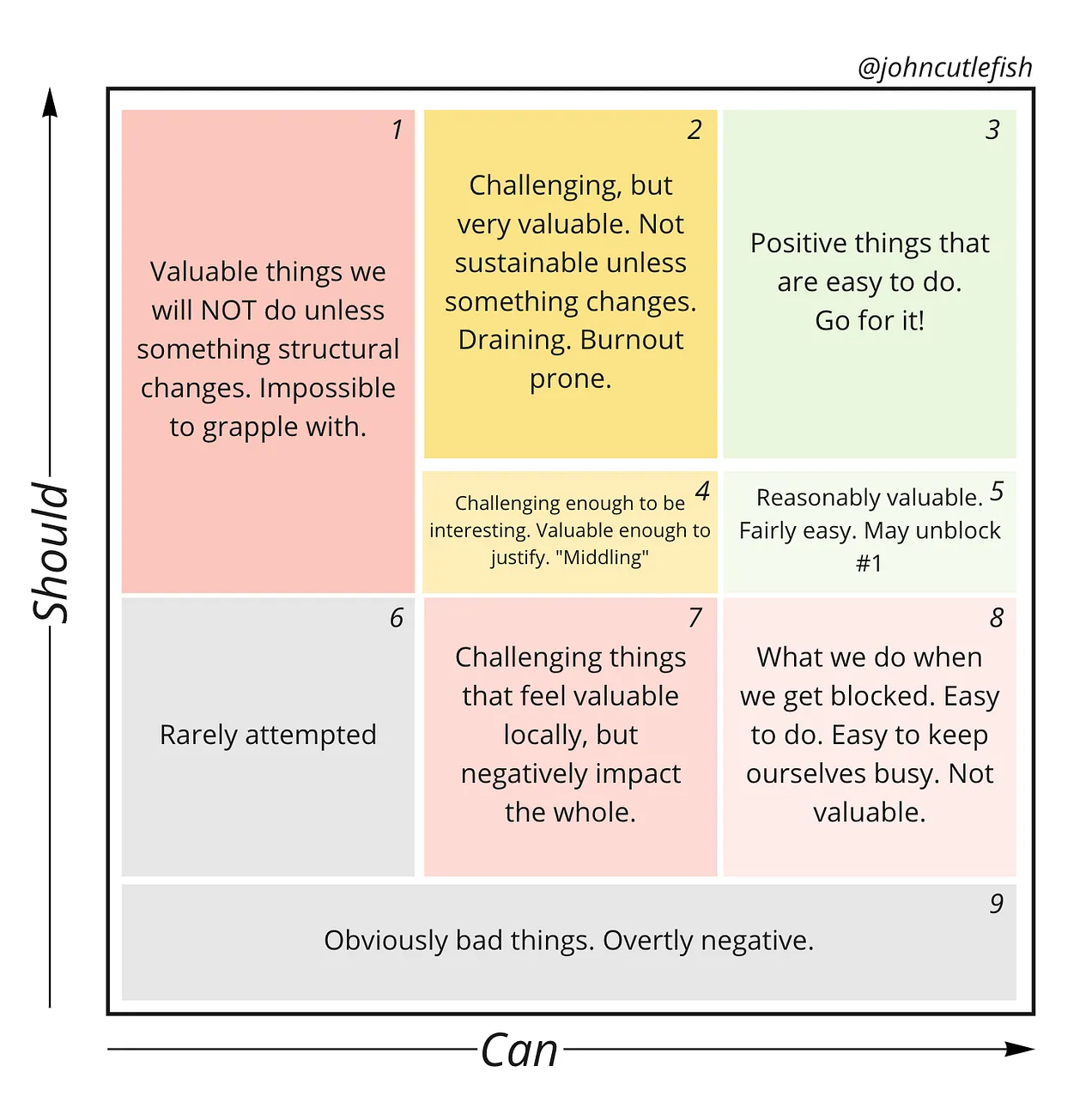
What should you do? Here’s a chart to guide you

I like this chart, found at substack TBM 16/52: Can Do vs. Should Do by John Cutler. I use a similar one when working with clients.

If you have a list of tasks you feel need doing, list them out and grade them on a scale of 1 to 3 (or 5 or 10). We grade them usually on a scale of Low, Medium and High. If you rank a task High for you Should do it and High for you Can do it, then that goes up in the top right corner of this chart (#3). Those are the tasks you want to do first.

See #1 and #2? The way we tackle them is by breaking them down and finding a part of them we can do. That part we move into the #3 section. There’s always some part of #1 and #2 you Can do, even if it involved asking someone for help with them.

Obviously those things you shouldn’t do (#9) should move off your list, no matter how capable you are of doing things. Likewise #6-#8 should be avoided, but sometimes we do #8 when we are blocked or tired (which is a form of blocked).

Anyway, a great chart. Check out the substack post for more insight on it.


How can you learn about Project 2025? Three ways

If you are curious about Project 2025 — and if you are an American, you should be — there are at least three ways you can learn more about it.

The first way is to go to a web site set up to describe it, Project 2025: Presidential Transition Project.

Personally, and as a progressive person, I found this the best way to understand the effects it could have, 25and.me: How Does Project 2025 Affect Me?

However, if all that is hard to get a handle on, or if you want something more neutral, you can also check out: Project 2025 in Wikipedia.

Chances are if Donald Trump is reelected president, many of the things proposed in Project 2025 will come to fruition in the four years he is in office. So before you vote, read up on Project 2025 and know what you might be in store for.

Computers and the Vietnam War: a cautionary tale

500
This piece, According to Big Data We Won the Vietnam War, should be read by everyone who  strongly believes the next new technology (e.g. gen AI) will be able to make decisive predictions to solve big problems (e.g. the Vietnam War).  The best computers and minds at the time thought they could win the war with technology. They were wrong then, and they will be wrong again.

If you think newer computers will win this time, reconsider that. If you think we learned our lesson last time, read this.

So you want to publish a cookbook? If so, read this.

If you are thinking of publishing a cook book, then you owe it to yourself to read this piece in Eater. Eater interviewed three cookbook authors on how they got their first book deal and touches on all aspects of the process they followed. It even talks about how much money you might make. (Emphasis on the word, might.)

Obviously this isn’t the last word on how to get published, but you will come away from it with a better sense of what those authors did to become successful. In one case, author Priya Krishna went on to become very successful with a prominent position at the New York Times. Who knows where you and your stack of recipes — or Instagram posts — will end up?


Have you had your joy snack today?

Who doesn’t want to feel more joyful? And who doesn’t like a snack? If you are still with me, then let me introduce you to the combined concept of a joy snack. As Neuroscientist and science journalist Richard Sima explains, these are:

… little moments of delight you experience throughout the day: He calls them “joy snacks.” These include things like your first sip of coffee in the morning, or telling a joke where the punchline hits just right. By savoring even small bites of bliss, you can transform an otherwise mundane moment into something joyful. And cultivating more joy can help you create a more meaningful life.

I like it! Joy and snacks: two great things that go great together!

For more on this, check this out: An easy way to feel happier: Snacking on joy. In The Washington Post.

Now get snacking!

It’s the weekend. Go do something with your hands

Why? Well according to this: Working With Your Hands Is Good for Your Brain (in The New York Times). It doesn’t matter if it is knitting or gardening or writing or painting. As long as it is not….typing.

It’s not clear why this is so, but studies show it to be true. So put the computer down and go do something manual. You’ll be glad you did.


The 20/20 rule for decluttering

The 20/20 rule for decluttering is simple and good:

First, ask yourself, “Could I replace this item for less than $20?” Then, ask yourself, “Could I replace it in less than 20 minutes?”

If the answer to both of those questions is YES, then toss it without thinking any more about it. Note: replacing it in 20 minutes means can I replace it by ordering it online.

PS: For more decluttering advice I’ve recommended, go  here. In that list is the “Box and Banish” approach, the 90/90 rule, and more.

Speaking of more, if you want to learn more about the 20/20 rule, go here: Ask Yourself These Two Questions Before You Keep Something ‘Just in Case’ at Lifehacker.

On the chocolate cake at Claud and what we can learn from it

The Claud chocolate cake can be a lesson for any restaurant in this day of social media and influencers.

Claud in NYC is a highly respected restaurant with subtle and sophisticated cuisine. Yet if you go to social media sites like Instagram, what you’ll often see is their chocolate cake, shown above. (And yes it is mine and I ordered it.)  Just looking at it and you can see why it is popular: it is an eye catching slice of dessert.

I hesitate to call it a gimmick, for it’s delicious and well made. But it is definitely an attention getter, and in this age of social media, getting attention is key.

There are many ways to attract diners. If you want an easy and low cost way to do that, get yourself a menu item like Claud’s cake.


Just Be It. Or what the inclusiveness of marathon running taught me about writing, art and other activities

If you train for a marathon and you run it in a big city, chances are you will be in the same race — not run, but race — as world class runners. You will not win of course, but you will be included. That’s what is great about marathon running: you are as much a marathon runner / racer as someone hoping to be in the Olympics. It is inclusive.

Nike is a company that also supports inclusiveness, not just for running but for athleticism in general. They like to say: “if you have a body, you are an athlete”. It doesn’t get more inclusive than that.

I think such inclusiveness should be seen in the art world. If you create, you are an artist. If you write, you are a writer. If you’re writing poetry, you are a poet. Taking photos: a photographer. Thinking about the meaning of life: a philosopher.

Maybe your art is not going to bring you fame or fortune. Your running might not either. But if you are out there running or cycling or skiing or whatever you do, you are an athlete. The same should be true of writing or painting or photographing: you are an artist. Don’t let others exclude you from the group; don’t let others discourage you and get you to stop doing the thing you want to do. You’re as much a part of it as the people up front. Put on those running shoes, pick up that camera, that pen, that brush, and be the thing you are.

Instacart recipes have a secret ingredient: AI. What cooks should know.

One convenient feature of Instacart is a listing of “Related recipes” it will provide you if you are searching for a product or ingredient. For instance, I was searching for “biscuits” and one of the recipes that appeared to me was no-milk biscuits. Hmmmm, that could be good and simple, I thought. Seemed reasonable too. Then I scrolled down the bottom to the recipe and came across the text: this recipe is powered by the magic of AI.

First off, let me say: AI is not magic. Second, this COULD be a good recipe. Or it could be something where AI hallucinated ingredients or quantities. For this recipe, it is somewhat close to this recipe for dairy free biscuits at allRecipes.com, but it is missing some ingredients and the quantities of some of the ingredients are different. I searched other recipes at other sites, and while it is close to them, it seems…lacking…in comparison.

Simply put: you would be better off getting recipes from either reputable cookbooks or websites where recipes are tested and confirmed. It is convenient to use the recipes in places like Instacart, because you can easily add the ingredients of the recipe to your shopping cart, but the results from the recipes generated by AI could leave you very disappointed. Especially when it comes to baking!

P.S. Not to pick just on Instacart: I suspect we are going to see more and more of this type of AI generated advice on websites. Keep an eye out for it.

If you are using python packages like xmltodict or yaml, here is something to be aware of

If you are using python packages like xmltodict or yaml to write and read your own XML and yaml files, you probably don’t need to know this. But if you are reading someone else’s files, here is something to be aware of.

This week I had to process an XML files in python. No problem, I thought, I’ll use a python package like xmltodict to translate the XML into a dictionary variable. Then I could edit it and print out a new file with the changes. Sounds easy!

Well, first off, it wasn’t too easy: the nesting was horrendous. However, with some help from VS Code, I was able to power through and get the value I want.

Here’s where I got burned. I wanted to change the text in the XML file, so I had a statement like this to read it


mytext = python_dict["graphml"]["graph"]["node"][nodecount]["graph"]["node"][i]["data"]["y:ShapeNode"]["y:NodeLabel"]["#text"]

and then a simple statement like this to change it to lower text:


python_dict["graphml"]["graph"]["node"][nodecount]["graph"]["node"][i]["data"]["y:ShapeNode"]["y:NodeLabel"]["#text"] = mytext.lower()

Very basic.

Now this particular file is an XML file that has a graphml extension, which allows an editor like YED to read it. YED can read the original file, but it turns out xmltodict writes the file in such a way that the YED editor can no longer see the text. I don’t know why.

I spent hours working on it until I finally gave up. I wrote a much dumber program that read through the graphml file a line at a time and changed it the way I wanted to. No fancy packages involved. Dumb but it worked.

This is the second time this year a package has given me problems. In late January I wrote some code to parse yaml files for a client to extract information for them and to produce a report. Again, there is a package to do that: yaml. Which is….good…except when the yaml it is processing it is poorly written. Which this yaml was.

Again, I spent hours linting the yaml and in some cases having to forgo certain files because they were poorly constructed. What should have been easy — read the yaml file, transform it, write a new yaml file — was instead very difficult.

And that’s often the problem with yaml files and XML and JSON files: they are often handcrafted and inconsistent. They MAY be good enough for whatever tool is ingesting them, but not good enough for the packages you want to use to process them.

I think those packages are great if you are making the input files. But if you are processing someone elses, caveat emptor (caveat programmer?).

How often to check your cell phone plan (and other plans too)


We are often reminded to change our smoke detector batteries twice a year by basing it on some calendar event, like the equinox or at the start of certain seasons (e.g. Fall and Spring).

I recommend you do that for your cell phone plans and other plans from service providers you have. Especially with cell phones, you will find that new plans will come out that are better than your current plan, and a call to your provider can save you money and get you better service.

Go through your financial statements and look at all the service fees you are paying. Then pick some times on the calendar and at that time either cancel the service or ask them for better or cheaper service. Over time you’ll save money.

Joan Didion, and why you should write

In the 1970s Joan Didion wrote:

I write entirely to find out what I’m thinking, what I’m looking at, what I see and what it means. What I want and what I fear. – Why I Write (essay originally published in the New York Times Book Review in 1976, here)

I think it is a good reason for all of us to write, regardless of our level of skill. I think I am going to be adopting that more, here and offline. I would hope the same for you, even if it is a matter of making notes in a composition notebook or a scribbler.

Writing as thinking. Not only deep thoughts, or correct thoughts, but thoughts in general.

A great collection of Joan Didion in her own words from the Guardian, here.

How to simply merge PDF files on a Mac for free with no additional software

If you want to merge PDF files on a Mac, you might be tempted to use a tool like www.ilovepdf.com. Worse still, you might try and do it from Adobe’s Acrobat site and end up signing up to pay $200 or more per year for the privilege!

The good news is if you are on a Mac, you don’t need to do any of that.

Instead, open your PDF files using Preview. Make sure your view shows Thumbnails of the pages in each document. Then drag the thumbnail pages of one document into another. Then save the document you added the thumbnails to and you are done.

For example, let’s say you have two PDF files: abc.pdf and xyz.pdf. You want all the pages in abc.pdf to be in xyz.pdf. You open them both using Preview, you drag the thumbnails of abc.pdf over to the thumbnail section of xyz.pdf. Then you save xyz.pdf. (You can save abc.pdf as an empty document or quit and have it revert back to how it was.)

If you want to leave abc.pdf and xyz.pdf untouched but merge them into a third document, first copy xyz.pdf and give it a name like abcxyz.pdf. Then open abc and abcxyz.pdf using Preview. Then copy the thumbnails of abc.pdf into abcxyz.pdf and save abcxyz.pdf and quit and do not save abc.pdf. Now you have three files: abc.pdf and xyz.pdf are unchanged and abcxyz.pdf are merged copies of the two of them.

Some thoughts on blog posts vs reels for advice

I spotted this post — Eponis | Sinope (Everything Is Awful and I’m Not Okay: questions to…) — and as usual I thought: I should share this because it contains a few nuggets of good advice and others would find it helpful.

Sadly, though, it reminded me of a reel I have seen in various forms on Instagram. Like many reels, that particular reel was less about passing on good advice and more about gaining attention to the creator of the reel.

That’s the thing I do like about blog posts and I don’t like about reels. You could come across a blog post, get the information you need, and never know or care about the person who made it. When you come across most reels (and I assume tiktoks), you might get information you need, but they seem more about the maker than the advice.

I realize this is a matter of preference and not a matter of right and wrong. I prefer just getting the information, while others prefer knowing the person who is giving the advice. Given how Tiktok and Reels are overtaking user generated content, I am likely on the losing side.

I’ll keep sharing helpful things here: that’s been the purpose of this blog since the late 2000s. I’ll also try to 99%**of the time not make it not about me. 🙂


(** did I say 99%? Ok, maybe it’s closer to 90%…😄)

Does your WFH desk / work area need a refresh?


If you are feeling your work from home (WFH) work area needs some new ideas, I think you should check out the following links for inspiration.

For example, this setup was designed to maximize productivity while minimizing your screen time. Also good:  every one of these wfh furniture pieces includes a secret feature to keep your work and life separate. Cool. Cool too are these Panasonic desks: komoru. (More on that panasonic desk, here.)

Need more ideas? Then check out these great  desk setups with minimal designs to increase your work from home productivity.


The way to make your Apple Watch more useful is to change your App View

If you want to make your Apple Watch more useful, you want to change your App View. Here’s how.

On your iPhone, find the Watch app icon and click on it. Look for App View and click on it. From here you can change the view to Grid View. (Grid View looks like the watch in the photo above.) Now click on Arrangement.

Once in Arrangement, hold your finger on an icon of something you use often. Drag your finger tip and the icon to the top left. Keep doing that so all the Watch apps you will use the most are on the top rows. Once you have it the way you like it, exit the Watch app.

If you are stuck as to what to put on top, my top apps are:

  1. Stopwatch
  2. Workout
  3. IFTTT
  4. Weather
  5. Text
  6. Phone
  7. Calendar
  8. Heart rate monitor
  9. Activity
  10. Maps

I have a few dozen more Watch apps, but those are the ones I use often.

If you want to see what you can have on your Watch, go back to the Watch app on your phone and scroll down to see what apps are installed on your watch and what ones you can install.

Once you rearrange the Watch apps,  press in the crown on your Watch. You will now see the Watch apps organized the way you want. I bet you start pressing your crown more to access and use the apps you have installed.

The Apple Watch is great. Squeeze more greatness from it by taking advantage of the Watch apps you have.

It’s the weekend. You’ve much to do but you still would like to watch a movie. Got 90 minutes?

Nowadays movies seem to be getting longer….many creeping up to 2.5 hours in length. (Don’t believe me? Check out this.) That’s fine if you have the time to settle into a film, but what if you can’t? What if your weekend is already packed as it is, but you still would like to see something?

If that’s your problem, then Lifehacker has the solution here: the best movies under 90 minutes. The list has everything: classic movies, kids movies, films that are fairly recent….you name it. Even better, it tells you where you can see it.

Highly recommended for your next sit down in front of the big screen at home.

Things to Pack When Heading to the Emergency Room

Here’s a really good list: 11 Things to Pack When Heading to the Emergency Room.

A few thoughts/additions:

  • take your smartphone. Much of this information can be found there. Indeed, you can put much of this information in a central, easy to find place on your phone, so when you are at the hospital and at admittance, you can easily share it with the hospital. Plus you may use your phone to order Ubers, pay for things, update work, etc.
  • take a smartphone charger. Your smartphone is your contact to the outside world. It’s also a reliever of boredom while you wait for treatment. You don’t want it to die on you while you are in a waiting room.
  • take your wallet. Things not on your smartphone are there.
  • take some snacks (e.g. granola bars) and water if you can. You may want to have some sustenance to keep you going if you are waiting for awhile. Don’t assume your trip will be brief or you can find food there.
  • take something to listen to sounds on your phone. It can help you stay calm and relaxed when you are waiting.
  • write down the timeline of events that made you decide to come to the ER. Do this either on your phone or on paper. It will help you when you have to repeat things and you and you are too tired or ill to tell them.