Blogging in the AI era

Traffic surge due to AI

Last week I wrote about AI and food blogging. After I wrote that, I got to thinking about my own blog. Above you see my daily traffic, with a big spike happening at the beginning of December. I looked at what visitors were looking at on my blog then: I could see someone looking at a bunch of links beginning with “A”, then beginning with “B”, then “C”, etc. It’s not something a user would do, but it is something a bot would do. I am assuming it is somehow AI related.

It made me wonder why I am still blogging if people are just going to bypass my blog and read it from AI. In some ways I don’t mind: if someone finds my content useful via AI versus my own blog, then it doesn’t matter to me. In other ways I do mind: I keep up a weekly discipline of posting at least 2x/week as much to keep the blog a living thing, but if AI is going to kill off my traffic, then what is the point of maintaining this discipline? Likewise, if I am getting traffic due to AI, then maybe it doesn’t matter to keep posting, since my site will still be getting traffic. It’s a pickle, I think.

I think I will still post because I choose and want to post, but the days of posting to help maintain interest in the blog may be over. Something to consider as I go into the new year.

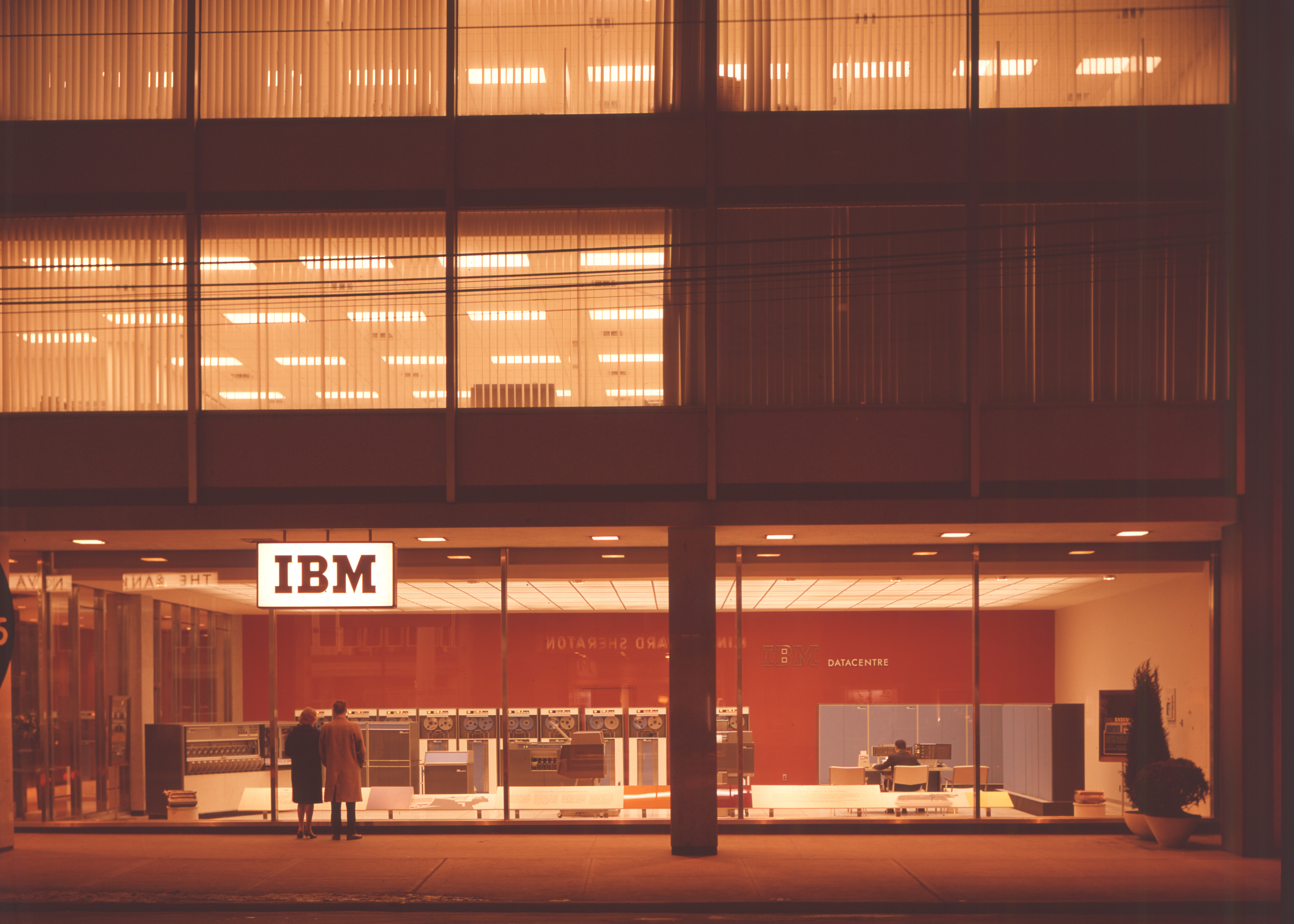
My dream of working from home started with this ad for IBM and Coppola’s Thinkpad (publish those visions you have)

The computer above, and the ad it is, came out in the mid 90s.

It was possible to work from home then, but it was not easy. I used to have a luggable computer that weighed 40 pounds and which I would …lug… home every day one summer to work from home. What I dreamed for, though, was to work from home with a small laptop like Coppola’s. A laptop where I could work from home daily, be it at a desk or in a beautiful kitchen like the one above.

It eventually happened. The laptops got better, the networks got better, and eventually the work cultures got better and I could do this. My kitchen wasn’t as nice, but everything else was nice.

Creative people, keep putting out your visions for a better world. You never know what dreams people will have. It might be as simple as a dream of working on a laptop in a kitchen. A dream that becomes more achievable once people can envision it.

On bike-shedding / the bike-shed effect

Anyone who works with a group of people needs to understand the idea of bike-shedding (as known as the law of triviality). Let me jump right to the Wikipedia entry to explain it:

The law of triviality is C. Northcote Parkinson’s 1957 argument that people within an organization commonly give disproportionate weight to trivial issues. Parkinson provides the example of a fictional committee whose job was to approve the plans for a nuclear power plant spending the majority of its time on discussions about relatively minor but easy-to-grasp issues, such as what materials to use for the staff bicycle shed, while neglecting the proposed design of the plant itself, which is far more important and a far more difficult and complex task.

The law has been applied to software development and other activities.The terms bicycle-shed effect, bike-shed effect, and bike-shedding were coined based on Parkinson’s example; it was popularized in the Berkeley Software Distribution community by the Danish software developer Poul-Henning Kamp in 1999 and, due to that, has since become popular within the field of software development generally.

Coming from the software development community, I’ve known about and seen countless examples of bike-shedding in meetings I’ve attended. I just assumed everyone knew the term. It was only when talking to people outside of software did I realize the term was not as well known.

Now you know it. And now that you do know it, you will see examples of it in many of the meetings you attend this week. 🙂


Venus if you will (What I find interesting in math and science, May 2025)


Venus

Here’s a number of pieces I’ve gathered in the last few months related to science and math that I found worth sharing. A few of them require deeper knowledge on the topic, but many of them are suitable for anyone to read.

in the area of space and astronomy:

Moving on to biology:

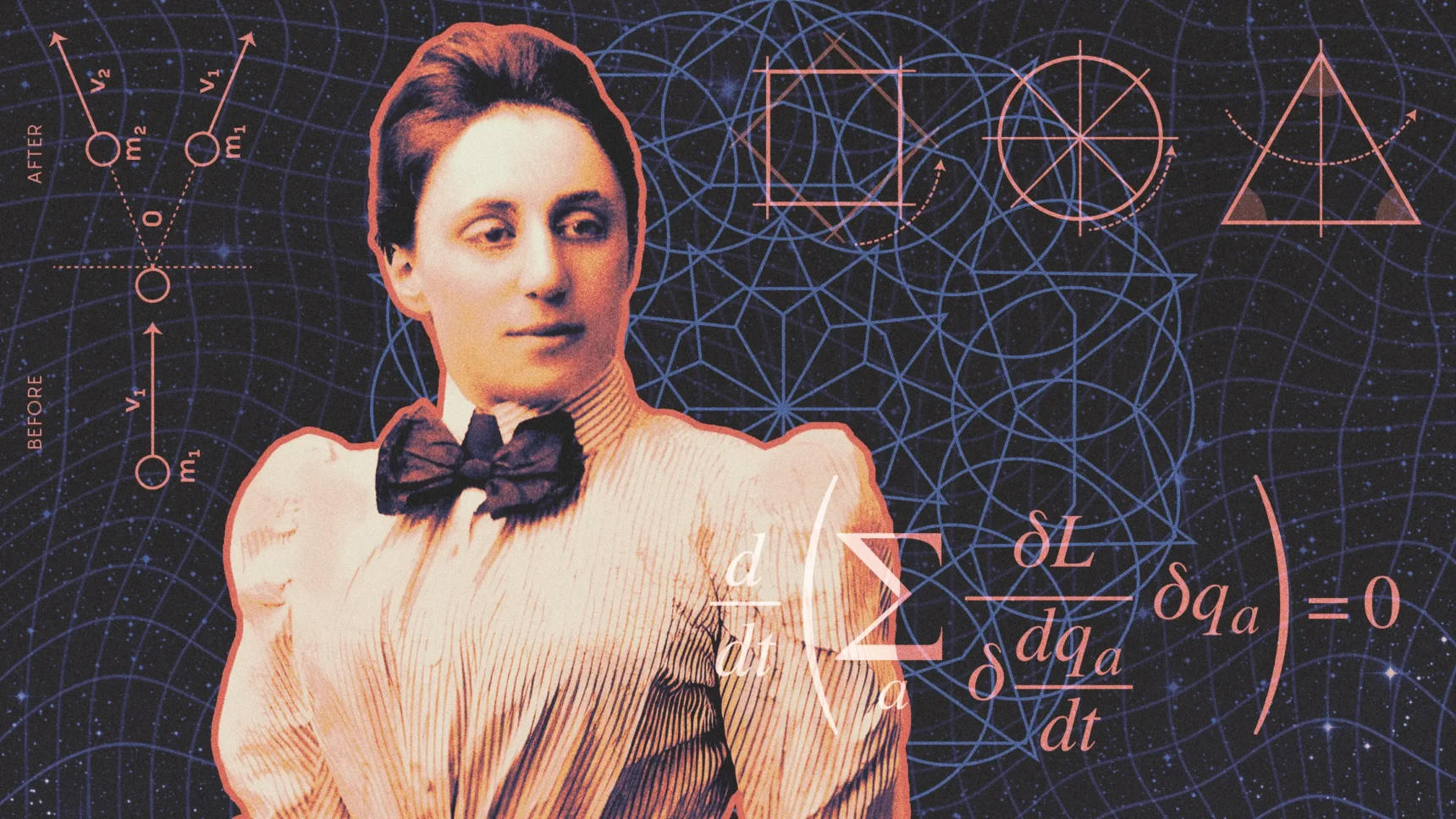
Emmy Noether

Regarding mathematics, physics and more:

(Photos – Venus, seen by NASA’s Mariner 10 spacecraft in 1974.Credit: NASA and Emmy Noether Credit: Kristina Armitage/Quanta Magazine)

On American state terror, new and old

The great Timothy Snyder has written an excellent post on the use of State Terror within the Trump administration. You can find it here. I recommend everyone read it.

I think he made a mistake with this sentence, though: “This is the beginning of an American policy of state terror”.  It may seem like the beginning for some people. But as this piece by Christina Greer in the New York Times argues, it is not a new thing at all. A key section from her piece is this:

“How can this be happening in America?” these people ask. “This is not the country I know, the country of rights and laws and due process.”

Needless to say, these people are almost all white and liberal and are not used to feeling this fear of arbitrary, brutal state authority. But this moment, the one that was explicitly promised by Project 2025 and Donald Trump when he was a candidate, looks a lot like what my grandmother experienced every day for much of her life. It is frightening and disappointing but not surprising if one knows anything about the Black experience in America. And not the sanitized just-so version of the Black experience in which America skips from slavery, Harriet Tubman and Frederick Douglass to civil rights, Martin Luther King Jr. and Rosa Parks and somehow ends with a postracial America and Barack Obama.

Black people have seen this America before.

Japanese Americans have also seen this when they were interned by the U.S. government during World War II. And they weren’t the only ones interned: German Americans and Italian Americans have also been thrown into American concentration camps in the 20th century. I can go back further and include the ethnic cleansing of Native Americans during the Trail of Tears in the 19th century. The list of State Terror activities within the United States of America is a long one.

Trump may be unique in the way he goes about using State Terror this time. But it is not a new thing in America.

(Image is a map of the locations of internment camps for German enemy aliens during World War II. From Wikipedia.)


A brief programming note about the blog’s new appearance

Well, sometimes an accident can lead to good things. The accident today was mistakenly replacing the theme on this blog, instead of my new blog.  When I realized the error, I thought: no problem, I’ll just reapply my old Coraline theme. I thought wrong: the Coraline theme no longer appears on wordpress.com.

Turns out I did fine a theme that was somewhat close: Colinear. At first I was not happy with the change. But I managed to get it close enough back to the old theme I am ok with it. Colinear also has features that Coraline does not have, like the ability to be looser with images inserted in posts. (Before I always had the specify a maximum width of 500. No more!) So some good with the bad.

I hope most people don’t care or notice too much. It will still have the same type of content, regardless of font changes and other design differences. I hope you will continue to like the blog.

The mongolian horde approach, or why you don’t have to be a fool to think that Elon Musk is incompetent

Is Elon Musk incompetent? Is he a genius? Or is he something else?

While some think his recent actions at Twitter and in DOGE indicate he is  incompetent, Noah Smith came out and defended Musk in this Substack post: Only fools think Elon is incompetent – by Noah Smith.

Smith starts off by saying that Musk …

is a man of well above average intellect.

Let’s just pass on that, since we don’t know the IQ or any other such measure of the intellect of Musk. Plus, competent people don’t need to have a high IQ.

Indeed Smith gives up on IQ and goes for another measure:

And yet whatever his IQ is, Elon has unquestionably accomplished incredible feats of organization-building in his career. This is from a post I wrote about Musk back in October, in which I described entrepreneurialism as a kind of superpower

So it’s not high IQ that makes Elon Musk more competent than most, it’s his entrepreneurialism. In case you think anyone could have the same ability, Smith goes on the say why Musk is more capable than most of us:

Why would we fail? Even with zero institutional constraints in our way, we would fail to identify the best managers and the best engineers. Even when we did find them, we’d often fail to convince them to come work for us — and even if they did, we might not be able to inspire them to work incredibly hard, week in and week out. We’d also often fail to elevate and promote the best workers and give them more authority and responsibilities, or ruthlessly fire the low performers. We’d fail to raise tens of billions of dollars at favorable rates to fund our companies. We’d fail to negotiate government contracts and create buzz for consumer products. And so on.

Smith then drives home this point by saying:

California is famously one of the hardest states to build in, and yet SpaceX makes most of its rockets — so much better than anything the Chinese can build — in California, almost singlehandedly reviving the Los Angeles region’s aerospace industry. And when Elon wanted to set up a data center for his new AI company xAI — a process that usually takes several years — he reportedly did it in 19 days

And because of all that, Smith concludes:

Elon Musk is, in many important ways, the single most capable man in America, and we deny that fact at our peril.

Reading all that, you might be willing to concede that whatever Musk’s IQ is, not only is he more than competent, but he must be some sort of genius to make his companies do what they do, and that you would be a fool to think otherwise.

But is he some kind of entrepreneurial genius? Let’s turn to Dave Karpf for a different perspective. Karpf, in his Substack post, Elon Musk and the Infinite Rebuy, examines Musk’s approach to being successful by way of example:

There’s a scene in Walter Isaacson’s new biography of Elon Musk that unintentionally captures the essence of the book: [Max] Levchin was at a friend’s bachelor pad hanging out with Musk. Some people were playing a high-stakes game of Texas Hold ‘Em. Although Musk was not a card player, he pulled up to the table. “There were all these nerds and sharpsters who were good at memorizing cards and calculating odds,” Levchin says. “Elon just proceeded to go all in on every hand and lose. Then he would buy more chips and double down. Eventually, after losing many hands, he went all in and won. Then he said “Right, fine, I’m done.” It would be a theme in his life: avoid taking chips off the table; keep risking them. That would turn out to be a good strategy. (page 86) There are a couple ways you can read this scene. One is that Musk is an aggressive risk-taker who defies convention, blazes his own path, and routinely proves his doubters wrong. The other is that Elon Musk sucks at poker. But he has access to so much capital that he can keep rebuying until he scores a win.

So Musk wins at poker not by being the most competent poker player: he wins by overwhelming the other players with his boundless resources. And it’s not just poker where he uses this approach to succeed. Karpf adds:

Musk flipped his first company (Zip2) for a profit back in the early internet boom years, when it was easy to flip your company for a profit. He was ousted as CEO of his second company (PayPal). It succeeded in spite of him. He was still the largest shareholder when it was sold to eBay, which netted him $175 million for a company whose key move was removing him from leadership. He invested the PayPal windfall into SpaceX, and burned through all of SpaceX’s capital without successfully launching a single rocket. The first three rockets all blew up, at least partially because Musk-the-manager insisted on cutting the wrong corners. He only had the budget to try three times. In 2008 SpaceX was spiraling toward bankruptcy. The company was rescued by Peter Thiel’s Founders Fund (which was populated by basically the whole rest of the “PayPal mafia”). These were the same people who had firsthand knowledge of Musk-the-impetuous-and-destructive-CEO. There’s a fascinating scene in the book, where Thiel asks Musk if he can speak with the company’s chief rocket engineer. Elon replies “you’re speaking to him right now.” That’s, uh, not reassuring to Thiel and his crew. They had worked with Musk. They know he isn’t an ACTUAL rocket scientist. They also know he’s a control freak with at-times-awful instincts. SpaceX employs plenty of rocket scientists with Ph.D.’s. But Elon is always gonna Elon. The “real world Tony Stark” vibe is an illusion, but one that he desperately seeks to maintain, even when his company is on the line and his audience knows better. Founders Fund invests $20 million anyway, effectively saving the company. The investment wasn’t because they believed human civilization has to become multiplanetary, or even because they were confident the fourth rocket launch would go better than the first three. It was because they felt guilty about firing Elon back in the PayPal days, and they figured there would be a lot of money in it if the longshot bet paid off. They spotted Elon another buy-in. He went all-in again. And this time the rocket launch was a success. If you want to be hailed as a genius innovator, you don’t actually need next-level brilliance. You just need access to enough money to keep rebuying until you succeed.

It seems that the path to success for Musk is not to be good at something, but to be tenacious and throw massive amounts of resources at a problem until you defeat it.

In IT, there is an approach to solving problems like this called the Mongolian horde approach. In the Mongolian horde approach, you solve a problem by throwing all the resources you can at it. It’s not the smartest or most cost effective approach to problem solving, but if a problem is difficult and important, it can be an effective way to deal with it.

It’s interesting that Smith touches on this approach in his post. He brings up Genghis Khan, the leader of the Mongols:

Note the key example of Genghis (Chinggis) Khan. It wasn’t just his decisions that influenced the course of history, of course; lots of other steppe warlords tried to conquer the world and simply failed. Genghis might have benefited from being in just the right place at just the right time, but he probably had organizational and motivational talents that made him uniquely capable of conquering more territory than any other person in history. The comparison, of course, is not lost on Elon himself

It appears that Musk is familiar with the Mongolian Horde approach as well. Indeed, Karpf illustrates the number of times Musk used this approach in order to be successful, whether it’s playing poker or building rockets.

If you can take this approach, with persistence and some luck, you can be successful. Success might come at a great cost, but it likely will come. And in America, if you are successful, people assume you are intelligent and highly competent regardless of your approach. That’s what Smith seems to assume in his post on Musk.

Even with this approach, you do have to have some degree of competency. If you are using this approach to play poker, you have to know enough about the game to win when the opportunity presents itself. But you don’t have to be the world’s best poker player or even a good poker player.

The same holds true for Musk and his other companies. He’s not incompetent, but he’s not necessarily great or even good at what he does. He just hangs in there and keeps applying overwhelming resources until he eventually wins. His access to resources and his tenacity are impressive: his competency, not so much.

P.S. Like many others, I used to think Musk was highly competent. I stopped thinking that when he took over Twitter and turned it into X. This “Batshit Crazy Story Of The Day Elon Musk Decided To Personally Rip Servers Out Of A Sacramento Data Center” in Techdirt convinced me his IT competency is not much better than his poker competency. Indeed, if success was a metric, then he is incompetent at running tech companies, based on this piece in the Verge: Elon Musk email to X staff: ‘we’re barely breaking even’. I won’t count him out until he abandons X, but if the time comes when X is successful, it will be because of him applying massive amount of resources (time, money, etc) to it, not because he is an IT genius.


A good mediation on fire…

 A good mediation on fire can be found here:  Fire and focus – Austin Kleon.

It can be hard to think about fire as a positive thing if you have been focused on the wild fires in Los Angeles. But it can be, and that comes across in what Kleon writes about it. It reminded me of growing up and the times my father would have a fire pit in the backyard, and we would spend hours around it, tending it, talking, watching it. It also made me think of times later on when I had a house with a fireplace and I’d love the meditative and contemplative aspect of it.

Fire can be a great thing. Read Kleon and see.

(Photo by Hayden Scott on Unsplash)


To stay focused, set 5 min timers and log

If you’re like me, you find all the screens and tasks you have to deal with make it hard to stay focused. I don’t know how many times in the day I find myself forgetting what I was working on until I look at a particular screen or a piece of paper and think: oh yeah, I was doing that! (Its bad.)

I have recently came across a trick to help me focus. It’s a simple trick: I set a short 5 minute timer. When the timer goes off, I write down what I was just working on. I find this helps me from getting too distracted. Then I go back to my master todo list I refer to in order to make sure the things I am writing down are aligned with what I want to be doing. Finally I set another timer and try and focus on the next task I should be working on.

Cool devices with e-ink display

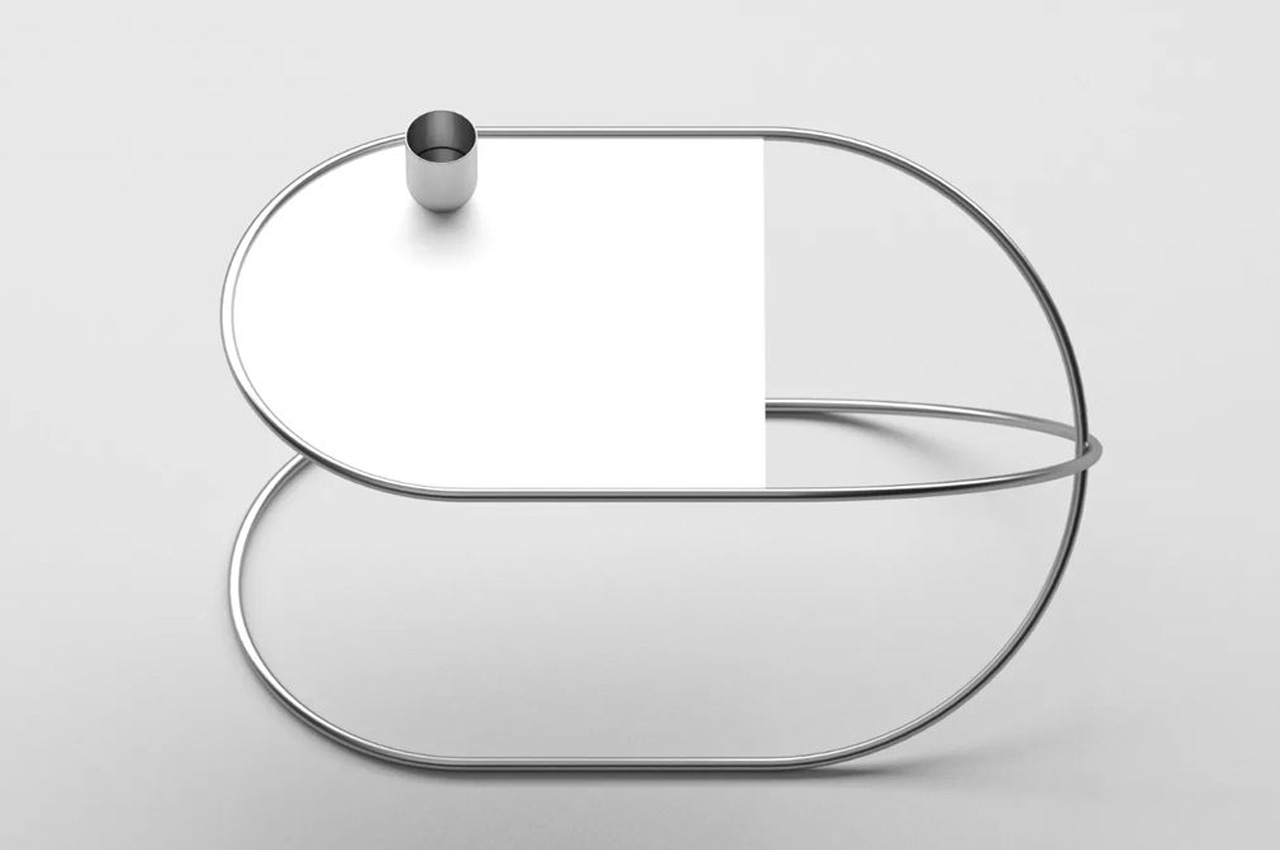
E-ink displays are useful for more than just for e-book devices. Take this portable e ink typewriter, for example:

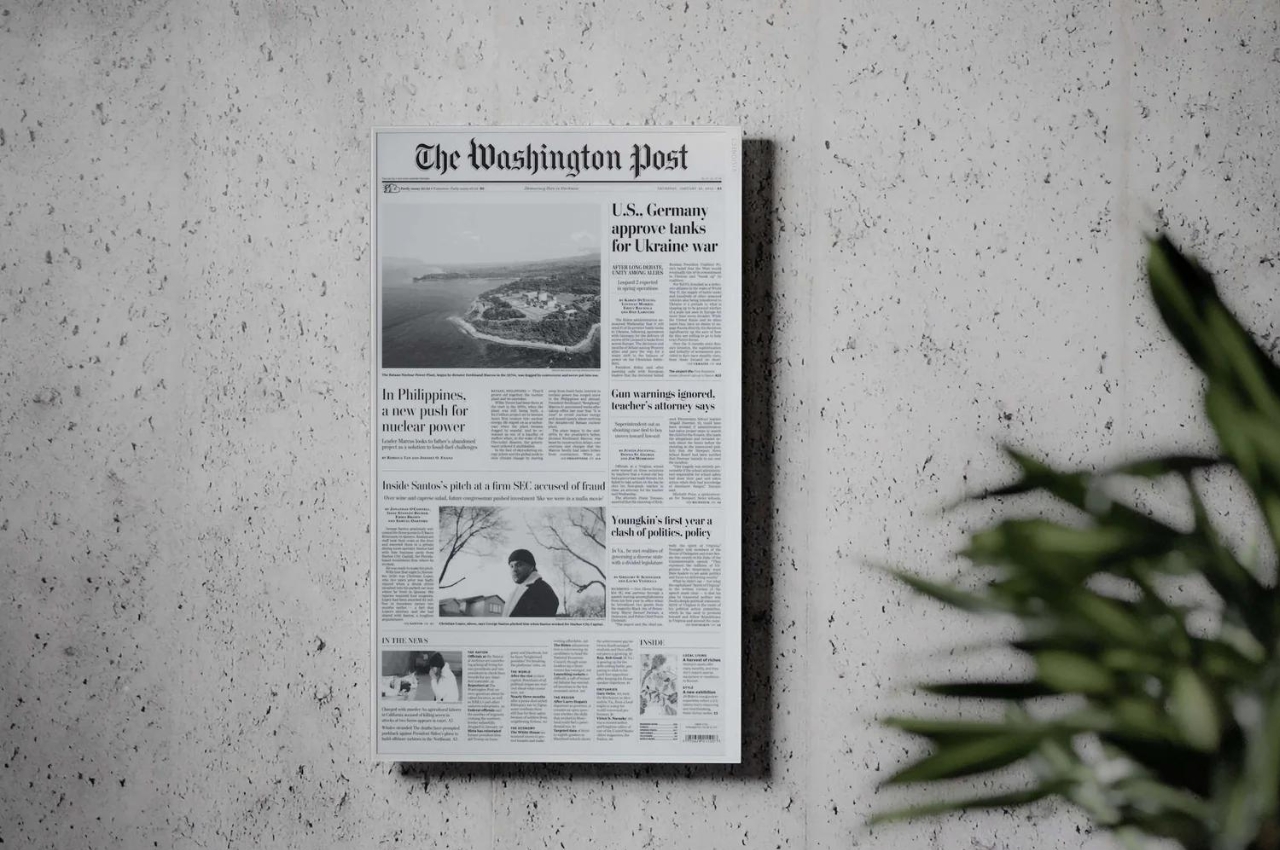
A great way to write your next great novel without being distracted. Or how about this e ink wall frame lets you read your newspapers front page:

Is it expensive? Very. Is it cool? Without a doubt.

You can find more cool designs using e-ink displays, here, at Yanko Design.


Forty things that have changed in IT and IBM in the last forty years (from 1983 to 2023)

If you were to ask me, on this day, what has changed with regards to computers and IT and IBM in the last 40 years, I would say it’s this:

  1. Access: Very few people had access to computers 40 years ago. Those folks used mainframes, minicomputers and the occasional personal computer from Commodore or Radio Shack or this new start up called Apple. Now everyone has access to a computer they carry around in their pocket. (We call it a smart phone, but it’s really a powerful computer that makes calls.)
  2. Ubiquity: Back in the early 80s the vision of everyone having a computer / terminal on your desk was just that: a vision. The few that did have these big monster 3277 or 3298 metal terminals or if you were lucky, a 3279-color terminal. People worked on paper.
  3. email: One of the drivers of having a terminal on your desktop was to access email. Back then IBM’s email system was called PROFS (Professional Office System) and it meant you no longer had to send you three-part memos (yes people did that with carbon paper between the memo paper, so you could give the cc (carbon copy) to someone else). You sent electronic mail instead. Everyone thought it was great. Who knew?
  4. Viruses: Viruses were new. My first was called the CHRISMA exec. In those days every Christmas people would send around runnable scripts (ie. Execs) and they would be the equivalent of digital Christmas cards. The CHRISMA digital Christmas card came from outside IBM. It read your address book and sent itself to all the people you knew. Sounds like fun. In fact it overwhelmed the IBM networks and IBMers around the world and we had to shut most things down to try to purge the network of this thing. It took days. Not fun.
  5. Networks: Companies sometimes had their own networks: IBM had one called VNET. VNET connected all of IBM’s computers worldwide, and it had connection points with outside networks like BITNET too, which is where the CHRISTMA exec was. There was no Internet per se.
  6. Network size: IBM’s VNET had over 1000 VM computers all connected to each other. All of them had an id called OP which was what system operators used to sometimes control the VM mainframe. Once on second shift another system operator and I wrote a program to messages all 1000+ ops in the world the equalivant of “hi hows it going”. To our surprised many of them wrote back! We manually started messaging them back and even became friends with some of them over time. It was like twitter before twitter or gchat before gcchat, etc.
  7. Documentation: Computer documentation was hard to come by in the 80s, and if you had any, you might hide it in your desk so no one else could take it. The operators had a special rack of documentation next to where they worked. I was thrilled in the 90s when you could walk into a bookstore and actually buy books that explained how things worked rather than having to get permission from your manager to order a Redbook from IBM publishing in the US.
  8. Education: In the 80s you could get a job in IBM operations with a high school diploma. Universities in Canada were just ramping up degree programs in computer science. By the start of the 90s most new hires I knew had at least a university degree and more likely a comp sci or engineering degree.
  9. Software: We take Microsoft’s dominance in software for granted, but decades ago Lotus’s 123 was the spreadsheet program we used, just like we used Wordstar or Wordperfect for word processing. Microsoft worked very hard to dominate in that space, but in 1984 when the ads for Macintosh came out, Gates was just one of three people in the ad touting that their software ran on a Mac.
  10. Minicomputers: In between the time of the mainframe and PC, there was the rise of minicomputers. DEC in particular had minicomputers like the VAX systems that gave IBM a run for the money. IBM countered with machines like the 4300 series and the AS/400. All that would be pushed to the site by….
  11. IBM’s PC: The first truly personal computer that had mass adoption was the IBM PC. A rather massive metal box with a small TV on top, it could run the killer apps like Lotus 123. Just as importantly, it could run a terminal emulator, which meant you could get rid of old terminals like the 3270 series and just give everyone a PC instead. Soon everyone I worked with had a PC on their desk.
  12. Modems: modems in the 1980s were as big as a suitcase. If a client wanted one, an IBM specialist would go their location and install one for you. In the 90s people got personal modems from companies that sent data at 9600 bps or 14000 bps or even 56 kbps! Today people have devices the size of a book sitting at home and providing them with speeds unthinkable back then.
  13. Answering machines: The other thing people used to have on their desks besides a PC was an answering machine. Before that every office had a secretary. If you weren’t at your desk the call would go to them and they would take the message. If you had been away for a time you would stop by their desk and get any slips of paper with the name and numbers of people to call back. Answering machines did away with all that.
  14. Paper planners: Once you did call someone back, you would get out your day runner / planner and try to arrange a meeting time with them. Once a year you would buy new paper for it so you could keep track of things for the new year. In its heyday your planner was a key bit of information technology: it was just in paper form.
  15. Ashtrays and offices: it may seem hard to believe but back then smoking in the office was common, and many people smoked at their desk. It was a long and hard process to eliminate this. First there was smokeless ashtrays, then smoking areas, then finally smokers had to smoke outside, then smoke in areas well away from the main door. Likewise people worked in cubicles. It was miles away from working at places like Google or WeWork, never mind working from home.
  16. The rise of Microsoft and the decline of IBM: The success of the IBM PC lead to the success of Microsoft. The adoption of MS-DOS as the operating system for the IBM PC was a stroke of luck for Microsoft and Bill Gates. It could have easily been CP/M or some other OS. With the rise of Microsoft and the personal computer, IBM started to lose its dominance. IBM’s proprietary technologies like OS/2 and TokenRing were no match for DOS / Windows or Ethernet. IBM did better than some computer companies like Wang, but it’s days of being number one were to be over.
  17. The role of the PC: for a time in the 80s you could be a company and not have computers. Paper and phones were all you needed. We used to say that companies that used computers would beat any competitors not using computers. And that became the case by the end of the decade.
  18. The rise and fall of AI: now AI is hot, but in the late 80s and early 90s it was also hot. Back then companies were building AI using languages like LISP and Prolog, or using specialized software like IBM’s Expert Systems Environment to build smart tech. It all seemed so promising until it wasn’t.
  19. LANs: all these PCs sitting on people’s desks needed a way to talk to each other. Companies like Microsoft released technology like Windows for Workgroups to interconnect PCs. Office had servers and server rooms with shared disks where people could store files. There was no SharePoint or Confluence.
  20. The rise of Ethernet: there were several ways to set up local networks back then. IBM had its token ring technology. So did others. It didn’t matter. Eventually Ethernet became dominant and omnipresent.
  21. Email for everyone: just as everyone got PCs and network access, in the 90s eventually everyone got mail. Companies ditched physical mail and FAXes for the speed and ease of electronic mail, be it from AOL or Compuserve or someone else.
  22. Network computers: one thing that made personal computers more cost effective in the 90s for people was a specialized computer: the network computer. It was a small unit that was not unlike a terminal, and it was much cheaper for business than a PC. To compete, the prices of PCs soon dropped dramatically and the demand for the network computer died off.
  23. EDI: another thing that was big for a time in the 90s was EDI. IBM had a special network that ran special software that allowed companies to share information with each other using EDI. At one point IBM charged companies $10/hour to use it. Then the Internet rose up and ISPs charged companies $30/month and suddenly EDI could not compete with a PC using a dialup modem and FTP software provided by their ISP.
  24. Electronic banking: with personal computers and modems becoming common in homes, banks wanted to offer electronic banking to them. Some banks like the Bank of Montreal even established a specialized bank, mbanx, that was only online. Part of my job in the 90s was to help banks create the software they would give out to allow their customers to do banking via a private network. While most banks kept their branches, most day to day banking now happened online.
  25. The Internet and the web: if the PC changed everything in the 80s, the Internet changed everything in the 90s. Suddenly ISPs were springing up everywhere. Even IBM was an ISP for a time. People were scrambling to get software to allow them to connect their PC and US Robotics 14.4 kbps modems to access FTP sites and Usenet and more. No sooner did this happen than the World Wide Web and browsers bust on the scene. For many people, the Web was the Internet. So long Gopher; goodbye WAIS.
  26. Google: finding things on the Internet was no easy thing. It only got worse as web sites shot up everywhere. Google changed the Web and made it usable. They changed email too. Sites like Yahoo! wanted to make you pay for more storage: Google gave people more storage than they could ever need.
  27. From desktops to laptops: with home networks in place, people wanted to be able to bring home their computers to work remotely. I used to have a luggable computer that weighed 40 pounds that I would bring back and forth daily. As more people did this, computer companies got smart and made the portable computers smaller and better. Apple was especially good at this, but so was IBM with their Thinkpad models. As time went by, the computer you used at work became a laptop you use to work everywhere.
  28. The Palm Pilot: the Palm Pilot succeeded where Apple and others had failed. They had come up with a device you could use to track your calendar, take notes, and more. All you had to do was put it in a cradle and press the sync button and everything would be loaded onto your PC. Bye bye paper planners. Hello Personal Digital Assistant.
  29. IBM Services: One time IBM gave away its services. By the 90s they had a full one line of business devoted to providing their people to clients to help them with their business. People like me moved from helping run IBM’s data centers to going around to our clients helping them run their data centers and more.
  30. Y2K: if Y2K was a non-event, it was only because of the countless hours put in by techies to make it one. Even me. I was shocked to discover that EDI software I wrote for a Quebec bank in 1992 was still running on PC/DOS computers in 1999. It was quickly rewritten before the deadline to keep running on January 1, 2000. Just like countless software worldwide.
  31. E-business: if PCs changed business in a big way in the 80s, e-business changed them in a big way in the 90s. Even with the dot com era crash, there was no going back. With e-banking your retail branch was open 24/7; with e-business, the same was true of your favorite local (or non-local) business.
  32. The resurrection of Apple and Steve Jobs: two things transformed IT and made it cool: one was the Web and two was the return of Jobs to Apple.  Boring beige boxes were out: cool colored Macs made for the Internet were in. People were designing beautiful web sites with red and yellow and blue iMacs.And the success of those iMac led the way to the success of the iPod, and the success of the iPod led to so much more.
  33. Blackberry and dominance of smartphones: if the Palm Pilot got mobile computing started, the Blackberry accelerated that. Email, texting, and more meant that just like online banking and e-business, you were reachable 24/7. And not just reachable the way you were with a pager/beeper. Now you could reply instantly. All the computer you needed fit in your hand.
  34. The decline of analog: with the rise of all this computing came the decline of anything analog. I used to buy a newspaper every day I would commute to work. People would bring magazines or books to read. If you wanted to watch a film or listen to a song, it depended on something physical. No longer.
  35. The rise of Unix/Linux: you use Unix/Linux every day, you just don’t know it. The web servers you use, the Android device you make calls on, the Mac you write emails on: they all depend on Unix/Linux. Once something only highly technical people would use on devices like Sun computers or IBM pSeries machines is now on every device and everywhere.
  36. Open Source: in the 90s if you wanted software to run a web server, you might pay Netscape $10,000 for the software licence you needed. Quickly most people switched to the free and open source Apache web server software to do the same job. This happened over and over in the software world. Want to make a document or a spreadsheet? You could get a free version of that somewhere. For any type of software, there is an open source version of it somewhere.
  37. Outsourcing/offshore: if people could work from anywhere now, then the work that was done locally could now be done anywhere. And it increasingly was. No one locally does the job I did when I first started in the computer industry: it’s all done offshore.
  38. The Cloud: if work could be done anywhere by anyone, then the computers needed to do it could be the same. Why run your own data center when Amazon or Microsoft or IBM or Google could do it better than most? Why buy a computer when you only need it for an hour or a day? Why indeed?
  39. The return of AI: finally, AI has returned after a long time being dormant, and this time it’s not going to be something used by a few. Now everyone can use it and be more productive, smarter. Like the PC or the Internet before it, AI could be the next big thing.
  40. Web 2.0/Social Media: One thing to insert in between the Internet and AI in terms of groundbreaking changes in IT is Social Media. Both public social media like this and private social media like Slack and Microsoft Teams. Without social media I couldn’t share this with you.

In 40 years the devices have gotten smaller, the networks have gotten bigger, and the software has gotten smarter. Plus it’s all so much cheaper. If I had to sum it up, I’d say that sums up all the changes that have happened in the last 40 years. And we are just getting started.

If you use two/multifactor authentication, make sure you have a backup

Multi-Factor authentication is great. There is only one downside: you lose your phone. The way to deal with that is to have a backup. To set that up, either read this if you use Microsoft’s authenticator: Back up and recover account credentials in the Authenticator app from Microsoft Support or this if you use something else for authentication: Make Sure You Have a Backup for Two-Factor Authentication.


I switched from grocery shopping at Metro (and Loblaws) to Walmart in 2022. In 2023 I am switching to a combination of Walmart and Food Basics. Here’s why.

Last year I did the math and found that I could save around $1500/year if I switched my grocery shopping from Metro / Loblaws to Walmart. I wrote about it here.

This year I have switched from Walmart to Food Basics for some things. So what changed?

First, Walmart’s prices have been rising over the last year, at least in Instacart. The same groceries bought at Walmart in 2022 add up to over $1000 more in 2023. I started noticing the items I have bought went up by 10% or more. Week after week those increases accumulate into that $1000.

Second, Food Basics prices either dropped or were much lower than Walmart’s to begin with and I didn’t notice last year. In almost every category now their prices are lower: beverages, condiments, dairy, snacks, pasta, frozen food, and meat. Only in the deli and produce section can I get better deals at Walmart. It’s close, but not that different.

Third, I think Walmart has changed their pricing policy in Instacart. They now say their prices are higher than in-store prices. Food Basics prices are generally the same as in-store regular retail prices. I think Walmart was that way before.

Walmart has also changed their approach to Instacart in other ways. For many months they have not had any products featured in the Deals section of Instacart. Now they do. Food Basics also has deals.

Because of how Walmart has changed, my shopping via Instacart has changed. Before I would automatically buy my groceries from them. Now I make a list and comparison shop between them and Food Basics. Most of the time Food Basics wins and I buy the bulk of my groceries from them. I still get my deli and produce from Walmart and some specific products Food Basics does not have. And if Walmart has a good deal on something, I will also buy that from them.

At some point I should go back and compare  Loblaws, No Frills, Metro, Food Basics and Walmart to see what has changed, because the grocery business is dynamic and competitive. Who knows: in a year, No Frills could be the leader when it comes to good prices.

For now I am mostly happy shopping at Food Basics and Walmart. In both places the prices are good, and the quality is high. The things I used to buy from Metro at high instore prices in my neighborhood in 2022 are less expensive when I get them via Food Basics on Instacart in 2023, so that’s good. too.

P.S. Here’s my spreadsheet on Google Sheets. You can review my numbers and see if they add up. This is my experience with this. YMMV.

P.S.S. I had to revisit my spreadsheet. At first I had Food Basic saving me $1500 over a year vs Walmart. It’s actually somewhere around $171. Not nothing, but not that much.


It’s summer! Time to eat your veggies! (or, food links for food lovers, July 2023)

It’s summer! And summer is the time you want to take all the great produce available from the markets and turn it into something. Let me help you with some great recipes.

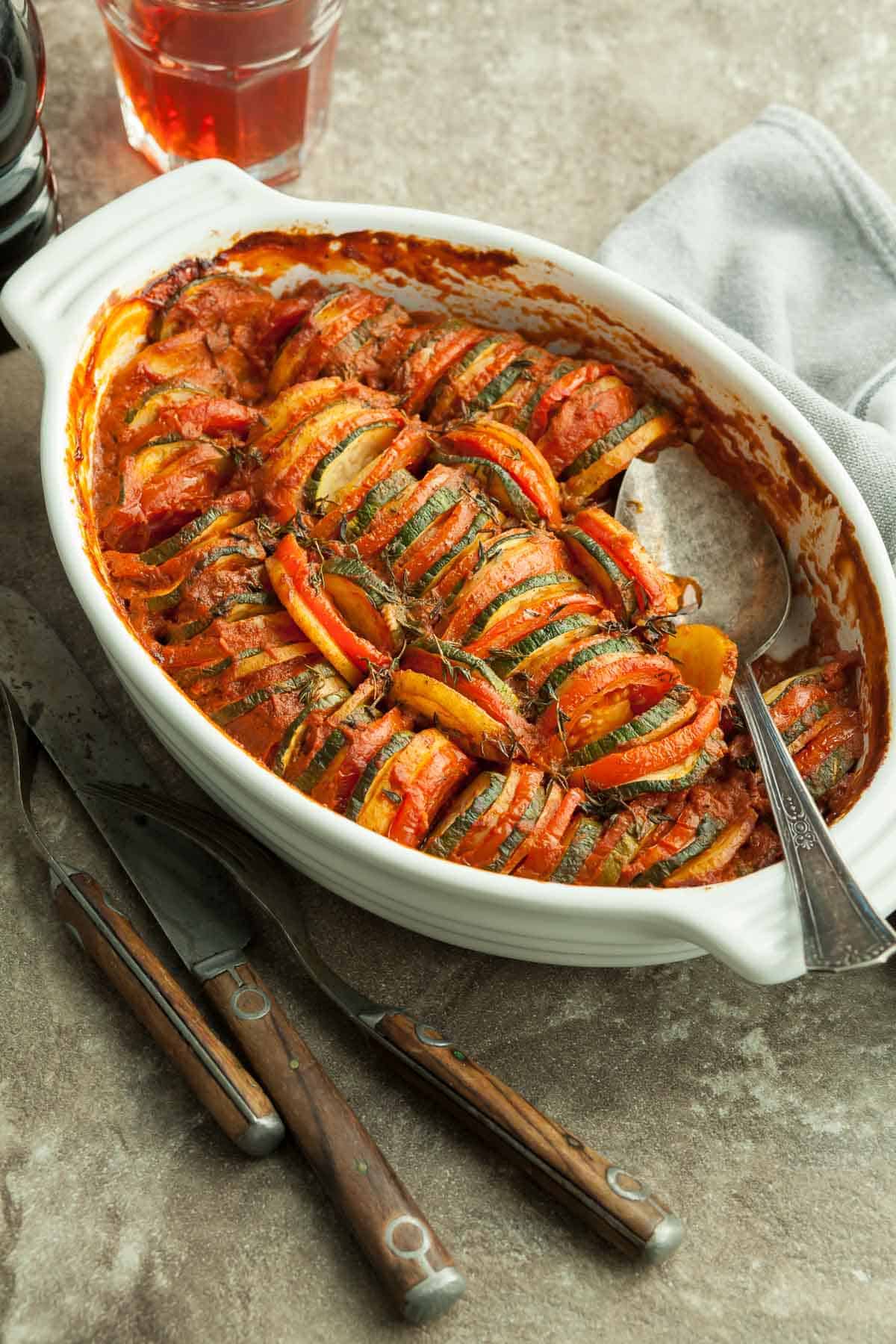
Tians: One way to use fresh veg is to lean into tian recipes. For example this one, provencal vegetable tian (shown above), or this one, which I made recently, summer vegetable tian. A tian is not all that different than ratatouille, but as Martha show in this piece, what is a tian, you can make one out of so many different vegetables. Need still more tians? Food and Wine has you covered with this Root Vegetable Tian.

Fresh veg: I love corn and broccoli, so I like this recipe for sauteed broccoli and corn salad. Corn salads look as great as they taste. Got green beans? Make Alison Roman’s blanched green beans with scallion and soy. Got some fresh kale or chard? Then make her lemony white beans with anchovy and parmesan. Packs a punch.

Do you have a bunch of asparagus? Sure you can steam it. But you can also bake it. Or to get a bit fancier, you can make this creamy Asparagus & Leek Crespelle (i.e. Italian crepe) (See below)

(If you lack leeks, this can help: leek substitutes.)

Crepes sound good, but so do galettes. If you agree, try this: This Cheesy Tomato Galette Needs Only 3 Ingredients. Use up those fresh tomatoes! If you need to use up some zucchini, try making this:  Crispy Baked Zucchini Fries.

Root veg: while all this fresh vegetable on hand is irresistable, I would be remiss if I did not include some root veggie recipes, since I love a good carrot or potato dish.

These Garlic and Herb Mashed Potatoes are a perfect side dish, as are these Basic Roasted Carrots from Hugh Acheson, whose recipes I always recommend. Parsnips are another great root veg, and I support this: In Praise of Parsnips, the Humble Heroes of the Vegetable Drawer.

Speaking of great sides, here’s Nigella’s salt and vinegar potatoes that make me think of Britain. (Here’s another version from the New York Times: salt and vinegar roasted potatoes. Relatedly, salt and vinegar spanish tortilla recipe from Serious Eats.) For a Greek side, these greek lemon potatoes go great with anything but especially lamb and chicken or really anything Mediterranean. (Again, here’s the New York Times and their version of greek lemon potatoes).

I love a good potato gratin, which is why I am giving you four versions of that dish: here, here, here, and  here.

To close out this section, consider making potato and cheese tacos. Or any of these beet recipes or cabbage recipes.

Misc.: none of these fit into a category other than delicious veggie recipes. Here’s 1 from Saveur: Asian Greens with Garlic Sauce (Choy Sum) and here’s 40 Ways You’ll Love Using Bitter Greens, also from Saveur.

This sounds great:  Tabbouleh with Marinated Artichokes and Baby Spinach. Do you have lots of peppers? Make peperonata.

You want this: a good guide on how to roast any veg. Here’s a fine way to use up your herbs: green goddess dip.  This is a good weeknight meal: one pot veggie rice bowl. Finally these are good for anyone on a budget: the BBC’s budget vegetarian family meal plan for four.

Carbs! Pasta and rice and noodles as well (food links for food lovers, June 2023)


I know I know….it’s only recently that I posted about food here: Beef and chicken and pork, too. Or is that two? (Friday food for mid-June, 2023) But I’ve got so many great food links that I wanted to write some more on it. This time I am focusing on carbs!

Noodles: When we talk about noodles, we are really talking about non-pasta noodles, because really spaghetti is as much of a noodle as anything.

So we have this recipe for curry singapore vermicelli noodles that I want to try. Or maybe I will try to make this version of singapore noodles. It’s one of my favorite noodle dishes, but instead of making it, I just keep collecting recipes, like this one from Bon Appetit on how to make Singapore Noodles. I think I need to make making them a goal for 2023!

Another noodle dish I’m afraid of making is dan dan noodles. I have made this:  dan dan celeriac noodles. It’s not authentic, but it’s good. Maybe I should follow this version from Joanne Chang at Food & Wine. Or this version, from Martha.

Meanwhile I have made these peanut noodles with chicken several times and they were easy and delicious. (see above)

Speaking of easy and delicious, this recipe for curry sheet pan noodles could fill the bill. As could these spicy vegetable lo mein noodles. If you are fan of udon noodles, check out Martha’s udon noodles shiitake mushrooms ginger broth . Still wanting noodles? Here’s:  16 Easy Noodle Recipes for a Quick Meal Any Time of Day.

Pasta: like many people, I love pasta. One reason I do is because it is easy. For example, this one pot pasta with ricotta and lemon recipe. Or this one pot macaroni pasta meal. And you can’t beat Marcella Hazan’s tomato sauce with onion and butter when it comes to easy and delicious. It’s one of my favorites. (More on Marcella Hazan and the 30th anniversary of her masterpiece, “Essentials of iItalian Cooking).

Speaking of Italian classics, here’s: Calabrian Carbonara Recipe from Andrew Carmellini at Food & Wine. More carbonara there.


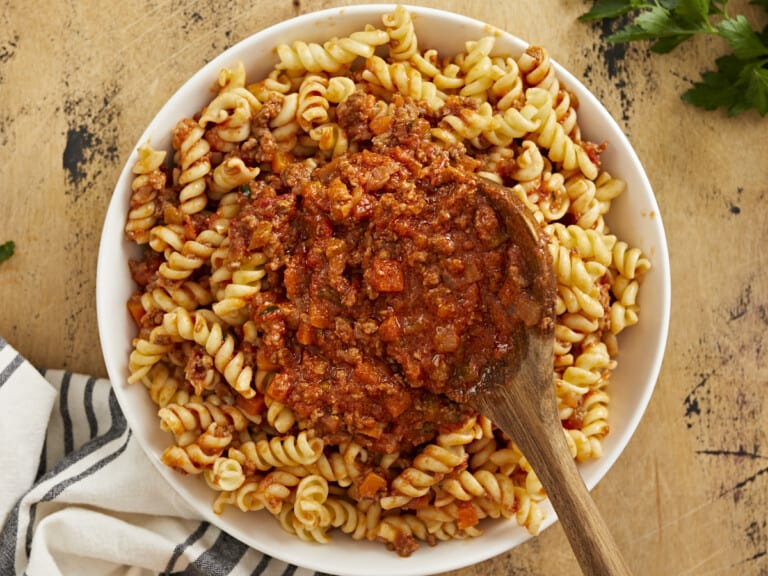
For fans of  bolognese, we have that from Budget Bytes (shown above) and this: bolognese meat sauce from Food & Wine. It may not be traditional, but this sounds good: Pappardelle with White Bolognese.

More Italian classics: Pasta alla Gricia, and Bucatini all’Amatriciana and Spaghetti Aglio e Olio. And let’s not forget arrabiata! Here’s Ina’s version if you like your pasta hot and spicy. Speaking of hot and spicy, here’s two takes on puttanesca, here and here (which for some reason Nigella calls Slattern’s Spaghetti).

Moving on from Italians, let’s talk about American pasta and people like Alison Roman and her pantry pasta. Or a classic Italian American pasta: Pasta Fazool This is very American: Easy BLT Pasta As are these two from Bon Appetit: How Chris Morocco Makes Pantry Pasta in the Time It Takes the Noodles to Boil and Macaroni and Peas Is the Desperation Meal That Always Satisfies

Pasta and greens go great together. If you agree, check out this garlicky spaghetti with mixed greens. Or pasta with garlicky broccoli rabe from smitten kitchen.  This has greens and beans: creamy chickpea pasta with spinach and rosemary. So does this: linguine with chickpeas broccoli and ricotta. And this chile crisp fettuccine alfredo with spinach sounds different but delicious.

And why not try this cheesy baked pasta? Or use up some sage with: Penne with Asparagus Sage and Peas. In a rush? Make: Fast and Easy Pasta With Blistered Cherry Tomato Sauce or this pasta sausage basil and mustard here 

For gnocchi lovers, turn up the oven for this four cheese gnocchi bake. If you like that, try this: Easy Baked Gnocchi. Or this  sheet pan gnocchi. How about: creamy tuscan sausage gnocchi?

Finally, here’s some advice on how to make polenta. And here’s a list of things to try using that pasta that looks like rice: 15 Favorite Orzo Recipes.

Rice: speaking of that other great carb, let me start with some Italian rice recipes. Like this lemon risotto. Or this Italian Wedding risotto. There’s this  sweet corn risotto too. And after you have risotto, you take your leftovers and go make Michael Symon’s Arancini Recipe perhaps.

Italian rice recipes are great, but so too are these ones from the Americas. For instance, this one pot cuban chicken rice and beans is one of my favorites (seen below). Try making pollo asado with black beans and rice or southwest chicken and rice. You’ll be happy and full in no time!


Happy cooking!

On the changes to the Twitter API in 2023 and why I’m not using it

Looks like Elmo (Elon Musk) and team have finally gotten around to making big changes to the twitter API, which you can read about here.

There is a free tier if you just want to tweet. But if you want to do what I do, which is read tweets via the API, the price starts at $100/month. Yeah, no to that.

I’ve been using the Twitter API for years. At first you could programmatically interface with Twitter simply using the cURL command. That was easy to use and likely easy to abuse. Eventually Twitter did a proper set of APIs and I’ve written several programs over the years — first using Perl and then using Python — to post tweets and to read them.

My last project was  tracking a group of users to see if Twitter usage was declining and twitter was dying. As of sometime in May, I did not see any decline in use. But who knows going forward. I am not going to pay $100 a month to find out.

It’s too bad: the new API code looks good and the tech people at twitter — not Elmo — have done a good job with the documentation, sample code at github, etc. Perhaps they will surprise me and they will get lots of people to use it and throw money at them. Or maybe it will be as unsuccessful as the Twitter blue checkmark program.


What Ethernet (which is 50 years old today) taught me about technology (open and cheap and easy and good enough wins)

Today the Ethernet is 50! It’s the dominant networking standard in the world and important enough to merit a Turing Award for it’s creator, Bob Metcalfe (well deserved).

If you had asked me what I thought of it back in the 80s when it first came out, I would have told you it was dumb in so many ways. As Network World explains:

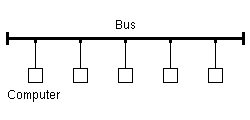
Basically, the (Ethernet) protocol makes sure that the line (bus) is not in use before sending any frames out. Today, that is far less important than it was in the early days of networking because devices generally have their own private connection to a network through a switch or node. And because Ethernet now operates using full duplex, the sending and receiving channels are also completely separate, so collisions can’t actually occur over that leg of their journey. Other than when encountering a collision situation, there is no error correction in Ethernet, so communications need to rely on advanced protocols to ensure that everything is being transmitted perfectly.

And that was the problem. Early networks could be half duplex, so device A on an Ethernet network would try to send information to device B on the network, but if device C tried to do this at the same time, a collision would occur and A and C would have to retransmit. If you only had a few devices on the network, it was ok. If you had many devices, collisions would happen frequently and communications was a mess.

Other / better technologies like Token Ring were designed to get around that. I was sure that they would beat Ethernet and become the standard. I was wrong.

Ethernet may have been not as good as the other technologies, but it was more open, cheaper and easier to use. And it was good enough. Anything open, cheap, easy and good enough wins. C beat other languages by being that way. DOS+Windows 3.1 won over OS/2 for similar reasons.

The next time you see a new technology that has those features, you can bet wisely that it will end up being a dominant technology. People will adopt that technology over others that lack those four features. Once adoption occurs, that tech will get better, become more than simply good enough.

Happy birthday, Ethernet. You weren’t very good in the beginning, but you were enough. Stay easy, stay cheap, stay open.

Some thoughts on being sufficient

It’s an easy thing to make yourself feel you are insufficient. You simply have to pick a task that you believe you can do but that is beyond your reach. It can be a nearly impossible physical task, like running a long distance. Or a mental task, like memorizing a long work of fiction. Or it can be a social task, like having plenty of fans and friends. Regardless, it can be something you can be guaranteed to fall short of achieving in the attempt.

The hard thing is to make yourself feel sufficient. To look past your failings and limits and judge yourself worthy. It requires knowing yourself. Knowing what is required of you. Knowing that even if you can’t do everything or even many things, you still can do some things, and that those things are enough. Those things are sufficient. Just like you are sufficient.

On appreciating the Chrysler Building (my favorite building in the world)

I love the Chrsyler building in New York City. While there are many great buildings in the World — never mind Manhattan — it’s always been my favorite. So I was happy to come across this on the site, Open Culture: An Architect Demystifies the Art Deco Design of the Iconic Chrysler Building. That site highlights a video from AD and explains:

In the Architectural Digest (AD) video… architect Michael Wyetzner takes us on a tour of that design, explaining how each of its features works with the others to make an enduring visual impact. Some, like the gleaming oversized radiator-cap gargoyles, impress with sheer brazenness; others, like the Native American-derived patterns that repeat in various locations at various scales, take a more practiced eye to identify.

Fans of this building, like I am, take note.

P.S. I think Ridley Scott is also a fan. In the opening minute of his film, Someone to Watch Over Me, he takes an entire minute to lovingly film the skyscraper just as night falls. Here’s a clip of it:

Beautiful.


I eye, You eye , We all scream for AI (What I find interesting in AI, Mar. 2023)

Have you heard of…A.I.? Of course you have! You can’t go anywhere lately without reading or seeing something about AI. Not even the Kardashians can generate this much interest or hype about something. It’s incredible.

I’ve been collecting a number of links on the topics, which I’ve grouped below. As well, I have been blogging all week on the topic, trying to give my perspective on it all.

Things are changing rapidly when it comes to this subject. I hope these things help you gain a better understanding of where things stand at the moment, even if it is a brief moment.

Ideas/thoughts on AI:

Tools and technologies:

Science:

Finally:

  • Roger Schank passed away. He was a leader in the field of AI.
  • Cool stuff:  OpenWorm project is an example of just how complex organisms are.
  • I am normally a fan of our world in data, but their brief history of AI  is far too rosy for me.

Why your next dinner party should be un apéro dînatoire


Wait, what, you say? Un apéro dînatoire? Qu’est-ce que c’est?? Well according to Food and Wine, it is a…

 …snack dinner: the weeknight meal that offers free license to pull assorted things from the fridge, loosely arrange them on a platter or cutting board, and call it dinner. The French have perfected the art, dubbing it l’apéro dînatoire, and in the process, created a chic way to shift fluidly from cocktail hour to dinner with nary a place setting in sight.

Sounds good, yes? I agree. If you need some ideas, here’s 43 of them. Still stumped? Here’s 80 more. As for me, I would not sweat it. Get some spreads, some dips, maybe some cheese or cold cuts, some veg and bread — and of course drinks — and you are all set to have a chill and relaxing dinner party all can enjoy. For more on it, see the F&W piece, here: A French Aperitif Party Guide.

Of course it doesn’t have to be a weeknight: a weekend meal would be great too.

Bon appétit. Santé!


On restaurants (deeply) loved and lost: Grano’s

Grano’s was not just a restaurant to me. For much of my adult life it was my second home. When I walked in, I felt like I lived there. Like I belonged there.

Starting from the late 80s (when I was in my 20s) until just before the pandemic, it was the restaurant I frequented the most. I celebrated some of my most cherished moments there. I ate often by myself there too. When I did not know where to go, I went to Grano’s.

When I first came to Toronto in mid 80s, I started to learn how to eat proper Italian food in places like Masianello’s downtown in Little Italy. Toronto is a great Italian city, and to live in such a place, you should learn to eat proper Italian food. I did, and I loved it. This love led me uptown to Grano’s, which was then a simple one room place. Over the years it expanded in width and depth, filling up with its maximalist Italian style and food as well as patrons wanting to devour it all. I was always one of those people.

Grano’s was as much a feast for the eyes as it was for the belly. Bright Mediterranean colored walls, prints of classic artwork, vintage ads and plenty of pieces from the Spoleto festivals could be seen everywhere. It paid to walk around slowly (or to sit quietly) and take it all in. It never got tiring to behold.

If you wanted — though why would you? — you could rush in and buy some bread or some Italian delicacies and go home. You could stay briefly and have a glass of Italian white and some grilled calamari (one of my favorites). Best of all, you could invite dozens of friends and loved ones and have the servers bring you bottles of Italian wines and plates and plates of antipasti and pasta that was always on hand for you and your guests. Whatever you needed, Grano’s would provide. And when it was finally time to end the meal, you could savour a plate of biscotti and a perfect cappuccino before you went home happy.

As you can see, Grano’s the place was great. But what made it especially great to me was Roberto Martella, the host. No matter when I came, he always treated me like I was his favorite customer. No doubt he made everyone feel that way, but it was still appreciated by me. I even took Italian classes there once, and years afterwards he would speak to me a little in Italian and I would try my best to reply back with the little I knew.

After going there for decades, I had hoped Grano’s would last as long as I would. But sadly Roberto had a stroke, and the restaurant limped along without him for awhile before closing in 2018. You can still see the remnants of Grano’s today in 2022, though it’s been divided up into new places that lack what I loved about it.

It’s sad to lose your home, especially one you loved for so long. That’s how I felt, and continue to feel, about Grano’s. I live nearby to where it was, and I often have a pang to wander over for a plate with the ease I used to. I don’t know if I ever will get over that feeling. Sure, I can get great wine and bread in others places, but “non si vive di solo pane”. Mille grazie, Roberto. Mille grazie, Grano’s. Thank you for everything.

P.S. For lots of good photos of it when it was at its best, see here: Foto. The photos I have linked here are from there.

This is their old home page on weebly. It has a short history of Grano’s, here: 1986. 

There’s only a few images, but this is their IG account.

Finally two pieces on them: The culinary influence of midtown’s Roberto Martella – Streets Of Toronto, contains a good history. This is also good: The fall and rise of Roberto Martella, Toronto’s ‘vibrant’ don of dialogue in The Globe and Mail.


On the joy of train travel compared to air travel


Train travel is good.  Train travel from Toronto to Montreal and back exceptionally so. Let me count the ways by comparing it to airline travel.

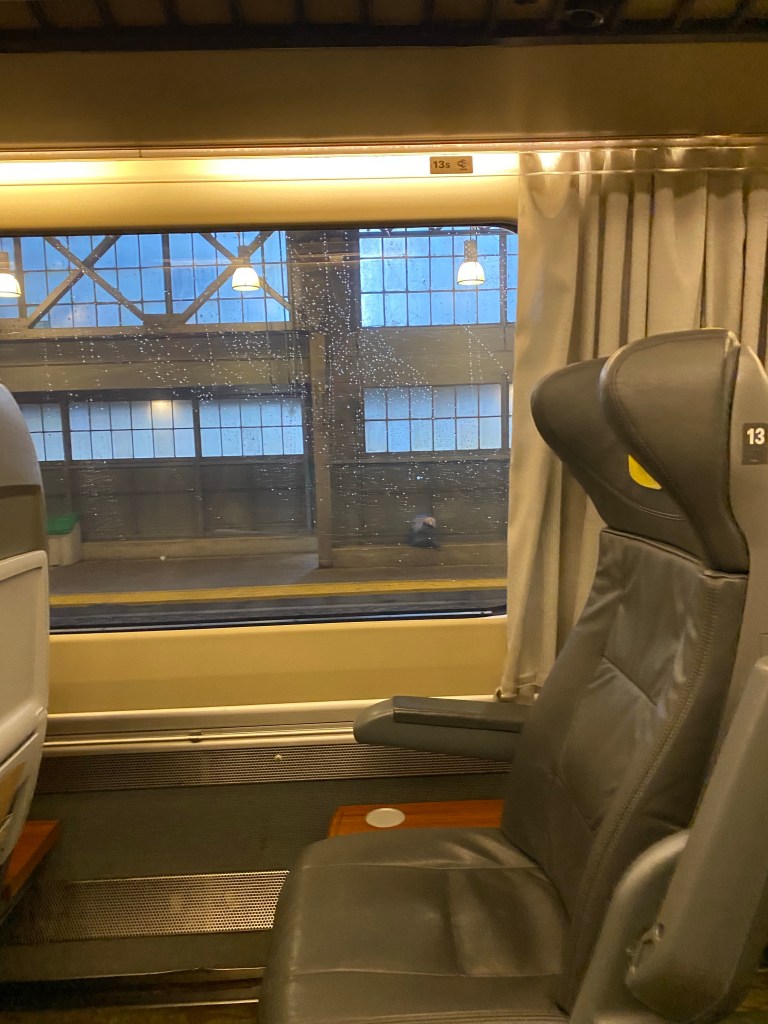
It starts off before you even get on the train. In Toronto you can catch a subway or an Uber to Union Station downtown. Once there, it’s a short walk to get to where you board the train. There’s no getting stuck in traffic on the 401 trying to get to the airport. No paying for expensive cabs or limo. Fast and cheap.

Then you get to the station. There’s no multiple checkpoints to get on the train. You find out where the train is boarding and you line up to get on. Quick and easy.

Once on the train, you have lots of room to move around. No having to sit in your seat all the time. No seatbelts. Wide chairs. Comfortable.

If you take the business class train, you get a constant supply of food and drinks. Wine, caesars, port and cognac is all available and included. Plus hot towels, snacks and full meals. Satisfying.

Then there’s the scenery. There’s lots of it and it’s easy to see out the big windows. Tired of the scenery? You have a good amount of time to watch a movie, read and even nap. Relaxing.

Finally, you start in one downtown and end up in another downtown. You don’t have to get in still another cab to get to your final destination. Sweet.

Sure you can take Porter at Billy Bishop, but you still need to cab into Montreal from Dorval. And while the flight itself is short, the time you take getting to the airport, getting through security, building in extra time so you don’t miss your flight….it all adds up. 

Air travel is essential for long distances. But for shorter distances, you owe it to yourself to take the train.


It’s Labour Day. Put away that computer and make something creative

It’s Labour Day. Take a well earned break from your work. Perhaps you plan to relax and take it easy. That’s a good choice. If you are itching to be more active, though, why not do something creative?

If you are looking to make something, the Washington Post has a section on beginner diy projects.

Perhaps you always wanted to learn to paint? If so, Domestika has this creative watercolor sketching for beginner course.

If you have already started painting and you want to improve your skills, these
YouTube videos by Ian Roberts on Mastering Compostion are good. Likewise, if you can go to the artistsnetwork.com and get guides like this: how to thin acrylic paint and more.

Another source of education is My Modern Met Tutorials.

If you fantasize about going to art school but can’t imagine how you could pay for it, read this: Don’t Want to Pay for Art School? Here’s a Streamlined Syllabus for Getting your MFA.

If you want to do something musical instead, check out patatap, a fun way to make noises and visuals with your keyboard.

Finally, if writing is your thing, you can start a blog here at WordPress. If you want more people to read you though, consider writing for a larger audience and see if they will still take first person articles at The Globe and Mail.

There’s lots of ways to be creative. Have fun!

How to find more joy in your life

If you want to find more joy for your life, you can go about it in two ways. One way is to read the work of Ingrid Fetell Lee. She has a book and a web site that can help you do just that. I like her and recommend her.

So that’s one way. Another way is simpler and almost too obvious. List all the things you enjoy…those are the things that bring you joy! They are people, places and things. They are activities. They are inactivities! They are free things, and not so free things. They are rare things, and they are common things.

Here’s the main thing though: when you enjoy them, take the time to really enjoy them. I often find I partake in things I enjoy, but I allow myself to get distracted. Don’t be like me. If you are enjoying a sunrise, or a trip to someplace new, or a conversation with a friend, or a new outfit, really enjoy it.

On Counting

Too often I seem to spend my days counting. Counting the hours in the day until the work day is done. Counting the hours in the evening until the day is done. There is little joy in such hours: I am just passing through them. Some hours are boring: others are painful. At night I often think: ok, that day is over. Thank god.

Before I get up in the morning, I find my brain anticipating the hours ahead and trying to deal with them. Some mornings I can convince my brain to think about something else until I get up; some mornings that enough to let me get back to sleep.

For a long time I did not want to be here anymore. I had converted it from not wanting  “to be” to “not want to be here”.  Other people want me to be and want me to be here, and so not wanting to make things worse, I remain. A remainder of a divided life. I try my best to be responsible for those who want that dividend.

Lately people have taken to treating my heart. They are worried about the literal one, but the metaphorical one is troublesome too. Hearts are too often troublesome.

People make recommendations to improve, as if I don’t know. As if I have not tried. I know enough. Enough to keep counting. Counting the days, the hours, the beats. Counting things that don’t count. Counting on things that matter will go on after me.

Counting down. Counting off. Counting.


On restaurants loved and lost: Mike’s Lunch in Glace Bay

It doesn’t look like much. Only that Teem sign on the right tells you that this is the location of the famous Mike’s Lunch of Glace Bay. It had a good run of 109 years in various locations in my hometown before closing in 2019.  It was one of my favorite restaurants in the whole world, and it was the first place I went and dined by myself as a young man.

Back when I was young, it was located on Commercial Street in a little galley type restaurant. It had a counter in the middle where you ate, while pinball machines lined the walls behind you and the cooking was done in front of you. In the summer I would sit next to the open door and look out at the beautiful house across the street (the only house left on Commercial Street). I can remember the sunshine and the warmth and the joy of sitting there while I waited for my food. While many diners had the famous fish and chips, my meal of choice was the Club Sandwich. Toasty bread and toothpicks held together chunks of turkey, crispy bacon, lettuce and mayo. Mine was completed with hot french fries coated with gravy and ketchup and accompanied by an ice cold Coca-Cola. To this day it is still one of the best meals I ever had.

Years later Mike’s Lunch moved to a nicer space in the Sterling. The pinball machines never made the transition, but it still had a counter. It also had nice tables and booths and friendly waitresses. I never failed to go any time I visited Glace Bay, often more than once a visit. I don’t know how, but no matter how long I had been away, when I returned they always remembered me. And the club sandwiches were as good when I was 50 as they were when I was 15. No wonder we all loved it.

I miss Glace Bay for many reasons: the Chip Wagon, Venice Pizzeria, and Colette’s, to name a few great places. But of all the places I miss, I miss Mike’s Lunch the most. Thank you Mike’s Lunch for all the great meals and great times I’ve had there. I have been to many great restaurants over the years, but if I could walk through the doors of any one of them one last time, it would be yours.

Bonus: footage of Commercial St in 1988. The town changed over time, but this is how I remember it growing up. By this point Mike’s Lunch had already moved to the Sterling. Teddy’s (or as this video called it, The Greasy Spoon, and a similar restaurant to Mike’s) was still there.

In 2022, I switched from grocery shopping at Metro (and Loblaws) to Walmart and Instacart. It’s been much better. Here’s why

(2023 Update: I’ve recently switched from Walmart to Food Basics. You can read about that here.)

I did the math and found that I can save around $1500/year if I switch my grocery shopping from Metro / Loblaws to Walmart. I save much less and it gets more complicated if I include Instacart in the mix, though I am still doing it. Let me explain.

To determine what I could save, I built a spreadsheet of all the things that I typically buy. I set up the following columns:

  1. the price at Walmart (using numbers from the Instacart app)
  2. the price at Metro (same day numbers from the app)
  3. the difference in price. If the cell is green, Walmart is cheaper; if red, Metro is cheaper; if yellow, the comparison is off; if blue, the price is essentially the same (around 2 cents different). You can see almost everything was cheaper at Walmart, sometimes by a lot
  4. How much I save if I bought everything at Walmart that week
  5. How many times a year I buy that item
  6. How much I save a year if I buy it at all at Walmart
  7. The name of the item
  8. The category of item (Deli, Frozen, etc)
  9. The quantity of the item
  10. A description
  11. A comment

Here’s my spreadsheet on Google Sheets. You can review my numbers and see if they add up.

Of course I may buy different amounts,  and I may buy items not listed there. But that amount of savings for the year will be close, I think.

Now here’s the problem for me: I live very far from a Walmart. I don’t have a car, and there is no way I want to take that much groceries on public transit to get them. (If you can drive to any grocery store you want, then go to Walmart and you can save that much too. Maybe more.)

To solve my problem, I decided to sign up for Instacart. The problem then is all the savings turn into Instacart fees. I still estimate I save around $100 / year. (The spreadsheet has the details). Not much, but still. I essentially get the savings from Walmart to pay for my Instacart.

Overall, I see the switch to Walmart/Instacart as  positive for number of reasons:

  1. I used to shop 2-3 times a week to get all the groceries home. (This is because I don’t have a car.) It was a lot of time and effort. Now I shop with my phone on my couch and get all the groceries I need in one go. If I do any shopping in person now, it’s for speciality things. So my quality of life is greatly improved.
  2. I used to shop at my local Metro which I have hated for years. It was a crappy store for ages until Loblaws moved in. To compete, it did a make over and kept its prices low enough to keep me going there, for the most part. (I took what business I could to Loblaws). Last year they really raised their prices for the things I shop for by A LOT. There were no loss leaders. No discounts. All staples seemed to go up by 1-2 dollars. The prices were also much higher then what is in my spreadsheet. It really made me mad and frustrated. Taking my business elsewhere is satisfying: I don’t have to put up with that horrible store where I feel taken advantage of.
  3. I am budget conscious when it comes to grocery shopping. I want to best deal on food, and for commodity foods, I want the lowest price. Walmart gives that to me.

If you like grocery shopping in person and you can get to a Walmart, go to a Walmart. (Or possibly No Frills.) You can save a fair bit of money. And it’s not just my opinion. To see what I mean, read this: Which foods can you get at a big savings at discount stores? | The Star

If you hate grocery shopping and/or you don’t have a car, switch to Walmart and Instacart. You won’t save much, but the quality of life will improve considerably.

This is my experience with this. YMMV.


On Liz 2 and Chuck too. (Monarchy Watch)


The Queen of England continues to be well loved by many, both in England and abroad. Even in TV series like The Crown, she comes across well, unlike many others in it. Fine and good.

But we will all have to face a choice once the Queen dies. To make that choice, I thought these pieces are worth bearing in mind:

August 6, 2022: you would have thought after literally being caught red handed holding the bags of cash, that Prince Charles would be embarrassed enough to not do it again. You’d be wrong. Here he is taking money from the bin Laden family. Amazing.

Meanwhile schools are renaming themselves so they are no longer associated with that other disgraced royal, Prince Andrew.

September 8, 2022: the Queen has passed away today. The new monarch is Charles III.

February 28, 2023: Well it hasn’t taken too long for King Charles to start wading into political matters in a big way, this time on Northern Ireland. I expect we will see more of this, alas.


On Apple, the Newton, the 90s and me

500

For people in this time, it’s may be hard to imagine Apple as anything other than a tremendously successful company. But in the 90s, it was the opposite. Under John Sculley and others, it was a company in major decline and all but at death’s door before Steve Jobs came back.

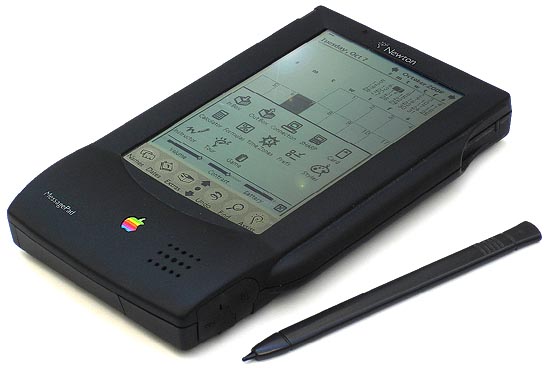
In some ways the Newton you see above was emblematic of that time. It was a device that Apple tried to use to regain the magic that it once had. It failed, but in some ways it was a glorious failure. (The Powerbook also came out at that time and it was a fine machine but the problems of Apple were baked into it.)

I’ve always had a fondness for the Newton, and wanted one for a long time, even though I could not justify getting one. And then Jobs returned and tossed it in the bin like so much crumpled paper. It was a smart decision, but a sad one for me.

That’s why I was really interested to read this recently: The Newton at 30. It’s a great rundown on that device. Reading it, I was happy to see that some of the original ideas found in the Newton later made their way into other mobile products from Apple. Good ideas deserve a home, even if they were never going to find that home in the Newton.

In the 90s I had a small role in developing IBM software that ran on Macs and that allowed our customers to access our IBM Global Network via a Mac. I loved building Apple Software, even if it was a nightmare at times. (Writing software for a rapidly declining company is no easy thing.) At the time I got to work on the Powerbook 1400 and 3400 and hang out at Apple and play around with the emate 300. It was a good time despite the difficulty. I never got a Newton then, thought I got close.

Later in the second decade of the 21st century I finally got to buy my own Newton! Mint condition, from Kijiji. 100+ bucks! Funny, a device that was so cutting edge when it first came out seems so limited now! It was a good reminder how fast technology moves. I was still glad to have it. It’s a wonderfully collectable device.

For more on the Newton, click that link.

Happy Anniversary, Newton. You were truly ahead by a century.

The solution to poverty and crime and homelessness is simple

And what is the solution? GIVE PEOPLE MONEY. Just give it to them.

Here’s what I mean. Case study #1: Liberia’s stunningly effective way to reduce shootings and other crimes.

Case study #2: The expanded child tax credit lifted 3 million children out of poverty.

Read and see. Over and over and over again, it’s always the same. You give people money, much of our social problems go away. Much? Most. All? Not all.

Shouldn’t we give them jobs? Jobs is a way to give people money. Good jobs are a great way to give people money. Crappy jobs, not so much. In fact, many jobs are an indirect way of giving people money, it’s just that people sit in an office for eight hours a day filling out online forms or sitting in meetings because someone has a sense that they are needed so that someone else can have someone give them money.

Where does the money come from? From people who have more money than they know what to do with. From programs we fund now to the hilt because we worry about crime. From taxes on people and organizations that harm our society, that pollute, that run their businesses on the assumption that it doesn’t matter that they treat people badly.

Won’t this cause moral hazards? It’s a good tradeoff to have.

In the future we will be harshly criticized for not doing the thing that is obvious to alleviate all our problems because of our inhumanity towards others. For allowing people to be homeless. To be hungry. To suffer needlessly. The obvious thing is to give people money.

Once they have money, then the next thing is to help them with the things they need to have a better life.


It’s getting warmer. Here’s the perfect speaker / lamp to help you enjoy music outside

It’s nice to sit outside in the summer and have some music playing while you grill food or enjoy a fire or simply relax. Now thanks to this collaboration, you can: IKEA teams up with Spotify to debut the Vappeby, a $65 wireless lamp/speaker with built-in ‘Spotify Tap’

The nice thing about it is that it is not only portable, but that it looks just as nice inside too:

If having sound outside this summer is on your todo list, check out the piece in Yanko design, then head out to IKEA (or their website) and try and get one soon.

How to use the motivation equation to get more motivated

On Saturday I wrote about how the motivation equation explains why you are or aren’t motivated. I want to write now on how you can use the same equation to get more motivated.

Here’s the equation again. Recall we replaced the I with F, for Friction

In short, to get more motivated, you need to:

  • Increase the chances you can do something (E)
  • Increase the value of doing it (V)
  • Decrease the things that make it harder to do something (F)
  • Decrease the delay in it occurring (D)

Remember, we all have alternatives (A) in terms of what we can do. And this is where context C comes into the picture.

Let’s take some classic examples to walk through this. I’ll underline the approaches you can take to motivate yourself and emphasize how it relates to the formula.

First example: lie on the couch or go to the gym and get in shape? V may be the same for both, but E is low and D is big for getting in shape. Plus there is hardly any friction F in being a couch potato. Going to the gym means getting ready, getting to the gym, dealing with people at the gym, washing up, and then going home. So much friction! If only you could motivate yourself to get off the couch and do something!

The way to motivate yourself with this is to reframe things. Change the context. That will help you change the equation and bump up the Vs and Es and decrease the Ds and Fs. If you need motivation for getting in shape, the question should not be: lie on the couch or go to the gym and get in shape? The question should be: 1) lie on the couch and feel bad later and sink into poor health or 2) go to the gym and feel good now and get in shape? In that context, V for #1 drops and V for #2 increases. Next, tackle the friction F for going to the gym. People do all sorts of things for that: find a gym near them, have a gym bag packed, find a friend to work out with, or skip the gym altogether and workout at home. There are lots of actions to decrease F. Likewise, if you focus on the short term goal of feeling good on the day you go to the gym,  E increases and D decreases and your motivation goes up.

This leads to my next approach: you need a plan. Plans help increase expectations E and decrease delay D. If you want to run a 5K or a marathon, if you want to learn a language, if you want do achieve anything worthwhile, it helps to have a plan. Plans help with E:  if you have an authority (coach, instructor) telling you that if you stick to the plan you will succeed, E goes up. Plans help with D too because now you can imagine/see D decreasing with every day that passes. Likely V increases every day too. Finally plans decrease F. Uncertainty of what to do is a source of Friction. A plan decreases uncertainty and thus F.

Planning is easier than you think. Can’t come up with a plan? Do this. Say: I will do this today and tomorrow. Or today and the rest of the week. After you do it, make a record. Write it down. Mark a calendar. Whatever works. After a week, tell your stupid brain: that was the plan, dummy…I tricked you because you were telling me I couldn’t do it and I did it and before you tell me I can’t do it again you told me I couldn’t do it at all and I did so I know best and I will do it! (It’s worth a shot). Don’t let planning stop you. Any plan, even a bad plan, will help. Here’s a plan: buy a dozen beer or Gatorade. Put them on a shelf. Plan to drink one every time you work out. Put the empties next to the full ones. Plan to finish them all. Voila! Who said you can’t plan?

Another way of dealing with expectations E (and your stupid brain) is visualization. Chances are you use visualization already, just in a bad way! You imagine all the reasons you cannot succeed. Now be like a professional skier or runner and imagine all the ways you can succeed. Whenever you imagine failing, imagine successful alternatives instead and practice going over them in your mind. You will see increases in E if you work at it.

Related to visualization is internal chatter. In sports, coaches will tell players on the bench to “talk it up!”. Why? Because it encourages teammates and defeats their negative internal chatter. You should do the same. When you motivate yourself to do something and you are done, what do you do? Do you just move on to the next thing? If you do, you are telling yourself: that didn’t matter. If a team scores playing a game, they get excited! They cheer! When a team is defending, everyone yells “Defense!” All of these things increase the value V of the thing they are doing. You need to do the same, and by doing so, increase the value of what you are doing or what you did. And when you succeed, you give yourself a cheer and your brain thinks: I can do it! And with that, the next time you try and do it, E is increased.

Another way to motivate yourself is overloading. If you aren’t motivated to go to the gym to get in shape, come up with several reasons to go. You aren’t just going to the gym to 1) get in shape. You are going to the gym to 1) get in shape 2) get out of the house 3) meet your friend 4) reasons of vanity 5) reasons of pride 6) etc. Give yourself as many reasons as possible. Brainstorm ideas. Ask friends. List them all out. Get as many high value ones as possible.

Related to overloading is overshooting. Didn’t do any of your hobby last month? Missed meeting up with friends? How about planning to do it every day next month? Twice on Sunday even! Imagine making huge improvements on your drawing or sewing or photography. Think about all the enjoyment you’d get seeing all your friend or just contacting them. List all the ways you could derive value V from that. Now after a month, look back. You likely didn’t do it all. (If you did, awesome!) But look at the improvements you made. As they say, you aimed for the stars and landed on the moon and that in itself is incredible. No doubt all the effort resulted in ways you learned to decrease friction F and improve expectation E. You will find you are much more motivated to do things by planning to overshoot.

Refuse to fail.This is useful if expectations E are low and is related to overloading and overshooting. So you and your friend skipped the gym but you had a good time and you needed a break and you went the next day. Or you didn’t create anything but you cleaned up your work area and made it easier to draw the next day. Sure you could beat Today You up for not doing the thing. But give yourself credit for helping Tomorrow You be more motivated by reducing the friction  For the expectations E for tomorrow. You don’t fail if you get up the next day. There is no timeclock.

If you should do good things for several reasons, do bad (or not so good) things for one reason. Don’t lie on the couch and eat cake and watch movies and talk with friends, etc. If you do, you are going to be very motivated to be a couch potato! If you are tired, lie on the couch. If you want a slice of cake, go get one (preferably as a treat…maybe after the gym.) Talk to your friends in person. You want to decrease the value V of lying on the couch. Heck, pile stuff on the couch (increase the friction F) or lie on the couch only after you do some other things (increase D) or only lie on the couch if you flip a coin and it comes up tails (thereby decreasing E).

Understand what does motivate you and apply it to other areas. If you still are struggling to motivate yourself, sit down and write down what you are motivated in doing and understand the V, E, F and D for them, Then look at what you are not motivated in doing and see how they are similar. Is there any way you can change the unmotivating ones to look more like the motivated ones. You should see ways to increase your motivation.

Keep a log for things you regularly struggle to find motivation for. Write down the V, E, F and D for the last time you did them. Maybe you are imagining F and D as being worse than they are. Likewise, maybe it was easy for you and you enjoyed some aspect and the value V and expectation E are higher than you imagine. If so, great! If not, keep logging and log what you changed to motivate yourself this time. Keep tweaking those values until you are doing better.

Choose the next best alternative. Can motivate yourself to go to the gym? Go for a good walk rather than lie on the couch. Can’t call that one friend you should call due to high friction F? Call someone else where the value V is high but F is lower. Can’t do the creative thing you think you should be doing? Do something else creative instead. Eventually you will need to understand your lack of motivation for not doing that one thing; doing a close alternative can help.

Lastly I want to mention two last things: Habits/Routines and Novelty. Habits/routines are very good at decreasing friction F and increasing expectations, E. But they can also cause you to feel a decrease in value V, because things get stale and boring and less enjoyable. That’s where novelty comes in. Novelty decreases expectation E (who knows what will happen) and increases friction F (because it is new), but can also increase V (less stale and boring) . If habits/routines are the main dish, novelty are the herbs and spices. You need both.

If you’ve read this far: wow! you were motivated! Good work! I hope the value V was high and the fraction F was low.

If you were wondering: why did he keep repeating those letters? It’s because I really think the key to motivating ourselves is to think in those terms: V, E, D and F. Repeating them helps reinforce that. Also there is nothing new here when it comes to approaches to motivation. What I think is new (at least to me) is applying them in light of the formula. I hope you found it the same.

Now go and do good things. Great things, even!



32 good pieces for a Sunday afternoon


It’s spring cleaning time. All these links are worth reading and worth commenting on, but I never found either the time or the words to do so. But on a quiet Sunday, you might find something here worth reflecting on:

  1. Intriguing:  How civilization started
  2. How to stay young (if you want to)
  3. Hmmm:  On mental illness
  4. It’s a problem:  When the rich don’t pay their fair share it exposes society to risks
  5. The problem with the trolley problem
  6. The history of holes tells a story of power and potential
  7. How to fulfil the need for transcendence after the death of God
  8. A stable sense of self is rooted in the lungs heart and gut
  9. Stephen Hawking’s Philosophical(!) Position on the Uncertainty Principle
  10. George Saunders’ commencement address: Try to be kinder – good advice
  11. New York’s Shadow Transit | The New Yorker
  12. Now adults have them – Once Upon a Time, Bedtime Stories Were Just for Kids
  13. Life is hard: I work at an office with no parents and it suck
  14. A sad story:  Drug addicted teens
  15. Something we can forget:  People Who Take Drugs Are Real People
  16. Good luck with this The out of touch adult guide to kid culture
  17. Sleep well: Insomnia tips
  18. On twitter: twitter fact watch
  19. The best read it later apps
  20. Helpful:  Working woman’s handbook
  21. Ha!  Stop being a jerk on Venmo!
  22. Can maintenance save civilisation?
  23. More on old age De Beauvoir on Aging
  24. If you care:  Is “cancel culture” over?
  25. On horseshoe theory
  26. The Crito by Plato – worth reading
  27. Not sure this is a thing:  Radical Centrism
  28. Thich Nhat Hanh on Life War and Happiness
  29. Truth is real and philosophers must return their attention to it
  30. For those who care: Fantastic Beasts Never Understood ‚Harry Potter Fans – The Atlantic
  31. End-of-Life Conversations Can Be Hard but Your Loved Ones Will Thank You
  32. Finally  On that crazy Fourier

My grandfather’s pansies

When I was a child I would often visit my grandfather’s house and admire the pansies he grew near the backdoor of his house. This area would get no sunshine. Worse it was where he would dump hot ash from his coal stove. In this dark fiery place grew white and yellow and purple pansies.

In our culture we associate pansies with softness and weakness. I learned instead that they were hardy and beautiful and defiant. We all should be like my grandfather’s pansies. We should all be so wondrous.


I wrote the above earlier this week and I realized it comes across like so many things I write. I don’t even know why I write this way anymore. Why I write like someone needs advice and I am the one to give it to them. There are few if any that need such things.

Perhaps I should write like most people. Write about what happened recently, what happened in the past, and what if anything I thought about it.

My grandfather did have those pansies. They were beautiful to look at. Even as a kid I was impressed that they could grow there. I liked seeing them as I came through the backdoor of the house he made with his own hands.

I also treasure that memory because I only have a few times I recall interacting with my grandfather. Typically they were about his yard and what was growing there. He grew so much, from the carrots and the cucumbers at ground level to the flowers and the dill that waved high in the breeze. Of all that I appreciated the pansies the most.