I love this webcam so much I decided to post it here so more people can know about it. It’s a camera provided by the CBC that focuses on downtown St. John’s in Newfoundland, Canada.
It’s a perfect webcam if you ask me. The setting is as picturesque as anything. There is just enough activity happening to make it seem real (as opposed to a still photo): cars go around constantly, birds fly by, and occasionally you’ll see a boat in the harbour.
CBC has other webcams, but this seems by far the best. Check it out if you have a minute. It’s perfect especially for anyone from Newfoundland feeling homesick.
The second half of 2025 is done, so it’s time to follow up on what I wrote at the end of the first half of the year. Having just had a good dump of the white stuff (sleet) all over my yard, I’ve decided to stay warm and dry indoors, make myself a big cup of coffee to sip on, and sort out what’s happened since June. Let’s take a look.
As with the previous edition of my not-a-newsletter newsletter, this one is somewhat preoccupied with what is happening in the Trump Administration, though less so. Like the man himself, we are all weary of his presidency, even though he’s been in office a year. (Though technically this is his fifth year as President.)
Is he still engaging in extreme corruption? Yes. And not just for himself. The fact this is no longer considered “news” may account for why the media is focused more on other aspects of his Presidency, even though such corruption is a big deal.
Among Americans opposing Trump, there’s been one new name that’s been attracting much attention over the last year: Zohran Mamdani, soon to be mayor of New York City. Ironically, he and Trump got along great when he visited the White House, much to the shock of many.For why people — especially young people — voted for him, read this. He seems ready to hit the ground running come January, based on this. Could be an exciting year for NYC.
Slowly the air is coming out of the fame of Taylor Swift and now everyone is talking trash about her. That’s a big change since last year. Will she disappear? I doubt it.
For the last few years I’ve shared interesting links I wanted to write about some day and maybe I will. Last year it was 28. The year before it was 85. As in other years, I think these links are all interesting, even if I don’t have much to say about them.
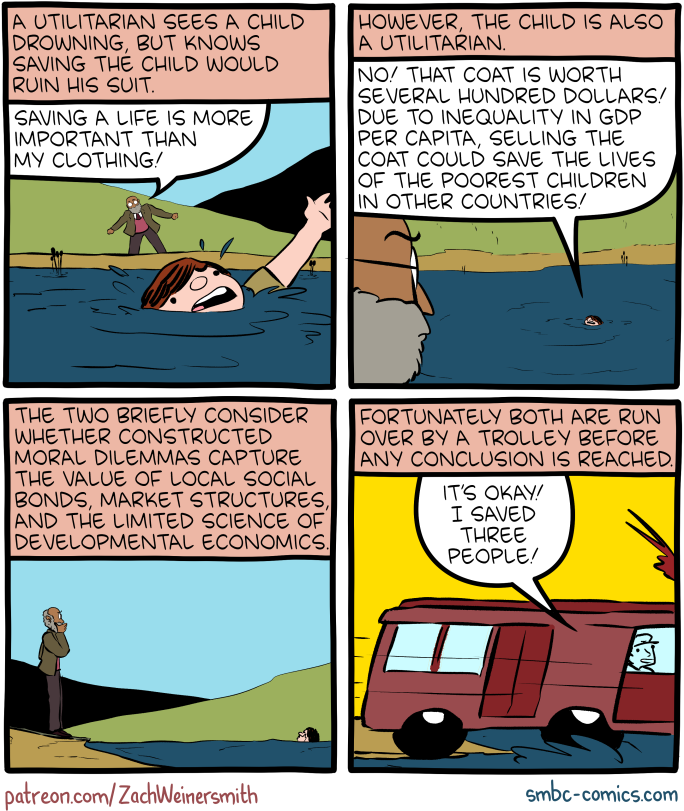
For some time I was wanting to write a critique of Peter Singer and his arguments about affluence and morality. So I read a number of pieces on him and his argument here, here, and here. In the end the cartoon shown above (and found here) summed up what I wanted to say, so I leave it at that for now. In addition, I wanted to also write on the correspondence theory of truth (more on it, here) but didn’t. Same goes for Compatibilism.
What has changed is the site you should go to if you also want to vote that way. It doesn’t look like this site, strategicvoting.ca, is working any more. However this site SmartVoting.ca, seems up to date, at least for the Ontario election this week. And it looks like they are preparing to work on the soon to come Federal election.
It’s good to check out regardless of how you plan to vote.
Not too long ago Danielle Smith in Alberta had a leadership review in which she won with 91.5% approval. 91.5 certainly sounds like a win. But what if she got 80%? Or 70%? Is that still a win? What about 55%?
Hot town indeed! Toronto has recently suffered through a heat wave as we head into the summer of 2024. We had tremendous thunderstorms, crazy wind squalls, and very high temperatures. And yours truly does not generally do well in the heat. Here’s to that heat subsiding somewhat, although, hey it’s summer, why should I expect?
Meanwhile, here’s a seasonal cornucopia of posts and articles I found worthwhile this spring. I hope you find it worth a read. Maybe they can help you cool off. 🙂
COVID/the pandemic: I should be cool about this, but one thing that gets me hot under the collar is the lack of acknowledgement of death that occurred during the pandemic. In Washington there was the temporary memorial of small flags, but it’s gone. I don’t know of any national memorials in Canada. We should have something national like the Covid heart wall in London, England. It is great that we were able to recover so quickly from the pandemic and get back to normal, but we should do more to remember the loss that occurred.
Indeed, most of the stories I’ve seen with regards to COVID seems to be about putting it well into the past. Perhaps the only way we will remember it is through such things as covid 19 related art.
I would be remiss if I did not mention the death world that is crypto, where the hammer is coming down on Binance’s CZ (Changpeng Zhao). Meanwhile, bankruptcy lawyers for FTX said customers of that cryptocurrency exchange were set to get all their money back, plus interest. At least someone is recovering from the crypto meltdown.
In world news: The American election drones on with Joe Biden having a narrow path to victory. Speaking of drones, the war in the Ukraine continues with drones playing a big part. In other wars, the War in Gaza goes on, despite massive student protests in the US and elsewhere. The war on women continues in the US as well.
As an aside, one promising thing for American women has been the rise of Caitlin Clark and the related rise of interest in Women’s Basketball. As a basketball fan and a believer that women in sports deserve better, I was glad to see this.
In Canadian news: Some day Canada Post will be no more, based on that article. Some day has come for the Canadian journalist Rex Murphy, who recently died. I used to look up to him a long time ago. Also not doing well is healthcare in Ontario. The Ford government continues to underfund it. Remember when we considered healthcare workers heros? The Ontario government should go back to treating them that way.
The arts: a number of the great artists passed away this spring, Alice Munro being one of the most notable. (The Times has a collection of the best of her work, here.) Another favorite of mine who passed on was Joe Flaherty. He didn’t get the recognition of some of his SCTV counterparts, but he was equally great and very funny. And I would be remiss if I did not note the death of another great Canadian, Donald Sutherland.
Not Canadian, but truly great, was musician David Sanborn, who is now playing in the great beyond. (Two pieces on him here and here.) Among other things, he was the host of the show “Night Music”, a show I adored and wrote about, here. May they all rest in peace.
Finally: We had solar eclipse recently. Did Google searches for eye damage jump after it? Sadly in Ontario they did. Did this woman in Texas build a spa for squirrels to handle the killer heat? Apparently she did. The world is weird.
Let me close off with this link to the Lovin Spoonful’s “Summer in the City”. Enjoy the season! I’ll have another newsletter in the Fall, god willing.
For many Novembers the LCBO and other alcohol distributors in Canada made a big deal of Beaujolais Nouveau Day. In Ontario it started with a few French winemakers and expanded to winemakers in Italy and other countries releasing similar styled wines on that date. I personally thought it was fun and a bit over the top and expected it to grow and get bigger in the future.
That’s why I was surprised to see at the beginning of November that the NSLC in Nova Scotia was dropping the whole thing. No doubt plunging sales had something to do with. Then the LCBO in Ontario dropped it as well. The bubble had burst.
Beaujolais Nouveau Day is not just about uncorking a bottle, it’s about a shared experience—a time when wine lovers around the world unite to raise a glass and celebrate.
So now doubt they are still into it.
If you are in France or elsewhere, grab a bottle and have a fun time. In Canada, you’ll just have to drink the older style of beajolais wine. And there’s nothing wrong with that.
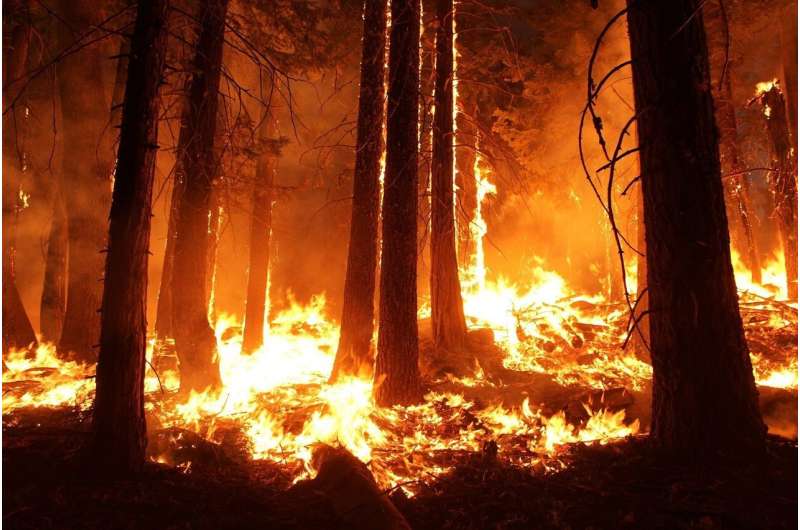
It’s hard to find any good news when it comes to climate change. First off, we have extreme weather conditions. That’s bad enough, but it also leads to additional problems, like wildfires. How bad is the problem with wildfires in Canada as temperatures climb? Very bad. To be specific, Canada wildfires have burned over 10 mn hectares this year. And it’s not just the loss of forests or the poisonous air people have to breathe. There is also the tragedy of lost homes and lives.
Climate change damage is not limited to Canada, obviously. It’s so bad in parts of the U.S. that insurers are pulling out of California. Something similar is happening in Florida. I suspect the list of states will not stop there.
Not everything resulting from climate change is bad, though. California’s weather catastrophe has flipped and become something of a miracle, as “gushing waterfalls, swollen lakes and snow-covered mountaintops (have) transformed the state’s arid landscapes”. You can read about it here.
So far that’s a good news story for that state. But the extremes of climate change might eventually overwhelm their infrastructure. Look at Texas, for example. Climate change is wreaking havoc on the Texas power grid transmission lines.
In searching for other good news, I see that the world is finally spending more on solar than oil production. Also, the New York Times reports that scientists at Purdue have created a white paint that, when applied, can reduce the surface temperature on a roof and cool the building beneath it. Every bit helps. Maybe even the new electric Cadillac Escalade iq vehicle is at least a sign of the shift we need to be making, if anything else.
Finally, here’s two more pieces on climate change I thought were worth reading:
Maybe cleaning up the Great Pacific Garbage Patch isn’t a good idea and is causing more harm than good. VOX explains.
Early in my blogging days, I would post music on Friday Nights. I stopped because so many videos got pulled and my blog is full of broken links as a result.
However, this song has stuck in my head and I like it, so here goes nothing. 🙂
It’s Canada Day! So what better way to celebrate than dining at one of “The Best Places to Eat in Canada”. That’s according to Chris Nuttall-Smith, writing in that quintessentially Canadian magazine, Macleans.
It’s true: those are great places to eat. You’d be lucky to be able to dine in the highly expensive but amazing Prime Seafood Palace (shown above)). Can you get a table at places like Edulis? Good question! I sure can’t! 🙂 But if you can, I am sure it will be good.
So Canada, if you are looking for a good place to go, you can’t go wrong with any of the ones listed. Regardless of where you dine this evening, have a happy Canada Day!
I loved this film, just like I use to love my Blackberrys. If you loved yours, or the era of the Blackberry, or just want to see a great film, I recommend you see “Blackberry”.
There’s a number of ways you can watch this film. You can watch it just as a story of that weird era from the 90s until the early 2000s. Or as a story about the tech industry in general. Or a story about Canada. It’s all those stories, and more.
But besides all that, it’s a great character study of the three main characters: Mike Lazaridis (Jay Baruchel ), Jim Balsillie (Glenn Howerton) and Doug Fregin (Matt Johnson). The arc of Lazaridis in the movie was especially good, as he moves from the influence of Fregin to Balsillie in his quest to make a great device. It’s perhaps appropriate that Balsillie has devil horns in the poster above, because he does tempt Lazaridis with the idea of greatness. And Lazaridis slowly succumbs and physically transforms in the film from a Geek to a Suit.
That’s not to say Balsillie is a caricature. Under all his rage and manipulation, you can see a human also struggling with ambition and is who is aware of the great risks he is taking. His arc might not be as dramatic as Lazaridis in the movie, but it is a rise and fall of significance.
As for Fregin, his character is important but he doesn’t change the way Lazaridis and Balsillie do. But if Balsillie is the devil on the shoulder of Lazaridis, then Fregin is the angel. He provides a reminder throughout the film of what Lazaridis lost in his transformation. (And the description of his life at the end of the film is *chef’s kiss* good.)
The film is a dramatization, but it gets so much right. Lazaridis and Balsillie were crushed in the end, just like in the film. Balsillie lost his dream of NHL ownership, and Lazaridis lost his claim of making the best smartphone in the world. There’s a part of the film when Balsillie asks: I thought you said these were the best engineers in the world?? and Lazaridis replies: I said they were the best engineers in Canada. That part is a transition in the film, but also sums up the film and the device in many ways. Their ambition and hubris allowed them to soar, but eventually they met their own nemeses whether they came in the form of Apple or the NHL Board of Directors or the SEC.
As an aside to all that, it’s fascinating to see the depiction of Blackberry defeating Palm/US Robotics. In the early 90s Palm and US Robotics (who later merged) were dominant tech players. Blackberry surpassed them and left them in the dust. Just like Apple left RIM/Blackberry in the dust when they launched the iPhone. (Google also contributed to that with Android.)
Speaking of Apple, it was interesting to see how backdating stock options helped sink Balsillie. He was not alone in such financial maneuvering. Apple and Jobs also got into trouble for backdating options. I assume this practice might have been more common and less black and white than it comes across in the film.
In the film, there is a certain prejudice Lazaridis has about cheap devices, especially those from China. It’s just that, though: a prejudice. That prejudice was once held against Japan and Korea too, because those countries made cheap devices for Western markets at first. But Japan and Korea went on to produce high end technology and China has too. The Blackberry Storm from China might have been substandard, but Apple has done quite fine sourcing their products from that country. Something to keep in mind.
I suspect I will watch the film many times in my lifetime. Heck, a good part of my life IS in the film as someone involved with the tech industry at the time. That business is my business. That culture is my culture. That country is my country.
None of that has to apply to you, though. If you want to watch a superb film, grab “Blackberry”.
If that’s you, consider this. If there is a Walmart near you that sells groceries, go to the Walmart. And if there is not a Walmart near you but there is one on Instacart, then sign up for Instacart and buy your groceries that way.
I have been shopping at Walmart via Instacart for well over a year now and during this time I have been very satisfied with the goods I’ve received from them. The produce is excellent, the meat is excellent, the commodity goods are fine, and both high end and low cost items (“Great Value” vs “No Name”) are good. Most importantly for me, the savings are substantial. It never ceases to amaze me how the exact same product can be $0.50-$5.00 less at Walmart than Loblaw or Metro. Other than price, there is no difference in terms of what you get. You are essentially paying a Loblaw tax (or Metro tax) for buying from them.
I understand why people like shopping at Loblaw: the stores are pleasant, they have great selection, and their President’s Choice brand is still a treat. But you are paying a high premium for that.
Should you switch to Metro or Farm Boy or some other place? Not if you want to save money. What about No Name from Loblaw? Well, I checked it out, and many of the No Name products are still more expensive than every day Walmart products.
If you think of art forgery at all, you likely think of internationally known painters like Basquiat. But did you know that here in Canada we also have a history of art forgery? You can read about it here: how a forgery scandal rocked the canadian art establishment in 1962. Of course, you don’t have to go back decades to find this occurring. Only recently arrests were made in a Norval Morrisseau forgery investigation kicked off by a member of the band, Barenaked Ladies. And current forgeries are not limited to Morrisseau. Fake works of the artist Maud Lewis are also coming onto the scene. (And are likely here already.)
Art forgeries are everywhere, including Canada. With that type of money involved, it’s not too surprising.
Here are a number of good pieces I’ve come across concern indigenous groups in Canada exerting their rights both politically and economically.
First up, on the West Coast there’s this story of the Squamish who are “transforming the land (seen above) into one of the largest Indigenous-led development in Canada’s history, on its own terms — free from the rules that bind most urban developers. But not everyone is happy about the nation’s power and autonomy over its project”. Second, in Central Canada, there’s this story of an Indigenous cannabis shop in London that could be major test for Ontario. I also came across this story on the Innu out East fighting for what’s theirs. It states that although “they’re getting financial compensation, the Innu have yet to receive the rest of what was agreed upon: self-governance.”
Despite setbacks and roadblocks, there’s progress, as this story illustrates, when the federal government and 325 First Nations agree to settle a class-action lawsuit that sought reparations for the loss of language and culture brought on by Indian residential schools, for $2.8 billion.
In mid November the Twitter account Canadian Paintings posted the above work by artist Chris Flodberg. At the time I said: “I see some people don’t like this painting but I think it’s fantastic. Just like the Gare St Lazare paintings of Monet are fantastic. They reflect our lives. I even like the palette of this one – it’s a muted palette that goes well with the subject matter. Good composition too.” That tweet led to a good discussion on the work and to aesthetics in general.
I really do think it is a great painting. For one thing, I love the idea of it. The viewer is on the precipice of entering the painting in their car. If you have ever driven on such a road, you can easily imagine going down the hill and merging with the traffic and then heading over the horizon. Flodberg has positioned the viewer so that the go down and to the left, then up and under (a bridge) and then to the right, giving the painting a dynamic feeling.
There’s almost a danger too, with the concrete walls everywhere. Plus the fact you are about to enter a high speed highway. The dynamic and the danger make the painting exciting to me.
It’s interesting to me what he has put in the painting: the office buildings to the right and a jumble of stores to the left. The objects that make up the painting could be anywhere in a big suburb in Canada (or the US). It has a universality in that regard. I thought it was of a part of the 401 near me: turns out it’s near Calgary. (Fun exercise: compare the painting with the images in that link…how does it make you think differently about the painting.)
Flodberg is not the only Canadian to paint a highway. If you do a search like this on Christopher Pratt or this on Jack Bishop, you can easily see that. Canadian landscapes contain many things, including highways: it makes sense good painters want to paint them.
Speaking of Pratt and Bishop, I get why some people don’t like Flodberg’s painting: his colors are dull and dark in comparison. But I think they perfectly capture many a day I’ve driven along stretches of the 401. Some of those days were mundane, and some were magical. They all get stirred up in my imagination when I take time to look at the work above. A great work, I believe.
I don’t think I would have come across this work if it wasn’t for twitter. Nor would have thought about it deeply if it weren’t for the comments people tweeted. Twitter has many flaws, but there are times when it does things no other site does. I am grateful for that
Thanks to Auditor General Hogan, there has been much discussion about CERB (Canada Emergency Response Benefit) and fraudulent claims. Indeed, this piece indicates it’s a problem: Canada paid out billions of dollars in CERB to people who lied about needing it. I mean billions of dollars is a lot! It must be really bad. So let’s look at what was said, and specifically, let’s look at the numbers.
The article states: “In the end, the federal government distributed $210.7 billion ($74.8 billion in CERB alone) to Canadians who were unable to work — or rather, those who told the government they couldn’t work.” So $74.8 B went out for CERB.
Why did the government do this? It goes on to say: “The government’s decision to take workers at their word, without any sort of screening, was criticized by some when the pandemic first hit, but Prime Minister Justin Trudeau argued that getting payments out swiftly was more important than verification.” It also states that: “Officials promised at the time that they would conduct extensive post-payment verifications to claw back anything taken by scammers or ineligible recipients, but according to Hogan, they have yet to sufficiently do so.”
Key word there: sufficiently. Let’s drill down further to see why that AG said that. The article says: “In doing so, it (the Government) recognized that there was a risk that some payments would go to ineligible recipients. We found that overpayments of $4.6 billion were made to ineligible individuals, and we estimated that at least $27.4 billion of payments to individuals and employers should be investigated further.” Ok, so now we have some extent of how many billions were lost. But wait, we also have this: “Hogan noted that some $2.3 billion of errantly-distributed funds had been recovered as of this summer, thanks mostly to voluntary repayments from individuals who’d received them.”
In short, of the $74.8 billion that went out for CERB, the AG knows that $4.6 billion of that went out to ineligible individuals but it retrieved $2.3 billion of that. So around 6% of the overall money went out to ineligible individuals but then half of that was retrieved. Another way to look at it is 94% of the money went to eligible individuals, and of the remainder, half was recovered.
Now it’s possible that a good chunk of the $27.4 billion also went out to ineligible individuals. But based on the concrete data that was provided, it seems like the program was effective, based on percentages.
This doesn’t mean fraud is good or unimportant. Fraud is bad and payment systems and payment providers need to combat it. But in light of these numbers, the amount of fraud seems low. For what it’s worth, this piece argues that in the US medical system, fraud can be as high as 20% of all claims. In an ideal world, there would be no fraud. In a real world you want to get close to zero, but you proceed knowing there will be some fraud and make tradeoffs in comparison with other benefits.
In the case of CERB, the benefits were real and significant. I agree with the government on this: there was no time to put a rigorous benefit program in place. The pandemic needed quick solutions: you could not take 12 or 18 months to develop a system to get money to people you told could not work. That would have led to all sort of societal problems. You needed to get money into the hands of people now. Delay is fatal. The last time I saw government organizations fail to take action was at the beginning of the Great Recession: that failure almost led to the collapse of the global economy.
CERB was an essential program that kept parts of the Canadian economy afloat during the worst part of the pandemic. It’s upside was good, and despite what the AG says, the downside was not that bad.
There has been discussion about what should go on Canadian money now that the Queen is dead. For some, the choice is obvious: Charles III. For others like me, the choice is less obvious.
One thought I had was to commission Canadian artists to produce works to go on the front of the coin. We had done something similar for the back of the coin, in 1967. Then Alex Colville produces a series of animal images that graced six of our coins as part of the Centennial celebration. I think now would be a good time to commission one or more artists to produce images for the front of the coins, too.
We would still have our toonies and loonies with consistent images on the back. But now we could have new images on the front. I like the idea a lot.
For more on Colville’s coins, this piece was interesting.
P.S. Relatedly, here’s why the monarch on our coins face the way they do. Fun!
So Edmonton has gotten cold feet and cancelled the installation of Ken Lum’s sculpture for reasons you can ready about here and here.
You might conclude there’s some irony here, because Lum has expressed support of toppling monuments. There is a fine distinction between the nondescript monuments of historical figures and Lum’s unique art. Too fine, perhaps. The tide sweeping out statues of Ryerson and Cornwallis have ignored such a fine distinction and swept out his work also.
This rejection of Lum is not unique. It’s one of many examples of fear of art. To be precise, fear of how some will respond to art.
For example, in reviewing the recent Guston exhibit, John Yau writes:
A lot of issues are raised by the museum’s presentation of Guston, which have been eloquently discussed by Barry Schwabsky in The Nation and Sebastian Smee in The Washington Post. My complaint is cruder. I got sick of the museum’s defensiveness, such as the “Emotional Preparedness” card by health and trauma specialist Ginger Klee, that preps visitors for the show, and of being repeatedly told by the the wall labels that Guston’s hooded figures are about America’s racist history, because I think they are more than that, and that is what makes them so powerful, necessary, urgent, and, most importantly, relevant to whatever present they live in.
Whatever is driving them, sponsors of works of art are afraid. This fear is leading them to pull works or to water them down, in a sense. And that’s a shame.
P.S. Ken Lum was recently at the AGO and it was a good show. You can see more of Ken Lum at that link.
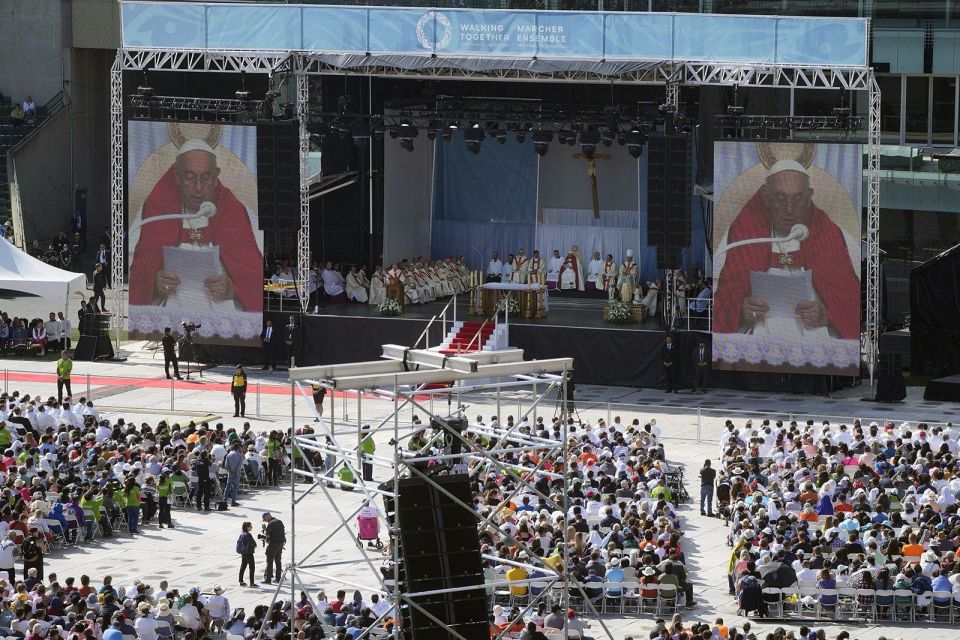
The Pope was recently in Canada to apologize for the role of the Catholic Church in the residential school system and the suffering that was inflicted on indigenous people within Canada. Here’s the NYTimes on the visit. Here’s NCR online. Even our Prime Minister weighed in.
When it was over, we got follow up stories from the NYTimes, from America Magazine and from NCR online, each assessing the visit, as well as highlighting statements like: Pope Francis Calling the Abuse of Indigenous People in Canada a “Genocide”.
While the Papal Bulls got a lot of focus, what seemed to get less focus was money that the church had pledged but failed to deliver. The church failed to provide $25 million in compensation for the victims of residential schools, as this story showed. Despite claiming they could not raise the money for their sins, the Church did manage to raise much more than that amount for their properties. It was maddening to me that the media did not focus enough on that. (Later on they did report on a deal the government made freeing Catholic entities from $25M campaign for residential schools. You can read about that here and here. That would have been useful to know about before the visit.)
I had hoped for more from the Pope, the Church, the media, even activists. I hope at least the victims of the residential school system benefited from the visit and the actions of the Pope.
On a different topic, one thing I think everyone will benefit from is the appointment of Michelle O’Bonsawin to Canada’s Supreme Court. We need more indigenous leadership in the justice system, and she is in one of the key roles to provide that. You can read more about that here and here.
Finally, this New York Times interactive study on Benjamin West’s painting on the death of General Wolfe is relevant in many ways to the topic of this post. I recommend you check it out.
(Image: link to an image from one of the NCR Online pieces)
One of my favorite Canadian artists are General Idea. Living in Toronto in the 80s and 90s, there work was often on display and often on my mind. If you want to see how great they are for yourself, the National Gallery of Canada in Ottawa has a big exhibit of their work that is running until the Fall of 2022. Well worth a visit to take that in.
The Pope will be coming to meet some of those who suffered as a result of the Residential School system. Here’s more on that from the CBC. Let’s pray for progress.
I was going to say Canadian or Newfoundland painter — for he was that — but it is better to leave off the modifiers. His greatness can stand against any painter of any time or place. I am especially drawn to his hyperrealist paintings of roads and boats and houses. How the light in them changes, how your mood changes as you absorb them. There’s an abstraction to them, despite clearly recognizable imagery.
Canada has had many great painters. While many people say Colville is their favorite — especially when it comes to east coast artists — I have always preferred the work of Pratt.
Though he lived and painted in Newfoundland, for decades he’s been represented by the Mira Godard Gallery in Toronto. If you want to read more about him or see his fine work, go there.
(The image above, Summer on the SouthEast, is a link to the Mira Godard website. I can just feel the heat of the east coast summer as I look at it. I can hear the drone of flies, see the brightness of the sun. It’s perfect.)
This is an interesting but odd view of the great Canadian artist, Maud Lewis. It’s somewhat about her, but really it’s more about the art world and how they go about. In short, it’s about how the paintings that she used to sell for a few bucks to buy food are now worth many thousands of dollars. It proceeds to speculate if they will continue to go up in value.
I think it’s worth reading. Her life and work are interesting. I still don’t think the art world knows how to think or talk about her.
If anything, she makes me think of the work of Henri Rousseau. They didn’t quite know what to do with him either. But eventually they did. I think the same is happening with Lewis.
Regardless what they think, I hope you will think she is a fine artist and seek out her work. (And Rousseau’s.) Your life will be enhanced the more you know of their work.
The twitter account devoted to Canadian Paintings is one of the best twitter accounts there is. Several times a day it will tweet out a great Canadian painting from artists famous and not so famous. It covers such a range of paintings too. Some days they will have something painted recently, other days something from decades ago. There are paintings from men and women, all regions, all eras, and just about every group of people in Canada you can imagine. I just love it.
First off, Happy Thanksgiving to all my Canadian readers celebrating. If you are wondering what to make, not only does Chatelaine have a ton of recipes for you, but they have some great menus for you too. All here ==> 8 Easy Thanksgiving Menus, Including An Under-4-Hour Feast | Chatelaine.
They have a menu for everyone:
A Thanksgiving dinner in under 4 hours
Their All-Time Favourite Thanksgiving Recipes
a Vegetarian Thanksgiving
a Rustic Thanksgiving
a Modern Thanksgiving
a 1-hour Thanksgiving for 4
a Roast chicken Thanksgiving
and a Classic Thanksgiving
So if you have always wanted to do a full on proper Thanksgiving meal, now you have lots of options to choose from.
This year I’m going to do their turkey recipe with gravy (with a dry brine), their brown butter green beans, their yukon gold mashed potatoes, the fig and radicchio salad, chestnut and sausage stuffing, and the chocolate-bourbon pecan pie. (I’m also sliding Alison Roman’s Harissa and maple roast carrots in there too because why not. And canned cranberries because I just love them! 🙂 Eat what you love.)
Happy Thanksgiving to all!
(Photo is not my meal but close! I took this from Chatelaine).
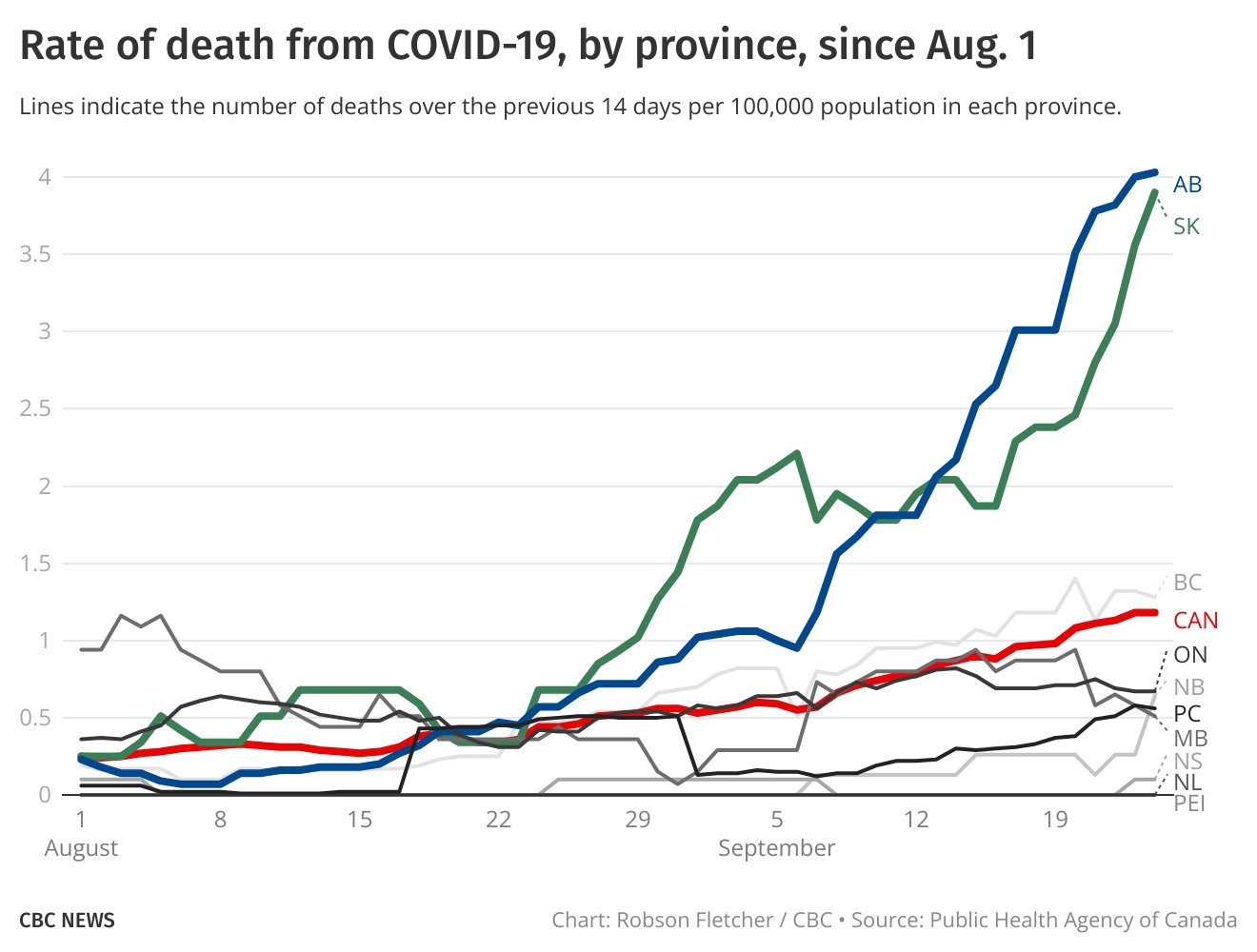
Here is Jason Kenney on twitter in July, 2021, celebrating removal of health restrictions:
Congratulations to my friend @PremierScottMoe and all of our neighbours in Saskatchewan on lifting their pandemic health restrictions and kicking off a #GreatSKSummer.
I mean, if people in your province are dying at 4X the rate of the other provinces because of direct policy changes you made, you are essentially killing people in your province under your leadership. I don’t know how else to put it.
Also, Jason Kenney should not speak for the Prairies or the West. Both Manitoba and British Columbia are doing better than Alberta and Saskatchewan. It’s not just right wing leaders either. Other right wing provincial parties have been much better stewards of their regions. Kenney and Moe and their leadership are to blame here.
It is terrible when leaders fail their provinces. But this is way beyond typical failure. I feel great sympathy for the people of this province who have died unnecessarily on their watch.
Well that was an odd election. If anyone came out ahead, I can’t see who it was. The Liberals did not get their majority, yet none of the other parties made any significant gains at their expense. Canadians voted to maintain the status quo and maintain it they did.
The one significant thing I noticed was line ups on Election Day. I’ve been voting for decades and I’ve never seen anything like it. As for me, I voted in the advanced poll and while I saw lots of good measures in place to limit the spread of COVID-19 the whole process was still pretty quick. I imagine those good measures slowed things down on Election Day.
It will be interesting to see if there is more voting via mail and via advanced voting in the next election. I expect we will have another one in a few years from now, though I would be surprised if the Liberals will be the ones to bring it on.
The next thing to pay attention to is what happens to the leaders of the various parties. I expect the Greens are going to have to make some difficult decisions. As for the other parties, I have no idea. I thought the leaders all performed well, but members of their parties might think differently. Let’s see.
After that, I’ll be very curious to see what Trudeau and his team do next. I hope they focus on the pandemic and what is needed to get to end of job in that with an eye on the economy and other promises they made.
I tend not to touch on politics on social media: it’s tends to be all downside with little upside. But this election was so odd I had to comment.
I am always trying to find ways to better understand the indigenous people of Canada and as a result I try and keep the better things I come across that help me with that understanding. I tend to be haphazard in how I research things: that shows in the almost randomness in what I have collected below. I think these links are worth reading, though.
On Residential schools: Recently there has been a strong focus on Canada’s Residential school system. Some people wrote about how people didn’t know this was happening back then. However this piece gives some important historical context as to what people knew at the time. As well, this piece gives more context as to how TB affected Aboriginal people.
Alot of what has been driving the focus has been the use of technology to find unmarked graves. Here are two good pieces on that ground radar technology. This piece gives a good introduction to it and this piece provides much more detail on how it works. For example, I naively expected the images to be more like an X ray or an ultrasound. It’s not quite that straightforward. Instead the images look like this:
(Image via CBC site)
As the use of the technology spread to other schools, some believed we would find graves at every residential school. However despite a lot of effort, there is no evidence found of unmarked graves related to Shubenacadie Residential School. I suspect this examination of schools will go on for a long time, and we will find more graves, but it will take time and not always come up with clear results.
As for why this is suddenly going forward, this story gives some context on how the search for the missing graves is being funded. Better late than never from the Federal government, but the lateness is still bad.
I need to go to Indigo bookstore and read more books and get a better sense of indigenous and Canadian history. If you feel the same, here’s a good list of what they have. Libraries are also good to go to and check out these books.
Other items:
Here’s a piece in the National Post giving an update on the work done so far on the 94 calls to action by the Truth and Reconciliation Commission. Needless to say, much work remains.
Often I find links that are interesting but I don’t know what to do with. Here are some for this month. I should have posted them in July but hey, it’s the thought that counts 🙂
Joni Mitchell’s great album, Blue, turned 50 this year. To celebrate, there’s been a number of good pieces done on it, including this superb one from the Times: Joni Mitchell’s ‘Blue’ at 50 – The New York Times.
We will soon enough have an election in Canada, and I hope this is a major topic during the campaign. No one should have undrinkable water in Canada. We need to do better as a country.
To improve society, you need governments to want to improve society. This seems obvious, unless you see government function as either wasting money or punishing the worst off in our society. But governments can function very effectively to improve society, and these two articles illustrate this:
In both countries, poverty isn’t declining by magic or the invisible hand of capitalism. It’s being driven down by specific policies and programs with an aim to eliminate poverty.
A better world is possible. Progress is possible. We just need people and their governments to want it to become possible. Never believe that progress is impossible or an illusion.
(Chart above from here. The downward line is people living in extreme poverty, while the upward line is people not living in extreme poverty.)
It’s Boxing Day in Canada. For many, it’s a time of resting and reflection. For others, it’s a time of frenzied shopping to get a good deal. I am more of the former. If you are more of the latter, this link will help you. It supposedly has the best deals for Boxing Day in Canada. Of course you can search on Google for that too. Regardless, all the best to you on your shopping. May you save a bundle.
For more on the history and traditions of Boxing Day, click here.
Changing the way Canadians get to decide who forms the government federally has been a hot topic for some time. Before the last election, the government tried and failed to implement reform. There hasn’t been much talk about it recently, but it is a subject for debate that is not going to go away.
The CBC ran the results of the last election through alternative forms of representation and analyzed the results. It is fascinating to see how representation changes, depending on the format followed. Kudos to the CBC for a superb visual representation.
I think reform is needed. I am still in favor of having a local MP and having the ability to have him or her voted out of office by the constituents of the MP’s riding. But I am also in favour of the percentage of each party’s MP aligning with the percentage of national votes that they received. Obviously I need to think about it some more.
In the meantime, take a look at what CBC has done, and decide for yourself.
One of my favorite artists is Emily Bickell, largely for her paintings of water, which I think are sublime. You can get affordable print versions of them here: Traces Art Print by emilybickell | Society6.
Better still, you can get affordable original versions of them here: Art Interiors.





 Not too long ago Danielle Smith in Alberta had a leadership review in which she won
 For many Novembers the LCBO and other alcohol distributors in Canada made a big deal of Beaujolais Nouveau Day. In Ontario it started with a few French winemakers and expanded to winemakers in Italy and other countries releasing similar styled wines on that date. I personally thought it was fun and a bit over the top and expected it to grow and get bigger in the future.






















 Smart People I Know