I create a super simple set of tools to secure your Ubuntu server

And you can get it here: blm849/supersimplehardening: A super simple way to harden your server.

I create a lot of Ubuntu test servers, and I find that as soon as I create a Ubuntu server on a cloud environment, it gets immediately attacked by automated software. This is obviously a concern. A bigger concern is that when I went  searching for recommendations on how to harden such a server, I found  a wide variety of recommendations! It can be hard to know what to do. Still, I needed something. As a result, I created this package of scripts. The scripts do a number of things:

  • prevent direct root login to your server via ssh. This was one of the things I saw consistently happen and once someone cracks the root access on your machine, it’s game over.
  • stop some basic security holes, like IP spoofing
  • download some useful software, like logwatch, ufw and others
  • upgrade all software on the server

This is just a very very limited number of things to prevent attacks. But it is better than nothing.

If you install Apache, PHP, MySQL or other software on your machine, there are even more attacks that will be launched against it. I recommend you get a firewall up and running and at least run logwatch on a regular basis to look for potential attacks being launched against you.

Finally, if it is important for you to secure your server, don’t stop with my scripts. Go out and consult with IT security specialists right away.

Good luck!

An odd thing happened to me on seeing Blade Runner 2049 for the third time

The first time I saw Blade Runner 2049, I found myself continually comparing it to the first Blade Runner. I loved it but I could not think of it without thinking about the first film.

The second time I saw it, I watched it for the details. It is an incredibly detailed film, and I found myself watching it for the all fine workmanship in the film (like the Japanese characters on the buttons of the jukebox that you barely see).

The third time I saw it, I saw the film in itself. That was the odd thing. It took me three tries to see the film as a narrative about these mostly new characters. I saw the film the way I would normally see any film that’s new. The other odd thing was that the film seemed to move faster the third time around than the first time. I thought it was slow the first time around and it was compared to the original film. But without that context and having absorbed all the details, I found the storytelling tight and essential.

I plan to see it many times. I think it is a masterpiece and every viewing yields something I missed in previous viewings. You may not want to watch it several times but I recommend you watch it more than once. You will be rewarded the second (or third) time you see it.

On statues and awards and the naming of things

The Edmund Pettus Bridge
Statues and awards and the naming of things (schools, hospitals, museums) are about many things, but first they are about power. Those with political or organizational or financial power decide what names go on things, what statues and monuments go where, and who should get awards. Sometimes it is simple, and an award or a thing gets named after someone or something powerful as a direct result of their power. Other times it is subtle, and the award or the statue or the naming of a thing reflects the values of those with power.

When people want to tear down statues or rename things or revoke awards, there is an outcry. That outcry is because of a group fearing their loss of power. You won’t hear people talk of it in those terms: you will hear people talk about values instead. But the change is the result of a shift in power. History isn’t erased because something is renamed or revoked or torn down: anyone who wants to know the history can know it in other ways. And history isn’t changed by putting up more statues or naming things differently.

Of all the ways of understanding history, objects are the worst. They are a crude reminder that a history exists, and they are put in place by powers that be or powers that were. As a place changes, the statues should change, the awards should be redistributed, and the things should be renamed. And this will indeed happen, and it will happen due to the new people in power.

Some somewhat objective thoughts on the new Trudeaumania

Lots of chatter on this recently, Justin Trudeau: Canadian Prime Minister, Free World’s Best Hope? – Rolling Stone.

It’s good that the world thinks highly of our leaders, whomever they are. Canada is a significant nation in the world with the ability to influence other nations, and having a leader that is looked up to makes a positive difference.

As a Canadian citizen, I’m more interested in the substance than the PR. And I’m more interested in what the government is doing, not just the Prime Minister. I try to look at the government’s policies, competency in executing on those policies (either through legislation or direction to federal agencies), and how the government supports democracy (through actions to make our country more democratic) or hinders it (by making the country less democratic or by being corrupt).

That means I spend less and less time reading pieces like this, which are along the lines of “if you people were as smart as me you’d realize how bad Trudeau is” . Instead, I look to sites like this which track the government’s progress. For example, this site, TrudeauMeter, has ongoing ratings of the government. Other commentators, like John Ibbitson, provide periodic ratings: Video: Opinion: John Ibbitson rates the Trudeau government as Ottawa wraps up for the summer – The Globe and Mail. Finding sources of information you find comprehensive and objective are always your best bet.

If you don’t support the Liberal government’s policies, then I can see why you would not want the government in place.  Likewise there will be times when you do support the government’s policies but you feel the level of corruption or incompetence is so high you want to turn to a different group. If you are going to rate the Prime Minister and his government, those are good criteria to evaluate them on, not PR like the Rolling Stone magazine, or any other specific good or bad focus pieces on them. The government works for you, and if you are a good boss, you evaluate them mainly on the entirety of their efforts, not just things here and there.

Some other thoughts on Trudeau:

From what I can see so far, his government is starting off unsurprisingly: being successful over things the government has control over (like spending) and having less success over things that requires working with other groups. I suspect they will make no progress on electoral reform unless there is a major push from Canadians. Likewise, there are so many issues and problems with regards to Aboriginal peoples that any progress there will be modest, at best. I wish neither of them were true, but I am not optimistic on those fronts.

I suspect that as long as the economy is doing fine, the government does not appear corrupt or incompetent, and people aren’t tired of his government, then Trudeau and his team will be in power for some time to come. The first one, the economy, will be the one that is most likely to hit him. Corruption takes time to seep in (although major scandals can occur at any time and make the government appear corrupt), and government fatigue takes longer still. Whatever you thought of Chretien or Harper, that was true for them and I suspect it will be true for Trudeau as well.

I will continue to ignore articles that underestimate Trudeau (like the one above). He’s flashy and sometimes appears smarmy, but he’s smart, he has a good team, and politics is in his DNA.  If you oppose Trudeau, underestimating him only works to his advantage and not yours. In addition,  he is as much his mom’s son as his Dad’s. The combination makes him much more effective than his Dad could ever be. His Dad may have had a higher IQ than him, but he has a higher EQ than his Dad ever had and that will make him more challenging to defeat than people who approach politics intellectually realize.

Likewise, I will continue to ignore articles that compare Trudeau to Trump. There is little if anything to be gained by them. Trump is an anomaly. Almost any leader looks good in comparison to the 45th President of the United States.

I like Trudeau for alot of reasons.  That said, it doesn’t matter if I like him or not, anymore than it matters that you dislike him or not. What matters is his ability to do the job. He’s not an entertainer: he’s an elected official. When the next election comes, it won’t matter how good or bad Trudeau’s PR is. What matters is that in comparison to other politicians looking to lead the country, is the government he proposes to lead the best one for the job based on the criteria I have.  That’s the only thing that matters.


How to get a Raspberry Pi working with a TV with composite/component input (as opposed to HDMI)

RaspberryPiTV
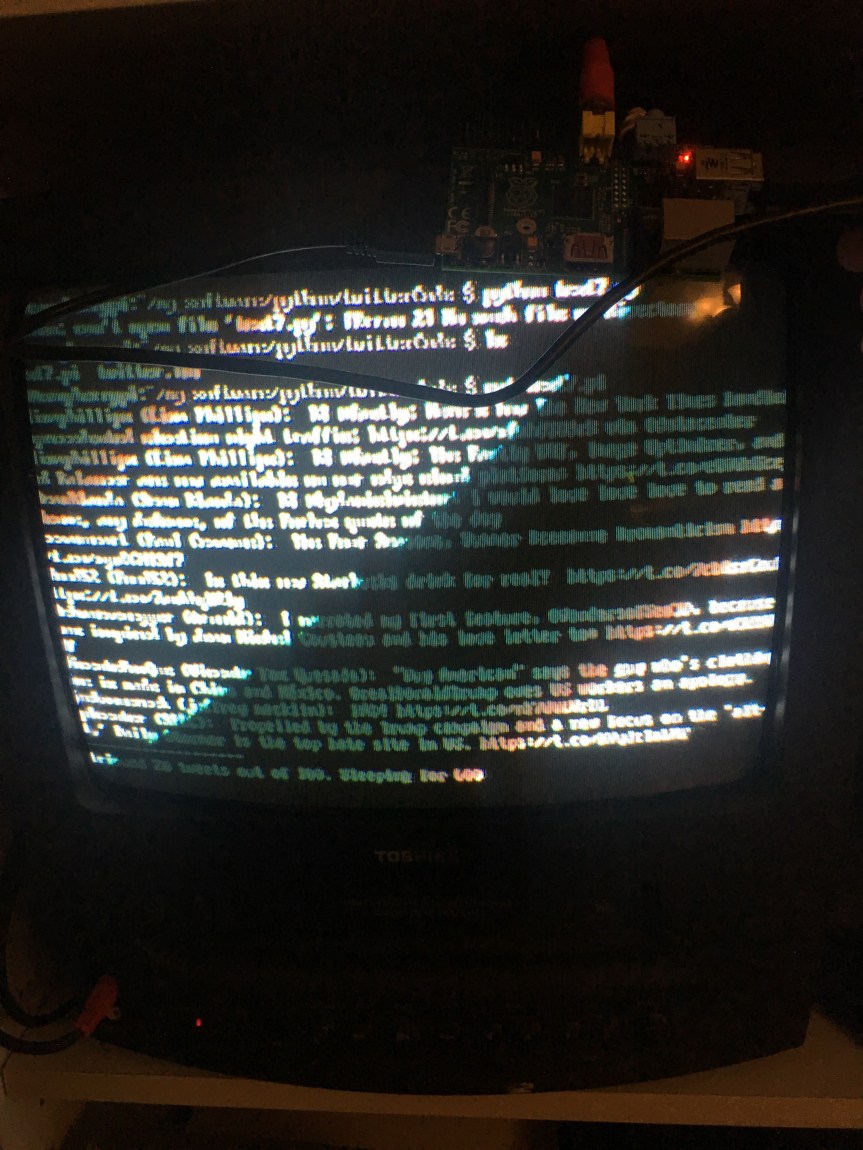
I had an old Raspberry Pi 1 Model A, with an HDMI port and a standard RCA composite video port for older displays and I also had an old Toshiba TV (pictured above) and I wanted to get them working together. Here’s what I did and here’s some things I learned.

First things first, I had to get a the Raspberry Pi functional. To do that, I mostly followed the steps here: http://www.pcworld.com/article/2598363/how-to-set-up-raspberry-pi-the-little-computer-you-can-cook-into-diy-tech-projects.html. I say mostly because I was using a Mac, so I used SDFormatter to format the SD card. If you have a Mac, you can get SDFormatter here.

Basic steps to set up the Pi were:

  1. Download Raspbian
  2. Download SDFormatter
  3. Put the SD Card in my Mac (you want at least an 8 GB SD card).
  4. Format the SD Card using SDFormatter
  5. Unzip Raspbian
  6. Take the files in the unzipped Raspbian folder and copy them onto the SD Card (which should appear on your desktop)

All that is pretty straightforward in terms of setting up the Pi. If you don’t care for the instructions from PCWorld, Google “Raspberry Pi setup Mac” (or Windows or whatever your operating system) and you will likely find a site that is helpful.

Now, once the files are copied on to the SD Card, modify the config.txt file on the SD card. This is a key thing I had to do. Before I did it, I could plug my Pi into the TV but nothing appeared on the screen. After modifying the config.txt file (and it took some hacking around), I was able to get it to work.

Why do you have to do this? It seems that Raspbian assume you will be using HDMI and will not recognize a non-HDMI output device unless you modify the file. So modify it you must.

Note! Before I edited the file and replaced the text in it, I selected all of the text in that file and copied and pasted it into a file on my Mac as a backup. I recommend you do the same. Then I made the changes to the file, saved it, then ejected the SD card and put it in my Raspberry Pi. If you want to see my version of the file, you can see it here.

It was a process of trial and error to figure out which lines in the the config.txt to change. I was fortunate that I could start with this page which had details on how he got it working. Unfortunately his config.txt and the one I needed were slightly different, so I kept at it until I figured out how it should work. (With his file, the text was unstable: it kept rolling up the screen. With my file, the text did not roll.)

In my config.txt, I have colour burst disabled, rendering everything in black and white. Enable it if you want colour. I disabled it because I thought it would improve resolution but it did not.

Other things to note:

  • I had trouble determining which part of the composite cable should go into the TV. I had one end plugged into the Raspberry Pi, but it took me trial and error until I figured out where to plug the other end into the TV.
  • It will take up to a minute or longer before the Raspberry Pi sends video to my TV. If you don’t see output right away, be patient.
  • Most newer TVs also have composite/component ports. I used them for some testing.
  • Is it worth doing this if you can hook up to HDMI? I’d say no. I wanted to make use of the old Toshiba TV but if I had an old monitor with an HDMI port, I’d get an HDMI cable from the dollar store and connect up the Raspberry Pi that way.
  • When is it worth doing? I’d say if you had simple output to display, and the only ports available on your TV were the component ports, than give it a shot. I actually wrote a simple Twitter client in Python that polls Twitter every 5 minutes and displays my feed in text form. For simple text output like that, this set up is perfect. (You can see the output above: it looks weird due to the refresh rate and my phone: to the eye, it looks ok.)
  • Is it component or composite? I see the words “component” and “composite” used  and I am not sure which is correct.  In my case, all I know is I have one cable to connect the Pi’s video output to the TV’s input port. The Pi has only one video port to plug into, so that’s easy. Most TVs will have more than one port to accept video input: you need to experiment to get the right one.

I hope you found this useful.

P.S. The other thing I like about doing this is: my TV now  looks like the TV between Leon and Holden in Blade Runner. 🙂

On the superior virtue of the oppressed

Unlike other essays in this collection, Unpopular Essays by Bertrand Russell (Google Books), “The Superior Virtue of the Oppressed” continues to be relevant today. It made a big impression on me when I read it, and I recommend it to anyone who has not read it.

You can read pieces by progressive writers still and find examples of this form of thinking. In some cases, oppressed groups do demonstrate exceptionally virtuous behavior in the face of adversity. My belief is they would rather be treated equally, fairly, and justly, and be free to go about their own business without having to take on the difficulty of pushing back on oppression. And rather than assign them a morally superior role, people in a position to break down that oppression should do so without elevating or denigrating them. (In other words, treating them equally).

Read the essay. Then read more of Russell. Regardless of your thoughts on his arguments, he is a good read for many different reasons, not the least being that he is a fine example of what philosophical writing can be: clear, concise, thoughtful, and accessible.

My Lessons Learned from Christmas’ past (including where to buy trees in Toronto)

Christmas for me is many things, including an annual exercise in planning. I keep a Word document that I update every year. It contains the typical list of things to do, by when. It tracks cards sent and received, presents given to whom, key dates, even what I need to buy for Christmas Day meal. One other thing I keep is a list of lessons learned. Here’s mine.

  • Christmas planning should start the day after Remembrance Day.
  • Get gifts at the end of November, if possible. It takes time to get
    them, wrap them, send them off.
  • Indigo has lots of gift ideas, not just books. Music, movies, nic nacs.
    Plus, if you shop there early, you can provide gift ideas for others
  • Winners is also good. Future shop (now Best Buy) is better than Toys R Us for electronics for the kids.
  • Get time consuming activities done asap. You have less time in December than you think.
  • Check Canada Post web site for mailing dates. It helps to keep you on track.
  • Get tree on Saturday. While it is settling, put up the lights. On Sunday bring it in and decorate it. It takes time to set it up and decorate and  it is difficult to get done during the week.
  • Get a poinsettia around the same time you get the tree (or much
    earlier). You can get some small plants at the green grocer for $2.99:
    has the same effect as a big one.
  • I used to say: get your tree at Sheridan: It is close, you don’t need a
    car, and the prices are better. But last year a 6′ tree was $60 and a 7′
    tree was $99! And we need a 7′ tree. I called after the fact and the
    Loblaws trees this year were $40 for 6-8 feet. IKEA trees are $20 and you get a coupon for $20 for a purchase of $75 or more.  After that, you can get your tree from Dominion at Bayview/Eg. It
    was better there than Loblaws. Then IKEA last.
  • Use cut off branches from the bottom of the tree to make something to hang on the door. Just add some red ribbon.
  • Plan Christmas spirit events throughout December. Start planning them in November. Besides putting up the tree and Santa, there could be: get a gift for poorer children, Swiss Chalet Festive Special Run
  • Put up decorations outside earlier than you think. Lots of people have them up in the first week of December before it gets too cold
  • Indigo is good for more than books: calendars, DVDs, music CDs,  nicnacs
  • The week before Christmas is busy. Not just with the Xmas activities, but with cleaning, etc. Don’t assume you have time to do much more
  • Playing shinny / going skating daily is a great idea over the Holidays.

(Originally posted on Posterous, December 5 2011, 7:51 AM)

The quality of darkness and the luminosity of winter nights

I like when artists emphasize darkness in photography and film. To me, it is not negative space, but an essential part of the space. Just like all colours are essential parts of a colour photograph, all tones are essential parts of a black and white image to me. If anything, the darker spaces are exciting because they challenge your eye – outer and inner – to see more, to see what is in the darkness and the shadows. What I love about a photographer such as Roy Decarava is how he uses exactly those ideas in his photographs to tell very powerful stories and convey powerful images.

One thing that I don’t like about most movies is that there is rarely any darkness. There is always some light somewhere lighting the protagonists. It’s as if there is a fear that people will complain if they have to use their ears and their imagination. I’d like to see more films where much of it is shot in near darkness such that the audience is more engaged in the film.

There is a quieting aspect to darkness or near darkness. We sleep in that state, or we watch movies or plays or concerts. We become quiet and still. We contemplate, dream, express our inner selves more than we do in the fast paced brightness of day. This is a quality of darkness too.

Looking out on the backyard tonight, what I realized, as I have before, how
it is that ‘dark’ really isn’t once your eyes get used to the light that is there. This is especially the case in winter, when the sky turns light gray with clouds and the fallen snow has a luminosity all of it’s own even without street lights or house lights. If it is snowing it can actually get quite bright, even at midnight, as the snow falls and sparkles. Some nights can be brights as days.

At this time of year in Canada there is also the luminosity of house lights and Christmas trees that shine on as the end solstice nears and Christmas is celebrated. Despite long nights, there is much light.

And as we pass through the bleak midwinter, I like to warm it up with tea
lights and roaring fires. Though it be dark, the darkness is tinged with that glow of burning logs and burning candles. And when finally when all that is spent, I can go to the window and given some time to adjust, my eyes can eventually see much that is visible, though it is very late, for in the darkness there is more light than we may have suspected, and much to see and enjoy.

These are some of the things that I thought of while I looked on the snowfall arriving tonight at midnight.

Thanks for reading this. Enjoy your night.

(Originally posted on posterous, December 15 2010, 9:53 PM)

Some thoughts on memory and winter

There are bad associations with winter. We talk of the dead of winter. Or the bleak midwinter. Plants and trees are barren. Animals hibernate, deathlike. Cold itself, winter’s prime attribute, we associate with the dead. As is the additional darkness that winter throws over us.

Yet these should not be the only associations we come to know of winter. For it is a time of joy and birth and beauty. And though light and heat are scarce, where they are concentrated, they are a treasure.

If spring is a season of rebirth and hope, summer a time of happiness and luxury, while autumn is a time of transition and abundance, then winter is a season of reflection and memory. Winter is a season of the mind. In winter we can look to the trees bare and the frozen earth and recall and imagine the fullness of leaves and grasses and flowers that will arrive in the months to come. Though they are not there yet, we can imagine them still. And in these acts of imagining, we can imagine further as we pass through the snow falling the times past and the times still to come. We can do this in other seasons too, but winter concentrates the mind.

(Originally posted on Posterous, January 18 2011, 10:25 PM)

Why I love Waze. 13 good reasons why it is my favourite app


Inspired, in a way, by this article, Why I hate Waze in LA Times, I’d like to share some of the ways that Waze has made my life a lot better. 13 ways, in fact. There are more, but if this doesn’t convince drivers to use Waze, I don’t know what will.

  1. It saves me a lot of time: I used to take my son to hockey practice every week on a trip that took me 50 minutes. After talking to some other parents, I downloaded Waze. The result: my hockey commute went from 50 minutes to 25 minutes! Before Waze, I was stuck taking the major roads that were severely congested because I didn’t know what else to do. Waze recommended roads close to the roads I was on but that had no traffic problems. Over one year, I have saved hours of unnecessary commuting and saved on gas as well.
  2. It gets me to places on time: not only will Waze give you a fast route to travel, but it will tell you to the minute when you will get there. At first I didn’t think this was possible, but I was and continue to be amazed at how accurate it is. Now, before I am going somewhere, I will put the destination in Waze and know when I will arrive. No more being too early or late.
  3. It gives me options on how to get to a place: What I love about Waze is that it gives me 3 different routes to get to a place. It always recommends the fastest, but I like having the options. Sometimes it will recommend a road or a highway and I will think: I prefer to spend a bit more time and go a more scenic route.
  4. It gives me better times to travel if that is an option: Waze will also show me how long over the course of a day the route I want will take.  a 40 minute route at 4 p.m. might be a 24 minute route at 7:30 p.m. If you can shift your travel time, you can save yourself some time on the commute, according to Waze. This is a great feature.
  5. It has made me a calmer driver: I used to get anxious when I would get stuck in traffic. I’d think: God! I am never getting out of this jam! With Waze, not only do I know how long it will take to get to a place, traffic jam or not, but Waze will tell me things like: you will be stuck in traffic for 6 minutes. Now I feel much more in control of my commutes. Plus, I always know the route I am going is the best way to get to a place.
  6. It’s made me a more confident driver: one thing I didn’t like about Waze at first but now I do is that it often tells you to make left turns. Sometimes on busy streets. I used to avoid this on my own and I would go and turn at an intersection with lights. However, left hand turns save time, and the more I do them, even on busy streets, the more I realize they are no big deal. You just have to be patient and wait for an opening in traffic. It will come, often in a few seconds.
  7. It has helped me know the city better: when traffic is busy, Waze will have you going down streets you might normally skip. As I have done this, I have been amazed at how many new streets in the city I have discovered. Now, even when I don’t use Waze, I know about these streets and that knowledge helps me get around my city better.
  8. It helps you with cities you have no clue in: if you are driving into a city that you don’t know well, Waze is essential. I was driving into Montreal which has busy streets that go all different ways. With Waze I could just type in my hotel’s name and it gave me the route to get there. I had done this before Waze and it was a nightmare for me. With Waze it was easy.
  9. You don’t need to know addresses: that’s the other great thing about Waze. You can type in a name of a place and it will do a search and give you a list you can choose from. It’s perfect for when you are out with people and they say: let’s meet up at restaurant XYZ. You can enter that in Waze and off you go.
  10. It is the perfect navigator for solo drivers: I used to write down maps to help me get to places. It was ok, but not easy. It was especially difficult in new cities or driving on highways. Waze is constantly telling you how long you have to travel on a road, when you can expect to turn, and then telling you exactly where to turn. And if you miss a turn, it will recalibrate on the fly and tell you have to get back to where you need to go.
  11. It is great at night: I travel to a lot of rinks at night in the winter. Many of them are down small roads and poorly marked. I would have a heck of a time without Waze. With Waze, it is dead simple to get to the rinks. Can’t see a road sign? Can’t see the rink set far away frm the street? No problem: just follow the directions that Waze is giving you and you’ll get there.
  12. It gives you lots of time to turn: with Waze, you get lots of warning about when you have to turn. It will say: “in 1.2 kilometers, turn left….in 300 kilometers turn left….turn left at street X. ” You never have to worry about being told to turn left at the last minute.
  13. You can be flexible: Waze will suggest the fastest route. However, sometimes I will be tired or not in a rush and I will stick to a road I prefer driving down. Waze will quickly recalibrate and make additional recommendations, right to the point I arrive at my destination.

On the beautiful weight that holds you under

Before you take hold of the beautiful weight, you read the stories written and listen to the tales told of holding on to it. But life is short, and when you are offered it, you are  more afraid of refusing it than you are of accepting it. You fear you will never get the chance again in your life, long or short, of having the beautiful weight. You see so many others, weightless and unbearably light and that seems worse than the load.

You step forward and shift the heavy beauty onto your back, and as you stumble forward, you experience the pride and panic of such a possession. The days and months and years will pass, and through each of them you will rise up and shoulder the weight throughout each hour, retiring it briefly each night.  If you are lucky, you will have a string of Hercules who will shift it onto their shoulders, however briefly, giving you a moment’s rest. Many unfortunately know no such solace, and the sublime burden falls solely on their backs.

The truly unfortunate are unable to walk steadily forward and eventually lose their footing, stumbling off the path, into the waters. Unable to let go, they go deeper and deeper down into the water, struggling to keep their head above the surface as the weight submerges them. 

Only those unworthy of the beautiful weight are able to slip out from under it. The rest get stronger from their struggle, or drown.

They say out loud that the beautiful weight makes life worth living. Afterwards they whisper something else. 

There is an art to carrying the beautiful weight, and though it is the most important of the arts, it is rarely taught. They will learn as they go, they mutter, and either sink or make do. And many make do, while some struggle terribly and then float quietly beneath the surface. 

My list of 59 thoughts on privilege

I read alot about privilege. Reading about it, I end up considering the privileges I have that arise from being an educated, white, middle-class man in an affluent part of the world with a high standard of living. The flip side to that is that I also consider the priviliges I did not have when I grew up, as well as the privileges I had and no longer have.  I tried to use that to write up a specific view point on privileges, but ended up with this list of thoughts on the topic instead. I have not come to any specific conclusion on the topic. If anything, the list points to the conclusion that I need to think further on the subject. That said, I think sharing the list is worthwhile.

Some people are interesting in certain aspects of privilege: white privilege, or male privilege, or the privileges of the 1%. I am interested in privilege in general, how it comes about, what effects it has, when is it good, when is it bad, and how to manage it in a way that leads to positive social action. That interest lead to this list.

With that all said, rather than sit on it any further, here’s my  list:

1. Privilege assumes a number of things.
2. It assumes that there are at least two distinct groups: the haves and the have nots.
3. It assumes that there is a social good that one group has a surfeit in and one group has a deficit in.
4. It assumes that the social good is recognized as such by both groups.
5. Privilege is about access and the ability to acquire or maintain that social good.
6. There many small social privileges that aren’t noteworthy (e.g. the privilege of belonging to a certain club).
7. Likewise, not all privileges are universally or generally desirable.
8. Some privileges are held by a small number of haves. Other privileges are held by a large number of haves.
9. Some privilege we earn. Some we get randomly. And some we get from belonging to a certain group by default.
10. Rights differ from privileges, for in theory rights are not a social good that one group should have more than another. (In practice, this may be incorrect, but in theory it is)
11. Some privileges are fairer than others.
12. Fairer privileges usually involve things in abundance.
13. Fairer privileges are either random or universally acquirable for most in a society.
14. Unfair privileges are never random: there is a recognizable pattern whereby one group is perceived to have more access than the other.
15. Fair privileges are assumed to be accessible by method agreeable to most of society. For example, to go to university can be considered a privilege, but it can be earned in a way agreeable and accessible to most.
16. Privileges that are most unfair usually involve scarce social goods or rules that are slanted to favor a particular group.
17. Economic wealth is rare privilege. Having a home is a common privilege. Even common privileges are still privileges.
18. Higher education used to be a rare privilege. Now it is a much more common privilege.
19. The right to vote used to be a rare privilege. Now it is a right.
20. Health is not a privilege, until heath care is involved. Then it becomes partially a privilege.
21. Many would like to have the privilege of being wealthy.
22. Many would like the privilege of working for specific companies, belonging to certain occupations. being members of certain organizations.
23. Everyone has privileges.
24. It is worthwhile to consider your own privileges.
25. If you are reading this, you have quite a number of privileges, starting with the technology you are using to access this post.
26. Technology is a tool, and the ability to access tools is a social good.
27. Challenges occur when there are statistical variables associated with privileges. A white man may have a 10% chance of acquiring a particular social good, compared to a 1% chance for everyone who is neither white nor male. From the point of view of the white man, a 1 in 10 chance may not seem much of a privilege. For everyone else, his chance of acquiring the social good is ten times great than theirs and this increased likelihood is a significant privilege.
28. Being aware of your privileges can help you appreciate what you have.
29. Being aware of your privileges can help you understand the grievances of others
30. Thinking you do not have privileges means you have not thought about it enough.
31. Renouncing your privilege doesn’t necessarily result in greater fairness, especially when there are large number of people involved.
32. For some social goods, especially when there are large number of people involved, it is easier to redistribute privileges so as to be fairer.
33. For other social goods, especially when there is only a few people involved, it is less likely to redistribute privileges so as to be fairer.
34. Even social goods that seem meritocratic are to a degree unfair.
35. Social goods that are meritocratic trend towards being less unfair than others, but still have a degree of unfairness to them.
36. Not everyone can have access to every social good.
37. Meritocratic systems are based on rules, and those rules exclude people from certain social goods from the beginning.
38. Social structures reinforce privileges. Friendships and families can reduce the chances of some having access to social goods.
39. Geography reinforces privileges. Being born into neighborhoods and communities with poor or no facilities can reduce access to social goods.
40. Some privileges are more unfair than others. Privileges based on religion, gender, race, sexual orientation, age, body shape are just some of those.
41. Certain privileges we accept. Physical, emotional, and intellectual ability generally are accepted as fair, even though these are not common when the ability is very high or very low.
42. Certain privileges we used to accept we no longer do. It is less acceptable to build publicly accessible environments that cannot be accessed by people who need wheelchairs.
43. As peoples lower needs (as laid out by Maslow) are met, privileges arise in the higher needs.
44. Everyone has access to certain privileges and are barred from having other privileges.
45. Individuals and societies give some privileges higher values than others. This weighting of privileges shifts all the time.
46. Some privileges become undesirable over time. Other privileges become common. Having electric lighting was once a privilege. Now it is so common as to be no longer seen that way.
47. Some technologists believe it is possible to make all social goods abundant so as reduce priviliege.
48. Some privileges may remain privileges because the social benefits outweighs the social cost.
49. Other privileges need to be tackled and dismantled if a society is to consider itself fair and just.
50. One way to dismantle a privilege is to make access more common.
51. Making it more common is possible if a social good is not scarce.
52. If a social good is scarce, then one way to tackle the privilege is to make access to it random.
53. Another way to deal with a scarce social good is to make the criteria for accessing it fairer.
54. The challenge of fairness is judgment.
55. The other challenge of dismantling privilege is the desire of privileged groups to maintain their privilege.
56. The challenge of dealing with privilege is agreeing if fairness consists of access to opportunity or access to outcomes.
57. In achieving certain privileges, I may trade off other privileges.
58. When individuals within a group are encouraged or forced to trade off certain privileges, they may not be able to reacquire them, as others may not want to release their access.
59. Ideally a society can produce such a wealth of social goods that any tradeoffs individuals or groups make, they still feel overall good with their choices and that the society they live in is a good one.

On rejecting most criticism and giving license to the best criticism

We come into a lot of criticism in the course of our lives.  Just on social media alone there is a lot. Some of it is directed at you, while other criticism comes at you indirectly. Some of it comes from people you like, while other critiques will come from people you barely know. You can be criticized for the things you say, the things you do, even for who you are: a man, a woman, a person of a certain race or financial class or nationality. Pick a trait you have and nowadays you can find someone saying something critical about it.

Given that you do have to deal with a lot of criticism, you can do take a number of actions. It’s not advisable, but you can run away from it. (For example, giving up on certain forms of social media, like twitter.) You can get into arguments with people. This seems like a good idea, but I often find it frustrating, endless, alienating, and the opposite of how you may want to be. You can learn to ignore it, though learning to ignore it is not always easy. Sometimes the criticism is invalid or worse, then it’s easy to ignore. But some of the criticism is valid and when that happens, it can get under your skin. It’s great if you are thick skinned, but if you are not, you need to do something else. You need to learn to manage criticism.

One approach to managing criticism is to use understand the idea of a license to criticize. This borrows from the famous Eleanor Roosevelt quote: no one can make you feel inferior without your consent. The idea of a license to criticize is that you should only accept criticism from a small group of people, regardless of how many valid and invalid criticisms you come across. A license is different from a right. As an adult, no one has a right to criticize you: you give them that ability. Even when you do give them the ability to criticize you, it is a privilege or license.  It is a license you are free to provide or revoke. They do not own it, and you get to say when they can or can’t use it. You should treat that license as valuable, and you should only give it to people whose criticism is going to result in you and your life being better as a result of their criticism.

In your life you will want to accept criticism. Accepting criticism from people you respect and who have an interest in seeing you succeed makes sense. You become a better person and enjoy a better life from such criticism. Accepting criticism from people you don’t respect and who have no interest in seeing you succeed makes no sense. That type of criticism just makes you miserable and ruins your life.

The next time you are offered criticism, ask yourself:

  • Do you respect this person?
  • Do you respect their criticism?
  • Is the purpose of their criticism to help you succeed?

If you answer Yes to those questions, then you will likely want to accept and act on that criticism. Otherwise it is in your best interest to ignore it and look for someone who can make you answer Yes to those questions.

Finally, the number of people you should give license to criticize you should be a very small number of people. It should not be something given out to just anyone you know, never mind just anyone on the Internet.

The myth of waste: some rainy Sunday thoughts on awareness redemption imagination + love

wet leaf

Walking out today, I looked down and saw this leaf covered in raindrops. I thought how beautiful it was and how I should take a photo of it. Sadly, this photo doesn’t do it justice.

The way we treat many things in the world, including people, doesn’t do
them justice, either. It often has nothing to do with meanspiritedness. More often it is the case that we are not aware of them, or not aware of the goodness that they possess. Their goodness is wasted in that sense.

Or we lack imagination to see the goodness that is there or how we can appreciate it. In the physical world, I think the notion of waste indicates
a lack of imagination as to how we think of something. We throw it away and
become unaware of it any more, instead of reusing it or recycling it and
making it new and better.

If waste is a lack of awareness and imagination with regard to appreciating
the value in something or someone, love is the opposite. To love something
is to be aware of and see the value in it and to see good qualities
invisible to others. What may be to others a broken old toy destined for
the trash may be to a child the most valuable thing in the world. In
Citizen Kane, the most valuable object ever possessed by the wealthy Kane
was an old sleigh, long gone.

If you are a Christian, you believe in a god who loves everyone and who
believes in your redemption, regardless of your faults and flaws. And as a
Christian, you should aspire to that ideal yourself, regardless of your own
limitations. You should see the value in everyone, including the least of
your brothers. And you should acknowledge your faults and strive to
overcome them.

While you may not be a Christian, the ideal of seeing the value in everyone
is a worthwhile ideal to strive for. Not everyone has the same value, but
no one is without value. No one is a waste.

Likewise with things. There is nothing wasted, though we think it so. Even
the dead are transformed as they decay into something other than they once
were. The leaves become compost, the windfall of orchards become cider, and
the dead animals that fall through force or through nature feed others.
If you donate your organs, others may see things they love with your eyes, and feel your old heart in their chest quicken at the sight of them. Though much is lost, all can be transformed, everyone can be redeemed, and nothing need be wasted.

As always, thanks for reading this.
—————–
Sent from my BlackBerry Handheld to my old posterous blog November 14 2010, 12:09 PM  

We long to be where we are not…

When we are sad, certainly. We long to be in a place where we were happy,
or where we will be happy. It may no longer exist, or it may not yet exist,
but we know that if we were there, a waiter would come by, and hand us a
drink and seat us and we would think: we have arrived at this place where
we were/will be happy.

When we are adventuresome, there is no doubt. When i was younger i listened
to old radios. Cities were painted on the front, and a slight shift of a
dial would take you from London to Dusseldorf to New York. I could travel
from one city to another with a turn of a wheel, and i could imagine being
in front of a radio in a parlour of a house in some great city. Such radios
are antiques now. Instead we travel the world with laptops and browsers and
high speed Internet connections. We scan photos on iphones taken in the
Mumbai dawns or the Palo Alto dusks. We can go anywhere, in a limited way.
We yearn to travel with the ease of the electrons that leave our computers.

Or we may look to the sky and watch planes go by and imagine us in them. Or
we may stand before rivers, stand at edge of oceans and seas, and see
ourselves setting out on boats that take us down stream. Always we are
departing, travelling.

From time to time we will arrive where we are happy, are content. We will
wish to stay there forever or else a very long time. We tie up our boats,
shelve our passports, leave our radios tuned to one station.

when that happens, the song of the Sirens will sing out to us and promise
us lands of even greater happiness. And friends will haul steamer trunks
past our path and speak of great travels they are embarking on. We will
recall that one trip we never found the time to take. That one friend, far
away, we must visit once more. That last pilgrimage.

When that happens, we will once again long to be where we are not. For only
the dead are settled.
—————–
Sent from my BlackBerry Handheld at September 15 2012, 10:50 PM  to my old posterous blog.

On the doors we pass through

When you are younger, there are so many doors you can pass through. They
spread out in front of you. You run in and out of doors. You play with
them. Some doors lead to other doors. Some doors are easy to pass through,
while others need preparation. Yet all doors seem available to you.

Until they are not. Some doors close behind you, and you can no longer go
back. Others will not budge. Men stand guard over certain doors: those you
will never pass through.

You get up every day and pass through doors. Some you pass through often.
Others only once. You can never be certain when a door is one that you will
no longer not pass through. They seem to be ones you can open. Until they
cannot.

Then you get older and you realize that you will have less and less doors
to open. the doors become more precious to open, to close, to handle, to
wonder what changes as you go in or go out.

Doors transform us, identify us, protect us, shut us out. We can stare out
a window and be untouched, but to pass through a door is to make a change.
Even the doors we pass through all the time, for there can be a time when
we say: that’s’enough, i won’t go through there again.

To pass through a door is to say: i am going to do something. I am going to
be different. That is why we like doors when we are younger: doors are
Change. When we get older, we cherish doors because we think: things can
still be different. Or we cherish them because we say: no, things will
never be different despite other changes.

Thanks for reading this. To read it, you clicked on a link that took you to
this page. That link was a door, in a way, too.
—————–
Sent from my BlackBerry Handheld at August 22 2012, 10:35 PM to my old posterous blog.

On the love we waste

We waste our love. We love the wrong people at the wrong time for the wrong reasons. We love people who no longer love us. We love people who never loved us. Crazy people. Calculating people. Frauds. We love them all, and more. We love people for what we thought they were, not what there are. We love shadows. And we love ghosts. Such good love, like gold, tossed into the sea, lost.

But love is not gold. Love is abundant. Like breathes and tears, sweat and blood, we are filled with a wealth of love. We may parcel
it out in a miserly fashion, but love is no more rare than heartbeats.

It is right that love is tied to the heart. If you use your heart, it gets stronger and beats harder and longer. Nothing the heart does is wasted. Even the most useless of exercise benefits the heart, and that strength makes your life better. So too with love. Every time you love someone, something, your heart gets stronger. Life gets better.

Love is never wasted.

Thanks for reading this.
—————–
Sent from my BlackBerry Handheld. Originally posted on Posterous at September 29 2012, 3:56 PM

On avoiding the trap of political outrage

If you are associated with people who are political activists, you will likely be presented with events from time to time and you will be asked  “why aren’t you outraged by this?” It can put you on the defensive. It can make you feel uncaring, selfish, or apathetic. You have to agree that a massacre or child abuse or great poverty is outrageous, and you feel at that moment that a) something should be done and b) you are somehow deficient for not doing something about it.

This is a trap. First off: is there something you can immediately do to stop this? If you can, then do it. Chances are you cannot. So outrage aside, you need to make a plan either to take action in the longer term, or not take action at all. But why would you not take action at all? Simply because there are more terrible things in the world happening than you can possibly tackle. Even if you were to devote your life to them, there would be many many more things you cannot do than you can. You need to have a plan to do what you can.

Feelings like guilt or or pity or outrage may spark you do something. But if things stop there, such feelings are self-indulgent. Instead, pick something that you are motivated to improve and work on.Can you do more? Do more.

Just avoid the trap.

(Originally posted at Posterous on April 24 2011)


The man who couldn’t think

The man came up to my son and I outside the theatre tonight and asked me about the hockey gear I was holding. I explained it was a gift to my son who would be playing hockey in May. No, the man said, hockey was ending. I tried to explain to him that it wasn’t. He listened very hard, and I could see from his eyes that he was trying to piece this together, but in the end he came back to telling me that hockey was done. He could not think through the additional information and work it into his understanding of the world.

When I was younger, I would have said that the man talking about hockey was deficient somehow. That he wasn’t normal. I believe now that this ‘normal/ not normal’ thinking is deficient and when I think that way, I am not thinking myself.

We are all struggling to understand the world we are in with the facts we have and the abilities we have. We all have varying capabilities to understand, and each of us has our own weak spots. I know I have sometimes been the man who couldn’t think. I have been the man who, when told sometime obvious, could not process it like others could.

We all think what we can, with the brains we have, the memories we retain, the facts we are given. There comes a time when each of us runs up against some limit of our brains, either temporally or permanently. There comes a time when we too become the person who cannot think.

Thanks for reading this

What computers are doing while you are sleeping

You may think that computers are doing little if anything while you are sleeping. While you are dreaming, you might think, if you think of it at all, computers are sitting mostly idle, running the odd screensaver program, waiting for you to return, your faithful servant.
Of course, some computers, like web servers, could be serving different people. Computers could be handling the requests from people around the world who are awake and working and reading and surfing the web. Some computers handle requests 24 hours a day, rarely having any time to themselves, to reboot, to load new software.They process requests until they are shutdown intentionally or fail dramatically.

But just like your body is resting and your brain is dreaming/sorting things out in the wee small hours of the morning, so too do some computers take the night time to get themselves together. While you are sleeping, they are running backups, processing files they don’t get to process in the daytime, defragmenting their disks, cleaning out their caches and buffers. Many computers have utility roles, doing a myriad of tasks you can only imagine. Plus for every set of computers handling your requests, there are entirely different sets of machines that check and make sure that the machines you use are working properly.
If the earth can be said to be automatic, so too can it be said of the many thousands of computers that are running while you are sleeping, running to keep the world running in the 21st century.

And I have thought of all this while I test run batch programs on a set of test computers during the graveyard shift, in order to insure that the real computers that we run can handle the volume of requests that the real (not test) computers will eventually have to handle. For in my case, what computers are doing while you are sleeping are helping me do my job successfully which will help you in ways you don’t even know (not only, but partially, because you are sleeping)

(Originally posted on posterous, July 21 2010).

Memory, space and time and the redrawing of a line

thebloor

Tonight I went back and retraced activities in places from long ago. I went to the Annex in Toronto and walked around Harbord Street and Bloor Street, had a massive wiener schnitzel meal at Country Style and then went to see Jonathan Demme and Talking Heads great concert film, Stop Making Sense.

These are things I used to do often many many years ago, for the theatre that showed the film, the Bloor Cinema, used to play the film at least once a month in the mid 80s, it seemed. I lived near it then, and whenever I had nothing to do, I might grab some Hungarian food – for Bloor Street had a lot of Hungarian places then – and enjoy that film.

If you are wise, you will have places that are memory touchstones for you, places that you can revisit, that will be like a cache of good memories. Like any good cache, you can draw upon them as needed by going there whenever you needed to be refreshed and rejuvenated. I recommend you cultivate such places, places that you may not visit often but that are accessible whenever you are in need. A wise person also has such stores to get them through the leaner parts of life. Or perhaps you can look at them more optimistically and treat them like a rare wine cellar which you dip into every so often for that great bottle to enjoy and to remember.

Last week I watched a video of a line being retraced. As it was retraced over and over, each new line varied more and more from the original until the later lines were quiet different than the original. Still, there was that resemblance, that connection through time. So to tonight, when I was revisiting my old neighborhood, I could still feel some of the same things I felt many years ago, even though much has changed and I am no longer the same in many ways. For though much has changed, many more things in the places and the food and the theatre and the film, even myself…many things have remained the same. The line redrawn tonight had enough points in common with the lines I would often draw many years ago.

Memory is often thought of as a picture, or a storage cabinet, but memory may be like a flower. A flower, a rose perhaps, red, white, perhaps even tea stained, that opens up in the early morning just as you are walking by, walking in that distracted way we all walk when we are in a hurry to complete the ordinary, when out of the edge of our vision we see its
vividness and are drawn to come closer and soak up the smell of it and perhaps even mistakenly catch ourselves on its thorns. Memories may not be
passive things like files or photos. Memories may engage us and transfix and transform us, much like the rose that waves at us as we stroll by on what would otherwise by an ordinary day in our life.

We should cultivate the moments in our lives like the gardener cultivates her rose garden, for those moments will be our memories, our roses.
—————–
Posted on my Posterous blog at February 23 2011 via my BlackBerry Handheld.

The beauty of night rain (insomnia tales)

Since I was a small child, I loved the night rain. I was likely 3 and I
remember listening to car tires hissing on rainy roads, and I would wait
for the sound of my parents car to return from their night out.

In Dustin Hoffman’s “Tootsie”, Bill Murray has a great scene describing how
he’d love to have a movie theatre that shows films on rainy nights. I
thought then and I still think how perfect that would be. To be wandering
aimlessly in the night rain and to come across a theatre showing a great
film for a rare showing. The solace and shelter and beauty of the cinema on
a rainy night would be wonderful.

When I was in college, there we no such theatres. But it rained often in
Halifax, and I would wander through the rainfall and window shop tucked
away magazine stores and diners with warm and dry and well fed patrons,
none of which I was. There was no solace then, save that of the enjoyment
of the beauty of the night rain. But later on there would be money and
women to press against while huddled under umbrellas, and the night rain
would lend itself to the promise of love and happiness.

Much weather of all sorts can bring back memories, but rainy night, mild
nights, bring back the most for me.

Thanks for reading my insomnia tales as I try to fall asleep

(originally posted on Posterous, June 23 2011. Written on my Blackberry)

The myth of adult independence

When you are a child, you believe that adults are independent. That they can handle themselves. That they can deal with things. Manage things.

As you get to be an adult, you see this is mostly true. Mostly. Then there are those moments when you see adults in anguish. Adults struggling against forces they can’t handle. Can’t manage. Internal forces and external ones. Smart adults will seek out others to aide them. People they can depend on, no matter how much they prefer to be independent. Other adults, the not so smart ones, suffer in isolation and separation from others who might help them.

The other myth of adult independence is when as an adult you think you can provide all your own needs. That you don’t need much of anything from anyone. That you are self-sufficient. That what you have is enough, because to ask for more means depending on others.

The reality is that we are dependent on others, and there are things we can’t deal with on our own. If anything, being able to depend on many people makes us more independent, not less. For it is a myth that we are independent, when all through our day we depend on a countless number of people to provide us food and shelter and work and protection and human companionship.

The more we see the dependencies we have on each other, the better we can mutually change it for the better. By doing so, we increase our independence, not decrease it.

Just trying to work out sone ideas in my mind. Thanks for reading this.

My 10 seconds of happiness exercise

I often struggle with how to get through the long, cold winter. If you do too, or are dealing with other difficulties that can make you sad and miserable, try this exercise that I find helps.

For a period of no more than 10 seconds, do something that makes you happy. It can be looking at something beautiful, enjoying a piece of music or a piece of food, or saying something good to someone you love. Choose the best thing you can think of. In that 10 seconds, don’t think of anything else, just that. Think about it before you do it, think about it while you are doing it, then think about it after you have done it. That’s it. That’s the exercise.

Now, maybe you think 10 seconds is too short and a minute or more is something you can focus on. Great! Do that then. Or you so enjoyed that 10 seconds of admiring the snow, or sipping you tea or juice, that you are going to move on and try the exercise with something else. Also great. Whatever you do, try the exercise and then try to do it repeatedly through the day, week.

Happiness is hard to define, and still harder to quantify. But I think that each of us, in our own way, can build up the part of ourselves capable of being happy and work it and make it stronger. The heart literally gets stronger through exercise. The heart figuratively can stronger through exercise, too. At least I think so. Try this exercise and tell me what you think.

Everything is amazing (late night thoughts)

It is an odd thing to conclude that everything is amazing, given that I am slogging through a quiet night with a miserable cold. But I looked at the gel cap medicine I was about to take, and I thought of the machines that can make such a precise thing as a gel cap. I thought of all the people involved in getting it to me, from the chemists that develop it to the cashier who sold it to me. The cashier handed me a debit device and I tap it with my thin plastic card and a transaction over many networks and devices all conspire to give my money to the cashier. We don’t think anything of it, but our entire landscape of high rises and subways and concrete and sewers, all of it, is sophisticated and unacknowledged as we make our way through the day. Or in my case this evening, as I make my way through the refrigerator, filled with containers from foods all over the world. We take it for granted that it will be tasty and consistent and safe to eat, no matter where it comes from, and that the fridge will keep it at the right temperature. Our houses are filled with such thing, and yet much of the time, they are anything but treasured.

I turned on a light and instantly I drew power from all over the province, into my house. People work through out the day to provide it to me and all I need to do is turn the smallest of switches to get it. I turned on my iPad, which is more powerful than computers that used to be the size of my fridge, and I checked my blog. Someone from Jordan visited it this evening. I can write something like this and people all over the world can read it. Once literacy itself was a rarity. Now we are striving to have everyone not only literate, but have access to sophisticated tech that a few years ago, only a handful of people had.

It’s not just that things are amazing, but people too are amazing. You are reading this using a range of technologies, from computers to wireless networks to the Internet to your browser. In the 1990s no one had this. In a short time we all have this. We have adapted these complex technologies into our lives with relative ease because of our intellect and our desire and our capacity to learn and improve and better ourselves.

When you finish reading this, at some point you can surf the Web and find videos from the International Space Station on YouTube or find still photography taken on Instagram taken by the Mars Curiosity lander sent to that planet from NASA. And after you see those photos or those videos, you can post your own. We don’t think anything of it, despite it all being fairly recent.

Later you can turn off the computers and the lights and just look at the stars and realize we live on this planet that is it’s own space station, and that you are a part of that.

Life can be mundane and difficult and frustrating, and yet if you are fortunate, you can catch it in your mind’s eye from just the right perspective, and when you do, you’ll see that everything is amazing.

Thanks for reading this.

Winter is for optimistic thinking

If I told you it was freezing outside, you would dress appropriately. You wouldn’t wear shorts and t shirt. Likewise, when winter comes, you should think appropriately. You shouldn’t think pessimistically: you should think optimistically.

It is easy to fall into the trap of thinking pessimistically in winter. It may feel Permanent, like it is never going to end. It may seem Pervasive, like it is dark and cold everywhere. And it can even seem Personal, as if winter has it out for you. Combine that with other negative forms of thinking and winter can bring you down.

If you think optimistically, much of winter’s overbearingness fades. If you think it is really only a short few months, then it doesn’t seem so permanent. The trick is to break winter up into short periods. The next thing you know, it is March and things are thawing and Spring will soon arrive. If you can find the chance to get away, or find ways to enjoy the indoors, then winter doesn’t seem so pervasive. Finally, if you think about it, winter hits everyone the same: it isn’t personal. If anything, if you learn to enjoy the time you have in winter, it can seem like the season for you, not against you.

Winter requires thought. Work to think optimistically about winter. When you do, it becomes the most interesting of seasons.

Everything is happening at this moment (late night thoughts)

Late at night, when it is quiet, it is easy to believe that nothing is going on in the world. The opposite is true. For every time zone that people are sleeping, in another they are waking up. All over the world people are being born and people are dying. People are making babies, having them, raising them, waiting for them to come home, wondering where they are. People are dancing in clubs, drinking in bars, sipping coffee in cafes. Some are wearing parkas while others are swimming in pools. Everywhere people are walking, drinking, lying down, getting up, working hard, resting. The world is filled with people active in some form. Everyone is doing something at this moment. Everything is happening now.

Your life is epic: you just don’t know it

If you were to ask most people if their life is epic, they would reply no. Theirs is no life of adventure, of quests, of heroism, they’d say. They do no awesome battles with great evils, nor overcome great obstacles. They might reply that they live ordinary and uneventful lives, just like you or I might, if we were asked.

Yet really, we all live epic lives. We all seek love, search out our fortune (however we define it), and set out on trips big and small into the dreadful unknown. What quests are more epic than that? What treasure could a hero in a story seek that is more precious than the true love we search for, or the great friendships we strive for? What grail could have more value than the achievements we put in so many hours to finally reach? If our aims are not famous, our reaching them are valorous and virtuous in their own way.

And ever day, in the work we do, the love we provide, the good words we say and the good deeds we do, we battle fear and loneliness, sadness and worry. Though these things are not material, they are evils nonetheless, and the things we do, however small, are great weapons in fighting such terrible things.

We all have our quests, our evils to battle. We all live epic lives.

We live in many worlds at once

We live in many worlds at once. The present world, of course. We live in the near future world, where the next choice we make creates the next present world. At the same time, we can be in old haunts, and in our minds, we now inhabit past worlds. Or our minds will imagine us living in worlds that don’t exist. Imaginary worlds. Worlds where we win the lottery, where we avoid past defeats, or we turn out different than we did. We live in worlds with fears and worlds with hopes, where the invisible things around the corner or over the hill shape our world even if we never encounter it.

We inhabit the world and the objects around us, but we live in many worlds at once. For our lives in the world are a function of mind, and with our thoughts we make the worlds.

Some thoughts on books as social objects

20131102-175329.jpg

This week I was carrying this book around with me and managed to have two people initiate conversations regarding it in the same day. First a younger waiter in a restaurant told me the author’s name was similar to a favourite children’s book she had many years ago. Then on the subway, a man who appeared to be a gamer engaged me in a long discussion about war games, the US Civil War, and the Napoleonic wars.

Neither conversation would have happened if the book were an ebook or even an abstract cover, I suspect. The cover itself caught their eye, and that led to further conversation.

Books are great social objects. They tell something about you, and they give a topic for others to start talking to you about.

Both conversations were not really about the book directly, but ways for people to share something about themselves. This is a benefit of social objects: you can learn much more by taking the object out in public. With private objects, you have to do all the work: with social objects, people help you learn more.

It likely helped that the book was not controversial. Plus it was odd enough to catch people’s eye. The potential barriers to starting conversations were low.

It is difficult to say what makes an object more social than others. Much of that is random. I had been reading the book all week: that day was the first one that people talked to me about it. Certainly something people are passionate about helps. Even that is random, though.

Other objects can be social, too, but books can be both personal and impersonal at the same time. That dual quality makes them a good social object. Strangers asking about highly personal objects may seem prying and put people on the defensive. Objects like food are too impersonal and not easy to make an interesting topic to start talking about. Books are nicely in the middle.

In short, get down your quirky looking books from your bookshelf and take them out for a walk. Your social life may improve. Even in a big city like Toronto.

An additional note: I was walking down Yonge Street yesterday, and I stopped to admire a mosaic on a wall. While I was doing that, another man walked next to me and told me about the construction of it and his thoughts on it. It too was a social object, thought I created the context for socialization by stopping to admire it.

Some thoughts on power and empowerment

In reading on empowerment, the key assumption in many of them is the form a person’s power takes. I can see how this happens. If you believe that money is the ultimate source of power, then you would assume that empowerment has to do with controlling amounts of money. If you believe control and influence over others is a source of power, then how much control and influence you have indicates how much power you have. Or personal autonomy: you may assume that the more control you have over your life, the more power you have. There are other forms of power as well, but you can see just from these three how someone could be seen as both empowered and powerless. You could be wealthy, but a recluse struck with a terrible disease. You could be poor individual, but have all the freedom you want and great influence over others around you and beyond.  The poor individual and the wealthy recluse both are empowered and powerless, depending upon the lens you use to examine their lives.

There are tradeoffs we all make in these areas of empowerment. I might work a certain job because it gives me greater power over some aspects of my life while restricting me in others. Same with being a parent.

Everyone makes tradeoffs to achieve the power they need.  You may not respect their choices, you may find the sacrifices they make to be wrong, and you may not see the power they seek as one that is worthwhile. Despite that, they are trying to gain some form of power over someone or something to achieve a greater good. They are empowered or becoming empowered to achieve that.  We can disagree that their goals are not good ones, but we cannot say they are not empowered. If they are on the way to achieving what they want, they are empowered.

Some thoughts on Miley Cyrus, Show Business and performers of her age

Having a daughter a bit younger than Miley Cyrus, I have followed her career and that of many of her peers whether I wanted to or not. I even chaperoned my daughter to a Jonas Brothers/Miley Cyrus/Hannah Montana concert! So I have always been interested in what happened to them, if only because they have been part of her life and part of my life indirectly. Most of them shone on as stars for awhile and then faded (e.g,. Hillary Duff, some of High School musical gang). Some of them have crashed and burned (e.g., Lindsay Lohan, Amanda Bynes). And some of them seem to be in the process of transitioning from kid stars to adult actors and performers (e.g. Miranda Cosgrove, Vanessa Hudgens). And some have been all over the map (e.g., Brittany Spears, who crashed and burned but now seems to be on the uptake, career wise).

Ideally all of them, because of talent, would mature and become successful adult performers (e.g., Jodie Foster, Joseph Gordon Levitt, Justin Timberlake). But that transition is difficult. First, because alot of them are in the Disney/Nickelodeon machine, and while they are in it, they are well managed and groomed, but once they are out of it, they are on their own. Unlike some of the other performers, Cyrus has an independent support network, and that seems to have kicked into high gear with the timing of the VHS performance, her video release, and the Rolling Stone cover coming one after another.

For those upset at how over the top it all seems to be, recall that she had a previous attempt at transitioning to performing as an adult and it was mocked and dismissed. She and the people she works with likely thought they would have to do something stronger to succeed. Hence the recent performances and appearances.

She does seem to be succeeding too, if you measure success by gaining and holding attention. That has always been the measure of success for American entertainers, and by those standards, she is succeeding. It would be best if she could gain that attention by the quality of her work, not by subverting her previously manufactured image of the stereotyped good little girl with the new stereotype bad girl, but I have seen her work, and it was never that good. For example, her show, much like the Jonas Brothers that came before her and many others like that, consisted of lots of costumes, dancing with other dancers, and generally doing a lip synced/over dubbed musical show while a bunch of middle aged dudes all dressed in black pants and T shirts played all the music in the background. (I imagine the star did play and sing, but the session type musicians in the background did all the heavy lifting, musically speaking, while Cyrus and the Jonas Brothers entertained the crowd.) That doesn’t mean she can’t sing and dance: she can dance, and at the end of the show, she performed a solo number, as if to show the audience that yes, I am real.

Did you know that Miranda Cosgrove recently did a series of rock n roll type concerts? No, you wouldn’t, because Cosgrove’s were pretty standard and very tame in comparison to Cyrus. She is comparable with Cyrus musically, and she has a ton of fans, who filled her shows. But unless there is a hidden talent she is holding back until a later time, she is never going to get on the cover of Rolling Stone or have people talking because of her music, fan base or not. To get that attention, you need to be either really good or really outrageous, or both.

Justin Bieber seems to get this. Or at least his handlers do. He should be fading now, but he manages to stay in the news with his behavoir these days. It too is a bad boy behavoir, though because of our patriarchial society, his bad boy behavoir comes across in a different way. It’s not bad boy behavoir compared to Keith Moon or Ozzie Osborne, but Bieber doesn’t have to be that bad to get attention. The same with Cyrus: she’s not Courtney Love nor Janis Joplin, but she doesn’t have to be.

A Show Business career, like alot of lucrative careers in the U.S., is a brutal business. Cyrus seems to know this and seems determined to succeed in it by whatever it takes to succeed. Mick Jagger once said that Madonna was a thimbleful of talent in an ocean of ambition. Like many quips, this is unfair and insightful. What is true is that Madonna would do what it took to stay on top, and has managed to do it for a crazy long time. That is her true talent. It looks like Cyrus has the same ambition, and she may decide to follow the same path to achieve a similar level of success.

The latest Rolling Stone has her interview here: Miley Cyrus on the Cover of Rolling Stone | Music News | Rolling Stone. I breezed over it, but she came across as pretty savvy here, which is not surprising, after I thought about it. She’s been in the business for along time, and she’s been a star for along time. Right now she is outraging people with her calculated behavoir, and the interview shows her dealing with some of the fallout for that. She is a professional, and that comes across in it. In a year from now, if a different set of actions will keep her in the news, I imagine she will tack in that direction.

It is possible she will crash and burn at some point. (The same could be said for Bieber.) I suspect she will not, and she will transform herself many more times over the course of the next few decades. Like Madonna, I suspect we will be listening to Cyrus for years to come, whether you like it or not. And like Madonna, that will be her true talent.

My latest technical paper on Cloud Architecture is here on developerWorks #geekish

The paper, Select the correct cloud adoption pattern, was co-written with a very talented IBMer, Tina Abdollah.

As cloud architectures get more complex, patterns can help cloud architects communicate what is needed. If you are looking to develop more complex cloud architectures, take a look at the paper and see if it helps. Thanks.


Jaron Lanier is wrong again

Jaron Lanier has a new book out called “Who Owns the Future?” and like his last book, “You are Not a Gadget”, he is out promoting it. (Jaron Lanier: The Internet destroyed the middle class – Salon.com.) In this Salon article, you find this:

“Here’s a current example of the challenge we face,” he writes in the book’s prelude: “At the height of its power, the photography company Kodak employed more than 14,000 people and was worth $28 billion. They even invented the first digital camera. But today Kodak is bankrupt, and the new face of digital photography has become Instagram. When Instagram was sold to Facebook for a billion dollars in 2012, it employed only 13 people. Where did all those jobs disappear? And what happened to the wealth that all those middle-class jobs created?”

When I read this, my first impression is: wow! Instagram in combination with other forces destroyed Kodak and all those jobs. Impressions are deceiving. In fact, what destroyed Kodak was Kodak management. As early as 1997, Kodak was under fire from Fuji and doing poorly (WHAT’S AILING KODAK? FUJI WHILE THE U.S. GIANT WAS SLEEPING, THE JAPANESE FILM COMPANY CUT PRICES, MARKETED AGGRESSIVELY, AND NOW IS STEALING MARKET SHARE. – October 27, 1997). Indeed, while Kodak has gone down, Fuji continues to do well, as I point out here: In considering Kodak’s demise, it’s important to remember that Fuji is still going strong | Smart People I Know.

The problem with Kodak was Kodak. It couldn’t deal with Fuji or the Internet. But Fuji was smart enough to do so, and if Kodak was as smart, they’d still be a going concern and alot of Kodak jobs would still exist.  If Lanier hasn’t done enough research to see that, I don’t know how much value you will find in his book. Maybe he gets alot more right and this is just a bad example, but I doubt it. Indeed, I blogged about him when he wrote his last book and how I thought that that book was troublesome: Jaron Lanier needs someone else to promote his new book, “You are Not A Gadget” | Smart People I Know. I’d expect more of the same from this book.

I don’t know what motivates him to write these books. He seems to get a pass when he does write them and the people who interview him seem to be impressed with his credentials and his appearance. To add to that, he is a well spoken individual, and I think there is even something in what he says. But I also think his writing is lazy and uninformed, and if you do wish to read authors critical of technology, I recommend you look elsewhere.

Some things to think about in between one work week and the next

If you find that you are feeling overwhelmed with work or the people at work, then you might find either one of these articles from the zenhabits blog to be useful: 13 small things to simplify your workday and 10 Ways to Deal With the Non-Simplifying Others in Your Life. If you read them now and then go on with your weekend activities, you may find that you have a plan to deal with these difficulties, come Monday. At the very least, knowing you have options can help you have a more relaxing weekend.

Good luck! Bon courage!

Ten truly great non-IT books for IT people* to read (*and non-IT people who like good books)

If you are an IT person or geek like me, chances are you wish you could read more non-technical books that still appeal to your technical side, but that also manage to go into areas that you are not used to reading. While it is easy to find lists of great fiction and non-fiction, there are not too many lists of great books that directly appeal to you as a technical person.  I think this list might. I am not the best read person, but I think this is a good list of books to read. Furthermore, I have read each of these books at least twice, and some of them more times than that.

The ten books are:

1. Everything and More : A Compact History of Infinity by David Foster Wallace
2. The Periodic Table by Primo Levi
3. Ficciones (English Translation) by Jorge Luis Borges, with translation by Anthony Kerrigan, Anthony Bonner
4. Inferno: First Book of the Divine Comedy by Dante Alighieri with transalation by Allen Mandelbaum and illustration by Barry Moser
5. A Short History of Financial Euphoria by John Kenneth Galbraith
6. How Proust Can Change Your Life-not a Novel by Alain De Botton
7. Designing Freedom by Stafford Beer
8. Existentialism from Dostoevsky to Sartre by Walter Kaufmann
9. Lessons for Students in Architecture by Herman Hertzberger
10. Fateful Choices: Ten Decisions That Changed the World, 1940-1941 by Ian Kershaw

Here’s the details, including book plates why you might like them, and what you might want to read next. (Note, I have included links to Amazon: you can click on the link and go and buy the book if my description sounds appealing.)

1. Everything and More : A Compact History of Infinity: David Foster Wallace: Amazon.com: Books
David Foster Wallace is one of the great writers of the late 20th century who also really knows mathematics. This book wonderfully illustrates the story of mathematics and Georg Cantor while telling the history of the concept of infinity in a way that only DFW can. How many hard science books are written by great authors? There’s one: this one. This book is singularly great: you get superb writing and you get to learn/relearn a lot about mathematics. I know some mathematicians complained about some of the math, but they missed so much by doing so. (Plus, I studied this in university and to my feeble undergraduate mind it looks ok.) I can’t recommend this book highly enough. This book is a gift for people who enjoy mathematics. And math phobes, give it a try.
 
If you like it, read more Wallace. Really, anything is worth reading.  And there are other books in this series as well.

2. The Periodic Table: Primo Levi: 9780679444633: Amazon.com: Books

Primo Levi was a chemist, an Italian, and a Jew living during WWII and the Holocaust, and those parts of his life form a complex compound here in this book. Many of the chapters of this autobiography are named after elements in the periodic table, and the story in such a chapter (e.g., gold) is centered on the element. Levi’s love of chemistry and science comes through, and his writing is superb. Any field of science would be fortunate to have a such writer represent it.

After reading this, I’ve read more of Levi, and the more I read, the more I’ve appreciated his depth and profundity. This book has that, but with an accessibility that makes me recommend it over his other books. Read this, and if you like this, get his other books next. You won’t be disappointed. Every time I read Levi I take on some of his depth and humanity. 

If you like Levi and are looking for something similar, start with Italo Calvino’s books or Viktor Frankl’s “Man’s Search for Meaning”.

3. Ficciones (English Translation): Jorge Luis Borges, Anthony Kerrigan, Anthony Bonner: 9780802130303: Amazon.com: Books

I joke that if science fiction is really good writing, then they don’t call it science fiction anymore. Same with fantasy and other genres. If believe that if you love those genres, you will love Borges. Like Kafka, there are few writers that imagine worlds the way he does.  And like Kafka, his writing is superlative. I love science fiction, but I rarely have time to read anymore, and I often feel like I could be reading something better when I am reading it. I think this is a fault of mine, but that’s how I think when I read SF. Borges allows me to feel I am reading great writing and still getting my fill of science fiction and fantasy.

You may think I am entirely wrong and you may have a lengthy list of great SF writers that I have neglected. Read Borges, and if you think there are some that approach him in terms of writing, I will be delighted to hear from you.

If you like this, try Labyrinths next, also by Borges.

Margaret Atwood is another writer who writes SF but it isn’t called SF because she is a great writer. Try her next. And of course, you should go read/reread Kafka.


4. Inferno: First Book of the Divine Comedy (A New Verse Translation) (Illustrated): Dante Alighieri, Allen Mandelbaum, Barry Moser: Amazon.com: Books

There are a multitude of translations of Dante’s Inferno, so why read this one? First off, the translation is very detailed, and the notes in the back are worth reading as much as the translations themselves. More importantly, Mandelbaum aims to get the poetry into the English translation, and the result reads beautifully. If you can read Italian, you are in for a great feast, for the Italian and the English are across from each other on each page. Regardless, it reads beautifully in whatever language you can read.

To top it off, the Moser illustrations are frighteningly good. The superbly horrific illustrations give it feel like a graphic novel. Unlike a graphic novel, though, you get all of Dante’s writing, not just snippets. This book is a feast.  I think everyone should read Dante’s Inferno, and if you agree, this is the one I recommend you try.

5. A Short History of Financial Euphoria (Penguin business): John Kenneth Galbraith: 9780140238563: Amazon.com: Books

With all the interest in bitcoin, it behooves IT people to learn more about economics. J.K. Galbraith has an entire book on money called “Money” that deals with the history of it. “Money” is a great book, but I love this book more. It is a slim volume covering all the manic moments in history regarding money and in particular, financial bubbles. It is written in a very dry and witty style that will make you smile as you read Galbraith eviscerate one historical figure after another who promises: this time it’s different.  After reading it, you will be innoculated against bitcoin and all other future movements that again promise this.

If you like this, then there is alot of Galbraith you can read, including his essays. I find his ideas still fresh and provocative after all these years, and his histories hold up well. Just as importantly, Galbraith writes well and thinks clearly and skeptically.  Even if you can’t imagine yourself reading anything to do with the topic of economics, I recommend you read this.

Of course you can also read Paul Krugman, Adam Smith, Karl Marx, Milton Friedman, Karl Popper, and Joseph Schumpeter. Galbraith is funnier. Under no condition can I recommend that you read Ayn Rand, unless you are trapped somewhere with nothing else to read.

6. How Proust Can Change Your Life-not a Novel: Alain De Botton: Amazon.com: Books

I tried to cover alot of different types of genres, from biography to poetry to history. One genre that gets overlooked or looked down upon is the Self-help genre. While there are lots of terrible self help books — that is true of every genre — there are some exceptional ones, like this one. I also think this book is de Botton at his best. It’s not a “do this, do that” type of self help book. Rather, it is one that says: think about this, and when you have, your life will be improved. Read it that way, if you must. But if you read it with an open mind, you will get so much more, including a love of and a desire to read Proust. I think that is the Inception thing that de Botton has going on here: if you read this book, you WILL want to read Proust, size be damned. But before you do run off and tackle Proust, read this. It’s smart, witty, clever, insightful, and humane. I’ve ready many of de Botton’s other books, but this is the one that I’ve enjoyed the most. If for no other reason, read it for the part when Proust and Joyce get together. After you do, you’ll no longer bother to think “what would it be like for two great people to finally come together”?

This book is smart like an Oscar Wilde play, and just as effortless to read. At the end, you will be thinking long after you stop laughing to yourself.

Another great self-help book is Bertrand Russell’s “The Conquest of Happiness”. Read that next.

7. Designing Freedom: Stafford Beer: 9780471951650: Amazon.com: Books

Every year, the CBC in Canada hosts the Massey Lectures. The lectures are then published in book form like this one. The CBC has been doing this for decades, and the quality AND quantity is amazing. If you had to pick a series of books to buy, you could do no better than getting the complete Massey Lecture series. It is an education in itself.

One of my favorites is by Stafford Beer. He takes clearly about cybernetics and system design, but then uses it to talk about how to redesign establishments and societies. It says here it is from 1990s, but the lecture was given in 1973. Anyone interested in how IT affects society should read this.

Note: you may want to get the Kindle edition: the original looks to be a collector’s items and is over $100! (I have a copy…I didn’t realize how valuable it is.)

If you like this, any of the Massey Lectures are good. (e.g. C.B. Macpherson’s “The Real World of Democracy”).


8. Amazon.com: Existentialism from Dostoevsky to Sartre: Walter Kaufmann: Books

Of course the authors in this anthology are great, but what makes this book particularly great is Kaufmann.  Not only is he superb at selecting works to include in this volume, but he even does the translation (or re translation) necessary to bring the ideas across. You might think: that looks unreadable; trust me, it is anything but.  You could read it just for the fiction included and you would be rewarded. For example, the passage from Dostoevsky’s Notes from Underground is like nothing I’ve read anywhere.  Or one of my favourite parts is Sartre’s Existentialism is a Humanism paper. (Sartre may have regretted it later, but it is a great lecture.) The entire collection is a masterpiece and a demonstration of the power of a good anthology.

More over, this is a book of philosophy that is highly accessible. Even if existentialism isn’t for you, anyone wanting to read great philosophical writing and thinking should give this a try.

I have other books of philosophy, but nothing approaches this.


9. Herman Hertzberger Lessons for Students in Architecture: Herman Hertzberger: 9789064505621: Amazon.com: Books

I think IT people could benefit from knowing more about architecture. Much of how architects think about spaces and how they relate to people could be borrowed by IT architects as they design systems for people. This isn’t a book about how to build STARchitecture. This is a book about how to make places for people to live, work, and meet. IT people can learn alot from this book. IT people would design better systems after reading this book.

Of course non-IT people can learn alot from this as well. You will see your world and the buildings you inhabit in a fresh and smarter way after reading this book. And anyone who has been in a building and thought: “why is this building this way?” would benefit from this book.

Again, I have other books on architecture, but most of them are historical or technical. The depth and breadth of thought here is what makes Hertzberger worth reading.

10. Fateful Choices: Ten Decisions That Changed the World, 1940-1941: Amazon.com: Books

IT people should read more history. I am always struck by how little history IT people know. Even the history of their own industry, never mind history in general.

There’s a massive pile of great history to read, but my preference is recent English historians. AJP Taylor, Antony Beevor, and Richard J. Evans all write with a mastery and clarity that makes them accessible and worthwhile to read for non-historians. To that list I would add the name of Ian Kershaw. His “Hitler” is a masterpiece. However, I recommend this book because it shows how history is a volatile thing at the time it is being made and not some dry carved in stone set of events. Kershaw shows the decision to be made, shows how it was discussed, and then looks at what may have happened if an alternative decision was made. It will make you challenge any other history you read after you have finished this book.

If you like this, read the other authors that I mentioned. Taylor is my favourite, but some of his work is more accessible than others. I have reread his “Europe: Grandeur and Decline” so many times it has fallen apart. Beevor’s “Stalingrad” is over 600 pages and I have read it three times, it is so good. Evans is also great. I would add Margaret MacMillan and her “Paris 1919” to the list.

Thanks for reading this. I hope you find something you find worth reading and thinking about.