Mark Zuckerberg says Social Media is dead (and other thoughts on social media for Dec 2025)

Last year I wrote that Bluesky is making social media fun again, and that was true. It’s still somewhat true: of the remaining platforms, Bluesky and Instagram are still getting steady use from me in 2025.

That might change in 2026 if Instagram starts floods itself with AI content, though. Already I am seeing more and more people posting terrible reels that either are explicitly AI generated or probably AI generated (I’m looking at you, cute animal videos.) Once AI video slop takes over that platform, my Instagram days will be over.

Despite my use, is it true in 2025 that social media really dead for most othe people? In a recent court trial, Mark Zuckerberg of all people says so. It was in his interest to say so in the trial, though. I still believe that the 1-9-90 rule continues to apply to social media: 1% of users create new content, 9% of users will engage with that content, and 90% just consume content. The difference now is the content people consume is not so much from their friends but from organizations and influencers.

As for where they consume it, according to Pew Research Center, most people in 2025 get their content on sites like Youtube, Facebook, Instagram and TikTok. Those platforms are also the ones that have seen growth since 2021, according to Axios. Axios adds WhatsApp and Reddit to those sites seeing growth.

The one social media platform seeing decline since 2021 is X (Twitter).  It doesn’t help that X is the go to site for antisemitism, according to CNN. (More on that, here.) And that’s just one of many reasons for people to flee it for twitter-like sites such as Threads and Bluesky.

As for Threads and Bluesky and Truth Social, they just don’t have the juice that Twitter had in it’s heyday. Maybe Mark Z is right: maybe social media as we knew it is dead. Maybe now those social media platforms are just full of people watching TikToks and Reels and Youtube videos, when they aren’t streaming music and video. And maybe that’s not a bad thing.

P.S. For more detailed analysis, I highly recommend the Pew report I linked to.

On life and death and the substack writings of Helen de Cruz

If you want to read some thoughtful posts today, I highly recommend the Substack of Helen de Cruz.

I used to follow her on Twitter while I was still a user of it. He posts there were always thoughtful and wise. To find out she was writing on Substack was a blessing. To discover (via Bluesky) that she passed away in 2025 was terribly sad.

While she was a philosopher by profession, her writing on Substack is very accessible. And thoughtful. And wise. Give what she wrote a read when you can.

(Image = link to one of her colored pencil drawings on her substack)

Mark Zuckerberg doesn’t care about you and your friends

Mark Zuckerberg was roasted recently for saying the following:

“There’s the stat that I always think is crazy, the average American, I think, has fewer than three friends,” Zuckerberg told Patel. “And the average person has demand for meaningfully more, I think it’s like 15 friends or something, right?”

“The average person wants more connectivity, connection, than they have,” he concluded, hinting at the possibility that the discrepancy could be filled with virtual friends.

Some thoughts on that:

    • He’s wrong. The majority of Americans say they have four or more close friends, according to this Pew Study. And 2/3rds of Americans have three or more close friends. That just close friends. Obviously the list of total friends is much higher than 3 for most Americans.
    • Zuck just wants to find justification to start forcing AI into the social technologies that Meta owns so he can sell more ads. But he and Meta don’t seem to want to come out and say that. So he offers up these “virtual” friends as justification.
    • Meta’s products don’t foster real friendship and social connections.  Meta exploits people with technology that makes it easy and desirable to connect with others. Once you establish social connections there, they short circuit that by inserting ads into your communications. They also enable others (e.g., influencers) to insert their communications into your feed. In the end the technology you used to communicate with your friends becomes a firehose of others trying to get you to buy things.

You might push back and say: what do you expect? That’s the deal you made to use their “free” social media technology. There’s some truth to that. But there are degrees of exploitation, and Meta is the most extreme form of it and have been since Facebook first took off in the early 2010s. They aren’t just a parasite living off their host: they take over the host and eat it alive.

It’s instructive to compare Zuck’s proposition with what is being offered by the porn actress Sophie Dee, as outlined in this Washington Post piece. She too is offering up social connections, albeit of a different nature. In the end though, the game is the same: foster enough social interaction to push and promote the services she is selling.

There are ways to foster real friendship and enable communication with technology. That’s not what Mark Z or Sophie Dee are offering though. They are offering an illusion via AI to sell more things to you. Let’s be honest about all this. Let’s ignore this talk from Zuck about his virtual friends, for they are no friends at all.

On the joy of the Web: from Kleon to Pullman to Rembrandt

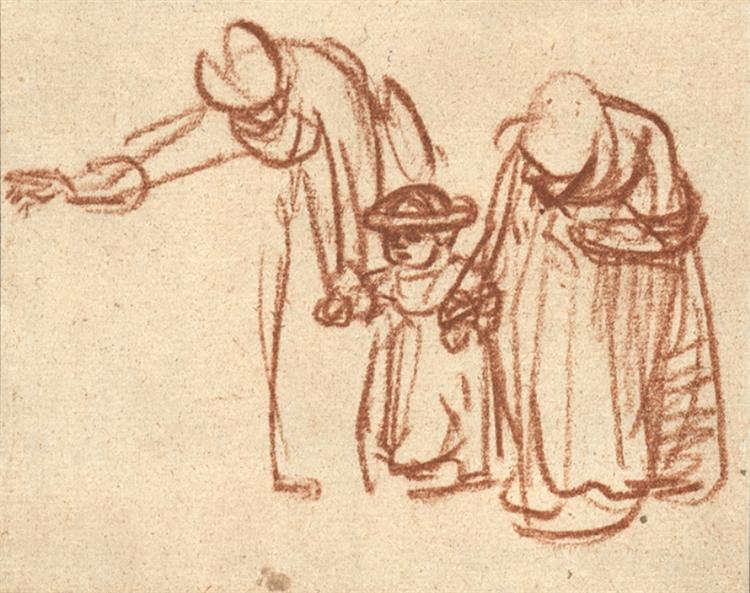
I was reading this piece by Austin Kleon, and there was a reference to a piece by Philip Pullman in which Pullman discussed drawing and spoke of “Rembrandt’s astonishing drawing of the toddler learning to walk”. That led me to the link which all these great Rembrandt drawings, including the one above. What a joy it was to serendipitously see these sketches of the Dutch master.

That experience reminded me of the joy of the Web: you surf from one page to the next, and suddenly you find something unexpected and wonderful. There’s so much bad material on the Web these days, it’s was great to have the kind of experience I used to have when I first started using a browser.

Like in life, try and follow and associate with the better people of the Internet and the World Wide Web. It will pay off with benefits you didn’t know were possible.

On substack and it’s alternatives and why you might want to switch

If you use Substack, should you stay on it? You might want to leave because of its Nazi problem, and that’s a good reason to do so. However for this post I’d like to focus on why you might you might want to leave for financial reasons.

To see what I mean about financial reasons, take a look at this chart above. I found it via this post on Bluesky: “Here’s some napkin math for how expensive Substack is compared to its competitors, assuming that roughly 7% of all subscribers will pay for their subscriptions, and that subscriptions cost $5/month. — Molly White (@molly.wiki) April 11, 2025 at 10:47 AM”. According to the chart, once you get above 18 paid subscribers, it gets worse and worse to be on Substack vs some of the other platforms there. And if you have 350 paid subscribers, all of the alternative platforms are cheaper.

I commented that I thought 7% was the highend, since I’ve seen a numerous substacks with 3% pay/free, but she replied she got the 7% from substack. Fair enough. I did come across this chart that showed the percentage varies, depending on the substack topic. Regardless of what percentage of your followers are paying one, once you start getting a significant number of paying subscribers, you should consider moving.

If you still need convincing that switching seems like a good move, read this.

On letting go of the last of Twitter (with a PS on ephemerality of tweets)

A few weeks ago I downloaded my twitter archive from X.com and deactivated my main account there. I assume this will result in blm849 being deleted, but who knows with that site.

I was unsure of what to do with this archive of mine. I had a lot of good memories of posting and interacting with people on that site, but the archive was taking up too much space for the value it contained, so I deleted it.

I still have all the blog posts I wrote about twitter, here. And an old tumblr of mine still has quite a few tweets contained in it. But overall it was time to let it go. Twitter was good while it lasted.

P.S. I always knew tweets were ephemeral. All digital media is, but tweets seemed more ephemeral than most. If you want to create or maintain a presence or a record, consider less ephemeral ways to do it.  Don’t depend on a site or a tool that can be easily taken away from you, or a record that is hard to replay.

Does participating on social media contribute in a positive way to your life?


Does participating on social media contribute in a positive way to your life? I came across a form of that question today. I think it sometimes can. And because it sometimes can, I think we are led to continue to participate. But even in that case, is the occasional positive contribution enough to keep reading various feeds every day? Is it enough to keep creating user generated content? I don’t know the answers to those questions these days.

This post, for example: I think the positive thing about it is it allows me to set a marker for myself. Such markers, in a sense, are a way of contributing to my future self in a positive way.

On the whole, though, is my participation in social media a positive thing? It’s something I am going to be thinking about in the new year. Perhaps you will too.

Bluesky is making social media fun again (and other thoughts on social media for Nov 2024)


Bluesky is making social media fun again, and that’s a good thing. For example, you have people developing creative new apps that show Bluesky skeets (posts) like the digital rain in the Matrix or firehose effect or a nightsky. All very cool.

It has some asking: is Bluesky the new Twitter and is that a good thing? Right now I would answer Yes to both parts of that question.

One thing for sure, people are paying attention and piling on. As the New York Times noted, Elon Musk and his swing to the right had much to do with people fleeing Twitter (ok, X.com).

What’s odd is that they are mostly going to Bluesky. After all, Bluesky is not the only game in town: Threads still exists. However Bluesky is rolling out features that are making Threads and X users want to move the butterfly app. And Threads has noticed and has started making changes. (While also trying to deal with their engagement bait problem.)

Will the changes at Threads be enough to keep Bluesky from surging to the lead? We will have to wait and see. Meanwhile I am interested in learning more about Bluesky and how I can experiment with it. If you feel the same, check out their documentation and read about the AT protocol.

Not everything about social media is fun and good. Over on X.com you have Elon making nazi jokes and spreading election conspiracies. Maybe he should spend less time doing that and more time on  X.com’s technical problems. I’ll leave Ed Zitron have the last word on Elon Musk (he has several words, and they are all rightly scathing). While over on visual social media, we have TikTok users spreading misinformation on melanoma. And famed YouTuber MrBeast being sued over ‘unsafe’ environment on upcoming Amazon reality show. Not good and all.

I once believed that new developments in social media were over. But the growth of Bluesky has convinced me otherwise. I’ll be curious to see how it grows over the next few years. Hopefully people like Musk and other fans of Trump (ahem, Marc Andreessen and Ben Horowitz) stay away.
 

How to change your Bluesky handle if you have you own domain at netfirms

If you’re like me, you may have a domain name that represents you (e.g. berniemichalik.ca) and that domain name is set up with netfirms. You have decided you want that domain name to be your Bluesky handle. Great! Here is the process I followed.

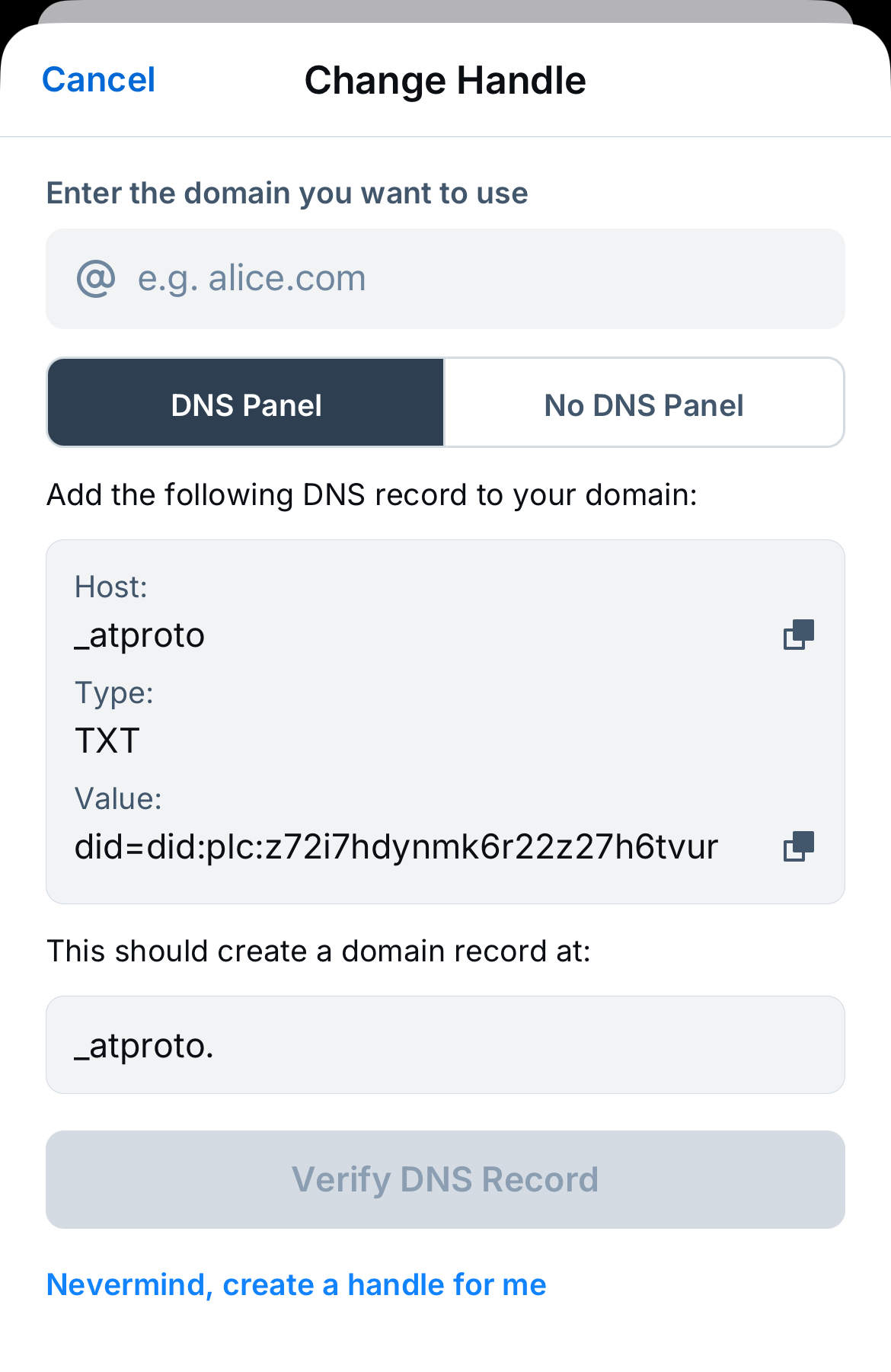
First, you will want to start by following the process outlined by Bluesky here. As you are following their process, you will see a Change Handle screen like the one below. When you get there, write down or save in a file the Host information information (_atproto), Type information (TXT) and the Value information (did=…..). You will need that information when you log in to netfirms.

Once you have that information, you can do the following:

  1. Login to your netfirms account (https://secure.netfirms.com/secure/login.bml)
  2. Click on the word Domains at the top left of the screen. Look for the domain name you want to use and then click on the Manage button associated with it.
  3. Scroll down on the column on the left until you see the words     DNS & Nameservers and click on that.
  4. Look for the words DNS Records and click on that.
  5. Click on the round button with a plus sign in it to the left of the words Add DNS Record
  6. A box labelled Add New DNS Record will open. Fill in the input boxes you see.
    1. For Name, enter the host information: _atproto.
    2. For Type, it should equal TXT like it does about.
    3. For Content, enter the value information from Bluesky that started with did=…. (Make sure you enter all the information for the value.)
    4. For TTL, it should equal 1 hour.
  7. Once you fill in all this information, click the Add DNS button.

That’s all there is to it! If you follow their process successfully and make the changes in netfirms as I outlined, you will have a new Bluesky handle. Now anyone wanting to verify that your Bluesky account truly is you can check out your web site listed in your handle.


Why social media content is so addictive (at least for me) and what it has to do with raw dogging flights

As I waste time doomscrolling through text based social media or reels, I will often stop and ask myself: why am I doing this? Why am I not reading a book or watching a movie? After many an hour wasted on the couch with my phone, I’ve come to the conclusion that it’s not that social media content that is a problem: it’s the social media format that is a problem.

Social media is essentially a stream of randomness: a collection of words and sentences and images with limited or no connection. You can surf along and not have to hold anything together in your head. That’s it’s format.

Now if you are reading a book or watching a movie, the format is different. Sentences are connected to paragraphs which are connected to stories or chapters. Characters and scenes and dialogue in a movie are connected to other characters, scenes, dialog. Your brain has to work to keep all those connections in mind when reading or viewing. The format of books or movies demands it.

With  social media content, you don’t have to maintain any of those connections in mind. You read and scroll and read and scroll, or you swipe through reels or Tiktoks, and in the end perhaps you retain one or two things.

Not having to maintain these connections in mind makes it easier for your brain to process social media content. That ease can make it more preferable, especially when you are tired or in a low energy state. Which, if you are like me, is fairly often.

Now it seems like some people are taking it to a new level by raw-dogging flights. (What Does ‘Raw-Dogging’ a Flight Mean? All About the Viral Travel Trend). Perhaps because they are in a low energy state and they don’t have access to social media, they just stare ahead the whole trip. It’s almost meditative. Again, the brain has very little to do here. People on a flight watching the flight path have zero connections to maintain.

So the next time you are beating yourself for wasting time on social media, perhaps acknowledge your brain is tired and this is all you can do. If you can, try meditating or napping or just going outside. Just understand that social media knows you are the way you are and it will suck you in if you are not careful.

Why OneMillionCheckBoxes.com shows we can never have nice big things again on the Internet

500

The site onemillioncheckboxes.com is just that: a site that has one million checkboxes to check (and uncheck). But it has become something more.
As The New York Times describes it (the bold emphasis is mine):

By providing a blank slate to users, One Million Checkboxes has also cycled rapidly through the stages of internet maturity, serving as something of a microcosm of the joys and horrors of digital life. First there was a period of exploration, in which users worked together to check as many boxes as they could. Next came creativity, as some began filling in boxes to illustrate hearts or, in more cases, crude drawings of male genitalia. Then things devolved, as they often do online, into all-out war. Steven Piziks, 57, a science fiction author in Ann Arbor, Mich., began checking boxes on Tuesday because he thought it might be soothing. He soon noticed someone else working behind him and unchecking every single one. He started checking even faster, and about half an hour later, the site’s built-in tally said he had checked more than 1,000 boxes. It was not soothing at all. It felt “like a metaphor for all of social media,” Mr. Piziks said. “We go into it thinking it’s going to be wonderful and collaborative and interesting, and it kind of turns into a fight.” Some bad actors on the site are human mischief-makers who take a perverse joy in undoing other people’s work. Others are simply bots that have been programmed to uncheck boxes en masse, Mr. Royalty said. (He has been working to contain them, with mixed success.) Those bots have been particularly infuriating to Frank Elavsky, 34, a Ph.D. student at Carnegie Mellon University who has checked more than 20,000 boxes in his “fight for the cause.” He got in a spat on X with someone he suspected of tinkering with the site’s code in the name of unchecking. “It became kind of personal,” he said. “I’m like, ‘You foul, foul demon. How could you?’” The website’s creator has been watching this all play out at a kind of omnipotent remove.

The freedom that the site gives users also comes with risks. In addition to lewd drawings, users have checked boxes in order to spell out profanities and at least one racial slur.

And that’s why I think OneMillionCheckBoxes.com shows we can never have nice big things again on the Internet. We can have big things, like OneMillionCheckBoxes.com, but you eventually get bad actors, bots, and racists. And we can have nice things with a significant investment in content moderation, but that doesn’t scale. Right now Threads.net is trying to prove me wrong, but in the end they will go for scale over nice, and when that happens, it’s only a matter of time before it all declines. Just like Facebook, and Twitter/X and others.

It will be interesting to check out (and maybe even check) OneMillionCheckBoxes.com in July 2025 and see if it is still active, or whether it succumbed to a combination of bad actors and ennui. I’m not optimistic.

For more on this, see: One Million Checkboxes, ‘Useless’ Internet Game, Lives Up to Its Name – The New York Times

Also the Washington Post has an interview with the creator, here.

You don’t owe anyone anything on social media….

You don’t owe anyone anything on social media.

You can better meet your personal and social responsibilities elsewhere in a manner you think is best. If you think there is something wrong in the world, you can contribute directly either with your time or your money or with whatever resources you see fit. If you need ideas, consider this thing I wrote some time ago.

Social media is a construct of large corporations to capture your free user generated content and feed it into a mechanism that allows them to capture fees (usually ads) from other corporations and organizations. In exchange for that free work, you get an opportunity to read what others are saying gratis, as well as giving others a chance to see and comment on what you are posting, also without cost. That’s it. That’s social media.

If you want to contribute your voice on social media to a cause you feel strongly about, go ahead. I personally believe it doesn’t amount to much, but your mileage might differ. Like I said above, you’d likely be much better off meeting your responsibilities elsewhere.

Social media these days is largely a mess, and it is doubtful it has an overall benefit on the whole. So extract what value you can from it, then leave it alone. You don’t owe anyone anything on social media. Not the people who see your posts, and certainly not the people who run the companies.


You should set up two-factor authentication (2FA) on Instagram. And you should use an authenticator app

You might think: no one is going to hack my Instagram account. And you might be right. But here’s the thing: if someone does hack your account, you have next to no chance of getting someone at Instagram to restore it. Rather than make it easy for hackers to take over your account, spam your friends and delete years of photos, you should use 2FA. To do so, read this article: How to Turn on Two-Factor Authentication on Instagram.

While you can use SMS, I recommend using an authenticator app. That article explains how you can do it either way. Authenticator apps are more secure than SMS and are the way to go these days. For more on that, see PCMag.

Twitter is dead, and the rest of text-based social media ain’t great

Twitter is dead. Sure there is some good parts of it remaining in the new company X, as this argues. But I am not certain for how much longer. If Musk wants to use it as a vehicle to relive his start up days , I don’t have much hope for it.

I still go on X to see what some people are doing, people who seem to be posting exclusively there. I was hopeful to jump to Threads, but after a flurry of activity, engagement seems to be dropping off. I tried Bluesky, but it seems better for people who used to love to argue on Twitter. That was never my thing.

I’ve also tried Mastrodon and even some Discord servers, but the problem in all cases is I cannot reproduce the social network I built up over time on Twitter. That social network kept me coming back and wanting to read and wanting to add. I don’t have the desire to build that up again.

The closest I have to that type of social network is what I have on Instagram. But it’s highly visual and I long for the text based social communication I used to have on twitter.

I don’t know what can be done about it. Maybe nothing. Maybe it’s the dusk of social media as we knew it from the Web 2.0 days. That could be fine.

In the mean time, here’s some more interesting links on social media I’ve liked recently. None of them are positive, alas:

On the mega long YouTube phenomena

Would you watch a youtube video that is 24 hours of a blank screen? Can you guess how many do? Would you guess over 40 million people? If that intrigues you, then I recommend you read this. It’s about the makers of extra long YouTube videos and it’s quite good.

3 thoughts:

  1. I’ve watched several of them, including those for fireplaces, beaches, and aquariums. They’re great! I draw the line at blank screens though. 🙂
  2. They reminded me of Andy Warhol’s “Empire” film that was over 8 hours long. You can read about that, here. Once more he was ahead of his time.
  3. It’s easy to take Youtube for granted, but it can be a platform for the creation of media not possible in the 20th century.

Some thoughts on learning to appreciate Instagram as a recording media

Yesterday I wrote about using Instagram as a recording device to track special events, such as life during the pandemic. As I was writing about it, I started thinking about Instagram as a service.

A weird thing happened to that service in the summer of 2022. The folks at Meta (who own it) hamfistedly tried to change the app, only to face a backlash from famous and not so famous. Unlike Twitter, Meta actually backed off from some of the changes (though they are still trying to make Reels happen). I’m glad they did.

In some ways Instagram has become my default way of sharing my life, mainly through Stories. The same 50 or so people see all my posts and can keep up with what I find interesting, and that amount is fine with me. On Twitter you can imagine lots of people are paying attention to what you post: on Instagram, you know who is. I no longer use Facebook, and who knows who reads these blog posts. 🙂 So Instagram it is.

Like many people, Instagram photos are not my life, but rather a version of it. I realized that especially when I put together my collection of images from Year 1 of the pandemic. There were plenty of things that I took photos of but never posted there. Anyone not close to me might think that’s everything happening in my life, but it’s only a sliver of the pie.

It’s good that Instagram allows you to collect Stories in Highlighted sections. It helps with the ephemeral nature of them. In most cases, the fact that photos in Stories are fleeting is good. But not always. It’s good to shape some of them into a virtual scrapbook to display.

Of course I could use Instagram Posts, but like many people, I post to Post less and less. Now I mostly use it to mark  a moment in time.

Instagram may not be the best place to publish photos, but it’s pretty good. Of course everything could change tomorrow, and all of it could be gone. I keep that in mind and keep my photos backed up separately. You should too.

Instagram has plenty of problems. Anyone reading their Wikipedia page can see that. But it has its benefits and does better than most social media these days. At least for me. Find me there, at least for now, at bernie_michalik.


All social media companies are bad, but some are successful. (Social media roundup, April 2023)

All social media companies are bad, but some are successful. The older ones like Meta and Twitter have fallen on difficult times for many reasons. They are bad companies doing badly. And the new kid on the block, TikTok, has gotten all the wrong attention recently. It’s a bad company doing well, at least in some aspects. Let’s talk a look.

Meta/Facebook: Meta continues to do poorly, and I for one am glad about this. Remember, no matter how stupid Twitter is or how creepy tiktok is, Meta/Facebook is all that and worse. For how they are creepy, read this on the slow death of surveillance capitalism in WiReD. Or this bit of outrageousness on how GoodRx leaked user Health data to Facebook and Google (Google is also bad.) And it is not just GoodRx: Cerebral did it too. Sure health web sites like GoodRx and Cerebral are horrible, but the social media companies facilitated it.

As for stupid, just think of the metaverse. Or don’t. Disney is giving up. More will too. And that will lead to more Facebook/Meta  layoffs.

Tiktok: Tiktok continues to be under fire politically. And Mark Z would love to see it get shut down and replace it with Instagram Reels.

Despite all that, it continues to thrive, and things that take off there really take off. For example, here’s a piece on how Sofia Coppola’s daughter went viral with her one cooking tiktok. TikTok gets our attention.

For some companies, it gets too much attention. So they panic when they see people are using tiktok to definfluence others, for example.

Other Tiktok pieces that got my attention: this piece on Olivia Dunne, college gymnast has 6.7 million TikTok followers. I don’t, but Some people like Cory Doctorow. If you are one of them, you will like his piece on Tiktok’s enshittification. Speaking of crappy, this is on borg drinking and tiktok. Young people being dumb is not news: the innovative ways they are dumb is.

Twitter: Let’s not forget good ole twitter: Elmo Musk continues to drive the company into the ground. Twitter ad sales plunged 46% while TikTok Pinterest gained. What a genius he is. He’s saving the company money by falling behind on rent. And  laying off staff.  Firing top engineers. And employing his  “extremely hardcore” approach. Then he follows up with more layoffs, including Esther Crawford, who made a big deal about being hardcore and sleeping on the office floor in a sleeping bag. That worked well.

All those layoffs were good for system stability. NOT. Some stuff on the twitter outages can be found here and here (on how a single engineer brought twitter down).

No wonder people headed for the exits. Initially  more than a million people switched to Mastodon. That lead to things like this: Movetodon: Find your Twitter Friends on Mastodon this. Even Medium got into the act and  opened mastodon subscription memberships.

Additionally here’s two pieces on their tech. One on their API and one on their rss feed. Enjoy while you can. David Crosby did. He  was great on using twitter.

Finally: here’s a piece on how a community came to a Toronto restaurant’s defence after one-star review. Good for them. Online reviews mostly suck.

And hey, let’s not leave off Substack. In January they said: Don’t start a year. Start a Substack. I guess.

I started tracking a group of users to see if Twitter usage was declining and twitter was dying… I was surprised by what I found

Like many people, I thought twitter usage was going to decline in 2023 due to all of the shenanigans of Elon Musk. While it seemed like usage was dropping off, I wanted to take some measurements to be certain.

To measure usage, I started by creating a list called good_twitter. It contained 98 accounts. I figured if the users on this list stopped tweeting, I would stop too. Then I wrote some python code to call twitter’s API and count the number of times each person on the list tweeted. I started counting at the beginning of January.

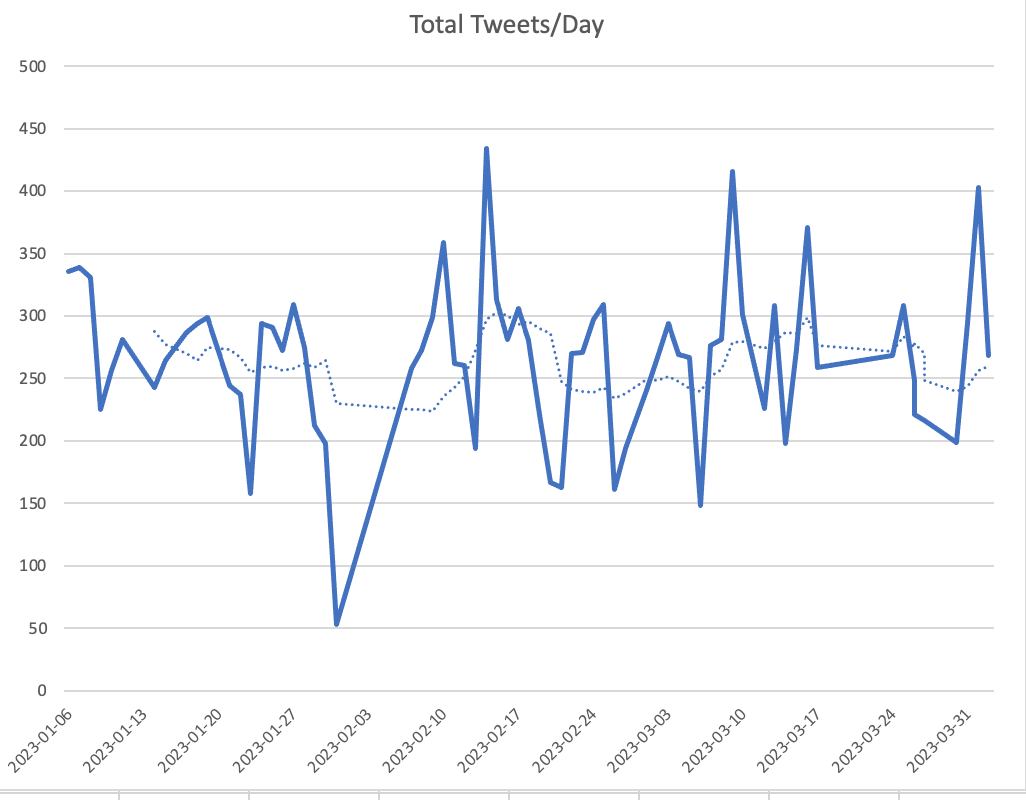
My first thought was that people would tweet less and less each day. However, as you can see from this chart below, on average the people on my list tweet around 250 times / day. Some days it’s over 350, some days it drops to around 150. (And one day my program died and I only counted 50. :)) So people are not tweeting less as time goes by.

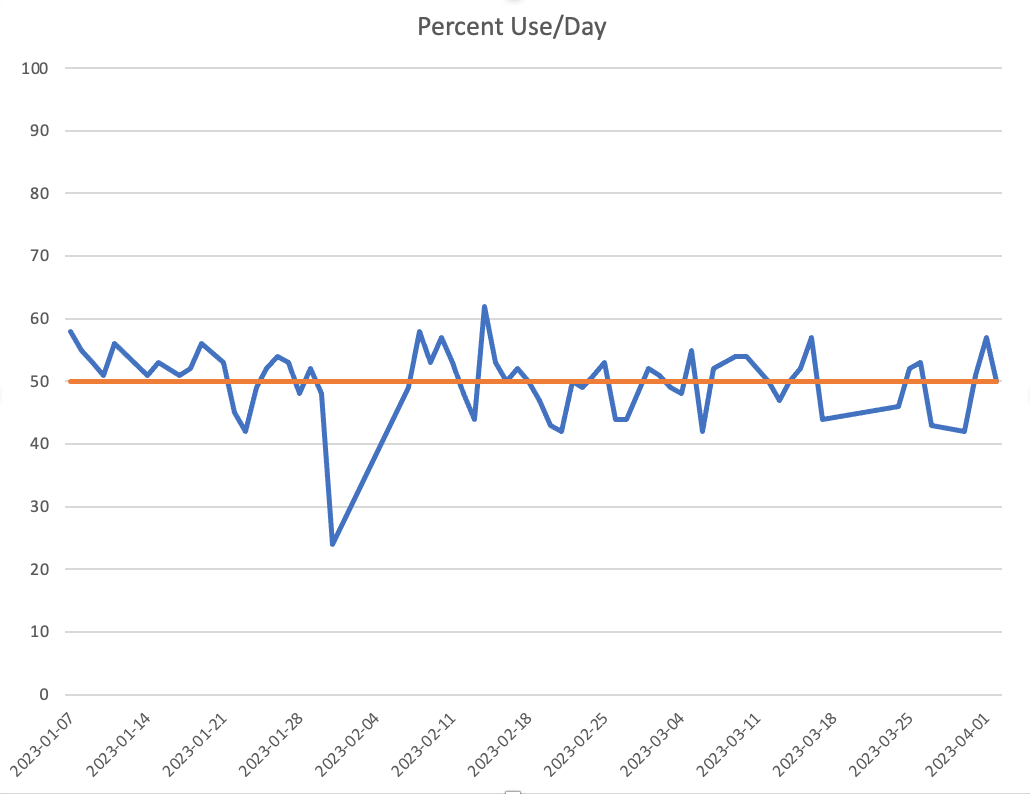
My second thought was that some people were dropping off, but other people on the list were tweeting more, and hence the total amount of tweets was not dropping. To measure this, I counted how many people on my list tweeted once or more per day.  The chart below shows approximately 50% of the 98 people on the list tweet at least once a day.

Given these two results, my final thought is that people are not giving up on twitter, even with all the problems we all have with it. I found that surprising. I expected a big decline initially. Then I expected a gradual decline. I don’t see either.

I don’t know why only 50% of users in the good_twitter list tweet while the other 50% does not. I am sure some people have quit twitter. But the hard core — like me — seem to be sticking around.

P.S. A fascinating byproduct of this study is how individuals tweet. I would have thought everyone uses twitter the same way. Wrong! Look at this chart below:

It turns out most people on my good_twitter list (and me) tweet/retweet 0-10 times a day. We are all part of the Long Tail to the right.

However there are two other types of people on the short end of the tail to the left. There are power users who tweet/retweet between 20-50 times a day every day. And there are a number of super users who tweet/retweet 50-100 times a day. (Power and super users are my nicknames.)

Some of the power users are obvious: they are mainly news and government accounts. Less obvious ones tend to be activists. They use twitter as a soapbox, pulpit, what have you. I have a few super users I follow: Shawn Micallef, Anthony DeRosa,  Deray and a couple more. For power and super  users,  retweets make up most of that content.

All that said, it’s been an interesting experiment, but I am not sure if I will continue to track usage. It may not be up to me: I expect Musk and company will turn off my free access to the API, and that will be that. And I am satisfied with my final thought that usage is staying constant for now.

Like any study, YMMV. But besides my good_twitter list, I also measured a few of my shorter lists and I found roughly the same result: at least half of the people on the shorter lists tweeted once a day.

Two good pieces on two good pieces from IKEA


Here’s a good piece on how the ubiquitous IKEA Råskog trolley (seen above) has become famous as the TBR (to be read) cart on social media. Move over bedside table: IKEA is bringing on competition.

That trolley is old and good. What’s new and good from IKEA is the  VINDSTYRKA smart sensor (seen below) which monitors air quality inside your home:

It’s interesting that IKEA continue to make forays into home devices that are not necessarily furniture (e.g., home speakers). I for one am here for that.

He said, she replied. A story of my weird twitter. #hssr

Long ago, twitter was interesting for many reasons. One reason was people trying to be creative within the 140 character limit. Or to link things seemingly unrelated with hashtags. Weird twitter, as some called it, was good twitter.

Between 2013 and 2015 I did this for awhile. I created a series of tweets based on an imaginary dialog between two people that stuck to a certain format and came with the hashtab #hssr (he said, she replied).

You can still find them on twitter, here. I just came across them in a folder I had in Evernote. (I had a service (IFTTT) save them.)

Who knows if they will be still on twitter a year from now? So here are most of them, as a backup. It was good to be on twitter then and I enjoyed contributing to it. I rarely feel that way now, and I hardly act creatively any more when I tweet.

That aside, here are my “he said, she replied” tweets:

  • Who believes in angels? That’s stupid, she said. We are all each other’s angels, he replied. #hssr
  • There is not much here anymore, he said. The opposite of what it was, she replied. #hssr
  • You used to say such interesting things, she said. There used to be more people listening, he replied. #hssr
  • You’ve very quiet, she said. The better to hear others, he replied. #hssr
  • I was shiny and new then, he said. You just need polishing, she replied. #hssr
  • You just might wave hello again, she said. I believe, he replied. #hssr
  • What did you bring, she asked. All the beauty I could gather, he replied. #hssr
  • What shall we do, she asked. More than we feared and less than we hoped, he replied #hssr
  • What are you listening to, she asked. The beat of my own drummer, finally, he replied. #hssr
  • No one understands these tweets of yours, she said. You are not no one, he replied. #hssr
  • In the end, you’ll be left alone, she said. It’s not the end but the beginning, he replied. #hssr
  • It is safer to be quiet, he said. Being quiet takes it’s own toll, she replied. #hssr
  • Freedom is a terrible thing and once you have it you should keep it, she said. Oh, i know i should, he replied. #hssr
  • The world is terrible, he said. The world is beautiful, she replied (and it was). #hssr
  • You thought your life would lead to something, but it’s led to nothing, she said. You’re half right, he replied. #hssr
  • I hear the mermaids singing, he said. Those are sirens, she replied. #hssr
  • Why do you live, she asked. Because i have someones worth living for, he replied. #hssr
  • You’re dancing again…I’m surprised, he said. A good song came on, she replied. #hssr
  • Once you danced so well, she said. In time I lived on dance floors but dance floors are for young men, he replied. #hssr
  • So much to do, he said. Only if time allows, she replied. #hssr
  • My life, he said. A hard road, but you make it harder, she replied. #hssr
  • So much time has passed, he said. For you, she replied. #hssr

My notes on falling to build a Mastodon server in AWS (they might help you)

Introduction: I have tried three times to set up a Mastodon server and failed. Despite abandoning this project, I thought I would do a write up since some people might benefit from my failure.

Background: during the recent commotion with Twitter, there was a general movement of people to Mastodon. During this movement, a number of people said they didn’t have a Mastodon server to move to. I didn’t either. When I read that Dan Sinker built his own, I thought I’d try that too. I’ve built many servers on multiple cloud environments and installed complex software in these environments. I figured it was doable.

Documentation: I had two main sources of documentation to help me do this:
Doc 1: docs.joinmastodon.org/admin/install/
Doc 2 gist.github.com/johnspurlockskymethod/da09c82e2ed8fabd5f5e164d942ce37c

Doc 1 is the official Mastodon documentation on how to build your own server. Doc 2 is a guide to installing a minimal Mastodon server on Amazon EC2.

Attempt #1: I followed Doc 2 since I was building it on an EC2 instance. I did not do the AWS pre-reqs advised other than create the security groups since I was using Mailgun for smtp and my domain was elsewhere at namecheap.

I did launch an minimal Ubuntu 22.x server that was a t2.micro, I think (1 vCPU, 1 GiB of memory). It was in the free tier. I did create a swap disk.

I ran into a number of problems during this install. Some of the problems I ran into had to do with versions of the software that were backlevelled compared to doc 1 (e.g. Ruby). Also I found that I could not even get the server to start, likely because there just is not enough memory, even with the swap space. I should have entered “sudo -I” from the start, rather than putting sudo in from of the commands. Doing that in future attempts made things easier. Finally, I deleted the EC2 instance.

Attempt #2: I decided to do a clean install on a new instance. I launched a new EC2 instance than was not free and had 2 vCPU and 2 GiB of memory. I also used doc 1 and referred to doc 2 as a guide. This time I got further. Part of the Mastodon server came up, but I did not get the entire interface. When I checked the server logs (using: journalctl -xf -u mastodon-*) I could see error messages, but despite searching for them, I couldn’t see anything conclusive. I deleted this EC2 instance also.

Attempt #3: I wanted to see if my problems in the previous attempts were due to capacity limitations. I created a third EC2 instance that had 4 vCPU and 8 GiB of memory. This installation went fast and clean. However despite that, I had the same type of errors as the second attempt. At this point I deleted this third instance and quit.

Possible causes of the problem(s) and ways to determine that and resolve them:
– Attempt the installation process on a VM/instance on another cloud provider (Google Cloud, Azure, IBM Cloud). If the problem resolves, the cause could be something to do with AWS.
– Attempt this on a server running Ubuntu 20.04 or Debian 11, either on the cloud or a physical machine. If this resolves, it could be a problem with the version of Ubuntu I was running (22.x): that was the only image available to me on AWS.
– Attempt it using the Docker image version, either on my desktop or in the cloud.
– Attempt to run it on a much bigger instance. Perhaps even a 4 x 8 machine is not sufficient.
– See if the problem is due to my domain being hosted elsewhere in combination with an elastic IP address by trying to use a domain hosted on AWS.

Summary: There are other things I could do to resolve my problems and get the server to work, but in terms of economics: the Law of Diminishing Returns has set in, there are opportunity costs to consider, the sunk costs are what they are, and the marginal utility remaining for me is 0. I learned a lot from this, but even if I got it working, I don’t want to run a Mastodon server long term, nor do I want to pay AWS for the privilege. Furthermore, I don’t want to spend time learning more about Ruby, which I think is where the problem may originate. It’s time for me to spend my precious time on technologies that are personally and professionally better rewarding.

Lessons Learned: What did I learned from this?

– Mastodon is a complicated beast. Anyone installing it must have an excellent understanding of Linux/Unix. If you want to install it on AWS for free, you really must be knowledgeable. Not only that, it consists of not only its own software, but nginx, Postgres, Redis and Ruby. Plus you need to be comfortable setting up SSL. If everything goes according to the doc, you are golden. If not, you really need an array of deep skills to solve any issues you have.

– Stick with the official documentation when it comes to installing Mastodon. Most of the many other pages I reviewed were out of date or glossed over things of note.

– Have all the information you need at hand. I did not have my Mailgun information available for the first attempt. Having it available for the second attempt helped.

– The certbot process in the official document did not work for me. I did this instead:
1) systemctl stop nginx.service
2) certbot certonly –standalone -d example.com (I used my own domain and my personal email and replied Y to other prompts.)
3)  systemctl restart nginx.service

– Make sure you have port 80 open: you need it for certbot. I did not initially for attempt 3 and that caused me problems. I needed to adjust my security group. (Hey, there are a lot of steps: you too will likely mess up on one or two. :))

– As I mentioned earlier, go from the beginning with: sudo -i

– Make sure the domain you set up points to your EC2 instance. Mine did not initially.

Finally: good luck with your installation. I hope it goes well.

P.S. In the past I would have persevered, because like a lot of technical people, I think: what will people think of me if I can’t get this to work?? Maybe they think I am no good??? 🙂 It seems silly, but plenty of technical people are motivated that way. I am still somewhat motivated that way. But pouring more time in this is like pouring more money into an old car you know you should just give up on vs continuing to try and fix.

P.S.S. Here’s a bunch of Mastodon links that you may find helpful:
http://www.nginx.com/blog/using-free-ssltls-certificates-from-lets-encrypt-with-nginx/
app.mailgun.com/app/sending/domains/sandbox069aadff8bc44202bbf74f02ff947b5f.mailgun.org
gist.github.com/AndrewKvalheim/a91c4a4624d341fe2faba28520ed2169
mstdn.ca/public/local
http://www.howtoforge.com/how-to-install-mastodon-social-network-on-ubuntu-22-04/
http://www.followchain.org/create-mastodon-server/
github.com/mastodon/mastodon/issues/10926

On the four eras of Twitter

There were four eras (so far) of twitter:

  1. Twitter is born: this was the early days when it was mostly geeks tweeting about their lunch. Celebrities like Stephen Fry started to use it, but it was just one of many Web 2.0 services available to people.
  2. Twitter is good:  This was around the time when Oprah Winfrey spoke to Ashton Kutcher about how great it was. The time when news of the plane landing in the river in NYC was discovered on Twitter before the news. Tweetups happened. Famous people spoke directly with their fans. Journalists piled on to make it a news destination.
  3. Twitter is bad: Then activists good and bad discovered twitter. There was Gamergate. There was brigading. The designation “hellsite” got tossed around a lot. The fun bar that was Twitter in the good days became the biker bar with lots of fighting and very little enjoyment.
  4. Twitter is dying: This is the “Elon Musk owns it” phase. Maybe this will be the last phase, and “twitter is dying” becomes “twitter is dead”. Let’s check back in a few months, years.

For more on the history of twitter, see this.

On twitter poisoning


At first I was dismissive of this oped by Jaron Lanier on how  Trump, Musk and Kanye Are Twitter Poisoned because I thought he was overstating the case for that trio. I thought: those three were messed up long before twitter!

The key thing that changed my mind on the idea of twitter poisoning was this:

Twitter poisoning is a little like alcoholism or gambling addiction, in that the afflicted lose all sense of proportion about their own powers. They can come to believe they have almost supernatural abilities. Little boys fantasize about energy beams shooting from their fingertips.

When I read that, a light went off. I know people on twitter like that! People who started off small and went on to accumulate many followers, and along the way they have suffered that form of poisoning. They have lost their sense of proportion. They seem to think they are more influential than they really are. In addition to what Lanier describes, the poisoning also seems to make some of them harder and meaner somehow. Less their former selves. The vanity that rose from their position on twitter curdled them.

Go read the article to get a full sense of this affliction.

If you are looking to join a Discord Server or run yours better, read this

David Seah provides an excellent model for anyone looking to run their discord server effectively. I recommend you check out what he has to say, here: DSri’s Virtual Coworking Cafe – DSri Seah. As he describes it:

The DS|CAFE Discord is a virtual office that has became a virtual coworking space in 2016. It’s designed to provide “the right level of distraction” you need to have a productive day with the option of sharing our interests with each other.

He goes on to briefly describe what it’s for, what the people are like, what the main chat areas are, and — very important — what the chat guidelines are. I would hope all discord servers are as thoughtful.

You might be thinking: that’s all well and good, but I don’t want to start a Discord server, I just want to join one.  Well, you are in luck, because David’s server allows you to sign up. Instructions are on the site. If you do on my recommendation, I also strongly state you should respect their guidelines and their community.

P.S. David Seah is one of those people who makes the Internet a better place by sharing what he has. We need more people like that.


On Mark Zuckerberg’s Legs and other stupid things we have to try and ignore

So in Mark Zuckerberg’s hot new remake of Second Life, avatars will soon have legs. Woo. It’s something I’d rather not think about.  Just like I don’t care about Elon Musk and whether or not he spoke with Putin. Or anything to do with Kanye’s opinion on pretty much anything. But that’s the problem with social media these days. Even if you don’t want to know about these things, other people want you to. People whose opinion you’d normally are interested in. I mean, even I am guilty of this right now. So why do this?

What I would hope for is to nudge folks a little so that they find other things to share on social media. Things like stories about themselves. Or good things that they’ve discovered, be it big or little. Maybe facts or ideas about people other than those manic attention seekers that are everywhere on the Internet. That would be great if that could happen.

Will it? Likely not. That’s why I expect to see new forms of social media taking off. Perhaps it will be Discord. Perhaps someplace else. But some place you can go and avoid those that are so hard to avoid currently.

Meanwhile, congrats to Mark Z on growing a pair…of legs. Happy for you.

P.S. Turns. out Mark Z’s legs were a lie. Amazing.

Facebook is wrecking Instagram. Here’s why.


I knew the day that Facebook/Meta bought Instagram that it would eventually wreck it. It took awhile, but that day has come, at least for me. It will for you too. It went from being a place to post photos to a place to post stories to a full on replacement for Facebook/TikTok/Messenger/etc. Yuck. I can barely use it now.

For more on the disaster that Instagram is becoming, read: Building a new Titanic on the deck of the old one. This piece shows it isn’t even helping Facebook/Meta: Data Shows Decline in Instagram Post Engagement As App Favors Reels. So they ruined it for themselves AND the users. Interesting business model.

Overall I think this development suggests the decline of Facebook/Meta, the company. For more on that decline, see: What Is Facebook? in The New York Times


This week in forbidden tweets

Generally I think it is a good idea to keep it positive and light on twitter. I especially try and avoid political tweets. However, I found that hard to do this week. To stop myself, I kept a log of all the things I was going to tweet about but didn’t. The following is the log.

(The good thing about sharing them in a blog is you can moderate who comments on such things. I don’t mind saying such things: I do mind having to fight with randos.  I also don’t like to make people read things that they don’t want to read. Twitter does that to you: blog posts don’t. Here’s the things I was going to tweet but didn’t.)

  1. saying things are a war crime doesn’t amount to much. If it did, Kissinger would be locked away. (Lots of people talking about war crimes, as if somehow this will result in some action. It might, but it’s very unlikely).
  2. just because you feel justifiable sympathy for Ukraine doesn’t mean they aren’t lying to you (I mean, maybe 120,000 Ukrainian kids were taken to Russia, but given how the war is going, do you really think Russia is organized to do this?)
  3. accuracy in a war zone is a rare commodity. (Always remember that.)
  4. there’s no way Marine Le Pen is going to win, but it’s fun and dramatic for journalist to make like she will (I mean what is this, her third or fourth try? Every time people get all excited about her chances, and then she fades away. I don’t know why this time is different and I haven’t seen an explanation)
  5. Tucker Carlson’s whole schtick is to get people riled up by hosting vile people.
  6. Elon Musk has nothing more important to do than troll people. (Seriously. I think SpaceX and Tesla now are run by adults who know what they are doing. Musk is just farting around trying to get people to pay attention to him.)
  7. It is a losing game to take people like Musk or Carlson at their word. (The two of them are terrible humans, although Carlson deserves a lower level of hell then Musk.)
  8. The problem with following right wingers or the side opposite of you is that they tweet a lot of thoughtless garbage to show they are on Team Right (or Team Left) (I tried to follow right wingers to get some perspective, but the perspective I got is most of them aren’t critical thinkers. )
  9. People who are good writers can have some amazingly bad opinions and ideas (ahem, David Mamet. Pathetic.)
  10. People thinking highly of something Pierre Poilievre said about housing while forgetting he is PP (I have no idea what Gerald Butts and Chantal Hebert were pumping him up this week. He’s PP! Skippy! A French version of Stockwell Day! All hat no cattle! Sure, he can win the job for head Conservative, but so what? So he can fight Bernier to see who is more like Trump? If support for the Liberals collapse, and that’s a big if, I can’t see him coming out on top. Maybe he will….Doug Ford did. )
  11. Kieran Moore doesn’t care what you think he should do. Some doctors are bad at their jobs. Likely more than you can imagine (I mean this guy is Doug Ford’s man. What else can I say?)
  12. Writing about cancel culture on university is boring. (And yet so many people on twitter love to write about it)
  13. People complaining about consultants. Oy. (They have no clue what consultants do or why. But consultants make a great straw man).

No, I will not be commenting on this post on Twitter. 🙂

On surveillance capitalism, Tiktok edition

If you are like me, you can be spooked at how much social media companies know about you. I’ve become so concerned that I recently moved over to Duck Duck Go for some of my searches in a (vain?) attempt to prevent this from happening. I also have some privacy tools installed on my browser in the hope I can cut down on the information companies are gleaning about me.

We all have our ideas on how they do this. If you want to know how one company does it, see:  How TikTok Reads Your Mind.

More on surveillance capitalism here.

Is Facebook / Meta in trouble?

Is Facebook / Meta in trouble? Kinda. I mean, it has lost a lot of market cap. On the other hand, having done so brings it other benefits, such as less scrutiny:
Facebook market cap under $600 billion threshold for antitrust bills

And losing value is not the only problems it has, as this shows: 6 Reasons Meta Is in Trouble – The New York Times.

I think instead of thinking it is in trouble, think of it in transition. The rebranding is only part of transition. Transitions tend to be tough. Right now Facebook sees itself in a corner in many ways: from declining users to pressing regulators. It has to do the transition at some time and now is likely the best time. So yes, it is in trouble, but not fatal trouble. I suspect we will have Meta with us long into the future.

On one of the best twitter accounts there is, Canadian Paintings

The twitter account devoted to Canadian Paintings is one of the best twitter accounts there is. Several times a day it will tweet out a great Canadian painting from artists famous and not so famous. It covers such a range of paintings too. Some days they will have something painted recently, other days something from decades ago. There are paintings from men and women, all regions, all eras, and just about every group of people in Canada you can imagine. I just love it.

Someone finally wrote about the account, and you can find it here: Canadian Paintings tunes out the noise of social media with its contemplative feed of visual art – Winnipeg Free Press

(Image from the Free Press article).


Billie Eilish, or what’s no longer new in social media

Social media is in a funny period these days. For one thing, the “old” social media seems to have plateaued and is not yielding big results. For example, Ms Ellish’s Millions of Followers did not result in big book sales. Nor did Mr. Timberlake’s social media fans. No doubt their books suffered for many reasons, but one time social media could be the thing to propel them to success. Not any more.

It’s been long known that Facebook has been struggling to maintain its young users. It seems the same is now true for another part of Facebook/Meta: Instagram. It’s not that people have given up on social media. For example, there are new contenders, like Twitch and Discord. Perhaps Meta will buy them to stay fresh, just like they bought Instagram and WhatsApp. Meanwhile, Meta plans to remove thousands of sensitive ad-targeting categories. The more things change….

Before I close, if you still use RSS like I do (with the Feedly app), here are the  Top Toronto RSS Feeds.

(Image from NYTimes)


A good reminder that the large social media sites are bad because they choose to be

You might think that there is nothing to be done with the the people who spread lies and misinformation (and worse) on social media. But I believe that there is nothing inevitable about it and it is not impossible to fix.

For a case study of this, see this piece: Vaccine misinformation has run rampant on pregnancy apps in The Washington Post. The What to Expect app was being overrun with misinformation until they decided to clamp down. The result?

The experience of What to Expect shows that, when smaller apps do explicitly prioritize content moderation, the results can be striking.

The Post backed off a bit, but I would not. I think that if bigger apps did this too, the results would also be striking. I think the bigger apps like YouTube and Facebook and TikTok and Twitter only do it when things get too extreme. Otherwise they are happy to have the engagement, even if people think their sites stink.

(Photo by Prateek Katyal on Unsplash )

It’s Hallowe’en. Here’s my pandemic highlights and ramblings for October, 2021(a newsletter, in blog form)

Happy Hallowe’en to you. For those celebrating, I hope the weather is good and the night is sufficiently scary and enjoyable. Here’s my monthly newsletter and ramblings as the year passes the three quarter mark. Grab some candy and dig in.

Pandemic: the pandemic is not new and not as scary as it used to be, but it is still bad enough and still not done. Alas. Publications like Vox are wondering what the winter will bring, Covid wise. So far we have seen a decline in cases, but not near enough to zero. Even places like New Zealand have had to abandon their Zero-Covid ambitions. As I have said before, the pandemic humbles us all. If you run restaurants, this has been especially true. Ask Toronto celebrity chef Mark McEwan, whose restaurant and gourmet foods business filed for creditor protection, citing a cash crunch. Or the poor IT people from Ontario whose website to download Ontario vaccine QR code crashed on first day it’s open to all residents. The pandemic has been challenging no matter what you do or where you are.

It doesn’t help that if anything the virus may be mutating into new variants of concern, as this shows:  3 takeaways from the emergence of the Delta Plus coronavirus variant. Yikes. That hasn’t stopped people from yearning to go back to the office, though it seems employers are not communicating post-pandemic workplace plans. I am not surprised: COVID-19 makes it hard to plan anything. For example, some places are wondering how to deal with  the Great Resignation, although there is talk that the notion is over blown. Certainly you would think so if you read this: A worker in Florida applied to 60 entry-level jobs in September and got one interview. Sooner than later we will go back to the office. Some of you even missed the commute. If you have, then read this: The Myth of the Productive Commute.

As for me, I’ve been working with a great team on  Alberta’s Vaccine Passport rollout. I am happy to have contributed in a small but positive way to ending this pandemic.

Non pandemic: there has been much happening that has nothing to do with the pandemic. For example:

Facebook has been in the news much of late. Mark Zuckerberg has tried to shift the conversation to the new name and vision for his company. This piece talks a little about Meta, Facebook’s new name. I can’t help but think it’s a Second Life clone (Third Life?). Whatever you think of Meta, I think Vice sums up the venture nicely for me: Zuckerberg Announces Fantasy World Where Facebook Is Not a Horrible Company. And what is Mark Z and his team trying to get you to not think about? This: The Key takeaways from the Facebook Papers.

I don’t know what will happen to Facebook-the-company. I have long suspected Facebook-the-service has been in decline in all sorts of ways for years. Generally, we have long realized that much of social media is not good for us. Some people have likened it to smoking. I think this may be a better comparison: Social Media Has the Same Downsides As Alcohol – The Atlantic

Climate-wise, the 2021 United Nations Climate Change Conference is starting today. What will come from it, I can’t say. We will know in the middle of November. Recently I have been somewhat cheered up by this piece that argues that yes there is progress but no it is not enough. A fair assessment. It’s not that there are not Climate change solutions, it’s that we can’t deploy them fast enough. My belief is that things will accelerate in this regard and we will get much further faster than many now think. That said, much will be lost and damaged in the meantime. I am cautiously hopeful though not naive.

China has much to say about climate change, and  Xi from China will be there at the climate conference, but how influential he will be remains to be seen. He has been withdrawn lately, as this shows: Xi Hasn’t Left China in 21 Months. Covid May Be Only Part of the Reason. Part of the reason may be that China’s government is starting to screw up. Still, the government has its supporters, such as  the patriotic ‘ziganwu’ bloggers who attack the West. The question I have is what will happen if China’s growth slows significantly? Or if big companies fail?How will Xi’s crackdowns affect Chinese society and his reign? We will see in 2022.

Russia has been in the news of late, and not for the best of reasons. As someone who values a free Internet, the fact that Russia is censoring the Internet with coercion and Black Boxes is a bad thing. There is talk that Russia wants to cut itself off from the Internet. It’s easier said than done if you want to be a successful country. Though they are trying. And the coercion doesn’t stop with Russians. Even American companies like Apple and Google Go Further Than Ever to Appease Russia. Not good.

Gee, Bernie, this version of your newsletter is bleak. What’s good? Well, this is fun: Cats and Domino. I loved this: Essential Irish Slang Everyone Should Know . This was interesting: Beat writers and bohemians: One woman’s memoir of 1950s Greenwich Village. Speaking of NYC, we should go to the Big Apple and visit  the 14 Most Iconic New York City Bars and Restaurants. That would be fun. Not fun, but fascinating is this story: The Medieval-like reformatory for ‚Fallen women on Riverside Drive, New York.

Finally, I would be remiss if I didn’t bring up some NFT lunacy. Here’s the latest gem: Our Lady Peace looks to the future by bundling NFTs with new album . Honestly I could fill my newsletter with this stuff. As for newsletters, it seems Newsletter Writer Fatigue Sets In . Ha! I am not surprised. They need to learn a lesson from Andrew Sullivan, who discovered this ages ago with his blog and ended up hiring staff for what became a publication disguised as a blog. Of course it helps to be pulling in serious money like he does: not many people can do that.

That’s it for another newsletter. Thanks for reading my ramblings! Winter is coming soon: enjoy the Fall while you can. It’s a season of colour and cornucopias. Soak up its wealth and coziness. In no time Winter and Christmas will be here, for worse and for better.

Last word:  I came across this fabulous infographic via this: Wes Anderson Films and Their Actors [OC]. Like Christopher Nolan, he likes to work with specific actors over and over again.

He has a new film out now: The French Dispatch. It looks fun. We could all use some fun! Go and have all the fun you can. Until next month….


The best example of why we need to regulate the social media industry? The auto industry


Wired magazine makes the case, here: Facebook’s Fall From Grace Looks a Lot Like Ford’s.

Worth considering. Social media is struggling to govern itself and Facebook is often downright defiant.

P.S. In Facebook’s defense, you may seem them play the “we are weak” card. The New York Times makes the case for their weakening, here.

(Photo by Firmbee.com on Unsplash )

On Facebook’s new glasses

So Facebook has teamed up with RayBans to make the glasses seen above. One of the features of these glasses is you can tap them and record pictures and videos. Mike Isaac has a good write up on them, here. I’d like to highlight one quote from that piece:

“Facebook is not naïve to the fact that other smart glasses have failed in the past,” said Jeremy Greenberg, policy counsel for the Future of Privacy Forum, a privacy nonprofit that is partly financed by Facebook. But, he added, “the public’s expectations of privacy have changed since the days of previous smart glasses releases.”

Yep. Pure Facebook. An org funded by Facebook indicated that people are cool with potential invasions of privacy.

From a design point of view, this partnership has made a better looking pair of glasses than Google did with their Glass product. From a privacy point of view, however, these things things are at least as bad if not worse than Google’s product.

I can’t predict how well these will do. I can predict, however, that we will see abuses of privacy as a result of them. For more on them, see: Smart Glasses Made Google Look Dumb. Now Facebook Is Giving Them a Try. by Mike Isaac in The New York Times.

How is twitter holding up in 2021?


How is Twitter holding up in 2021? It depends on how you look at it. As a service, it is trying to innovate with new features, but as this piece argues, it is kinda stuck: Twitter Is Stuck With Itself, Too – The New York Times.

As a company, though, it is doing well. For example, it continues to be profitable: Twitter Continues Its Profit Streak, While Still Shedding Users – The New York Times. The shedding users is a concern.

And compared to other services like YouTube, it is doing ok, as this piece shows: YouTube Is Underwhelming – The New York Times. In fact:

Twitter, which is not so hot at money, pulls in roughly double the ad sales on average from each of its users compared with YouTube.

Perhaps it should be acknowledged that the early social media companies like Twitter and YouTube are mature now and their growth and innovation peaks are behind them. Maybe they will continue to be like Facebook: mimicking every new company in the hopes of draining off some of that enthusiasm.

At least Twitter as a company seems to be doing well. For 2021, that may be all they need to be.
(Photo by Edgar MORAN on Unsplash)

Good rules for twitter use


There’s been some discussion of the pros and cons of twitter this week. From one of the pro pieces came these rules which I thought were pretty good:

Never check the site before 8am.

Mute anyone who is neither funny nor polite.

Mute notifications regularly.

Delete the app periodically.

Never assume anything is important just because it’s big on Twitter.

Never say in conversation, “As I recently tweeted”.

The pro piece is here: I’m a Twitter addict and I don’t care | Financial Times

(Photo by Brett Jordan on Unsplash)

How powerful is twitter?


I agree with this assessment by Noah Smith: it is not powerful at all. It can seem powerful at times, like a very high wind. But like a very high wind, it either subsides or moves on. Sometimes there is damage, but mainly not.

If you disagree, I recommend you read his piece. It’s a pretty strong argument for why twitter as a social force is limited.

P.S. I have felt that for some time. I mainly post things that are either positive or amusing. If I want to take social action, there are concrete ways to do that.

P.S.S. Tweets are like straw, blowing this way and that way, yet not moving and not affecting things, besides making a nice noise.

(Photo by seth schwiet on Unsplash )

On China and LinkedIn

Unlike other social media giants, LinkedIn rarely generates controversy or makes the news. An exception to that is this story about the platform running into problems in China: China Punishes Microsoft’s LinkedIn Over Lax Censorship from The New York Times.

What happened? In a nutshell:

LinkedIn has been the lone major American social network allowed to operate in China. To do so, the Microsoft-owned service for professionals censors the posts made by its millions of Chinese users. Now, it’s in hot water for not censoring enough.

I am not sure how they are going to recover from this, if they ever do.  It’s going to be worth keeping an eye on this, as well as how other social media companies make changes to suit the needs of the Chinese government. Those companies might find they land between two chairs if the U.S. government starts pressuring them in other ways.

(Photo by Greg Bulla on Unsplash)