Phishing alert! Look for emails with the subject: Your iCloud Account Invalid Address #fb

This phishing attack is really good. Other than text like “we regret to announce” and a misspelling of “Apple”, most of the phrasing is well done and it all looks very official. Of course they sent it to my wrong email address, so that was another sign it was a phishing email. Most of the links are valid, too, except one that points to myioscare.uk. So yeah, beware. Here’s the text of the email:

Apple ID – <my email address at work>, (19 – September – 2014)

This notice is to therefore to inform you we regret to announce you that your Apple/iCloud Account (<my email address at work>) has been temporarily frozen until we can verify your iCloud Account details. This security measure to protect your Apple Account from unauthorized usage. We apologise for any inconvenience caused.
You will be unable to access Apple sync/backup or the iTunes/App Store & Apps Store until you update your Apple/iCloud Account details on file, we urge you to complete validation as soon as you can. Failure to update your account details within a 74 hours can result in deletion of your Apple/iCloud Account to protect our system.

How can I validate my Apple Account and restore my iCloud/Apple ID?
Just proceed to the highlighted link below to verify ownership of your Apple ID. Log-in in using your Appe/iCloud login and password, then read the instructions.

> Validate My Apple/iCloud Account

While using Apple products and apps, you’ll still sign in with your primary e-mail address as your Apple account.

If you have queries and want support, please visit the Apple Account Care site.

Regards,
Apple/iCloud Europe
Case Validation Request: #UJ13HA41317-EU11

How To Set Up Your Raspberry Pi For The First Time


If you just bought or are thinking of buying a Raspberry Pi, then two things:

  1. Congratulations!
  2. Read this: How To Set Up Your Raspberry Pi For The First Time – ReadWrite.

Not only will it help you get set up, but it also has a list of projects to get your started on doing something useful with it. As well, there’s some links to other resources.
There’s lots of material on Raspberry Pi’s on the Web, but if you haven’t found them yet, try this one at ReadWrite and get started.

Two good articles on the new economy (work is changing)

These two articles: In the Sharing Economy, Workers Find Both Freedom and Uncertainty and Is owning overrated? (both from the NYTimes) look at how people are changing their how they work and what they own in the new (American) economy. I don’t think there is one thing driving these changes. Partially it is how people feel about work, but also what type of work is available to them. Plus technology is allowing for people to work and own in ways not available before.

I found the first article depressing. My hope is that as more companies like this come along, they will need to compete more and this will be better for the workers. Indeed, this seems to be happening to Uber as Lyft (and likely others) come along. As for renting, I think there is a limit to this. While it makes sense to rent some things, I believe that subset is alot smaller than one may initially imagine. What may happen is that people own things for smaller windows.

What seems certain is that the days of working for one employer for along period of time is only going to decline further. Additionally people may conspicuously rent or hold for smaller periods of time and then release things.

Time and changes in the economy will tell.


Do you have Chromecast? Then you want 5by

Chromecast is great for putting YouTube videos on your big screen TV. The problem for me, though, is finding good videos to watch: I want to spend less time searching and more time relaxing. 5by.com answers that problem by providing you videos picked by them around themes. I have just started with it, but it looks good (in more ways than one).

For more information, see Video Concierge.

NYC has a good problem to have (some thoughts and observations)


New York City has a good problem to have: it’s getting increasingly more expensive to live there. In the second half of the 20th century, it had the opposite problem and the question was would anyone want to live in all but small parts of it. Those days are gone, so much so that Manhattan became too expensive for most, which partially led to people moving to Brooklyn. Now even Brooklyn is getting too expensive, according to this: Moving Out of Brooklyn Because of High Prices – NYTimes.com.

It’s not surprising to me: NYC is more desirable than ever to move to. Yet the parts of Manhattan and now Brooklyn that people find too pricey are not the whole city. I expect in a few years from now people will be talking about great spots in Queens and the Bronx and how they too are becoming more expensive.

Globally populations are leaving small towns and rural areas and moving to cities. Cities like New York will be the beneficiaries of this, and will grow accordingly.  Assuming they are well run cities, they will find ways to accomodate newcomers, and the parts that were cheaper will rise in value.

I don’t see NYC getting cheaper any time soon. It will be more what parts of it people live in, and what the housing will look like. I expect you will see more high rises built in places where none were before, and more and more neighborhoods being gentrified.

Here’s to a growing New York.

(Creative commons image from picsbyfreyja)

Interested in the MEAN stack? Check this out

Like alot of folks, I am interested in the MEAN stack, but in getting started, I haven’t found too many concise, all in one, pieces on the topic that are good intros. (I am sure there are some: I just haven’t found one.)

This IBM developerWorks article looks like it could be the one for me (and you): Mastering MEAN: Introducing the MEAN stack.

The title is confusing: you won’t be mastering MEAN with one article in devWorks, but you will have a chance to learn enough to get started.

Try it out and let me know what you think.

Why I am backing the ‘1984’ Stealth Fashion for the Under-Surveillance Society by Zoltan Csaki on Kickstarter

Here are my reasons for (and why you might want to as well):

  • To reduce abuse of access to your data: There are more and more stories of organizations, government and other, using and abusing data given off from your cell phone (e.g. this story on location based marketing in Toronto being just one).  This product can help put a stop to that.
  • To increase the amount of control I have: I may not have an issue with others using this data and there may be times when I think there is a benefit to me to have this data accessible. Generally I don’t, but I like the option. This product helps with that.
  • To encourage more people to make such products: if this campaign is successful, I hope to see more businesses attempting similar but different and possibly better products, which is a benefit to me and people like me who values their privacy.

Reasons against:

  • it’s not foolproof. By that, I mean anyone with enough motivation could still use the data you inevitably will give off when you are using your phone to extrapolate things about you. As well, there are other ways you can be tracked (E.g., abusive apps).

In my case, I think the reasons for outweigh the reasons against, and that is why I have pledged to this Kickstarter campaign . I would encourage you to pledge as well.

Here’s a link to it: ‘1984’ Stealth Fashion for the Under-Surveillance Society by Zoltan Csaki — Kickstarter.

Lost your iPhone? A PIN won’t save you from it being abused. Here’s why

My son misplaced his phone. I assumed he was safe because it had a PIN on it and it was locked. Turns out someone must have found it and was using it to rack up big long distance phone bills. Here’s just one way people can do this: 3 Ways to Bypass iPhone Passcode – wikiHow.

Obviously I am not encouraging people to do this, any more than I would encourage people to steal or commit other crimes. I am encouraging you to call your provider whenever you can’t find your phone.

Eight quick thoughts on the Apple Watch: its more than watch, more than IT.

Here’s eight quick things I concluded while watching Apple talk about their latest product: the Apple Watch

  1. In the future, you won’t own one Apple Watch, you will own several. For the record I have two shuffles and a number of iPods. I can see the same with Apple Watches.
  2. I expect Apple to experiment with different face types over time. The only thing that changes more than IT is fashion. So expect a steady stream of changing Apple Watches, which will embed fashion and IT.
  3. I also expect Apple to launch partnerships with an array of other companies like high end fashion houses. Just like others make sunglasses for Tom Ford, Prada, etc., I expect Apple to make watches for them. They will be able to use higher end materials, like gold and expensive leather. They might even come with high end apps. Jony Ive was right to say that high end watch makers should be nervous. Apple can work with others to make high end watches that have sophisticated IT: not many (any?) can claim the same thing?
  4. This is also tough for copycat IT companies like Samsung. Apple can now move at the pace of fashion, which is faster than the pace of IT. Plus fashion is about taste, which is an essential part of Apple. It is in their DNA, so to speak. Not so with other mobile device makers.
  5. The Apple Watch is not simply a watch, any more than the iPhone was simply a phone. There is alot of emphasis on the watch part right now, just like there was alot of discussion about the phone part of the iPhone at first. I expect that to change over time.
  6. Right now the Apple Watch depends on the iPhone or other device: it is secondary. I expect the Apple Watch will become the primary device over time, especially with advances in IT. It will be possible to become primary and that makes sense, because you don’t have to carry it: you simply wear it.
  7. Apple has two wearable devices right now: the Apple Watch and Beats. Expect more and more. I expect even Apple eye wear. Unlike the fiasco that is Google Glass, it will be done correctly the first time. And like the watch, you will have more than one pair.
  8. I don’t expect Apple to make a wide range of wearable computing devices. Apple tends to focus. They have a limited range of personal computing devices: I expect them to have a limited range of wearable devices.

P.S. The Apple Watch is not the iWatch. A small shift. Also, this has been a good day for Tim Cook. He is an understated CEO, but he has transitioned Apple from Steve Jobs very well. His first priority was to steady the company. Now he is charting a new course.  Apple shareholders are lucky.

Lastly, these are my opinions only, and not my employers.


Should you take vitamins? A simple two step evaulation process

Vitamin image from wikipedia

1) Read and print this: Don’t Take Your Vitamins | FiveThirtyEight.

2) Talk to your doctor. Discuss this article. Then decide.

I’ve seen a number of articles like the one in FiveThirtyEight saying one shouldn’t take vitamins. Others treat them like chicken soup, saying: they can’t hurt. Regardless, if you are putting anything that is not food into your body on a daily basis, it only makes sense to talk to your doctor.

(Image via the “Vitamin” section of Wikipedia)

A fashionable option for men who don’t want to wear leather shoes (or Tom’s shoes)


If you are a man (or someone who like to wear shoes traditionally associated with men) who doesn’t want to wear shoes from leather, don’t want to wear Converse or Toms shoes but do want to wear dress shoes, you have what I think is  a good alternative: Delli Aldo shoes. I came across them via Cool Tools (a newsletter and a section of Kevin Kelly’s website) and I think they are great for a number of reasons:

  1. they are very stylish
  2. they come in a wide range of styles
  3. they are low cost
  4. they are vegan

Beware: they run large (e.g. if you wear 8, consider getting the size 7 or 6.5) and they stink the first few days you get them (then apparently they do not).

For more information, check out the link to Cool Tools or go right to Amazon and pick up a pair.

It’s 7 a.m., you haven’t slept a wink, and you need to go to work. What do you do?

You print off this article: How to Get Through a Workday on No Sleep — Science of Us and you follow it step by step, hour by hour. Really. It has a great rundown of all the things you should do and why.

Of course the best thing is to do what it takes to get some sleep the night before. Or call in sick and get some rest. If neither of those options are available, what you read in that article may be the thing that saves you.

P.S. Thanks for reading this. If you have found it useful and you’d like to say thanks by buying me a coffee, you can do so here. Thanks! That’s awesome!

Vox does maps well

It’s a quirky feature of vox.com that explains things with diagrams versus “listicles”. I like it, and of the various posts that they’ve done, I got the most from this one: 40 maps that explain the Roman Empire

Should you share this with kids? It depends: one of the 40 items talks frankly about sex. If you are ok with that, then yes! for the overall piece is highly education. Kids or not, I highly recommend it to you.

On class, Tim Hortons, and Starbucks


While there is alot being written about the Tim Hortons/Burger King merger from the point of view of taxes and finances, this piece in the blog Worthwhile Canadian Initiative touches on something else: class

Can’t we at least get a decent class analysis of this question? There are two sorts of people: Starbucks people; and Tim Hortons people. And this class distinction is far more important than anything based on superficial differences like income and occupation. As a Tim Hortons person, who feels deeply ill-at-ease in a Starbucks, and who does not understand the menu, I cannot stop myself asking the “barista”(?) the subversive question: “Can I have a small double-double please?”

In my experience with going there, Tim Hortons is an establishment that seems to be staffed sith and patronized by working class people. As opposed to Starbucks, which seems to be staffed and patronized by middle class people. This is not to say that one class is better than another, but there appears to be this class distinction that differentiates them. The blog post linked to above talks about cultural or educated classes, but I think there is a case to be made that this also has to do with economic classes as well as a rural / urban / suburban divide.

Economically, the lowest coffee advertised by Tim Hortons is closer to one dollar (in Canada). In Starbucks, the lowest coffee advertised is closer to two dollars. While that may seem like much to some, for working class people, it makes a big difference. (Never mind that alot of the coffee bought in Starbucks is over three dollars once you start getting it from the espresso bar versus from the coffee carafe.) Likewise, a coffee and a donut costs less than three dollars in Tim Hortons, while a coffee and a snack at Starbucks is closer in the range of four to five dollars. (Based on the many coffee / snack combos I have bought at both.)

In terms of rural / urban divide, Tim Hortons has been over time making a move into the downtown core (at least in Toronto), while Starbucks has been slowly expanding outwards (e.g., Sydney, Nova Scotia recently got a Starbucks).

Those of you who say you have good taste may say: yes, but Starbucks is better. (And there will be others that say both are terrible and only indie coffee shops have good coffee.) I believe it is better too, though I don’t think Tim Hortons’s coffee is bad. (I have drunk bad coffee, and Tim Hortons is not bad.) I think for Tim Hortons customers, coffee is a hot beverage with caffeine that is good to drink while driving and at work.  Having it cost less makes a difference. Tim Hortons advertises that their coffee is fresh: that is the quality it has. Starbucks will talk of their coffee in terms of where it comes from and with terms you often hear wine experts talk about: those are the qualities it has.  Your values will determine where you buy your coffee from.

By the way, one of the stereotypes was that only middle class people (and pretentious ones at that) drank lattes. Now Tim’s has machines that make lattes and a wide range of milk based coffees too. They may not be as good as those in other places, but they are not bad and they have two other qualities: they are fast and they are lower in cost. Those two qualities are valued by working class people. And working class people like to try things too: they are no different from people with more money and more education who live downtown in the city.

Coffee is about class. It’s about the different classes we have in our society that center around money, education, where you work and where you live. Starbucks and Tim Hortons are based upon that as well, though as each attempts to grow more, they are expanding from their class base. As someone who comes from a rural working class background but lives an urban middle class background, I am comfortable in and recognize the value in both.

In Canada, we don’t talk about class much, but it is everywhere. Including the coffee shops we patronize.

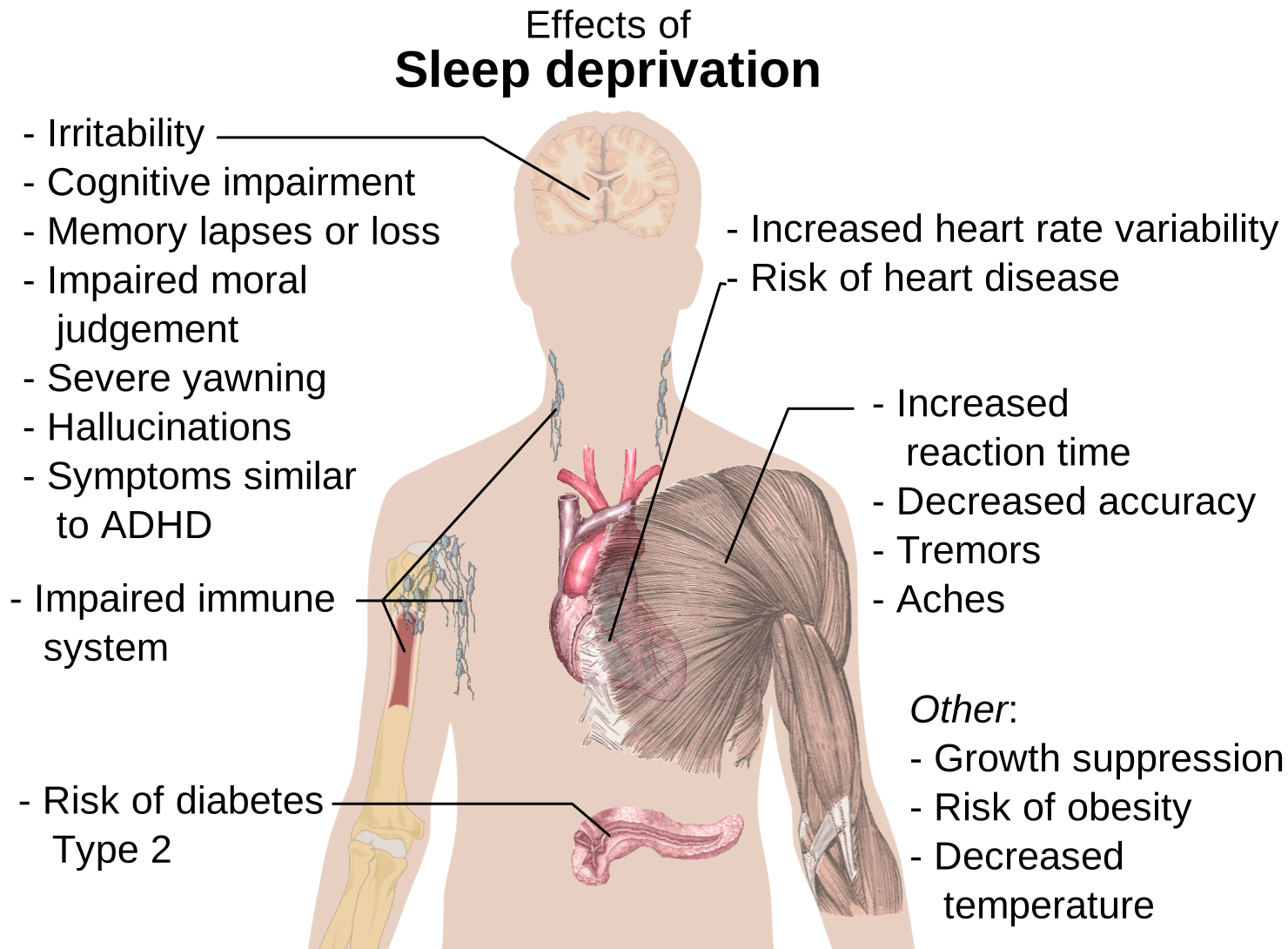
How much sleep do we need? Seven hours? Eight?

This WSJ article makes the case that you can probably get by with less than eight. Given the audience of the Wall Street Journal, I am not surprised they would have such an article.

For more reasonable people, this article in Real Simple (So Now We Only Need 7 Hours of Sleep? Not So Fast) makes more sense.

As I get older I lean towards getting more sleep, but to each their own.

Regardless, the weekend is coming up. Get some sleep.

P.S. The image, from the wikipedia section on sleep, shows the downside of lack of sleep.

Everyone should have a good minestrone soup recipe

And this one from Food52 could be yours. Once you get in the habit of making minestrone, you can really adopt any set of vegetables and beans you have to make the soup you want. Don’t like cabbage? Don’t use it. Out of chickpeas (garbanzo beans)? Use something else. It may not strickly be minestrone if you do, but who cares: it will still be delicious. Needless to say, this is a great way to use up bits and pieces of vegetables in your crisper.


Why Read the Classics? Italo Calvino has the reasons

It’s the weekend. You could use something to read. Instead of going to the latest books — which are no doubt very good — why not consider picking up a classic and reading it. If you are furrowing your brow at the thought, please take a moment and read Calvino’s argument for why you should in this NY Review of Books piece.

One thing that Calvino doesn’t mention is that the classics can be fun. Not all of them, of course, but many of them can be as delightful and engrossing as any book you might find.

Whatever your reasoning to select one, here’s hoping you start reading one this weekend. Enjoy!

(The image contains text from Calvino’s book, “If on a winter’s night a traveler” and it contains the best description of the process of reading. I don’t know if it’s a classic yet, but it will be and is also a great read.)

Teach your kids (and parents…and yourself) how to download software

null

Why? Because they are going to do it regardless of whether or not you teach them, and if you don’t teach them properly, there is a good chance they will download malware or at least the wrong software.

To back up, my son was complaining last night he could not download some software for his computer. He had gone onto Google, entered “download software XYZ” and clicked on the first thing at the top of the page. Now often times the first thing is NOT what you want: it is some company that purchased the right to show up first. I told him to instead look at the URLs that are displayed, and look for the company name in the URL. I told him to be careful about what you click on. (The software he wanted was on the first page of the search results, but about 3 or 4 entries down.)

The safest thing is to always have them talk to you before they download something. Or you email them a safe link instead of them clicking on what shows up in Google.

A return to Twitter (not the service, but the community)

After the frustration with the Twitter service for changes like this, I thought I would give up Twitter. However, Twitter is the sum of a number of parts: there is the service that Twitter provides, from the backend servers to the APIs to the user interfaces and client software you use;  and then there are the people that contribute to Twitter. Among those contributors are people I really enjoy socializing with whom I cannot connect with any other way. To give up all of Twitter means tossing out the baby, the bathwater and even the tub itself. That’s dumb. (I do dumb things often, but typically correct most of them in time. :))

To get around that, I decided to use my limited software skills and the APIs that Twitter provides to write my own Twitter client, in a way. It is a hack, but it is a good hack (for me). I am able to control what I see this way. Not only do I not have promoted tweets, etc., in my feed, but I am able to get rid of things like RTs from everyone, rather than having to turn of RTs one at a time. I’m also able to save all the tweets in a spreadsheet or some other format, so I can look at them when I am less busy, or decide on other filters I want to apply, etc. Later on I can write more filters so if a trending topic gets to be too much, I can just delete it or save it to a different file for later.

Now my Twitter experience is gone from poor to great (for me).  I have thrown out the dirty bath water, but kept the tub and the baby. This makes more sense, obviously.

Last but not least, I appreciate all the people who expressed concern over my leaving Twitter. It was very kind of you, and why I want to stick around, if I can.


Are you traveling? You need to know to look out for tourist scams

Anyone who has travelled, even a little, has likely encountered one of the scams listed here: Tourist Scams I’ve Fallen For (And How to Avoid Them). I know I have run into the Overly Kind Stranger scam, and I have been lucky to avoid some of the others, like the “It’s Closed” scam.

The list in the article are worth reviewing regardless of how often you have travelled. The best way to deal with them is to know about them, expect them, and have a plan to deal with them.

Good luck! Don’t get scammed.


I am giving up on Twitter

I am going to take a sabbatical from twitter. It’s been a long time coming, but now it feels like it is due.

Twitter has always been a weak service filled with great people that made it great despite it’s weakness. That weakness has been there since the Fail Whale days, yet there was something unique about it that made me stick around.

In what appears to be its increasing effort to become less unique and more like Facebook, I am feeling less and less like sticking around. For whatever reason, last night Twitter decided I needed to read more tweets on Ferguson in the U.S.  (This is remarkable, since almost all of the tweets I was reading in my feed and on lists were regarding Ferguson). To accomplish this, it first gave me tweets that people I follow favorited. Then it started giving me tweets of a journalist that someone I know follows. It’s one thing to put sponsored tweets in my feed, but when twitter takes away control of my feed and just fills it with tweets it presumes I want to read, I am done with being a big user of this service.

I used to love Twitter as a service. I loved it and promoted it since the beginning. Recently, though, it has become a poor experience for me. As a service, I now consider it like I consider Facebook or LinkedIn: something I can use to stay in touch with people and share things, but not much more.

I expect I will still share good things with people and actively encourage people who take the time and effort to share good things with me. During this time, I will look at new tools and new platforms to be social and to make the world a better place. (Maybe I’ll write my own.) Perhaps right now someone is working on a new and better Twitter.

Thanks for the follows, favorites,  retweets and replies.

A Mathematician’s Apology by G. H. Hardy is free and online

The great mathematician G.H. Hardy wrote a slim book that is great for mathematicians and non-mathematicians alike. Best of all

As fifty or more years have passed since the death of the author, this book is now in the public domain in the Dominion of
Canada..

So yes, you can get it for free, here.

I highly recommend it. (Did I mention it is a great read for non-mathematicians, too. It really is.)

Thanks to @anitleirfall on twitter for pointing this out.

Bezos’s (naturally) says it’s time to ditch the datacenter for cloud computing

And he and Softlayer (part of IBM) make a good case for it here: Bezos’s law signals it’s time to ditch the data center  in Tech News and Analysis.

This reminds me of a similar article, by Nicholas Carr, that was famous some time ago: Does IT Matter?

In both cases, where IT is a commodity like electricity or running water, getting the lowest cost and most generic (but good quality) version of it should be the goal.

However, IT can also be used as a differentiator. So can a data center. In those cases, company’s should control and manage their IT / data center to give themselves a competitive advantage.

P.S. As always, these views are my own and not necessarily my employers. See the “About” page for more on this.

How to set up Kanboard (a visual task board inspired by Kanban) on the IBM Bluemix platform

It is very easy to set up Kanboard on Bluemix, IBM’s PaaS solution. (For those of you not familiar with Kanboard, it it a visual task board inspired by Kanban). I encourage you to visit the Kanboard site for more information. 
 
Meanwhile, to set up Kanboard in Bluemix, I took the following steps, some which are optional:
 
1) Download the kanboard code from here: http://kanboard.net/downloads
2) Unzip the kanboard folder.
3) (Optional) Copy the kanboard folder into a local test environment. I had a Xampp test environment and I put the kanboard there. (e.g., C:\xampp\htdocs\kanboard). I started Apache and then pointed my browser at http://localhost/kanboard to see it working. (One of the benefits of doing this is I can configure the Kanboard environment before I push it into Bluemix. In my case, I created some new users, changed the admin password, and added some default tasks. If I push this folder, these changes will also show up in Bluemix.)
4) I had a copy of the Cloud Foundary executable (cf.exe) to push the code into Bluemix: I put the cf.exe file in the Kanboard folder.
5) I created a manifest.yml file in the Kanboard folder. In my manifest.yml file I had the following 
 

applications:
– name: <my app name>
  memory: 256M
  instances: 1
  host: <my host name>
  buildpack: https://github.com/zendtech/zend-server-php-buildpack.git
 
You can make the name and host name anything, though the hostname is part of the URL for the site, so it must be acceptible as part of a URL. Also the hostname needs to be unique in Bluemix. I tend to make the app and host name the same.
 
Open a command window, and from the Kanboard folder, enter the following commands:
  1. cf api https://api.ng.bluemix.net
  2. cf login -u <your Bluemix login account>
  3. cf target -o <your Bluemix login account> -s dev
  4. cf push
Once you see that the health and status for the app is “OK”, you can either go to Bluemix to check it out, or go directly to  the url: http://<hostname>.mybluemix.net/
You should be able to login and proceed to use it. (The default userid and password is here).

17 great, short novels for people like me who struggle to finish larger volumes

If like me you want to read better but find yourself struggling to get through massive books that you tend not to finish, this post is for you. Rachel Grate has put together a list of 17 great books that cover a range of old and new, very well known and some less well know. What’s on the list?

  1. ‘The Awakening’ by Kate Chopin
  2. ‘The Hound of the Baskervilles’ by Sir Arthur Conan Doyle
  3. ‘Night’ by Elie Wiesel
  4. ‘Passing’ by Nella Larson
  5. ‘Candide’ by Voltaire
  6. ‘The Member of the Wedding’ by Carson McCullers
  7. ‘Animal Farm’ by George Orwell
  8. ‘Autobiography of Red’ by Anne Carson
  9. ‘Invisible Cities’ by Italo Calvino
  10. ‘The Buddha in the Attic’ by Julie Otsuka
  11. ‘The Old Man and the Sea’ by Ernest Hemingway
  12. ‘The House on Mango Street’ by Sandra Cisneros
  13. ‘The King’ by Donald Barthelme
  14. ‘The Metamorphosis’ by Franz Kafka
  15. ‘Notes from Underground’ by Fyodor Dostoevsky
  16. ‘Who Will Run the Frog Hospital?’ by Lorrie Moore
  17. ‘The Sense of an Ending’ by Julian Barnes

 As you can see, a great range. I highly recommend you go to the post and read why they are recommended. Then head to your local bookstore and grab a handful. 

One of my favourite books is ‘Invisible Cities’: I highly recommend it.

The problem with OKCupid and Facebook and their experiments is one of trust (and why that’s good)

Trust and mistrust is one thing that has not been explicitly mentioned in the many critical pieces about the experiments that Facebook and OKCupid have done with their users, but I think it is a key aspect of this that should be addressed.

When dealing with organizations, there is a degree of trust we put in them. Facebook has been eroding that trust for some time by evading it’s privacy settings. Now we find out that it is actively trying to see how effective it is at affecting people’s mood. It seems OKCupid is basically lying to you to see if it makes a difference.

However you feel about their actions, I think the common response is to trust these organizations less. I make an effort to avoid engaging with Facebook as much as I can. I haven’t used OKCupid, but I used to be interested in their data analysis:  now I no longer trust that analysis and I think it’s just as likely that they make up the data. I suspect others feel the same way,  and that can’t be good for either of them.

Furthermore, I am now distrustful of similar organizations that want to collect data on me. Two apps I downloaded recently, Happier and Unstuck, both looked appealing to me at first. However, after some thought, I stopped using them because I worried that they might misuse that data for their benefit and my detriment. I had no specific reason to believe they would misuse it, but Facebook has bred that mistrust, and that mistrust has spread.

Ultimately that mistrust is bad for organizations trying to build new technology, at least in the short term. However, in the longer term, I think this is a good thing. I think that mistrust and scepticism towards organizations will lead them (at least the smarter ones) to have more respect towards their users if they even want to have any users. Without that mistrust, organizations will continue to abuse their users in any way they seen fit. That abuse has to stop. This mistrust is a step towards stopping it.

P.S. This image…

… is from a great post on how Facebook has eroded privacy settings over time and is worth a look.

First bookstores, now restaurants being driven out of Manhattan

This Village Voice article has a run down of a number of great restaurants being forced to close due to the price of rent in Manhattan. Restaurants are following bookstores,  which are also suffering from the cost of doing business in this part of NYC.

I suspect low margin businesses like this will move to the other parts of NYC and away from the big rent/big money sections. It will be interesting to see the migration both of the businesses and the people. Compared to the way Manhattan used to be in the later part of the 20th century, this is a better problem for them to have.

For more on the bookstores closing, see this piece in the New York Times.

Bon Appetit teams up with IBM’s Watson for some great summer recipes, like these ribs


The story of IBM and Bon Appetit
is really interesting to me, since I love food and I am proud of the work IBM is doing with Watson. Anyone interested in the topic of innovation in IT or food should find it worth a read.

For people who aren’t interested in the high tech aspect of it, check out the recipes. In particular, these ribs with a range of flavours from bourbon to oyster sauce look fantastic.

The Day One app is free right now and it’s great. Here’s nine reasons why I really like it

  1. Reason #1: it’s free. I always like free apps. But there are lots of free apps out there, so….
  2. Reason #2: it’s a great journalling tool. If you are like me, you spend more time capturing things digitally and less putting things on paper. And yet you don’t want to put everything out there for the entire world to see. Day One gives you that. It makes it easy to capture words and images and save them. For people like me who have good intentions of keeping a journal but never do because it is never handy, Day One is perfect. Let’s face it: your phone or tablet is always handy.
  3. It works on alot of different devices. Right now I have it on my iPad and iPhone. It also works on the Mac, too. Regardless of what device you have, you can update your Day One journal and it syncs up with the other devices.
  4. How does it sync up? Via the cloud, of course. Even better, it will also back things up to cloud storage, like Dropbox. I particularly like the Dropbox integration. All the photos you capture in Day One are there, as well as the text. And the nice thing for geeks like me is that the text is in XML format, so there are opportunities to hack around with that. You don’t have to touch it at all if you want, but that is a nice option. Even if you aren’t a geek, here are more reasons to get it…
  5. You can go back to previous days via a Calendar and update them. That way if you get busy but want to keep a comprehensive journal, you can. Or if you want to find out what you entered for a certain day, you can.
  6. You can use tags to get more out of your journal. For example, if you wanted to keep a fitness journal and a cooking journal, tag some of your entries fitness and others cooking and then you can access just those entries by the tag
  7. You can add your location and the current temperature to a post, too. Perfect if you were using Day One as a travel journal.
  8. It has password protection as well: so if you are sharing your device with your kids or others, you can prevent them from looking at your journal.
  9. Did I mention it is free? Yep, it is at the time I am posting it. But if you ever buy just one paper journal for travelling, work, or fitness…if you replace it with Day One, it will more than pay for the app.

Day One is free for a limited time right now. You can click here to see it in the App Store.

Want to know what your IP address is? Try this

Depending where you are, you may have any number of IP addresses: one for your home network, one for your work network, and even one from the coffee shop providing free WiFi. Since it is not uncommon to have sites block you based on your IP address, it is good to be able to determine what yours is.

The site WhatIP.com does just that. It will tell you what country, ISP, and city it thinks you are in, along with your IP address.