Cleaning is part of a cycle. Complete the cycle (though cycles are never done)

I have come across the idea of completing the cycle when it comes to cleaning and it has made a difference in how I perceive cleaning.

I hate cleaning, but a contributor to that was I didn’t complete the cycle. If I was making a meal, I’d start the cycle by getting out the ingredients, then cook them, then eat them. The end of that cycle is putting the ingredients away and doing the dishes. But I didn’t commit to that, which meant the dishes would pile up. The same was true of other activities: I would stop at the satisfying part of activity (e.g. eating).

Once I committed to completing the cycle, things improved. I recognized that doing any activity meant I had to clean up at the end. Cleaning wasn’t a separate activity: it was part of the overall cycle of the activity.

I thought of this again when I read this piece in VOX on the vicious cycle of never-ending laundry. In it they are so close to getting it. It’s true, laundry is a cycle. They seem to think of it as something you can complete. You can never complete doing laundry, any more than you can complete cleaning your bathroom or complete eating. They are all cycles. The best you can do is complete a cycle of whatever you are doing.

Think of laundry as part of a bigger cycle of caring for your clothes, which is an extension of caring for yourself. There are any number of things you do to care of yourself during the week, from getting good sleep to exercising to…well, washing drying and putting away your clothes. Laundry is all part of that cycle you do every day and week to take care of yourself. It’s part of completing that cycle. Don’t think of it as a separate activity. (Unless you actually love doing laundry. :))

Completing the cycle: a smarter way to clean up and stay clean.

P.S. For more on the “Complete the Cycle” Cleaning Method, read this.

I also thought that this piece in the New York Times has some good advice on  how to clean was good.

Finally, if it is all too much, the Washington Post has an article on how to fake clean your house. Hey, whatever works.

If you are having a difficult time, you need to listen to Michael Caine

If you are struggling with difficulties in life, then you need to listen to what Michael Caine has to say on this. He recalls once when he was acting on stage…

“I opened the door, and I said to the producer who was sitting out in the stalls, ‘Well look, I can’t get in. There’s a chair in my way.’

He said, ‘Well, use the difficulty.’

So I said, ‘What do you mean, use the difficulty?’

He said, ‘Well, if it’s a drama, pick it up and smash it. If it’s a comedy, fall over it.’

This was a line for me for life: Always use the difficulty.”

I think that is great. He followed up by saying, if possible avoid the difficulty! 🙂

You can hear him talk about it, and more,  here.

Remember: USE the difficulty.

On bullshit jobs and how to overcome them

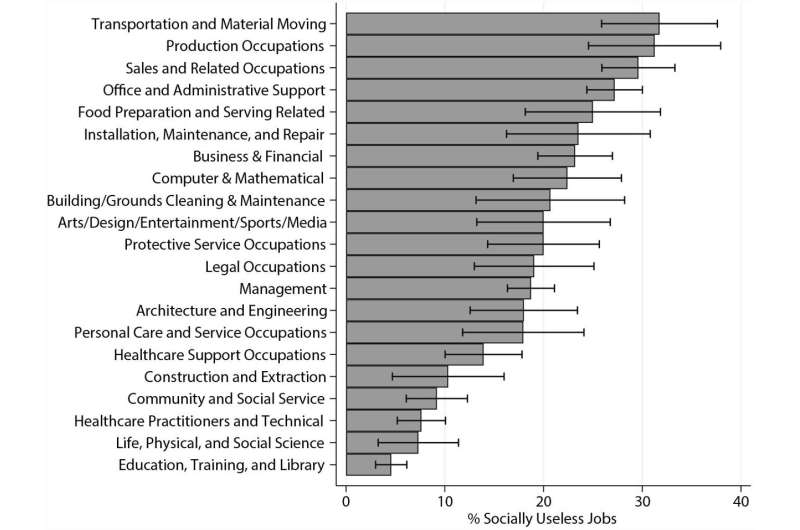
Do you feel like your job is socially useless? If so, you may have a bullshit job. As this piece shows, many people feel they work in pointless, meaningless jobs.  Just look at the graph above, taken from the article. People in all sorts of occupations feel like their job is a waste of time. People in office jobs especially so.

What I would like to focus on is the jobs at the bottom of that chart. Many of those jobs center around helping others, be it trainers, librarians, healthcare practitioners, and social service workers. There are also jobs where people make things, be it in construction or engineering and architecture. When you are making something like a building or a road, you know you are doing something useful. Likewise, you know what you are doing is useful if you are helping to educate someone or helping them get healthier. I suspect that is why people in those professions they don’t find their jobs useless.

If you have a job that you feel is useless, see if there are aspects of it that are helpful to someone. Or try and find activities where you make something that others can take and do something with. Or do both. It might feel like you currently don’t do any such things, but if you track what you do in a week or a month, you may find you were doing those things and you just weren’t aware of it.

You can also try and insert more of those activities into your job. Share the things you know with your coworkers. Mentor new people on the job. Create material that others can use to make their own job easier, even if it’s simply a spreadsheet or a Powerpoint template. Look for ways to be useful to others on your job. You may find yourself enjoying your job more in the process of being useful.

Good luck!


On there being two types of freedom

There are two ways to be free:

  1. to be in a higher state of being
  2. to be in a different state of being

The first way of being free requires a continual effort to remain that way. If you do not expend this effort, you will slip back down and no longer be free.

When political people say “eternal vigilance is the price of liberty”, they are talking about this type of freedom. It’s also true for people that get into shape, or quit a bad habit, or make improvements in other aspects of their life. Indeed, any type of freedom that has to battle decay and entropy is a type of freedom that needs continual effort.

The second way of being free does not require continual effort. When you graduate from school, quit a job, end a relationship, or move away from someplace, you become free of those things. You have transitioned to a different state of being.

You might argue that some people have to work hard to not go back to that old job, that old relationship, or that old home town. I’d counter that even if one does, they are a different person than when they left and what they return to has changed too Additionally I think most people do not go back. People move on. They move away.

It is easy to get discouraged if you think all forms of freedom require continual effort. Many do, but many do not. Sometimes you just need to push to get to the other side to be free, and once you do, you are free once and for all.

P.S. For more on this, see: It takes a daily effort to be free by Austin Kleon. His piece got me thinking along these lines.

P.S.S. If you think of life as being cyclical, you are likely to see freedom as being something you constantly have to work with. If you see life as linear, you are likely to see it as something you can achieve once and be done.

What actually is worth buying at Dollarama? Here’s my two cents.

That’s a good question. I thought about it when I came across this: what’s actually worth buying at Dollarama? Here’s my 2 cents (2 dollars?):

  • Much of the kitchen stuff is acceptable.
  • Cleaning supplies are fine.
  • Gift wrap and such are good.
  • Paper and school supplies are good to very good.
  • Frames are limited but not bad.
  • Candles and such are fine.
  • The tools are so-so. Like the kitchen stuff, it will do in a pinch.
  • Books are rarely good in my opinion.
  • Clothes are not so great.
  • The food is ok. Obviously not a great selection of nutritious food.
  • The computer accessories (e.g. cables) will do.
  • The lighting can be a disaster. I stopped buying it after two bulbs I put in my kid’s rooms blew up.

Other thoughts: some time the items in Dollarama aren’t cheaper, just smaller. That said, it can be cheaper than going to Canadian Tire or IKEA, but ymmv.

Dollaramas are everywhere, it seems. Make the most of them.

You should set up two-factor authentication (2FA) on Instagram. And you should use an authenticator app

You might think: no one is going to hack my Instagram account. And you might be right. But here’s the thing: if someone does hack your account, you have next to no chance of getting someone at Instagram to restore it. Rather than make it easy for hackers to take over your account, spam your friends and delete years of photos, you should use 2FA. To do so, read this article: How to Turn on Two-Factor Authentication on Instagram.

While you can use SMS, I recommend using an authenticator app. That article explains how you can do it either way. Authenticator apps are more secure than SMS and are the way to go these days. For more on that, see PCMag.

IBM Cloud tip: use Multifactor authentication (MFA) also called 2-Factor Authentication (2FA) with your account

If you are using IBM Cloud technology, I recommend you consider setting up MFA for your login account. MFA makes your access more secure, and it’s easy to do. To see how easy it is, go here: IBMid – Verifying your identity and configuring MFA. It’s a well laid out description about how to do it.

You can use either a verification app or email to get a verification code. I recommend an app. While email works, it can take several minutes to get the code, while with an app you get a code instantly. As for apps, I use IBM’s verify app, but you can use Google’s and likely Microsoft’s.  They all work fine. Just go to your favorite app store and download one. (Make sure it comes from IBM or Google or Microsoft, not from some developer with a lookalike app.)


If you use two/multifactor authentication, make sure you have a backup

Multi-Factor authentication is great. There is only one downside: you lose your phone. The way to deal with that is to have a backup. To set that up, either read this if you use Microsoft’s authenticator: Back up and recover account credentials in the Authenticator app from Microsoft Support or this if you use something else for authentication: Make Sure You Have a Backup for Two-Factor Authentication.


A checklist keeps you grounded and up to date. Do you have one?

If you are like me, you create some form of todo list to structure your work day. But do you also have a checklist?

The first thing I put on my to do list every day is: do my checklist. By doing that, I make sure I don’t forget to do the key things that need to be done every day. This is especially important  when I am overwhelmed with new things. Those few minutes of doing my checklist keeps things on track and prevents work from getting even worse.

The checklist also keeps me grounded. If I am not sure what to do next, I do my checklist. At least I know that is under control and I did the basics.

As for what to put on your checklist, I recommend you put the most important things on top. It often very basic things, like:

  • Review your email and list things to do
  • Review Slack/teams/etc. to see if you have to respond to people
  • etc.

Mostly the actions are: check on X and plan to take action or update Y. 

Don’t forget to put down things that aren’t necessary work things but things that make you more productive. So add things like drink water or take a 5 minute walk or check in on a loved one can help you be at your best every day. Heck if you find yourself missing lunch too often, then add take a lunch break.

So yes, having a todo list is important. But so is a checklist. Get one started. Mine is in an Excel spreadsheet, but use what works best for you.

For more on the importance of checklists, read these things I’ve written on them:


How cooking and other things can achieve mindfulness benefits


While mindfulness exercises can bring many benefits, benefits you might want, not everyone is cut out to do them. Even people who like them sometimes struggle with mindfulness exercises.

The good news is that other activities can bring similar benefits. This piece argues you should try cooking if you want the benefits of mindfulness. Now some people hate cooking, but read that piece and see if cooking could help you with the sort of thing mindfulness does.

Besides cooking, some people find cleaning helps them clear their brain. I used to find doing woodwork would do it for me. Maybe exercise is the thing that could replace mindfulness for you. Or yoga. Or bowling. Who knows? It all depends on the individual.

If mindfulness activity is working for you, that’s great. If not, don’t despair. There’s many ways to achieve the same benefits. Find the one best for you.

Beware the cost of self help apps


As someone who believes in self help, I have been caught off guard with the cost of self help apps. You can see a listing of some of them at this site, Product Hunt, where they have a list of the 15 best gratitude apps for positive thinking in 2023 and which they go on to describe:

We all need time out to focus on our wellbeing. Gratitude apps are designed to help users focus on their mental health, offering a wealth of features that can help track our thoughts and feelings.

While many of these act like self-care apps in that they offer a private space in which to reflect through journaling or mood check-in features, they can also act like a photobook of memories allowing media to be uploaded or even shared to our nearest and dearest.

Not to mention, some utilize community features so you can access global support, or even just talk to a mental health professional. I tested 11 gratitude apps that focus on all these areas to discover the very best.

While this is all very well, and while many of the apps are free to download and get started, once you get going they could cost you $20, $30, $50 or over $100 a year to continue to use. If you get value from them, it may be worth it. Just be aware of how much they could cost you over months or even years.

Some thoughts on using an accomplishment journal at work

Over at LifeHacker they recommend how to stay motivated at work by using an accomplishment journal. It might sound fancy, but a journal is simply a place for writing down what you accomplish in your work day. The accomplishments don’t have to be major ones: some days just getting a handle on your inbox or dealing with a difficult meeting can be an worth journaling.

Accomplishment journals are not new. Athletes have been using something similar for years. No one is better than athetes at setting goals, planning activities, and logging what they’ve been up to. So take your lead from them and start your own.

This doesn’t have to be solely for work. You can have journals for home improvement projects or personal improvement projects.

By the way, another benefit of an accomplishment journal? It can help you later when you have performance reviews and it can help you when you want to update your resume. Just go to the journal and you have all the material you need to proceed.

Good luck!

On the benefits of diaries, journals and notebooks


We’ve all have or had diaries and journals at some point. Sometimes they’re just a few abandoned pages: other times they are volumes of notes and information. If you are like me, you are in the former group, even though I’d like to be in the latter (no doubt smaller) group.

One person I know who is the group I am not is Austin Kleon. He has written extensively about them, and he creates several of them throughout a year (the photo above is of his collection). If you read him, you see he has a number of reasons to write them: to help him pay attention to his life, to give him something to write about later, and more.

Now if you are someone special like Paul Klee, then maybe someone will put them all online for others to study them (see here). Or if you are living in historic times, like the composers of these thousands of desperate vivid diaries from occupied europe, then historians may gather them and hold them in a special place like the NIOD Institute for War, Holocaust and Genocide Studies in Amsterdam. (That might happen to anything you write, especially if you kept one during the pandemic. Decades from now people will be curious to know what life was like during lockdowns.)

Regardless of what happens to your diaries, it is beneficial to record your life, as I argued here. The only beneficiary later may only be you, but that’s enough. If anyone else benefits from it, that’s a bonus.


Reliability is a key quality in a better life. You need more of it.


Last week I had a really good work day and when it was done, I was satisfied and happy with how it went. The key to everything going well that day hinged on one thing: reliability. During that day:

  • I could rely on myself to get the work done because I had done it before and knew what it took to do it in terms of time and other resources
  • The resources I needed to work with were also reliable: nothing was breaking down or old or flaky. I had time. I could focus on the task at hand.
  • I could also focus because my work environment was also reliable. I had no interruptions. I had no need to make changes to my work area or the area around me. I had the supplies and access I needed.
  • Additionally the people I was working with were reliable. If I needed anything, I could ask them for help and they would provide it.

If you are struggling to have productive days like that, ask yourself: is a lack of reliability contributing to the problem? If so, make it part of your solution to increase the thing you lack ASAP. And it’s not just a matter of being productive: being able to rely on the people and things and events in your life leads to be a better life generally. So dump those people you can’t depend upon. Trash those broken down tools you use. Find a better environment you can be certain of. Reliability and quality go hand and hand. Get more of both in your life. You’ll end up being more reliable for others as a result. The benefits ripple outwards.

Cleaning is a form of care, both for other things and for you

There are many ways to think of cleaning. You can think of it as a chore, a burden, or a responsibility. Most of the ways I think about cleaning are negative.

So I was happy to read and reread this: Cleaning as Self-Care from the site zen habits. It focus on how cleaning can be a form of self-care. By “cleaning, organizing, declutttering” what is around you, you are taking care of your life. Of yourself. The act of cleaning is the act of caring.

The act of caring does not stop with you. What you clean shows what you care for. By washing your favorite clothes, by decluttering your closets, or by organizing your desk, you are showing that you care about those things. Likewise for things you do not clean.

The next time you are cleaning, notice how you feel while cleaning something you love and then notice how you feel when you have to clean something you are indifferent too or dislike. Considering getting rid of the things you have negative feelings towards cleaning. And if you can’t get rid of them, perhaps you can work on changing something so you do care for them and you do have positive feelings about cleaning them.

Cleaning requires effort, and effort can lead to you feeling badly. Changing your perspective on it can result in you feel positive and caring. Give it a try.

Some thoughts on being sufficient

It’s an easy thing to make yourself feel insufficient: simply pick a task that is beyond your reach. It can be a nearly impossible physical task, like running a long distance. Or a mental task, like memorizing a long work of fiction. Or it can be a social task, like having plenty of fans and friends. Regardless, it can be something you can be guaranteed to fall short of achieving in the attempt.

(You might exclaim: who’d do something like that to themselves? But people do something similar to that all the time.)

The hard thing is to make yourself feel sufficient. To look past your failings and limits and judge yourself worthy. It requires knowing yourself. Knowing what is required of you. Knowing that even if you can’t do everything or even many things, you still can do some things, and that those things are enough. Those things are sufficient. Just like you are sufficient.

Are all self help books the same?

I am a fan of self help books. I’ve even written a defense of them. So I was interested to read this, which says that every self-help book ever comes down to these rules:

1. Take one small step.
2. Change your mental maps.
3. Struggle is good. Scary is good.
4. Instant judgment is bad.
5. Remember the end of your life.
6. Be playful.
7. Be useful to others.
8. Perfectionism = procrastination
9. Sleep, exercise, eat, chill out. Repeat.
10. Write it all down.
11. You can’t get it all from reading.

I don’t agree. It’s true, you will find many of these rules in popular self-help books. But the best self-help books give you insights and ideas you won’t find elsewhere.

So yeah, if you pick up the latest self help book, some form of those 11 rules may be all that you get. But take some time and do some research and you’ll find some guides that can really help you with whatever you are dealing with.

Don’t give up. Get the help you need. Even if its self help.

Art direction! Art inspiration! And other art links


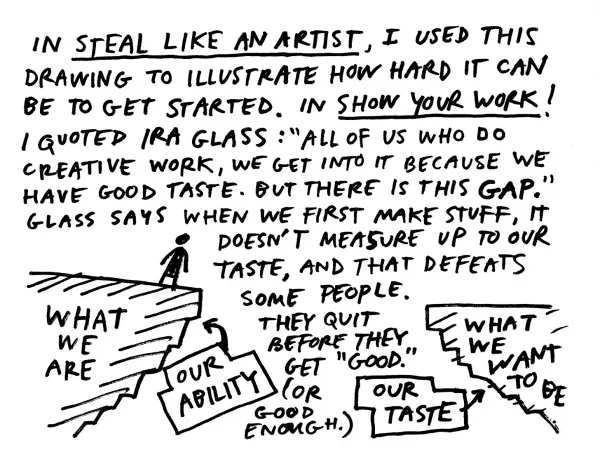
Austin Kleon explains how you can find energy in the gap pictured above. I like the idea of using the gap for your benefit.

I’ve been interested in drawing with ink lately, so here’s some good links on how to ink a drawing and how to make pen and ink drawings here. Two good videos on drawing with ink are here:  Draw with ink and Also draw with ink.

This may be  one of the best guides I have ever come across regarding thumbnail sketching from an instructor at RISD.

I’m a big fan of the artist who draws the Metropolitan Diary drawings, so I enjoyed this piece on what the Metropolitan Diary taught its illustrator about New York.

Here’s a clip I saved of  Peter Falk from Wings of Desire when he talks about the and the happiness with the simple things in life, like drawing. Speaking of Falk, here’s a story on his own art work, here.

I’ve always been inspired by Jim Jarmusch’s Collages and wished I did more. So I was happy when I found this piece on collage art ideas. Really good stuff.

I have always found these Scribbled Portraits of Brooding Figures by Adam Riches inspiring. It reminds me of some of the great drawings my brother Ed used to do.

More links: If you want to take up drawing cartoons; if you want to learn how to Draw a Self-Portrait; if you need more advice on how to draw, How to Draw in Six Steps;  here’s a quick beginner’s guide to drawing.

Finally, here’s some good things to consider:

Advice for all you frustrated artists out there (including me)


Sometimes you can get so hung up about making art you don’t make anything at all. This could be due to several reasons. For example, if you are worried about your style, read this. If you are frozen because you wonder if you are you good enough to be an artist, go here. You can also read this: how to boldly pursue your artistic calling even if youre riddled with self doubt. If you wonder if your art is good enough to sell, click this. For an example, see how this artist  sells art on etsy.

If you think you are no good, get over yourself and read:  7 sins of beginner artists what keeps you from being good and 21 days to be a better artist. If you think you have no skill, head over to this: create art without skill and this: you can draw and probably better than i can. If you think you need to go to art school, read: don’t go to art school. If you think you are too old: why it’s never too late to become an artist. If you need some prompts, go here: Some good prompts from Inktober.

If nothing else, make yourself a zine. Here’s advice on making a zine, on how to fold a zine, and how to make a one page zine. Here’s some zine advice and more zine goodness is there.


How to find your purpose in life

The folks at Vox have a good guide on how to find your purpose in life. According to them, your purpose…

  • is a long-term calling, act, or way of life that interests you
  • something you have some competence in
  • makes a marginal difference in the world

For some people, their purpose is obvious. Their work is their purpose. Or their role as a parent or sibling gives them purpose. Some gain purpose from acts of kindness. Others get it from creative tasks.

If you want some guidance on discovering your purpose, I recommend this: What do I do with my life? Here’s a non-stressful approach to finding your purpose. – Vox

A good reminder for the start of the weekend

I found this image on Instagram some time ago and I kept a digital clipping of it to remind me to make stuff even if the only person that cares about it is me. I would advise you to do the same. Sometimes I imagine an audience that does like whatever I make, but I am fine to make it just for me. Kids are like that, and they’re happier as a result. We should be more like kids, like the kid we once were. Make things and be happy with the making of it. Even if you immediately toss it aside. For making stuff can do wonders for us.

Happy Friday. Make something this weekend: a poem, a salad, a chalk drawing, a record of some sort. You’ll be better because of it.

How I am playing Wordle these days using Wordlebot as a guide and an opponent :)

If you like playing Wordle, then you should make a guide and an opponent of Wordlebot. I check it every time I finish Wordle.

Using Wordlebot as a guide, I noted which words it used first and second. Based on my notes it seems to always use SLATE as the first word. Of the second word I noticed it uses, CRONY is a common choice. That makes sense: those two words give you AEO and Y as well as CNRST. I find I can get a lot of matches this way. And if I don’t, I know the third word has an O or a U, and the remaining letters are easier to choose from.

Often I will play SLATE and then play CRONY even if I have matches with SLATE. My goal these days is to get it in three. I will only go for it in 2 if there is a good chance I can. (Like one day this month when the word was PLATE.) Currently the majority of my scores are 4: my goal is get the majority to 3. I am not sure that is possible, but it is what I’m aiming for.

While Wordlebot is a good guide, I also use it as an opponent. My hope here is to win by getting the word in less tries than Wordlebot. It does not happen too often. My next best hope is to tie Wordlebot but get a lower luck score. If we tie in tries but it has a high luck score, I also consider that a win.

One reason it is hard to beat Wordlebot is due to the eliminate process it uses. While the first word it uses tends to be SLATE, if it gets matches, it may play a word that comes from out of the blue but it is not. Wordlebot seems to calculate what possible words could solve the puzzle and then play a word to help eliminate them. If I had the ability to do the same, I would! Most of the time I do something less mentally taxing.

Wordle is a fun game, still. I especially love that people still post their scores on twitter. I consider it watercooler material. (“How’dya do on Wordle last night, Bob?” “Got it in 3” “Whoa, nice. Ok, have a good day” :)) Like Wordle, I don’t take Twitter too seriously either. The two go good together, like chocolate and peanut butter.

For more thoughts on the game, take a peek at this: Wordle is fun again. Here’s why that is for me…. | Smart People I Know


How to get better sleep using your Apple Watch and the Health app

I wear my Apple Watch every night while I sleep, and I have found it’s been helping me sleep better.

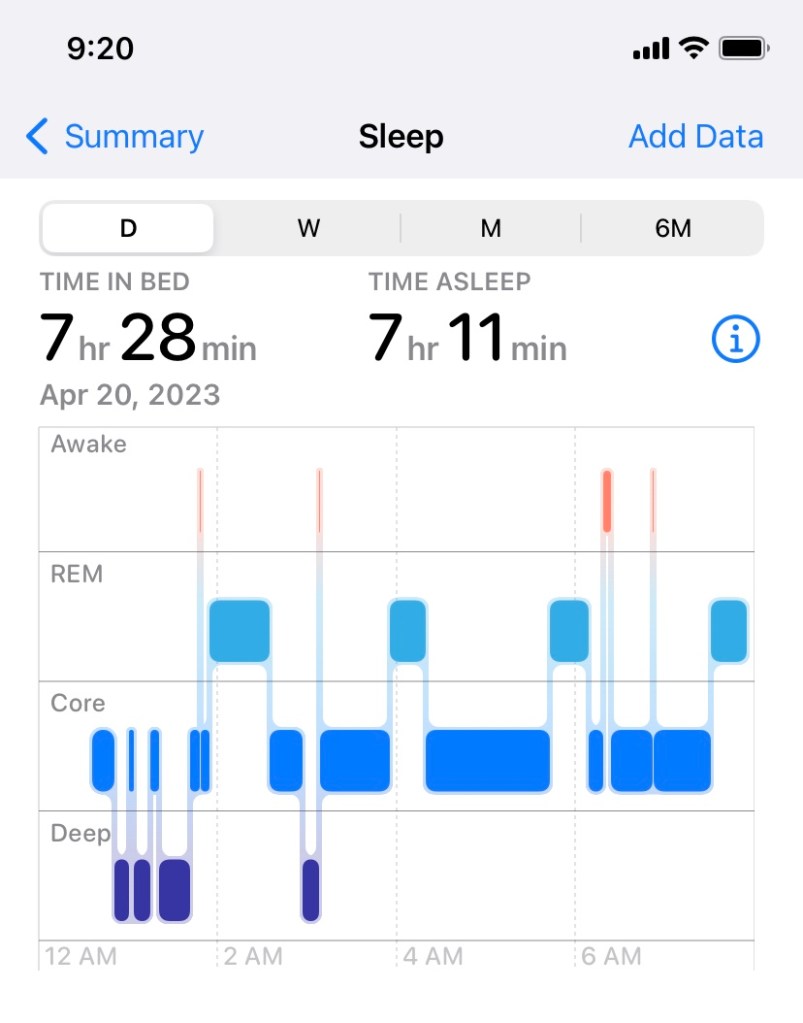
My watch sends a ton of information to my phone during the day, including information about how I am sleeping. When I wake in the morning, I head over to the Sleep summary in the Health app on my iPhone and check how I did that night. Here’s an example:

You can see this was a pretty good night for me. I slept for 7 hours, and I managed to get in a fairly decent amount (for me) of deep sleep. I don’t know if this is typical for most people, but it is for me. I have a number of deep sleep periods, about 4 periods of REM sleep, and the rest is core sleep. You can see I woke up twice, but barely for any time at all. I also found I was refreshed and alert the next morning. 

That wasn’t typical though. If you look below, you see my sleep for the week:

There’s quite a number of days where I was awake for large periods of time. Every day I would wake up and see that and think: what can I do to fix that? Some days it would be something simple, like the room was too warm. Or I ate too late. Other days it is due to more difficult things like too much stress. (Stressful days tend to cause other issues, like eating badly, which compounds the problem.) 

Before I had this data, I would let myself sleep badly for a long stretch of time. Now when I start seeing I am not getting enough sleep, I work hard to get the right conditions to get a better sleep the next night.

There are plenty of things you can do to maintain good health: eat well, exercise, and sleep well. The Apple Watch can help with all of those things. If you can get one with these features, I highly recommend it.

P.S. Why is deep sleep important? It could be the time your brain gets cleaned. To see what I mean, go here.

On the snowdrops in the yards of others

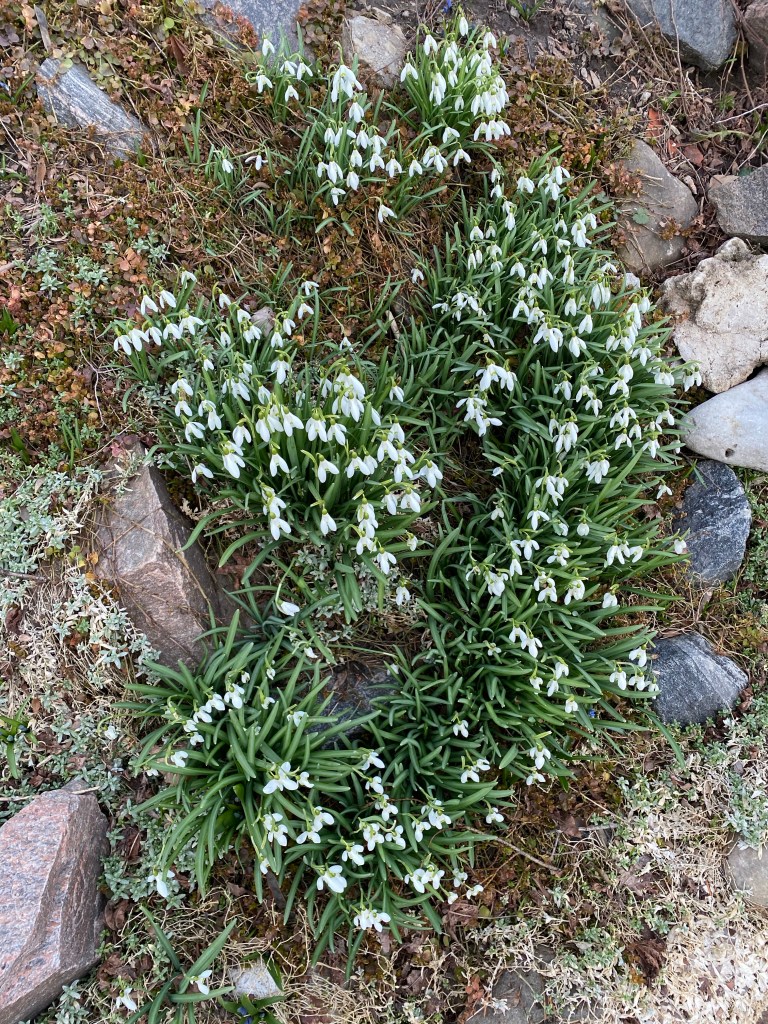
Someone on my street was kind enough to plant snowdrops in their front yard. Last week they were bursting from the ground and giving me the hope I always feel when I see them. Seeing snowdrops, I know winter is over: seeing snowdrops I know spring is starting. I love the significance of this small white flower. They’re a beautiful reminder.

If you are ever wondering about planting flowers in your front yard, I encourage you to do so. I am sure I am not the only one who walks by such beauties and feels joy. You will be giving a gift to the world with whatever you plant. How great is that?

How to travel in style and do it lightly

If you want to travel in style, then you owe it to yourself to read this: Dining in Style, at 90 Miles an Hour: Train travel is thriving in Central Europe, and so are dining cars. We rode the rails from Prague to Zurich and beyond, sampling regional dishes and savoring the views. It will have you looking up seats for the next trip.

If you want to travel lightly, read this: I Lived Out Of A Carry-On For 6 Weeks & Found My Personal Style Along The Way. You may not want to live out of a carry-on for 2 weeks, never mind 6, but the writer did and did well.


Thursday is a good day to be productive. A playlist can help

Thursday is a great day to be productive: you just got over hump day (i.e., Wednesday) and if you can get a lot done today, you can feel more relaxed as you head into Friday and then the weekend.

If you have your own playlists, I recommend you put them on. If you do not, that head over to domino.com and read this: A Good WFH Playlist Is the Difference Between a Slow Day and a Productive One. They have a number of lists from various people: one of them is bound to help put you in a mood to GTD (get things done) as you WFH (work from home).

Happy Thursday!

So you want to stop shopping at Loblaw and you need an alternative but you are stuck. Here’s what you can do

Maybe you’ve read articles like this, Loblaw gave ‘underpaid’ CEO Galen Weston a $1.2 million raise last year, and thought: I ought to switch from buying my groceries from Loblaw and go somewhere else.  But what to do?

If that’s you, consider this. If there is a Walmart near you that sells groceries, go to the Walmart. And if there is not a Walmart near you but there is one on Instacart, then sign up for Instacart and buy your groceries that way.

I have been shopping at Walmart via Instacart for well over a year now and during this time I have been very satisfied with the goods I’ve received from them. The produce is excellent, the meat is excellent, the commodity goods are fine, and both high end and low cost items (“Great Value” vs “No Name”) are good. Most importantly for me, the savings are substantial. It never ceases to amaze me how the exact same product can be $0.50-$5.00 less at Walmart than Loblaw or Metro. Other than price, there is no difference in terms of what you get. You are essentially paying a Loblaw tax (or Metro tax) for buying from them.

I understand why people like shopping at Loblaw: the stores are pleasant, they have great selection, and their President’s Choice brand is still a treat. But you are paying a high premium for that.

Should you switch to Metro or Farm Boy or some other place? Not if you want to save money. What about No Name from Loblaw? Well, I checked it out, and many of the No Name products are still more expensive than every day Walmart products.

For more on this, see this article I wrote earlier this year. It has details on how the savings from Walmart add up.

If you want to keep shopping at Loblaw, it’s up to you. But if you do want to switch, you can.


The Gartner Hype Cycle: one good way to think about technological hype

Below is the Gartner hype cycle curve with it’s famous five phases:

For those not familiar with it, the chart below breaks it down further and helps you see it in action. Let’s examine that.

Chances are if you are not working with emerging IT and you start hearing about a hyped technology (e.g., categories like blockchain, AI), it is in the phase: Peak of Inflated Expectations. At that stage the technology starts going from discussions in places like Silicon Valley to write ups in the New York Times.  It’s also in that phase two other things happen: “Activity beyond early adopters” and “Negative press begins”.

That’s where AI — specifically generative AI — is: lots of write ups have occurred, people are playing around with it, and now the negative press occurs.

After that phase technologies like AI start to slide down into my favorite phase of the curve: the Trough of Disillusionment. It’s the place where technology goes to die. It’s the place where technology tries to cross the chasm and fails.

See that gap on Technology Adoption Lifecycle curve? If technology can get past  that gap (“The Chasm”) and get adopted by more and more people, then it will move on through the Gartner hype curve, up the Slope of Enlightenment and onto the Plateau of Productivity. As that happens, there is less talking and more doing when it comes to the tech.

That said, my belief is that most technology dies in the Trough. Most technology does not and cannot cross the chasm. Case in point, blockchain. Look at the hype curve for blockchain in 2019:
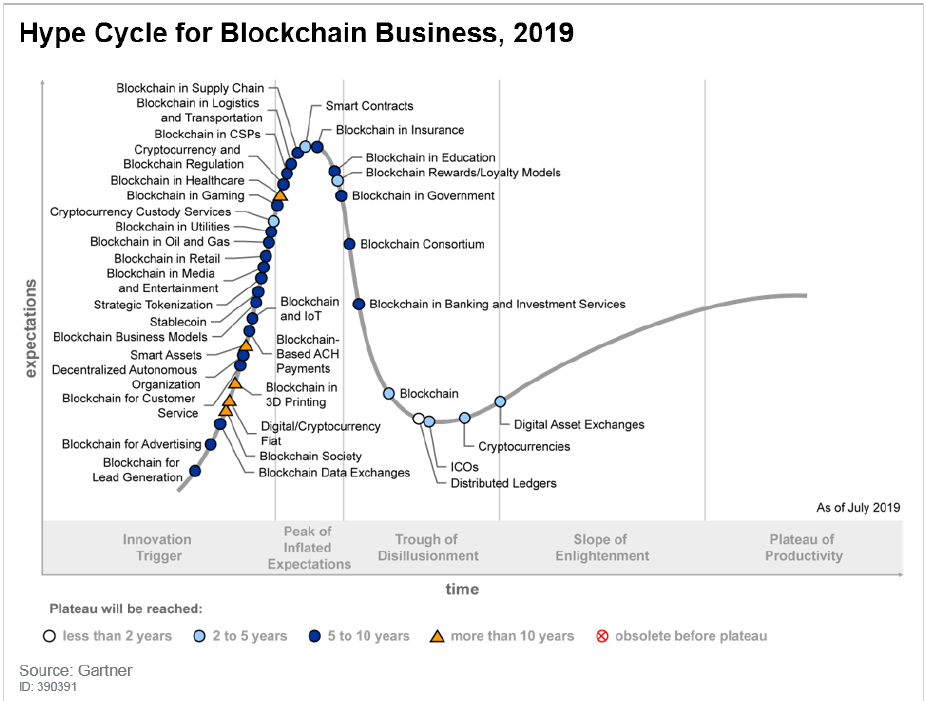
At the time people were imagining blockchain everywhere: in gaming, in government, in supply chain…you name it. Now some of that has moved on to the end of the hype cycle, but most of it is going to die in the Trough.

The Gartner Hype Curve is a useful way to assess technology that is being talked about, as is the Technology Adoption Curve. Another good way of thinking about hype can be found in this piece I wrote here. In that piece I show there are five levels of hype: Marketing Claims, Exaggerated Returns, Utopian Futures, Magical Thinking, and Othering. For companies like Microsoft talking about AI, the hype levels are at the level of Exaggerated Returns. For people writing think pieces on AI, the hype levels go from Utopian Futures to Othering.

In the end, however you assess it, its all just Hype. When a technology comes out, assess it for yourself as best as you can. Take anything being said and assign it a level of hype from 1-5. If you are trying to figure out if something will eventually be adopted, use the curves above.

Good luck!

A handy guide to spotting AI generated images

Well, two handy guides. One from the Verge and one from the Washington Post. The Verge talks about the phenomenon in general, while the Post is more specific.

It’s possible that the AI software that generates imagery will get better. But for now, those guides are helpful in spotting fakes.

(Image from the Verge. It is highlighting things to look for: weird hands, illegibility, odd shadows.)

Who knows how to clean an oven? Southerners do


Let me back that up: the Southerners of Southern Living do. They have oven cleaning tips here and here and specific tips on how to clean your oven door, here and how to clean oven racks, here.

Cleaning ovens may be a regular activity for some of you. Bless your heart. For the rest of us, it’s a good thing to do during spring cleaning. If you are like me and haven’t a clue how to start, check those articles out.

P.S. Southern Living has lots of advice on cleaning and more. Recommended.

(Image via a link to Southern Living.)

How to improve yourself this weekend

For some, the weekend is either a time of relaxing or a time of catching up.  I think that it can always be a time to improve yourself in some way. Here’s some ideas for you:

Get a hobby: Here’s a good piece on how to start a hobby. Perhaps drawing could be that hobby. Here’s how to get over yourself and start drawing. And if even if you don’t think you are very good, remember:  drawing can also be good for your mental mental health.

Improve your plant game: Plants make me and others happy. If you feel the same, maybe take some time this weekend and upgrade your plants: here’s when its time to repot indoor plants.

Get fitter: start with this piece, two simple ways to get fitter faster. If you need exercise routines, try these, fitness routines from Darebee. Or use this: strength training. Some people do better with devices to help them. If that’s you, then use this device to improve your fitness.

Like drawing, fitness can help you in many ways. For example, read this: How To Reframe Your Relationship With Exercise. And don’t forget, fitness is more than exercise. It is also about eating well. Here how you can eat  better:  4 easy strategies for adding more vegetables to your plate.

Get fashionable: sometimes new clothes can help you get out there. If that’s you, I recommend these new balance 574h hiking sneakers, the new balance 997h ice blue sneakers, this intro ponto footwear. Maybe even  jordan system23 clogs .

Finally, here’s a guide to  stop ruminating, if that’s something you do.

Regardless of what you decide to do, I hope your weekend is a good one.

On Lent, Sacrifice, and Giving Things Up


Atheists and agnostics like myself sometimes find themselves longing for or at least missing elements of the religious life. (Alain de Botton explored this in his book, Religion for Atheists.) One of these are periods of reflection and sacrifice, like Lent. Some people support something like a secular Lent, while others argue that “secular Lent” misses the point, and that:

Lent, fundamentally, is about facing the hardest elements of human existence — suffering, mortality, death. That the season has turned into giving up Twitter shows that we haven’t gotten good at talking about them yet.

Agreed. But that doesn’t mean you can’t benefit from making personal sacrifices for a period of time in order to see yourself and your place in the world in a new and different way. A period of chosen sacrifice can be a spiritual practice no matter what you believe. And choosing to do it at this time of year may be the best time to do it.

If you agree and you want help with quitting something, this can help. If you want to know more about Lent, this can help. If you are not religious but this appeals to you, consider reading de Botton’s book.

Good luck with whatever you decide to do.

Crime stopper tips if you are buying goods from Kijiji or Facebook Marketplace


Chances are if you buy goods from Kijiji or Facebook Marketplace you will be fine. Most stories I know of have been positive. Still, you are taking a risk buying or selling goods to strangers. To reduce the risks, read this: Toronto police warn of thefts involving Kijiji and Facebook Marketplace sales.

I would not recommend large cash transactions either. If you are about to meet a thief who knows exactly how much you are bringing to your exchange point, that is a recipe for disaster.

Stay safe, shop well. Good luck!

The grimness of being a veterinarian

This piece in Slate on veterinarians is very good and very grim: Our Business Is Killing. It’s all about the centrality of euthanasia when it comes to being a vet, and how that responsibility — killing animals effectively — takes a huge hit on all the humans involved.

Being a vet is a great thing and it can bring much happiness to people and pets. But anyone considering choosing that profession should read that Slate piece first.

Be more than your role(s) in life


We all play roles in life. We start off as someone’s child. Then we become students. Later on we take on work roles and community roles. Roles help us know what is expected of us and what we should do. But roles limit us as well.

In thinking about your role, this quote from Hunter S. Thompson on the blog NITCH is a good one to ponder as you head into the week:

We do not strive to be firemen, we do not strive to be bankers, nor policemen, nor doctors. WE STRIVE TO BE OURSELVES. But don’t misunderstand me. I don’t mean that we can’t BE firemen, bankers, or doctors…but that we must make the goal conform to the individual, rather than make the individual conform to the goal… Beware of looking for goals: look for a way of life. Decide how you want to live and then see what you can do to make a living WITHIN that way of life.”

William Makepeace Thackeray had another good quote: “Whatever you are, be a good one.” So whatever roles you are playing, play them well. But don’t define your life by that role, and don’t limit your striving to be just that role. If you limit yourself that way, you may become lost if the role disappears or you tire of it. Decide to live for more than just your roles, and your life will be richer and have more meaning.


On the importance of down/transition days during vacation


If you are going away on vacation from work, make sure you have some down/transition days at the start and end of it. At the end of vacation, having a day off between vacation and starting work will make it easier to begin your work day. Likewise at the start of your vacation, having an easy day after work but before travelling should make it less stressful and tiring for you.

I did not do this on a recent vacation I was on. I went from a busy week at work and home right into travelling for my vacation. I still went out after arriving at my destination and it was enjoyable, but I was also exhausted by the end of the evening. Likewise I arrived home on a Sunday evening and went to work the next morning. Again I managed it, but it was hard to shift from vacation mode to work mode. In both cases, a down day at the start and end of my vacation would have been good.

As well, have some down days in your vacation. It’s tempting to schedule non-stop activities for your whole time away. If you can manage it, fine. But try and have some low key days mixed in there. You may find your overall vacation more enjoyable that way. I did.

It’s tempting to sprint your way through from work to vacation and back to work. For short trips, that may be fine. For longer trip, pace yourself and give yourself permission to do low key days, especially at the beginning and end.

You had a month. Here’s the 13 work tips you now need.


Normally I like to give tips for the new year in January, but in some ways you need work tips in February. In January you are still transitioning from the holidays and work may seem fresh: in February you are reminded of the difficulties you have with your job.

If that sounds right to you, I have 13 work tips for the new year. Is there anything radically new there? Not really. But sometimes what we need is a common sense set of reminders. Have you set your goals for the year? Do you know your priorities? Things like that.

Here’s a test for you. If you say, I know that! I know my goals! Great: so write them down. Same for your priorities. How productive you are. Et cetera. If you find you cannot write them down, you know now what to think about and what to work on for a less stressful and more successful work year.

Good luck!

Having a bad day? Everyone has them. Even the greats, like Darwin

To see what I mean, check out this letter he wrote to To Charles Lyell on October 1st, 1861.. Towards the bottom of it he comments:

But I am very poorly today & very stupid & hate everybody & everything. One lives only to make blunders.

Sounds familiar to anyone having a bad day. If you are having one right now, maybe do what Darwin would do and go for a walk. It can’t hurt!

How to break bad habits. Now with science.


Do you have bad habits? Of course you do: we all do. And January is likely the month we are most likely to want to break those bad habits. Which may be why you are reading this.

If you’re thinking it’s too hard, I’ve have this good  piece in: Wired on how you can effectively do that. They talk to neuroscientists and psychologists to show how you can get on the right track to better habits. Specifically, there are two areas they think you should focus on:

  • The Power of Data, Environmental Factors, and History
  • Picking Your Habit, Digging Deeper, and Creating a Plan

That’s pretty classic stuff, by the way. Logging and planning are the two fundamental things you need to do if you are going to chance.

Read it for yourself and decide. Good luck with those upcoming changes.

Instacart tips, (some) from Food & Wine and (lots from) me


Over at Food & Wine, they have a good set of tips on: How to Be a Better Instacart Customer. Some of them are blatantly obvious (“Don’t Weaponize Your Tips”…yeah, no kidding) and others are good reminders (“If you don’t communicate clearly, shoppers can’t do their job.”)

I’ve been using it for awhile, and I like it. Here’s some tips from me that I find make my shopping experience better:

  • Use the Buy it Again feature. It can save you time.
  • If you are going through the Buy it Again feature, you can always search for something new, then come back to where you were in Buy it Again.
  • Double check your order before you order it. You might find you ordered two or more similar items. You can also take the time to delete those impulse items you threw in your cart.
  • It can be faster to add things to your cart at first and then delete before you buy, rather than looking up things one at a time.
  • Get creative on your searches. Typing the name of a cuisine (e.g. Chinese) might not only show your products you expect, but some you did not that you might be keen to order.
  • Check your order as soon as it arrives. I put mine away once and only hours later did I realize that I was missing a whole bag of food.
  • If you are missing things, let Instagram know. Hey, it doesn’t often happen, but it can happen. They will credit you if you are missing something. And when I have received something I shouldn’t, they let me just keep it. YMMV.
  • Be available for when you will be getting the order. You don’t want your order sitting outside for ages.
  • Book your order for later if you can. You can save a couple of bucks that way. But you should know that  it will often come earlier than you signed up for. The idea seems to be to get you your order ASAP.
  • Be specific where you want your order. I tell people not to put it in front of my door, because it opens out, not in, and I can’t get out to get the food if it blocks the door.
  • Look for things that are in stock. You are less likely to be disappointed.
  • Look for deals. Not everyone has them. Walmart, for instance, used to have them, but not anymore (at least in Toronto).
  • Comparison shop between stores. You may be shocked by the differences. But don’t get fooled by loss leaders: you might save on a few items, only to end up paying out more in the end.
  • Make sure you have Replacements listed for things you really need to have. If you really need eggs or milk, make sure you have a good replacement (e.g. XL eggs instead of large, 1% milk instead of 2%).
  • Don’t assume all shoppers will look for replacements and ask you. Some are great, others seem to just refund many things. Most are really good, in my experience.”