On Facebook, the company

Facebook is a company. It’s not Mark Zuckerberg. It’s not an app you use on your phone. It’s a collection of services that is growing rapidly and it may be poised to grow at even crazier rates than it has now, if you believe what is in this piece, Inside Mark Zuckerberg’s Bold Plan For The Future Of Facebook. Key point it raises:

The Facebook of today—and tomorrow—is far more expansive than it was just a few years ago. It’s easy to forget that when the company filed to go public on February 1, 2012, it was just a single website and an app that the experts weren’t sure could ever be profitable. Now, “a billion and a half people use the main, core Facebook service, and that’s growing. But 900 million people use WhatsApp, and that’s an important part of the whole ecosystem now,” Zuckerberg says. “Four hundred million people use Instagram, 700 million people use Messen­ger, and 700 million people use Groups. Increasingly, we’re just going to go more and more in this direction.”

Reading this, you get the sense of a company that is going to bigger in a few years than it is now, which seems incredible to me. Note this article: it will be worth revisiting in a few years.

That said,  there are a few points I’d like to add:

  1. I actually think that Facebook the app/website is declining in active usage. It is very clever showing you things people like, even if people you know aren’t posting things. You get a sense of activity on Facebook the app/website whenever you log in. You never get the sense that it is not being used by people, even if many of the people you follow aren’t actively contributing at all. I suspect if you dropped your Facebook friends down to next to none it would still show you the same amount of information. If Facebook the company is going to remain successful, it needs to diversify from it’s main service.
  2. It is interesting that people continue to compare Twitter to Facebook. To me, there is little to compare. Facebook seems to have a better growth plan and even have a better app. If Facebook the service declines, the diversification into places like WhatsApp and Instagram is strong in a way that is unlikely to be matched by services like Vine or Periscope. While there is some commonality between the two companies, I think the story of their divergence will become a bigger one over time. Contributing to that big difference is Facebook remains a stable company with a stable leadership while Twitter’s leadership remains chaotic and unstable.
  3. The narrative in that story is very optimistic. If the numbers for any of those organizations start to slip, I could see the narrative changing, just like it has for so many IT companies. Right now the narrative is: Facebook is a very successful company and it is going to become more successful with all these promising ideas. The narrative can easily become: Facebook is a very troubled company and it is going to become more troubled with all these ideas doomed to fail. (See Yahoo! for an example of such a narrative.)

Radical Candor is a bad idea with some exceptions

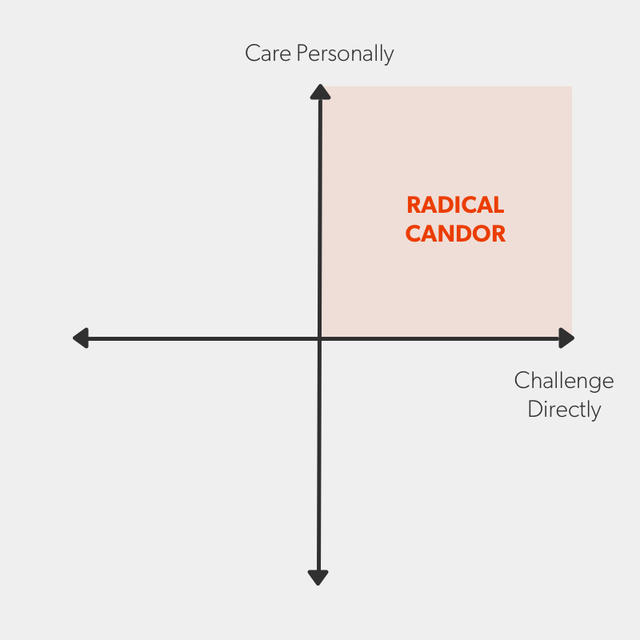
This article, Radical Candor — The Surprising Secret to Being a Good Boss | First Round Review, is making the rounds and is making my nervous. It makes me nervous because it is a terrible concept and it is very hard to do well. Even the example given – being called stupid – is a bad one. Be wary of any boss or any organization adopting this in your workplace.

My long work experience is that the Challenge Directly part takes little effort and energy, but the Care Personally part takes a lot of effort and energy. The result is a drift towards a demoralizing and toxic work environment with lots of criticism and little encouragement.

There is a rare exception where I have seen radical candor work: an elite athlete with an elite coach. Elite athletes sign up for and encourage radical candor because it is the best way to be the best. If you consider your work role similar to an elite athlete and you consider your boss an elite coach, then radical candor could work for you. Likewise if you are in the role of manager. Otherwise, I would recommend you pass on this approach and look for a better way to work.

A good review of Amazon’s The Man in the High Castle. And a good critique of what works based on the Philip K. Dick get wrong.

That review,here, is worth reading for anyone watching or interesting in watching the Amazon Prime series.

Anyone interested in works based on the novels of Dick should focus on this key quote (I added the emphasis):

Pop culture has exalted many of Dick’s wilder stories and novels. Since the release of Blade Runner (1982, based on the short novel Do Androids Dream of Electric Sheep?) and Total Recall (1990, based on the story “We Can Remember It for You Wholesale”), his pet motifs of false realities and artificial identities have captivated filmmakers. …Along the way to becoming popcorn entertainments, Dick’s motifs have shed a lot of their existential baggage. Today, the revelation that capsizes everything a movie character once believed about himself and his world is just another mind-blowing plot twist. No sooner have we gasped Whoa! than the film has moved on to the next chase scene, martial-arts display, or explosion. Nobody sits around questioning their own reality or humanity the way Dick’s protagonists do. Those questions, however, were the whole point of Dick’s fiction

That’s a great critique of even the better works based on Dick, like Blade Runner. Whenever you see or plan to see a film or TV series based on one of his works, it’s better if you can read the novel first. Doing so will add much more complexity and richness to whatever you are about to see.

Apple will not be getting into the car business, no matter what you read, because…

…it makes no business sense. A key take away from the article linked to below:

Ford’s revenue and operating income: $134 billion, 3.9%. Apple’s corresponding numbers: $234 billion, 40%! Or consider the world’s two largest car companies, Toyota and Volkswagen, both of which hover around $200 billion in revenue. Toyota just reported a higher than usual 10% net profit versus Apple’s 22.8%. The Financial Times recently pegged the VW brand’s operating margin at about 2%. (We’ll see how the German auto giant, which was ever so close to taking the industry’s Ichiban ranking from Toyota, extracts itself from its current engine management software troubles.) Yes, the car industry is large (around $2 trillion—that’s two thousand billions), but it grows slowly. In 2015 it saw 2% annual growth—and that was considered a good year.

There are so many other lines of business that could bring more revenue and profit to Apple. Unless the car business changes dramatically — and that is possible — then I can’t see how it makes any business sense for them to become car makers.

For more details on this, see: Why should Apple even bother building a car? – Quartz

The rock, the attendant and the vanishing soul: how fathers progress

When I first started off as a father, I was like a climbing rock: durable, constant,  capable of bearing heavy loads.

As my children mature, I find I am more the attendant. I watch their events, I monitor their behavior, I whisk away what is unwanted, be it spiders, dirty dishes, tears, anxiety.

In time they will be independent. I will hover around, like a ghost, a memory, reminding them of what is good in them and their past. I will be there but not there.

This is the life of fathers.
—————–
Written on my BlackBerry Handheld to my old Posterous blog, October 12 2011, 7:34 PM

Why do Apple’s Macbook chargers cost so much?

Simple: they are a complex piece of technology. The photo above shows a Macbook charger from Apple on the left: the charger on the right is from another company. You can clearly see that the one from Apple has a lot more technology packed in there. And for good reasons. To understand what those reasons are, see this piece:  Macbook charger teardown: The surprising complexity inside Apple’s power adapter. It was surprisingly interesting, from an engineering and design perspective.

Thanks to Tom Plaskon for sharing this on Twitter!

That story during the Paris attacks recently about a man named Zouheir, a Muslim, who saved thousands of lives? It’s mostly false.

As Snopes.com says:

An uplifting social media rumor about the purportedly heroic actions of a security guard named Zouheir during the Paris attacks was largely inaccurate.

For the details, see Zouheir: The MUSLIM Who Saved Thousands of Lives? : snopes.com.

More and more, whenever I see something viral, I check Snopes.com.

A short defense of Drake’s dancing in Hotline Bling

It’s well known that Drake has suffered alot of mockery for his dancing in the video for Hotline Bling. This is too bad, because for whatever criticism you can raise for Drake’s dancing, he is no worse than most major pop stars when it comes to dancing. So what’s the problem?

The problem, I see it, is in the directing. Here is the Hotline Bling video. Count the length of the average shot. When I did it, it was in the 5 to 10 second range.

Compare that to Ariana Grande’s Focus video.

Count the length of each shot. The longest is usually no more than 3 seconds: the rest are 1 to 2 seconds. Is she a good dancer? It’s hard to tell. If you go to around the 3 minute mark, you seen alot of dancing, but the shots are still short and the camera is constantly moving. Any short coming in the dancing can be made up for in the editing room. And I’d argue that the Focus video is typical of most videos: very short cuts with lots of camera movement.

Now, it’s possible the director wanted the longer shots due to the changing nature of the lighting. But there is a similar use of dramatic lighting in Justin Timberlake’s Let Me Talk To You/My Love and he comes across well with no loss to the lighting effect

And like Ariana Grande’s video, this video has the performer do well defined step in a 1-4 second shot and then cuts away. This is typical of many music videos. (Yes, JT does have an extended dance routine at the end of My Love, but most of the video is all quick cuts….also, he has been dancing since his early days as a Mouseketeer :))

Drake would have been better off with shorter cuts and simpler dance moves, the kind of thing you find in most other videos.

A good article: Why I Am Not a Maker. With one comment by me.

If you hang around with or are involved in some way with IT people, you will come across individuals extolling the virtues of being a “Maker”. Making things (typically software or IT systems) is seen as a virtue, in some case one of the highest virtues, and the implication is that makers are virtuous people.

A well written critique of that is here: Why I Am Not a Maker – The Atlantic. If you consider yourself  a maker or aspire to be considered one, you should read it. A key point is this:

When tech culture only celebrates creation, it risks ignoring those who teach, criticize, and take care of others.

This is true: tech culture sometimes places little or no value on other activities, such as the ones that the article mentions.

My main criticism of the article is that it has a blind spot for the middle ground. I know plenty of creative people whom I consider makers that also take care of others, teach, manage, administer…you name it. Often time the things they make are superior to those of people who devote themselves to being makers.

Being a maker is a virtuous thing, for the most part. But so is teaching, providing care, managing, cleaning, coaching and many other positive activities. Find the thing you are good at and contribute positively in your own way.  If you can make some things along the way, all the better.

How to tell who the next president of the US will be (ahem, Hillary Clinton)

There’s two ways to tell who will be the next president of the United States.

  1. Listen to the pundits: The Most Likely Next President Is Hillary Clinton – Bloomberg Politics
  2. Follow the betters: 2016 Presidential Election – Next President bet | betfair.com

In this case, at this moment, they are both in agreement: Hillary Clinton will be the next president of the United States. Now, the election is so very far away, anything can happen, a week is a long time in politics, blah blah blah, but right now it is hers to lose.

If you ask me, ignore the pundits and follow the betters: the latter are rarely wrong. Read the pundits if you want to know why she is winning.


The history of a great collaboration: Philippe Starck, Ian Schrager and the rise of the NYC designer hotel

It seems commonplace now, but the idea of hotels having the same cachet as a nightclub seem to me to come about in the 1980s with the rise of Ian Schrager as a hotelier. While he collaborated with others, the partnership he formed with Philippe Starck resulted in some really fantastic hotels, as can be seen in this post: The 21st Century Interior – Case studies – Philippe Starck/Ian Schrager: Designer Hotels – Blog – APID.

Nowadays many of these hotels have changed, but in the latter part of the 20th century they were opening with all the excitement of a new nightclub, which in some ways they resembled.  I remember hanging out in the lobby of The Royalton as it was just getting ready to open, talking to the staff in their Hugo Boss suits, marvelling over the designs of Starck, thinking of how the blue carpet made one feel as glamorous as anyone in the city. Later on I stayed at the Paramount and Morgan’s, each visit made Manhattan that much better.

Recently the hotels have been changing as they have been upgraded. Only The Hudson seems to have retained that earlier quality, it seems. Soon even that will transform into whatever brings in the guests. I haven’t been to The Hudson yet: I must get their before it is too late.

I am not sure if there is a history of great hotels, but if there ever is, I expect some of these places will find their place in it. Meanwhile, read the post on these hotels, and check out The Hudson in NYC while you can.

(Top photo of the Royalton, bedroom photo from the Paramount. Both linked to from the post, which has more great photos.)


For the curious: top chefs and their fridges.

You might be surprised (or you might not) to see that much of what top chefs have in their fridges is not all that different than you. If you are skeptical, you should check out this book: Inside Chefs’ Fridges, Europe. Top chefs open their home refrigerators. from TASCHEN Books. If anything, your North American fridge may have alot more in it than the typical smaller European icebox.

The book is worth a look: besides the peek inside, their is also recipes and other things of interest.

A quick reminder of the path to success

Media preview

I’ve seen the squiggly versus straight line path to success in many places. It’s a great concept, and a handy reminder to keep close when things seem in a muddle and you wonder if you will ever progress. It’s also a good reminder to keep a log of your progress. A log will remind you that you are succeed, despite those bewildering times when things seem like you are getting nowhere fast.

On declining ebook sales (two thoughts and some good material to consider)

If you are interested in books and ebooks in particular, you should read this: On the declining ebook reading experience. Two beliefs I have on this topic:

  1. Book sellers have become more competitive. In Canada, Indigo’s prices seem to be much lower and they sell books using low prices stamped prominently on the cover.
  2. He doesn’t say it, but the author hints that Apple should step in and make their own Kindle. I certainly would like to see Apple step up and make their own Kindle. The device and the user experience would be great, I am certain. It would blow the Kindle out of the water and likely make me switch over to becoming a bigger ebook reader.


Adulting: a funny self help book, not just for young people

For anyone starting out on the road to being an independent adult, the book Adulting (from Hachette) is a good guide to have. It is packed with tips – 468 to be exact – on pretty much any experience you are going to go through in your early 20s. If this is you or someone you love, this book will have an obvious appeal.

It’s not just for young people though. I think all adults could benefit from parts of the book, especially if you are having to start out on some adult experience that is either new to you or something you haven’t done for some time. It’s good advice, and good advice never goes out of date.

Even if you don’t need good advice, read it just for the humour. It’s a very funny book. (Note, there is a fair amount of profanity and references to sex, but if that doesn’t bother you, then you’ll be fine.)

Finally, if you want to have a better understanding of what life is like for that young person you know, this book can help you achieve that.

By the way, if you want a preview of it, you can check out the Adulting blog. Also very good.

I was killing time in a bookstore last night and I thought it looked good. I ended up reading it from cover to cover.


It’s not that Brooklyn is getting more expensive: it’s that Manhattan is expanding. Why?

Home prices in some of the city’s neighborhoods have not just climbed over the last decade, they’ve blasted off, landed on Mars and found water.

Why? Well, look at where the growth is, and then look at this map of the NYC Subway:

More than other factors, the price of real estate seems  is tied to how easy it is to get back and forth from Manhattan.

That said, I’d be interested to know the story behind the areas of Manhattan that are stagnating.

NYC is never boring.

Source: New York Home Prices | New York Real Estate Price History

On starting to take my personal life offline

I am supportive of people sharing things, both good and bad, on social media. Some people think sharing only positive things is best, but I think sharing bad things has benefits. When you share bad things you allow people to express empathy which can be good for them and you. Sharing negative experiences can also help people feel that they are not the only ones feeling that way. In either case, a small dose of negativity can lead to a larger response of positivity.

Lately, however, I have had so many bad things, big and small, happen to me that I no longer feel it is a net benefit to share them. I even wrote them down tonight and thought: yeah that is a lot of bad things at once. I think that sharing them all the time will just have a negative effect on other people. It will bring them down more than help them. It will also affect me as well, as people move away from me for various reasons, either because they don’t know how to respond or they don’t want to deal with it.(something I have experienced this year.)

As a result, I started logging much of the difficulties I have been having in Day One, which is a great app. Writing things there helps me vent and review it later without having it social. As I found, after I vented, I was able to gain some perspective and think better about the situation, which helped. Sharing things can be useful, but in some cases not sharing can be more beneficial.

If you share a lot of your life, I recommend this approach for people in a similar situation. I recommend the Day One app too.  It is great. 

Why you should not buy insurance for rental cars, toys or video games

Sales people asking you if you want insurance at a counter leans on your anxiety and often leads you to end up buying it. Should you? Well, if it is rental car insurance, Vox says no and does so persuasively, here: Why rental car insurance is usually a rip-off – Vox.

Two other places I see people wasting money on insurance is toys and video games. Toys R Us used to push insurance on me all the time. Before you buy it, consider how your child plays with a toy. Chances are, the insurance doesn’t buy you anything. If it is the only toy you are going to buy your child and the only one they will play with for a long time, then sure. But most children will play intently with a toy for awhile and then the interest drops.

Likewise with video games. Perhaps your child will play with it for a year and it will be their favorite game. Most times, I’ll bet they play intently for awhile, and then the interest drops.  During that time, the chance of damage is very slight.

The insurance for toys and video games is low, but it buys you next to nothing. If the store said: do you mind if we charge you an extra 5-10% on this item, you would laugh and say “no!”. Yet that is what they are doing with insurance.

Skip it and use the few bucks to treat your child to a sweet or yourself to a coffee or give it to someone in need.

Blackberry has a new Android phone coming

And I think it could be successful. First off, it looks good, and it has the famous BlackBerry keyboard. Plus it will work with BlackBerry Enterprise Servers. For some users, this is the best of both worlds. For BlackBerry fans who also want to tap into the benefits of Android devices, this could be for you. More details, here:  BlackBerry Priv — the Android phone formerly known as Venice — is on the way | IT Business.

How to run Minecraft on a mainframe and other cool things

Here are two interesting pieces of innovative things people have done with Minecraft. The first one, New Minecraft Mod Teaches You Code as You Play, is a novel way to learn how to code. If you have a young one who loves Minecraft and whom you want to learn how to code, this may be a good way to do this. The second one is an amazing story found on Reddit: My experiences with running a Minecraft Server on an IBM Mainframe.

I was amazed he managed to get it to run, albeit slowly. Needless to say, a Mainframe is not an ideal platform for this software. Still, that he did get it to run is a testament to his ingenuity and also the flexibility of Minecraft and the IBM Mainframe.

Pebble and their smart watches are not going away yet

After the Apple Watch came out, I wondered how this would affect Pebble, the company. Turns out, instead of folding, they have plans to evolve and grow. For evidence of this, check out their latest watch (in the photo, as well as here: Pebble Smartwatch | Smartwatch for iPhone & Android). They seem to be aiming to finding a market for those wanting some of the features of the Apple Watch without all the functionality (or cost).

With the watch above, you can see them adopting higher end materials and also getting thinner (and round). It is more expensive than the original Pebble, but likely better quality. And still much cheaper than Apple Watch.

I have a Pebble and I really like it. It does what I want, which is send me notifications without having to get out my phone, which is great in meetings, at events, or driving (carefully). And you can even easily write code for it. Finally, it is a great watch that needs to be rarely charged.

Needless to say, the Apple Watch is a great product. Depending on your needs, it could be a better choice than the Pebble. But the Pebble is a good product too, and I think there is a place in the market for a range of watch makers. Get one that suits your needs. With the Pebble, now you have more choice.

Some thoughts on recently teaching myself Python

I have jumped on the Python bandwagon lately. I did because I was finding that more and more of the examples provided for integrating with APIs and for working with new technologies were often in Python. So I decided, why not? At first I tried teaching myself by way of various web sites, but I didn’t find this a satisfactory way to ramp up my skills as well as I wanted. It wasn’t until I came across this book in my local bookstore, Python in 24 Hours by Katie Cunningham and started learning from it did I find my skills increased at the level I wanted. By the time I was through it, I found I was writing good (not great) Python code at the level I was happy with. Furthermore, I felt I had a pretty good handle on the language, its features, and what it can do.

I highly recommend this book, and Python too. If you are new to programming, or are thinking of picking up a new language, read this piece: Why Python Makes A Great First Programming Language – ReadWrite.

Something cool: an ‘Alien’ gargoyle on an ancient abbey

It’s not a hoax: there is a  gargoyle on a 13th century abbey that looks like something out of Alien. Seems the old gargoyles were falling apart and artisans were recently brought in to make new ones…and well, someone took a few liberties.

All of the new beasts attached to the abbey are excellent. You can see more of them, and more of the story, here:  ‘Alien’ gargoyle on ancient abbey from BBC News

Autumn is here. You need new dishes to make. Here’s coffee-braised lamb shanks from David Lebovitz

If you enjoy lamb, this recipe for lamb shanks braised in coffee with ancho chile and other great flavouring sound great. Not too hard to make, either. See this link, Coffee-Braised Lamb Shanks – David Lebovitz, for the recipe. (Check out the other recipes on the site, too. Lots of great things there.)

Something beautiful: DIY geometric paper animal sculptures by Paperwolf

These paper sculptures by Wolfram Kampffmeyer (aka Paperwolf) are gorgeous. You buy them and make them yourself. Simply go to Etsy, here, and order a from a range of different animals, sizes, and prices. Great gift idea, too.

If you want to see more of them, you can also check them out here: DIY Geometric Paper Animal Sculptures by Paperwolf. Not surprisingly, from Colossal.

4 p.m.: Wednesday risotto recipes

Risotto had (has still?) a reputation of being difficult. You do have to attend to it, but otherwise it is quite easy. If anything, I find tending to a risotto relaxing, slowly adding to it, stirring it, tasting it. I highly recommend it.

If you haven’t made it, or you want some new ideas, here some recipes to get started. I really liked this Caprese risotto recipe.

A small tip: when adding the garlic, I also added some diced red onion and sliced cooked sausage. I also used spicy vegetable sauce instead of tomato juice, and around 1 tbsp of dried basil as I was adding the liquid.

Here’s a number of other risotto recipes I came across that look appealing: Classic parmesan risotto, Seafood saffron risotto with fennel, Porcini-mushroom risotto, Cheat’s orzo risotto with olives and feta, Asparagus and brown-rice risotto

And if you have left over risotto, then you want to consider making this: Crispy mozzarella risotto cakes

Library porn: Prague’s Klementinum library

My Modern Met has some fantastic images of the Klementinum library for anyone (like myself) that gets excited about such things. Here’s a sample:

If you haven’t heard of it, here’s what that site has to say about this fantastic place:

Prague’s Klementinum library was opened in 1722 and has easily become one of the most beautiful libraries in the world. Aside from housing over 20,000 novels for your reading pleasure, this location showcases absolutely stunning Baroque architecture. As you’re perusing various timeworn bookshelves, you can take a moment to look up and see Jan Hiebl’s heavenly, Renaissance-style ceiling paintings. Amongst his work, there are symbolic designs that represent the importance of education, along with fantastic portraits of Jesuit saints. Hiebl’s paintings actually pay homage to the fact that the library was originally a Jesuit university. Many of the school’s rare, 17th-century books are still amongst its collection today. That would explain why Emperor Joseph II’s portrait is displayed at the head of the hall, since he was the one who arranged for abolished monastic libraries to send their books to Klementinum.

Detroit: imploding city

While I knew things were rough in Detroit, this story, Volume of abandoned homes ‘absolutely terrifying’ (from DetroitNews.com), gives you a context of just how incredibly bad it is. Two take aways from that story. First, this statistic:

Since 2005, more than 1-in-3 Detroit properties have been foreclosed because of mortgage defaults or unpaid taxes

Two, this map of foreclosures:

The situation is terrible, but the story is worth reading and the visuals (e.g. a bigger view of that map) really illustrate the damage. Worth reading, especially if you have recently read some pieces, as I have, of good news coming out of Detroit.

On rose gold, white gold, and gold generally

There was a lot of scoffing when Apple recently released this

and claimed the colour was rose gold. It’s pink, was the common reply.  But as this piece shows ( The Semiotics of “Rose Gold” – The New Yorker), rose gold is a specific material. It refers to an alloy of gold to which copper has been added. For that matter, white gold, which is an alloy with nickel or manganese, is also a specific material. Jewelers know this, of course, and Apple is smart to associate with the metal (gold) vs the colour.

The New Yorker piece is fascinating. Worth reading, especially if you are skeptical about the colour.


The best thing you will read about the upcoming 2016 US Presidential election (and why you can pay much less attention until then)

Check out this map:

And then read this piece by a very realistic US Republican on the upcoming US presidential election: A reality-check on the 2014 results

If you are a fan of Hillary Clinton* then it is great news. If you are a supporter of anyone else, you will see why it is going to be very difficult for anyone from the GOP to become president in 2016.

But don’t take my word for it: read the article. Bookmark it until next year. It’s very likely going to be true, regardless of the thousands of articles and millions of words that will be written between now and election day.

(* Yes, in theory, Bernie Sanders could be the nominee. In practice, I think it is very unlikely.)

If you feel you are stuck in the Procrastination Doom Loop, there’s help (by the Atlantic and yours truly)

Do you ever get stuck in this loop?

If so, then the Atlantic has an article for you. According to this article, The Procrastination Doom Loop—and How to Break It – The Atlantic,

Delaying hard work is all about your mood.

And it goes on to talk about how to defeat this.

Seven additional suggestions I have on defeating this doom loop:

  1. set a regular schedule of tackling difficult tasks and stick with it.
  2. dilute the difficulty by giving yourself a ridiculous amount of time to do it. If it will likely take 20 minutes, schedule 2 hours and just sit there and do nothing else until you get it done.
  3. set up a reward for getting it done.
  4. set up significant negative consequences for not getting it done. You might need help from a friend or coach here.
  5. log the positive feelings and thoughts you feel after you get it done. Review that often.
  6. log the negative feelings and thoughts you have before you do it. After you do it, analyse what you wrote and revisit your thinking and feeling. You will likely find it wasn’t as bad as you had expected.
  7. have a list of things you are procrastinating on. For example, if you have two things you are avoiding, try to avoid doing one of them by doing the other. It’s better to get one thing done than getting none done

It’s Monday. You are stuck on conference calls. Here’s some Paris hotels to fantasize about


For people who love Paris and fine hotels, NOW Toronto Magazine offers up 5 Paris hotels for design junkies you want to see. Perfect if you are needing a break from work, real or imaginary. After you read the article and gaze over the photos, your next tab on your browser may be linking to google.com/hotels or google.com/flights. Bon voyage!