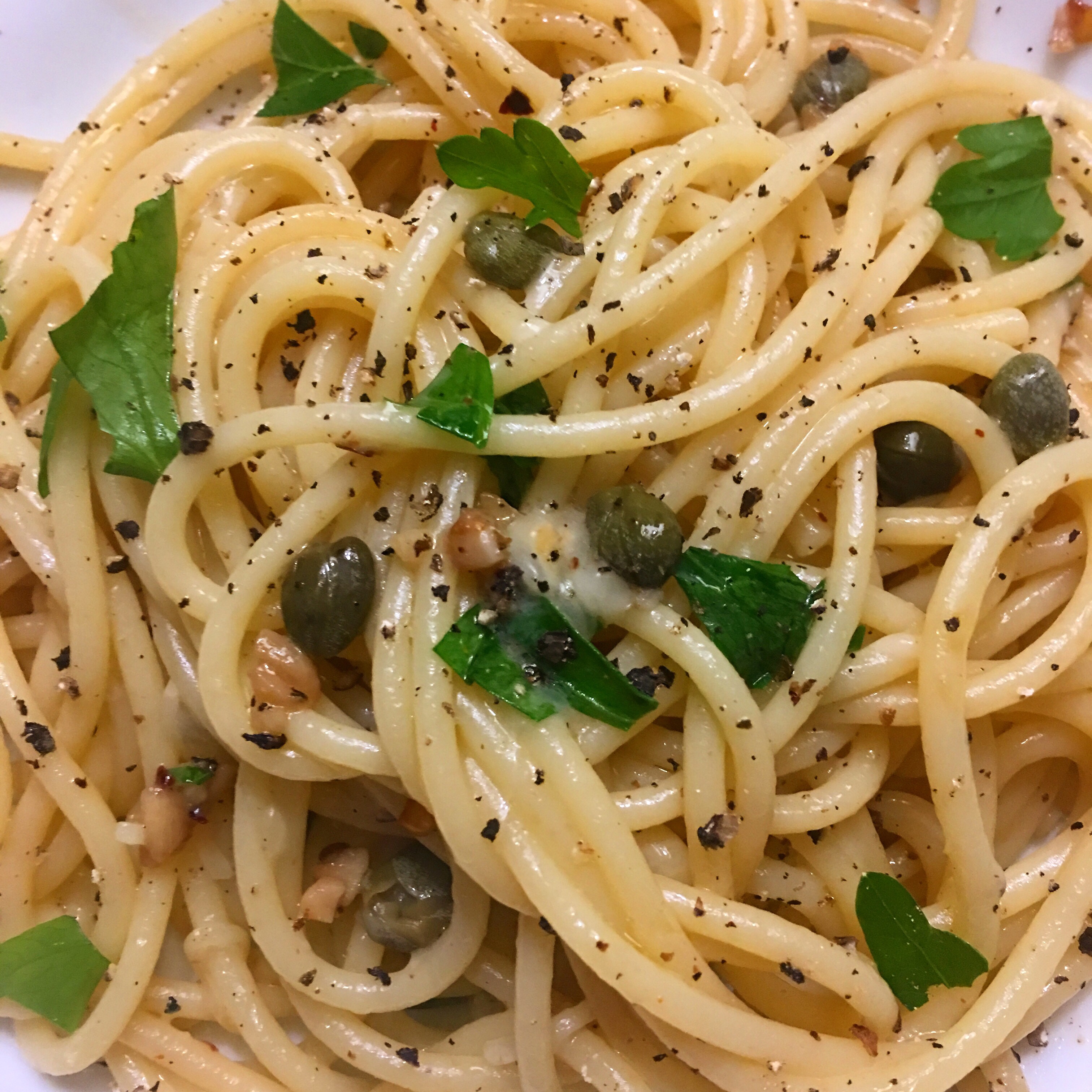
The joy of midnight pasta

If you are busy, or don’t feel like cooking much, or don’t have much in your fridge, then this pasta recipe is for you. It’s hard to believe something this simple could be so good, but it is. Lots of flavour with very few ingredients, ingredients you can have in your pantry.

Give it a try, especially when you are short of time, money, or food.

The photo is of the dish I whipped up one night.

Some contrarian ideas on happiness and being happy

Can be found here:

  1. BBC – Future – Why the quickest route to happiness may be to do nothing
  2. Daniel Kahneman explains why most people don’t want to be happy — Quartz

Basically, happiness is an elusive and not well defined idea and we are better off seeking things other than happiness. It is great to be happy, but it may not be great to try and be happy. Feel free to read and disagree.

10 Spectacular Roast Recipes That Aren’t Turkey

Many people

  1. want to make a roast turkey for Christmas
  2. do not want roast turkey

If that’s you, Chatelaine has your back with this:  10 Spectacular Roast Recipes That Aren’t Turkey | Chatelaine.

They truly are spectacular recipes, perfect not just for Christmas but any time of the year (ahem, winter) when a good roast is just what you need.

On cities and digital technology and loneliness

This is a good piece: How to redesign cities to fight loneliness.

It talks about how cities and services can be changed to fight loneliness. This is good. The flipside of it, though, is that cities are designed and have evolved to promote loneliness. One of the reasons people come to cities is to get away from things. The cost of that is often loneliness.

Cities are not the only contributor. Digital technology also can contribute to loneliness. But like cities, digital technology can also help to assist those struggling with being alone.

The bigger problem is loneliness in general. Cities and digital technologies can help there. But there are bigger social and cultural issues in the mix, and those need to be addressed as well.


Cook90: a goal for the new year

Can you cook 90 meals in a month? For many it sounds daunting. I like to cook and even I am not sure that I could do it.

If you like a challenge and the idea of it, there is a book you should consider: Cook90: The 30-Day Plan for Faster, Healthier, Happier by David Tamarkin from Epicurious, at Amazon. (Also available in Canada at Indigo).

I heard of it from Mark Bittman and his newsletter (which I recommend also).  One good quote from the newsletter was this:

“Entire industries want us to believe that cooking is so much harder and more time consuming than it really is.”

It’s true that you can make complex meals, but a simple green salad, a fried egg with toast, or those two things combined can make up a home prepared meal.


On exhibit: the Slave Bible

A fascinating exhibit in Washington, DC on the Slave Bible. What is the Slave Bible? It was a heavily reacted book with anything removed  that could have supported slaves seeking their freedom. It’s a sad but also interesting story, and more of the details are here: Slave Bible From The 1800s Omitted Key Passages That Could Incite Rebellion : NPR.

On “River”, the sad Joni Mitchell song that became a Christmas classic

A fine and detailed study on Mitchell’s great song from her masterpiece album, “Blue”: www.washingtonpost.com/arts-entertainment/2018/12/07/how-thoroughly-depressing-joni-mitchell-song-became-blue-christmas-classic/

My impression reading it was that there were no sad or melancholy Christmas songs before it, but “I’ll Be Home for Christmas” and “Blue Christmas” are two that immediately come to mind. And later on songs like “Last Christmas” have shown that the holidays can be sometimes difficult.

Read the piece though. Lots of good commentary by great singers who have covered it, as well as what it really means.

New York City and the future of retail in cities


I’ve read a number of articles talking about the demise of New York due to rising rents and gentrification. After reading them, tt’s easy to feel hopeless about New York and cities in general. Which is why I was glad to read this: New York City Reveals the Future of American Retail – The Atlantic. It’s true, there are big changes in New York, just like there are big changes in other cities. And it’s true that many beloved retail stores are disappearing in cities everywhere. But it’s untrue that vacancy rates are shooting up and it’s untrue that it’s only big chains taking over. While retail stores threatened by Amazon are closing, places like restaurants and fitness locations are filling the gap.

You can argue that a city needs more than this new world of cafes and restaurants and gyms. The article points out to ways cities can encourage that. Specifically:

According to Jeremiah Moss, specific policies caused the disappearance of old New York—like tax breaks for big businesses, which have been a hallmark of city governance since the Ed Koch days (and up through HQ2). Moss says that several new policies could fix the problem. First, he is an advocate of the Small Business Jobs Survival Act, which would make it easier for small retailers to extend their lease in neighborhoods with rising rents. Second, he favors zoning laws that would limit the density of chain stores. He and others have also called for “vacancy taxes” that punish landlords who sit on empty storefronts for months at a time. All of these policies could help small businesses push back against the blandification of New York and the broader country.

Cities thrive when there is a mix of establishments servicing the wants and needs of its occupants. After reading this article, I think cities, New York and elswhere, are doing well and have a viable path to get better.

44 short books to help you overcome your reading difficulties

This is brilliant: 44 Short Books to Help You Reach Your Reading Challenge Goal – Goodreads News & Interviews.

It’s a great list of books, for starters. Second, they tell you how long they long they are and a number of them are under 100 or 200 pages.

If you are trying to reach a reading challenge goal, or if you are stuck trying to get started reading, or if you find you never finish books due to their length, then you should check out that list.

Some thoughts on Philip Pullman, free speech and de-platforming

I think often of this speech Philip Pullman gave regarding the rights and limits associated with free speech. I like what he says, and I like how he says it.

I’d like to see a similar one for de-platforming. No one has a right to be popular on social media. No one has a right to access and use a specific platform. No one has a right to stay on the platform if they don’t abide by the rules. If they get kicked off, they can complain on other platforms. They can complain to the owners of the platform. They can build a platform of their own and make their own rules and say what they want in a law abiding way.

But wait, isn’t that a violation of someone’s free speech? I don’t think it is. It gives too much power to existing platforms to treat them like utilities. They are not utilities. If they are utilities, then they should be heavily regulated. Better that they are not regulated, that they do not gain too much power, and that people that want to exercise their free speech build their own platforms.

Free speech should be defined within the context of a citizen and their government. People should be able to say what they want within the law. People should also be willing to accept the social consequences if they say something that offends others. That is what Pullman is saying in some ways. If his book shocks and offends you, you can take action that may harm him by reducing the number of books he might sell. That is the consequence he is willing to take in order to write the book he wanted to write. He understands that free speech has consequences. The one consequence he is not willing to accept is to be prevented from speaking. (I would add that the other consequence he is unwilling to accept is to be physically threatened, an all too common threat that hangs over discussions of free speech on the Internet.)

People who are deplatformed are not prevented from speaking either. They are being prevented from speaking the way they prefer, and that is a different matter. They want to speak their way without the consequence of being deplatformed.


Beyond Twitter, or how Alexandria Ocasio-Cortez Has Mastered the Politics of Digital Intimacy using Instagram.

An interesting development. Ocasio-Cortez is using Instagram in a way that may bring on the new version of the fireside chat. For example:

A few days before Thanksgiving, newly elected New York Congresswoman Alexandria Ocasio-Cortez went live on her Instagram feed to cook dinner and chat with her hundreds of thousands of followers. She took questions on topics ranging from the challenges of entering Congress, to the specifics of progressive policy goals like the newly dubbed #GreenNewDeal, to whatever else came up. She made mac-and-cheese in her Instant Pot. The next day she used Twitter to thank attendees of the Instagram Q&A, but if you’d missed it, too bad: Instagram Live Videos are only available after the fact if the account holder chooses to save a replay and make it public. The same is true with Instagram Stories, which by default vanish from the site after 24 hours, unless the user saves them as a “highlight.” Right now, Ocasio-Cortez has only five of her many stories saved at the top of her account. If you want to keep track of the congresswoman-elect, you’d better stay logged in.

It will be interesting to see how this form of communication develops. For more on this: Alexandria Ocasio-Cortez Has Mastered the Politics of Digital Intimacy – Pacific Standard

Four fascinating music links

  1. “Love Will Tear Us Apart” by Iggy Pop & Bernard Sumner of New Order at Carnegie Hall: for fans of either or both, doing one of the best songs ever. (see above)
  2. A Big Choir Sings Patti Smith’s “Because the Night” | Open Culture: so good. I love this.
  3. Thinking About: Strange Fruit (& Friday Links) – Hither & Thither: a thoughtful analysis of a titanic  song.
  4. Hear the Famously Controversial Concert Where Leonard Bernstein Introduces Glenn Gould & His Idiosyncratic Performance of Brahms’ First Piano Concerto (1962) | Open Culture: this is a fascinating bit of musical history. Read the post to see why.

Thinking about sriracha


This is a great piece: Not So Hot: How I Fell Out of Love With Sriracha | TASTE  by David Farley. Sriracha is starting to reach the level of ubiquity that we associate with ketchup and it’s been so readily adopted that I doubt people think too much about it. If you have feelings about it — love or hate — then you want to read Farley’s piece.

Some thoughts on the end of Paul Krugman’s blog and blogging generally

I accidentally went to Paul Krugman’s blog today and was surprised to see he ended it some time ago. To quote him:

A message for regular readers of this blog: unless something big breaks later today, this will be my last day blogging AT THIS SITE. The Times is consolidating the process, so future blog-like entries will show up at my regular columnist page. This should broaden the audience, a bit, maybe, and certainly make it easier for the Times to feature relevant posts.

I remember when the Times (and many other places) finally recognized blogging as a way of communicating and started a big section on their site to blogging.

Is blogging dead? Not really. It’s no longer what is what, but people are still blogging. Does it matter? No. Blogging is writing. Communicating via words on the Internet. We have all these tools and media to communicate. For a time, blogging and blogs were a way to share that writing. Now people are doing it other ways.

What matters is the writing. The format matters much less. I still like the blogging format, but what I like more is that so many people can communicate with others.

Meanwhile, here’s a link to Krugman’s blog: Economics and Politics by Paul Krugman – The Conscience of a Liberal – The New York Times

How to travel back in time in NYC


One way would be to go to this place: Barbetta. The New York Times has a fine story on it, here: The Elegant Relic of Restaurant Row. Even if you don’t intend to go, you’d be rewarded just reading the piece.

Love that photo by Dina Litovsky for The New York Times. The sign is “made of opal glass. A forerunner of neon, it is the last of its kind in the city…”.  Fantastic.

Are the new iPhones more expensive than ever?

That’s been a question I have been asking myself for some time. I felt like the price just keeps going up. And if you read articles like this, it’s easy to conclude it’s true.

But here’s some numbers on the least expensive models over time, taken from this:

iPhone (4GB): $499
iPhone 3G (8GB): $599
iPhone 3GS (16GB): $599
iPhone 4 (16GB): $599
iPhone 4S (16GB): $649
iPhone 5 (16GB): $649
iPhone 5s (16GB): $649
iPhone 6 (16GB): $649
iPhone 6 Plus (16GB): $749
iPhone 6s (16GB): $649
iPhone 6s Plus (16GB): $749
iPhone 7 (32GB): $649
iPhone 7 Plus (32GB): $769
iPhone 8 (64GB): $699
iPhone 8 Plus (64GB): $799
iPhone X (64GB): $999

Looking at that, I have to think that the phones are getting more expensive, but likely they have always been that way. (And note, this doesn’t account for inflation or the improved quality of the phones, including greater storage.)

Occasionally Apple will make a cheaper phone like the 5C or the SE that are essentially remixes of older models. Or they will continue to support a wider range of phones, like continuing to sell the 7, the 8, and now the X. But it seems the high end was never inexpensive and likely never will be.

The William hotel in NYC, or how to use bold colour in your home.

I have not stayed at the William, but I don’t need to in order to appreciate the beauty of the place (shown above). Regardless of your travel plans, if you have decorating plans, it’s a great place that illustrates how to effectively use bold colour in your home. For many, using bold colours can be both desirable and intimidating. Some concrete examples can help you achieve your bold colour dreams and overcome your bold colour fears.

For more, see this:  A Bold, Colorful Hotel in the Heart of Manhattan – Design Milk

Thirty five links worth a look

Here’s a long list of things I had saved in Instapaper that I thought worthwhile, but never blogged about individually. While I hadn’t blogged about them, they are still worth a look:

  1. World population may actually start declining, not exploding.: one of those things I wish everyone thought about but don’t.
  2. sexplainer: good for teens and parents of teens
  3. Gibson Guitar: Min-ETune™: for those who want to take up guitar playing and want to stay in tune
  4. Networks and the Nature of the Firm – From the WTF? Economy to the Next Economy: the important on networks of all kinds when it comes to business.
  5. Anyone Depressed About The State Of The World Needs To Look At These Stunning Charts – Business Insider: keep your eyes on this and be more optimistic.
  6. Contact the ISS: fun! How to contact the space station!
  7. A property crisis: interview with Thomas Piketty | New Philosopher: a thoughtful discussion with one of my favorite thinkers in the world now.
  8. The Forthcoming–Behavioral–Economics of Abundance: more ideas on economics
    Mr Money Mustache: not a bad source of financial advice
  9. How I built a seven-figure business without employees – The Globe and Mail: not sure if everyone can build a business this way but it is fascinating to think about
  10. How you can grow your own tropical fruit, even in winter – The Globe and Mail: now if you want to grow fruit instead of money, you might find this interesting
  11. One Weird Old Productivity Tip: ha! For those who know their way around the operating system and want to be more productive
  12. Create Custom Flooring with Carpet Tiles & Area Rugs | FLOR: a novel idea for people who want nice rugs but have odd spaces or don’t want the commitment of a rug
  13. Slot-In Storage — Shoebox Dwelling | Finding comfort, style and dignity in small spaces: a very smart storage / shelf system. I might build something like this myself some day.
  14. Data Mining Reveals the Extent of China’s Ghost Cities – MIT Technology Review: fascinating. China has all these ghost cities, with buildings but no people, and this article shows how the author went about finding them
  15. A Lifelong Queens Resident Finds High Ground In The Bronx – Curbed NY: For NYC fans, Curbed NY. Also a reminder than NY has great places everywhere and since Amazon has staked a claim to parts of Queens, the next big place is likely the Bronx.
  16. Fooling The Machine | Popular Science: the next frontier of AI and IT security: deceiving AI.
  17. Top four sports cars around $15,000 – WHEELS.ca: a good reference for people looking for affordable cars
  18. If insects have consciousness, what then? – The Globe and Mail: from the always interesting Peter Singer.
  19. The Wannsee Conference: the entire Conference and film on YouTube. The banality of evil captured in 90 minutes.
  20. A Better Kind of Happiness | The New Yorker: good ideas on happiness
  21. The Lesser-Known Design Legend Behind The Rise Of The PC: IBM was smart to work with Sapper. While Ive at Apple gets plenty of worthwhile credit and recognition, Sapper deserves as much for the brilliant design work he did with IBM.
  22. 7 Ways to Reduce Anxiety in Your Home Through Design – The Aesthetics of Joy: not feng shui but interesting nonetheless
  23. Japan’s ‘no immigration principle’ looking as solid as ever | The Japan Times: it is often lost on people commenting on Japan with regards to robots and demographic information that the country has a very tight immigration policy. If you are one of those people, you should read this.
  24. Austen Heinz’s suicide and depression in startups – Business Insider: the success of startups is often reported and celebrated. The flip side is often kept hidden. Here is a piece on the flip side worth reading.
  25. Stop Worrying About How Much You Matter: the benefits of being less relevant. Really. Over time, we will all be irrelevant. If relevancy bothers you now, read this.
  26. Some Practical Thoughts on Suicide | The Blog of Author Tim Ferriss: well said.
  27. Is the human body becoming obsolete? – Motherboard: more interesting ideas.
  28. Cost Benefit of Google Perks – Business Insider: or why more companies could and should offer similar perks!
  29. The realist’s guide to being an online entrepreneur: for new entrepreneurs, worth a look
  30. The Thoughts of a Spiderweb | Quanta Magazine: fascinating
  31. This is Your Brain on Habits – Positive Psychology News: how to make and break habits
  32. 808 Site Found: Five Drum Machines Now Live In Your Browser – CDM Create Digital Music: fun! Put a drum machine in your browser.
  33. Inside the Shop of the Last Great American Watchmaker: for fans of watches and craft work generally
  34. StartupStash – The curated directory of tools for your startup: what it says. Good resources.
  35. Scared Of Failing? Ask Yourself These 6 Fear-Killing Questions: good advice

Cinephilia & Beyond on the Blade Runner Souvenir Magazine


A visit to this page is a must for Blade Runner fans: Blade Runner Souvenir Magazine: A Fascinating Blast from the Past from the Heart of Ridley Scott’s Masterpiece • Cinephilia & Beyond.

Pull quote:

The Official Collector’s Edition Blade Runner Souvenir Magazine is a wonderful source of information, abounding in great photos and articles; a genuine treat both for hardcore fans of the film and all the newbies who just got introduced to the world of Rick Deckard. There are a lot of fascinating stuff here, but we’re especially excited about the interviews with Philip K. Dick, Ridley Scott, Harrison Ford and Douglas Trumbull. We’re incredibly thankful to webmaster Netrunner from brmovie.com, who put a lot of effort into digitalizing the magazine and even contacted Mr. Friedman to get his blessing for the endeavor. While Netrunner shaped the material by separating photos from the accompanying text, we chose to offer you a .cbr file of greater resolution and quality, so you can browse the content more easily. If we may, we’d like to suggest using a little program called ComicRack for checking out this priceless blast from the past. Enjoy the read!


The greatness of what College Park in Toronto could have been

Sigh.

I love College Park in Toronto. I wish it were more of a destination spot for visitors. Perhaps if it had been built out like this photo, it would have. Instead, it was built out to the area outlined in white.  Still a lovely building, but it could have been a phenomenon.

What could have been.

Via The half-built relics of nixed Toronto skyscrapers – Spacing Toronto

Why suicide is falling around the world, and how to bring it down more

This fact is promising and the article in the Economist is worth reading (you don’t need a subscription to read it.)

Key quote for me:

Nonetheless, beyond America’s gloomy trend is a more optimistic story: that at a global level, suicide is down by 29% since 2000 (see article). As a result, 2.8m lives have been saved in that time—three times as many as have been killed in battle. There is no one reason. It is happening at different rates among different groups in different places. But the decline is particularly notable among three sets of people.

via Why suicide is falling around the world, and how to bring it down more – Staying alive.


The Disaster of Richard Nixon, and thinking about US presidents

A good book on something that people needs to be reminded of:  The Disaster of Richard Nixon | by Robert G. Kaiser | The New York Review of Books.

No matter how bad the current president is, longing for bad former presidents is nostalgia at its worst. It’s good that works like this are frequently published to remind us and give us perspective.