I bought a digital Holga for two reasons (some time ago):
I love the images produced by cameras like the Diana camera and hoped the digital Holga would give me similar images
I was happy to have digital images and not have to deal with film
Alas, my thoughts on the camera are similar to the ones expressed here. The images I captured were disappointing. I didn’t get what I had hoped for despite taking photos in a variety of light sources.
It’s true, you can make it better with with Adobe Lighthouse, as that piece argues. That kinda defeats the purpose of having the camera, to me.
If you are going to get one, then read this review: it is good for helping you understand the device.
Here are some of my photos. If you want to see more photos of this sort, this section of Flickr can help.
Finally, this here talks about the Holga in general.
New York is always great to revisit, and revisit it again I did last week. Like my visit in March, I stayed with my girlfriend in the Lower East Side, eating and walking around and even taking in a Broadway show (“Illinoise”). We hit up Freeman’s Alley and Lafayette for the breakfast, because they are always good. Plus Clinton Street Baking Company. We also dined at WildAir and King. The best of the lot, though, was Via Carota (seen above). Is it New York’s most perfect restaurant? This piece argues it is. It’s hard to disagree, although it is a bold claim, since New York has so many great restaurants. Not just now, but in it’s entire history. Read this piece on the social history of the city, told entirely through its restaurants, to see what I mean.
During the pandemic New York adopted outdoor dining and many places like Via Carota set up a big outdoor area to serve people. It’s still going strong, although the city is cracking down on outdoor dining. If you like that kinda thing, you may want to do it while you can.
Speaking of New York City post pandemic stories, here are two: this one on a 23 floor midtown Manhattan office building going for a 97.5% discount. (Practically free). And this one about how people are returning to the Met Opera, but selectively.
This piece, According to Big Data We Won the Vietnam War, should be read by everyone who strongly believes the next new technology (e.g. gen AI) will be able to make decisive predictions to solve big problems (e.g. the Vietnam War). The best computers and minds at the time thought they could win the war with technology. They were wrong then, and they will be wrong again.
If you think newer computers will win this time, reconsider that. If you think we learned our lesson last time, read this.
The last time I wrote about what I find interesting in tech, it was winter. Now it’s anything but, and I have lots of things I’ve been studying in IT. Lots of material on COBOL and mainframes since I am working on mainframe modernization. But there’s stuff regarding Python, cloud, Apple computers and so much more. Let’s see what we have here….
Software: this section is so big I need to break it up! First up, COBOL:
If you are thinking of publishing a cook book, then you owe it to yourself to read this piece in Eater. Eater interviewed three cookbook authors on how they got their first book deal and touches on all aspects of the process they followed. It even talks about how much money you might make. (Emphasis on the word, might.)
Obviously this isn’t the last word on how to get published, but you will come away from it with a better sense of what those authors did to become successful. In one case, author Priya Krishna went on to become very successful with a prominent position at the New York Times. Who knows where you and your stack of recipes — or Instagram posts — will end up?
Who doesn’t want to feel more joyful? And who doesn’t like a snack? If you are still with me, then let me introduce you to the combined concept of a joy snack. As Neuroscientist and science journalist Richard Sima explains, these are:
… little moments of delight you experience throughout the day: He calls them “joy snacks.” These include things like your first sip of coffee in the morning, or telling a joke where the punchline hits just right. By savoring even small bites of bliss, you can transform an otherwise mundane moment into something joyful. And cultivating more joy can help you create a more meaningful life.
I like it! Joy and snacks: two great things that go great together!
argued that gamification should really be called “pointsification,” writing: “What we’re currently terming gamification is in fact the process of taking the thing that is least essential to games and representing it as the core of the experience. Points and badges have no closer a relationship to games than they do to websites and fitness apps and loyalty cards.”
I think that’s true. If the whole game is just getting more and more points and levels, after awhile the game gets dull and easy to abandon.
So what should a game be, if it’s not just about keeping score? The article goes on to say:
“A game is about play and disruption and creativity and ambiguity and surprise,” wrote the late Jeff Watson, a game designer, writer, and educator who taught at the University of Southern California’s School of Cinematic Arts. Gamification is about the opposite—the known, the badgeable, the quantifiable.
Ideally that might be the case, but there is a range of game play, and some great games may only have a modicum of creativity and ambiguity and surprise and can still be loads of enjoyment.
Indeed, that’s the thing about games and indeed gamification. Some games can be engaging and great fun. And some games suck. The same can be said for gamification: some of it is fun, and some — alot — isn’t.
This is especially true for gamification that is imposed on us. We all can recall childhood friends who would say “let’s play a game” and the game turned out to be something that would be good for them and not for you. It was no fun then, and it’s no fun later in life where you are working for a company and your employer wants you to play a game in order to get you to behave in a certain way for their benefit.
If imposed games are bad, so are endless games. Games that never come to an end or that are practically impossible to win also suck. Yet for game makers, it is tempting to engineer the game so that you never leave it (and them). I was reminded of people I know who played Duolingo and who found once they got to a certain level, they were just floating there. Now it was no longer a game to them, but merely an activity. Now some activities can be fun, but it’s no longer a game.
Gaming is a structured form of play, and like any type of play, it should be fun and it should come to an end. Too often with gamification, neither of those things are true. That, to me, is the true problem with the practice of turning non-game activities into games.
What do tractors and leaves have in common? They are featured in the work of the artists I’ve been reading about recently.
The tractor is just one of the works I came across while reading about artist of Charles Ray. The New York Times has two pieces on him here and here, and this here piece (where the above image originates) is also good.
We lost some fine artists in the last while. The iconoclast John Wesley has died. (More on him, here.)Ben Vautier of Fluxus has also passed on. As has noteworthy black Broadway producer, Ron Simons. I was struck by Simons story, how he skipped the arts as a young man to go into IT, only to return to theatre at a later again. It was inspiring.
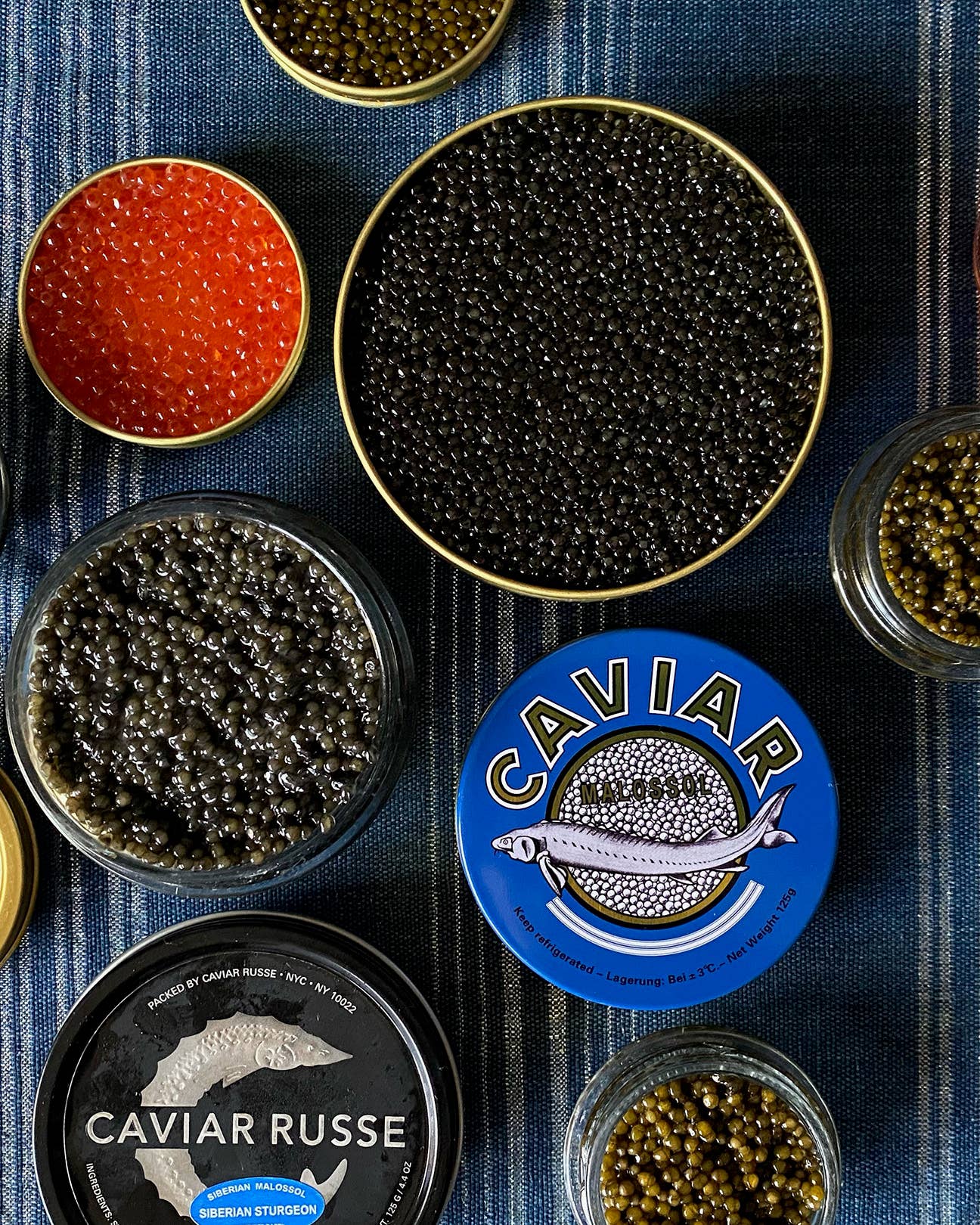
What does caviar have to do with the McRib? Hardly anything, other than they are edible and they are both featured in this blog post.
Now most of the time when I write blog posts on cooking and food, they are associated with recipes. Not today. This is mainly about highlighting good writing about food. So grab a chip and some caviar — or a McRib — and let’s go….
Privately, here’s what Jeff Bezos’s Blue Origin is doing. (Here’s more on that.) Not to be outdone, this is some of what SpaceX is trying to accomplish.
Besides the engineering problems of exploring space, there’s also the human problem. For example, can astronauts deal with the isolation of Mars? Space is hard on astronauts physically as well as mentally, as that piece shows.
Not a collaboration, but if you into pet furniture and a fan of Ikea, you’ll want to check this out. And speaking of pet furniture, imagine combining a dog bed with a desk — that’s what you’ll find here.
Like many of the other noted restaurants loved and lost, this one hurt. Especially so. I had only just started to make it a destination whenever I was in New York and suddenly it was gone. Or was it?
As this piece noted in 2023, the restaurant was being renovated and private events were being held there. Heck, Alison Roman and her beau had celebrated part of their wedding there. I was hopeful that it eventually would go from being private to being public. But as of March 2024, at least, it still looked like it did in the photo I took above. Indeed this article in The New Yorker at the same time said it is only available for private parties at the owner’s discretion. Sigh.
There was something magical about Prune. It was a world class restaurant that was also a small neighborhood restaurant. I remember the first time I went: I wandered by it while in NY’s Lower East Side and I popped in to see if they had any tables available for the evening. To my surprise they said I could sit at the bar at 7:30. I had a fabulous meal that day. I thought: I want to come back here often and for ever.
And maybe I will someday. Maybe Gabrielle Hamilton will throw open her doors to the public once again. But for now, I am including this among the restaurants loved and lost. I’ll miss your snack plate, Prune, and your duck breast over beans, and all the other great meals there. I’ll miss your small, perfect space. I may walk by you from time to time, but I doubt I’ll leave the sidewalk and cross your threshold any more.
As I waste time doomscrolling through text based social media or reels, I will often stop and ask myself: why am I doing this? Why am I not reading a book or watching a movie? After many an hour wasted on the couch with my phone, I’ve come to the conclusion that it’s not that social media content that is a problem: it’s the social media format that is a problem.
Social media is essentially a stream of randomness: a collection of words and sentences and images with limited or no connection. You can surf along and not have to hold anything together in your head. That’s it’s format.
Now if you are reading a book or watching a movie, the format is different. Sentences are connected to paragraphs which are connected to stories or chapters. Characters and scenes and dialogue in a movie are connected to other characters, scenes, dialog. Your brain has to work to keep all those connections in mind when reading or viewing. The format of books or movies demands it.
With social media content, you don’t have to maintain any of those connections in mind. You read and scroll and read and scroll, or you swipe through reels or Tiktoks, and in the end perhaps you retain one or two things.
Not having to maintain these connections in mind makes it easier for your brain to process social media content. That ease can make it more preferable, especially when you are tired or in a low energy state. Which, if you are like me, is fairly often.
Now it seems like some people are taking it to a new level by raw-dogging flights. (What Does ‘Raw-Dogging’ a Flight Mean? All About the Viral Travel Trend). Perhaps because they are in a low energy state and they don’t have access to social media, they just stare ahead the whole trip. It’s almost meditative. Again, the brain has very little to do here. People on a flight watching the flight path have zero connections to maintain.
So the next time you are beating yourself for wasting time on social media, perhaps acknowledge your brain is tired and this is all you can do. If you can, try meditating or napping or just going outside. Just understand that social media knows you are the way you are and it will suck you in if you are not careful.
The site onemillioncheckboxes.com is just that: a site that has one million checkboxes to check (and uncheck). But it has become something more. As The New York Times describes it (the bold emphasis is mine):
By providing a blank slate to users, One Million Checkboxes has also cycled rapidly through the stages of internet maturity, serving as something of a microcosm of the joys and horrors of digital life. First there was a period of exploration, in which users worked together to check as many boxes as they could. Next came creativity, as some began filling in boxes to illustrate hearts or, in more cases, crude drawings of male genitalia. Then things devolved, as they often do online, into all-out war. Steven Piziks, 57, a science fiction author in Ann Arbor, Mich., began checking boxes on Tuesday because he thought it might be soothing. He soon noticed someone else working behind him and unchecking every single one. He started checking even faster, and about half an hour later, the site’s built-in tally said he had checked more than 1,000 boxes. It was not soothing at all. It felt “like a metaphor for all of social media,” Mr. Piziks said. “We go into it thinking it’s going to be wonderful and collaborative and interesting, and it kind of turns into a fight.” Some bad actors on the site are human mischief-makers who take a perverse joy in undoing other people’s work. Others are simply bots that have been programmed to uncheck boxes en masse, Mr. Royalty said. (He has been working to contain them, with mixed success.) Those bots have been particularly infuriating to Frank Elavsky, 34, a Ph.D. student at Carnegie Mellon University who has checked more than 20,000 boxes in his “fight for the cause.” He got in a spat on X with someone he suspected of tinkering with the site’s code in the name of unchecking. “It became kind of personal,” he said. “I’m like, ‘You foul, foul demon. How could you?’” The website’s creator has been watching this all play out at a kind of omnipotent remove.
The freedom that the site gives users also comes with risks. In addition to lewd drawings, users have checked boxes in order to spell out profanities and at least one racial slur.
And that’s why I think OneMillionCheckBoxes.com shows we can never have nice big things again on the Internet. We can have big things, like OneMillionCheckBoxes.com, but you eventually get bad actors, bots, and racists. And we can have nice things with a significant investment in content moderation, but that doesn’t scale. Right now Threads.net is trying to prove me wrong, but in the end they will go for scale over nice, and when that happens, it’s only a matter of time before it all declines. Just like Facebook, and Twitter/X and others.
It will be interesting to check out (and maybe even check) OneMillionCheckBoxes.com in July 2025 and see if it is still active, or whether it succumbed to a combination of bad actors and ennui. I’m not optimistic.
Like last year, over the last 12 months I have found things I would like to write about but never do. I think people should check out these things/links at least, so I am including them all in this Sunday post to read at your leisure. Maybe you can write something worthwhile with them.
Waste is a failure of imagination. Woodworkers know that especially. Good wood workers will try and minimize waste by designing their cuts to use as much of their raw material as possible, and then they will try and use up the remains in one way or another.
We should be like good woodworkers, using our imaginations, our minds, to come up with new uses for things we consider waste. During the pandemic we even depended on our wastewater to tell us how we were doing. Even that kind of waste can be useful.
Not all waste is material. Waste can also be temporal: we talk about wasting our time and wasting our life. Here too, we should consider ways to minimize such waste. And not just by being busy all the time. Being idle is not always a waste of time: idleness can be often be necessary. Just as being busy without a purpose can be a great waste of time.
What is important is the context. How we spend our time — idle, busy, something else — and whether or not it is a waste depends on the context we have of it. So, doing nothing with someone you love is a good use of your time, just like working hard on a project no one wants could be a waste of time.
According to the site, Design-Milk, Philippe Starck is working with Kartell to use A.I. in the design of furniture:
Known as a progressive Italian brand that doesn’t shy away from experimentation and innovation, Kartell is becoming increasingly daring as their endeavors expand. At the moment, that means stepping into the world of artificial intelligence. In collaboration with Philippe Starck, they’ve released environmentally friendly furniture designs that merge human creativity with AI, bolstered by advancements in materials and manufacturing.
In case you are worried about them replacing designers, the site goes on to say:
Rather than replace the designer – a huge fear amongst creatives – artificial intelligence helps streamline the prototyping and planning phases, sticking to Starck’s vision and ensuring Kartell’s high quality and production standards are met. In this case, AI also contributes to calculating optimal material usage, a reduction in waste, and ultimately environmental sustainability.
Good to see! Speaking of good to see, you can see more of the furniture on the Design-Milk site, as well as the Kartell site.
Hot town indeed! Toronto has recently suffered through a heat wave as we head into the summer of 2024. We had tremendous thunderstorms, crazy wind squalls, and very high temperatures. And yours truly does not generally do well in the heat. Here’s to that heat subsiding somewhat, although, hey it’s summer, why should I expect?
Meanwhile, here’s a seasonal cornucopia of posts and articles I found worthwhile this spring. I hope you find it worth a read. Maybe they can help you cool off. 🙂
COVID/the pandemic: I should be cool about this, but one thing that gets me hot under the collar is the lack of acknowledgement of death that occurred during the pandemic. In Washington there was the temporary memorial of small flags, but it’s gone. I don’t know of any national memorials in Canada. We should have something national like the Covid heart wall in London, England. It is great that we were able to recover so quickly from the pandemic and get back to normal, but we should do more to remember the loss that occurred.
Indeed, most of the stories I’ve seen with regards to COVID seems to be about putting it well into the past. Perhaps the only way we will remember it is through such things as covid 19 related art.
I would be remiss if I did not mention the death world that is crypto, where the hammer is coming down on Binance’s CZ (Changpeng Zhao). Meanwhile, bankruptcy lawyers for FTX said customers of that cryptocurrency exchange were set to get all their money back, plus interest. At least someone is recovering from the crypto meltdown.
In world news: The American election drones on with Joe Biden having a narrow path to victory. Speaking of drones, the war in the Ukraine continues with drones playing a big part. In other wars, the War in Gaza goes on, despite massive student protests in the US and elsewhere. The war on women continues in the US as well.
As an aside, one promising thing for American women has been the rise of Caitlin Clark and the related rise of interest in Women’s Basketball. As a basketball fan and a believer that women in sports deserve better, I was glad to see this.
In Canadian news: Some day Canada Post will be no more, based on that article. Some day has come for the Canadian journalist Rex Murphy, who recently died. I used to look up to him a long time ago. Also not doing well is healthcare in Ontario. The Ford government continues to underfund it. Remember when we considered healthcare workers heros? The Ontario government should go back to treating them that way.
The arts: a number of the great artists passed away this spring, Alice Munro being one of the most notable. (The Times has a collection of the best of her work, here.) Another favorite of mine who passed on was Joe Flaherty. He didn’t get the recognition of some of his SCTV counterparts, but he was equally great and very funny. And I would be remiss if I did not note the death of another great Canadian, Donald Sutherland.
Not Canadian, but truly great, was musician David Sanborn, who is now playing in the great beyond. (Two pieces on him here and here.) Among other things, he was the host of the show “Night Music”, a show I adored and wrote about, here. May they all rest in peace.
Finally: We had solar eclipse recently. Did Google searches for eye damage jump after it? Sadly in Ontario they did. Did this woman in Texas build a spa for squirrels to handle the killer heat? Apparently she did. The world is weird.
Let me close off with this link to the Lovin Spoonful’s “Summer in the City”. Enjoy the season! I’ll have another newsletter in the Fall, god willing.
Even if you don’t care for cars, you have to admire the one above. It is more of a work of art than a vehicle. Even the motor is beautiful! To see what I mean, head over to Uncrate and check out the photos of this beauty.
And hey, it was up for auction. So if you got $8.5 million lying around, it could be yours.
I was developing a web page for my site berniemichalik.com and I used some Google Fonts to make it look better. When I checked the page on my Mac using my browser, it worked fine. However when I uploaded it to AWS and checked it with my browser, the fonts were not working.
It turned out to be a simple error. The link statement I used looked like this:
Note the use of “http”. However to access my website, I used “https”. That misalignment caused the font not to work. Once I changed the link to the font to “https” like this:
The 20/20 rule for decluttering is simple and good:
First, ask yourself, “Could I replace this item for less than $20?” Then, ask yourself, “Could I replace it in less than 20 minutes?”
If the answer to both of those questions is YES, then toss it without thinking any more about it. Note: replacing it in 20 minutes means can I replace it by ordering it online.
PS: For more decluttering advice I’ve recommended, go here. In that list is the “Box and Banish” approach, the 90/90 rule, and more.
The Claud chocolate cake can be a lesson for any restaurant in this day of social media and influencers.
Claud in NYC is a highly respected restaurant with subtle and sophisticated cuisine. Yet if you go to social media sites like Instagram, what you’ll often see is their chocolate cake, shown above. (And yes it is mine and I ordered it.) Just looking at it and you can see why it is popular: it is an eye catching slice of dessert.
I hesitate to call it a gimmick, for it’s delicious and well made. But it is definitely an attention getter, and in this age of social media, getting attention is key.
There are many ways to attract diners. If you want an easy and low cost way to do that, get yourself a menu item like Claud’s cake.
AI a year ago was mostly talking about AI. AI today is about what to do with the technology.
There are still good things being said about AI. This in depth piece by Navneet Alang here in the Walrus was the best writing on AI that I’ve read in a long time. And this New York Times piece on the new trend of AI slop got me thinking too. But for the most part I’ve stopped reading pieces on what does AI mean, or gossip pieces on OpenAI.
Instead I’ve been focused on what I can do with AI. Most of the links that follow reflect that.
Software/RAG: I tried to get started with RAG fusion here and was frustrated. Fortunately my manager recommended a much better and easier way to get working with RAG by using this no-code/low-code tool, Flowise. Here’s a guide to getting started with it.
Software/embedding: if you are interested in the above topics, you may want to learn more about vector databases and embeddings. Here are four good links on that: one two, three, four.
Prompt Engineering: if you want some guidance on how best to write prompts as you work with gen AI, I recommend this,this, this,this,this,this,this, and this.
IT Companies: companies everywhere are investing in AI. Here’s some pieces on what Apple, IBM, Microsoft and…IKEA…are doing:
“Bank architecture has conveyed a grandeur and stability essential to an industry that relies as much on public trust and confidence as hard-earned dollars,” says Barry Bergdoll, who has coordinated and installed the exhibition at Columbia. While architecture has played a fundamental role in establishing banks as “august and trusted guardians of wealth,” said Professor Bergdoll, the exhibition also reveals “the complex range of attitudes we hold as individuals and as a society to money.”
Banks used to look like this:
Very grand. Very stable looking.
The TD bank above does the same thing, but it reflects how we expect to see that now: modern, innovative, friendly, but still grand and stable looking. Their architecture needs to convey qualities you expect in a bank before you invest in their products or take out a loan. Then they did that with concrete pillars and fortress like doors: now it’s with neon and glass.
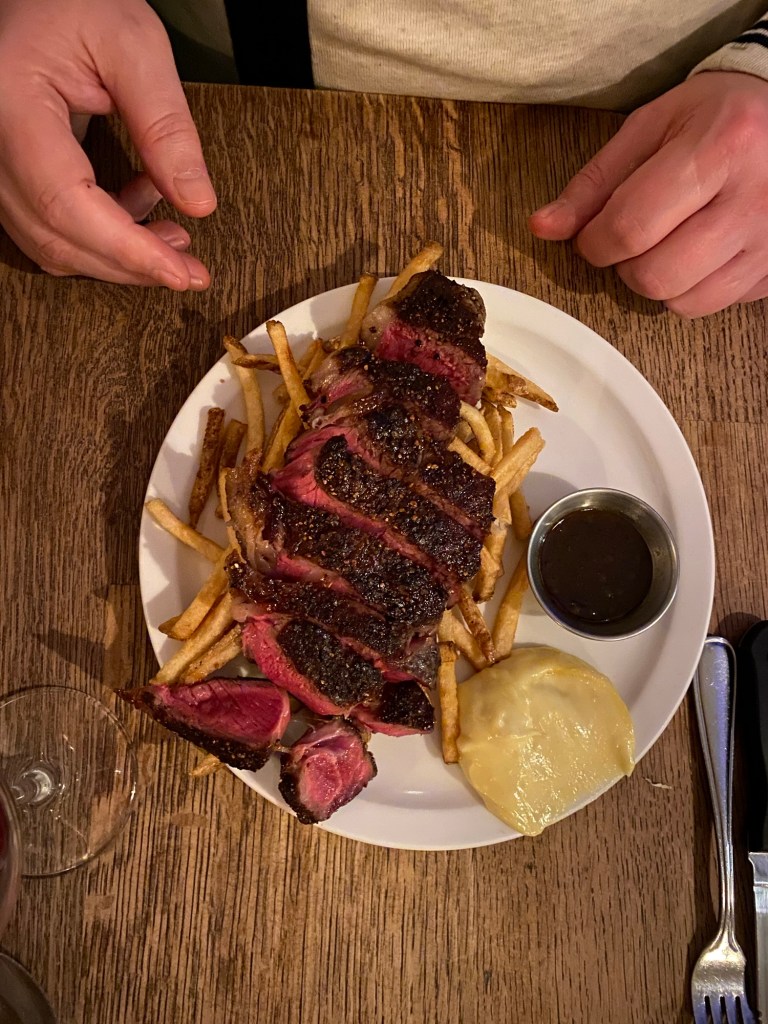
I love steak frites. While it’s always good wherever I get it, my favorite place to order it from is Cote de Boeuf in Toronto, where it was delicious and affordable.
I was somewhat shocked recently by the price of steak frites there. The Cote de Boeuf menu above was from Nov 27, 2021. A bit pricey but not bad. Two and a half years later, their steak frites will now set you back 47 bucks (up 34%), while the next highest price cut is a 12oz ribeye at 69 (32% increase). The cote de boeuf has gone up to 168 (only 12%).
At first I wanted to blame influencers for the price increases, since a) I don’t like influencers and b) I have seen many of them posting about how good this place is. (That it is the best place for steak frites in Toronto is not just my opinion.) My prejudice was confirmed recently when I walked by and there was a lineup even with their patio open. One thing I loved about the place in the past was the relative ease of getting a spot inside even without the patio. I figured this demand was driving up the price.
However I went through the list of places in that blogTO post and I noticed that some of them charge the same if not more than Cote de Boeuf. Now, much depends on the size and cut of meat. Le Select Bistro offers an 8 oz striploin version for $49 and a 12 oz version for $70! Compare that to the current 10 oz striploin at Cote de Boeuf for $47 and you are getting a better deal. Then again, Jules Bistro offers a 6 oz striploin for only $26.95., and the Ace offers a 10 oz hanger steak for $40. Le Paradis offers a flatiron steak of unknown size for $30.
I know the price of beef is going up and that is no doubt driving some of the cost increases. But I also suspect steak frites has become a more popular dish, and the demand for it is allowing restaurants to make it a more central and more expensive option.
I found another menu of Cote de Boeuf from February 2019 and steak frites was $28 then. No size mentioned, and it was listed as butchers cut (no doubt so the butcher could decide what was best to serve based on availability, etc.). Also there were seven mains then and duck confit was $29 ($1 more then vs $5 less now). Once the pandemic hit, restaurants trimmed back their menu options and no doubt have gone with their most popular items.
The whole trend makes me somewhat sad. I was never a fan of steakhouses with their exorbitant prices. I preferred a simple dish of steak frites preferably made with an unusual cut of beef like hanger or bavette. Good quality and not too expensive. It was like a burger and fries but for older people like me. I suspect those days are over.
Ah well.
As something of a consolation, I see more and more places slipping good quality pork chops and fries on their menus recently. Mostly priced well below the steak frites. Perhaps that will be my go to the next time I hit up a bistro style restaurant.
P.S. Here I am enjoying the last steak frites I had at Cote de Boeuf. Pure perfection.
P.S.S. If you want to make your own steak frites at home, here’s a recipe to get you started. If you want a peppercorn sauce to go with it, click here.
I was futzing around with code the other day. I wrote some html/css/javascript and then I wrote some unrelated prolog code. None of it had any value. The code didn’t solve some important problem. Some might consider it a waste of time.
But it wasn’t a waste. In both cases, I learned skills I didn’t have until I wrote the code. Those skills have value for the next time I do have to solve an important problem. Besides that, I enjoyed myself while coding. I was proud of myself for getting the code to work. That enjoyment and pride have value too.
Futzing around is a form of play, and any form of play is good for us as humans. Remember that the next time you consider taking on seemingly useless activities.
If you train for a marathon and you run it in a big city, chances are you will be in the same race — not run, but race — as world class runners. You will not win of course, but you will be included. That’s what is great about marathon running: you are as much a marathon runner / racer as someone hoping to be in the Olympics. It is inclusive.
Nike is a company that also supports inclusiveness, not just for running but for athleticism in general. They like to say: “if you have a body, you are an athlete”. It doesn’t get more inclusive than that.
I think such inclusiveness should be seen in the art world. If you create, you are an artist. If you write, you are a writer. If you’re writing poetry, you are a poet. Taking photos: a photographer. Thinking about the meaning of life: a philosopher.
Maybe your art is not going to bring you fame or fortune. Your running might not either. But if you are out there running or cycling or skiing or whatever you do, you are an athlete. The same should be true of writing or painting or photographing: you are an artist. Don’t let others exclude you from the group; don’t let others discourage you and get you to stop doing the thing you want to do. You’re as much a part of it as the people up front. Put on those running shoes, pick up that camera, that pen, that brush, and be the thing you are.
One of my favorite works of art in Toronto is The Pasture: nine bronze cows lying restfully on a field of grass. If it was located in another section of Toronto, might be less remarkable. But being in the heart of the financial district and all it represents, there is a superb tension between the cows in their field and the people in their offices. In the offices people are working hard, stressed, standing and walking. The cows are doing none of that.
If you ever in downtown Toronto near the Toronto Dominion center, I recommend you check out this fine work of art. It is an oasis of calm.
P.S. I remember when this sculpture first went in, for I was working at IBM and this sculpture went in right around when the IBM Tower on Wellington was established.
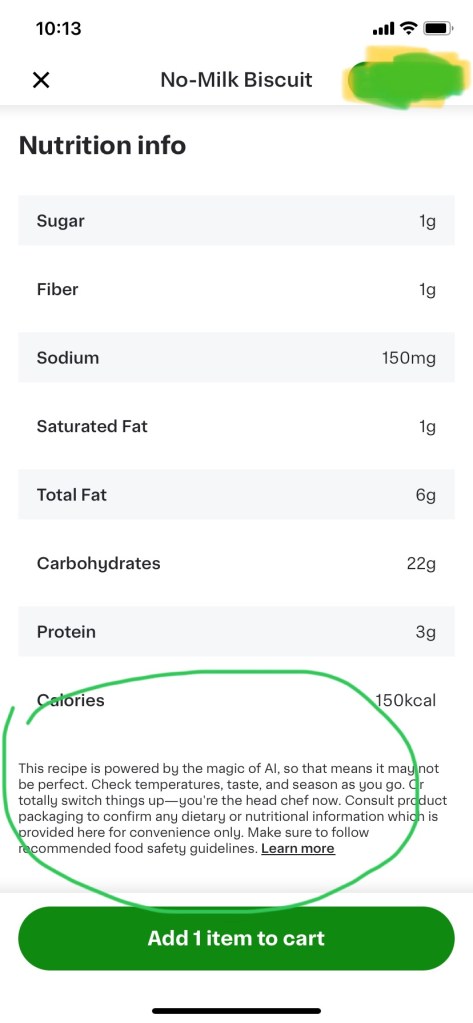
One convenient feature of Instacart is a listing of “Related recipes” it will provide you if you are searching for a product or ingredient. For instance, I was searching for “biscuits” and one of the recipes that appeared to me was no-milk biscuits. Hmmmm, that could be good and simple, I thought. Seemed reasonable too. Then I scrolled down the bottom to the recipe and came across the text: this recipe is powered by the magic of AI.
First off, let me say: AI is not magic. Second, this COULD be a good recipe. Or it could be something where AI hallucinated ingredients or quantities. For this recipe, it is somewhat close to this recipe for dairy free biscuits at allRecipes.com, but it is missing some ingredients and the quantities of some of the ingredients are different. I searched other recipes at other sites, and while it is close to them, it seems…lacking…in comparison.
Simply put: you would be better off getting recipes from either reputable cookbooks or websites where recipes are tested and confirmed. It is convenient to use the recipes in places like Instacart, because you can easily add the ingredients of the recipe to your shopping cart, but the results from the recipes generated by AI could leave you very disappointed. Especially when it comes to baking!
P.S. Not to pick just on Instacart: I suspect we are going to see more and more of this type of AI generated advice on websites. Keep an eye out for it.
If you are using python packages like xmltodict or yaml to write and read your own XML and yaml files, you probably don’t need to know this. But if you are reading someone else’s files, here is something to be aware of.
This week I had to process an XML files in python. No problem, I thought, I’ll use a python package like xmltodict to translate the XML into a dictionary variable. Then I could edit it and print out a new file with the changes. Sounds easy!
Well, first off, it wasn’t too easy: the nesting was horrendous. However, with some help from VS Code, I was able to power through and get the value I want.
Here’s where I got burned. I wanted to change the text in the XML file, so I had a statement like this to read it
Now this particular file is an XML file that has a graphml extension, which allows an editor like YED to read it. YED can read the original file, but it turns out xmltodict writes the file in such a way that the YED editor can no longer see the text. I don’t know why.
I spent hours working on it until I finally gave up. I wrote a much dumber program that read through the graphml file a line at a time and changed it the way I wanted to. No fancy packages involved. Dumb but it worked.
This is the second time this year a package has given me problems. In late January I wrote some code to parse yaml files for a client to extract information for them and to produce a report. Again, there is a package to do that: yaml. Which is….good…except when the yaml it is processing it is poorly written. Which this yaml was.
Again, I spent hours linting the yaml and in some cases having to forgo certain files because they were poorly constructed. What should have been easy — read the yaml file, transform it, write a new yaml file — was instead very difficult.
And that’s often the problem with yaml files and XML and JSON files: they are often handcrafted and inconsistent. They MAY be good enough for whatever tool is ingesting them, but not good enough for the packages you want to use to process them.
I think those packages are great if you are making the input files. But if you are processing someone elses, caveat emptor (caveat programmer?).
Apple released it’s latest iPad (Pro) recently and whenever this happens people debate the value of the iPad in general and ask questions like: is the iPad worth it?
I used to ask myself that question too. After all, between my iPhone and my Macbook, I thought I had all the computing technology I needed. But in the last year I got a new iPad — not even the latest and greatest — and I have to say that the iPad just does certain things better than either one. It’s especially better than my iPhone for:
Streaming video: Disney, Netflix, YouTube and more are all much better than my iPhone.
The library app Libby is much better, especially with the magazine section
The news sites like the New York Times and Washington Post are great on the iPad
Instacart: I can see more options when I order from it
Shopping sites like Zara and Uniqlo are better too for the same reason
X and other social media sites look great on my iPad, but not threads or Instagram because of some design ideas Meta has that are wrong.
And what I like about the iPad over my Macbook is a) there is no work apps on it so I don’t get distracted by work b) I can recline with the iPad (I don’t like doing that with the Macbook…it’s just no comfortable).
That’s just a start of my list. I’ll keep updating this list for anyone debating getting an iPad.
I’ve been going to Okonomi House since the 1980s. And what has changed over the years is…nothing. It was great then and it’s great now. They still serve pretty much the same food now that they served then, with the crown jewel being the okonomi style pancakes like the one below.
They serve other things too, but for me that’s what I go for when I go in. It’s sweet, it’s savory, it’s delicious. Just spread that mayo dollop all over the pancake and dig in!
There have been changes, but they are very minor. Young people seem to run the restaurant now, and they have tweaked the menu and added new things. Gone is the cup of soup that I loved even though it was literally Cup of Soup! In its place is a classier miso soup option. They have a nicer bathroom also: no longer are boxes piled up in it. Otherwise, the place is timeless. I hope it never leaves.
For more on it, BlogTo has a review, here. Read that, then go. I went a few Fridays ago and it was packed at around 7:30 pm. The good news is table turnover is fast (and service is great), so if you can’t get a seat right away, just wait for a few minutes and you’ll be soon eating okonomi in no time.
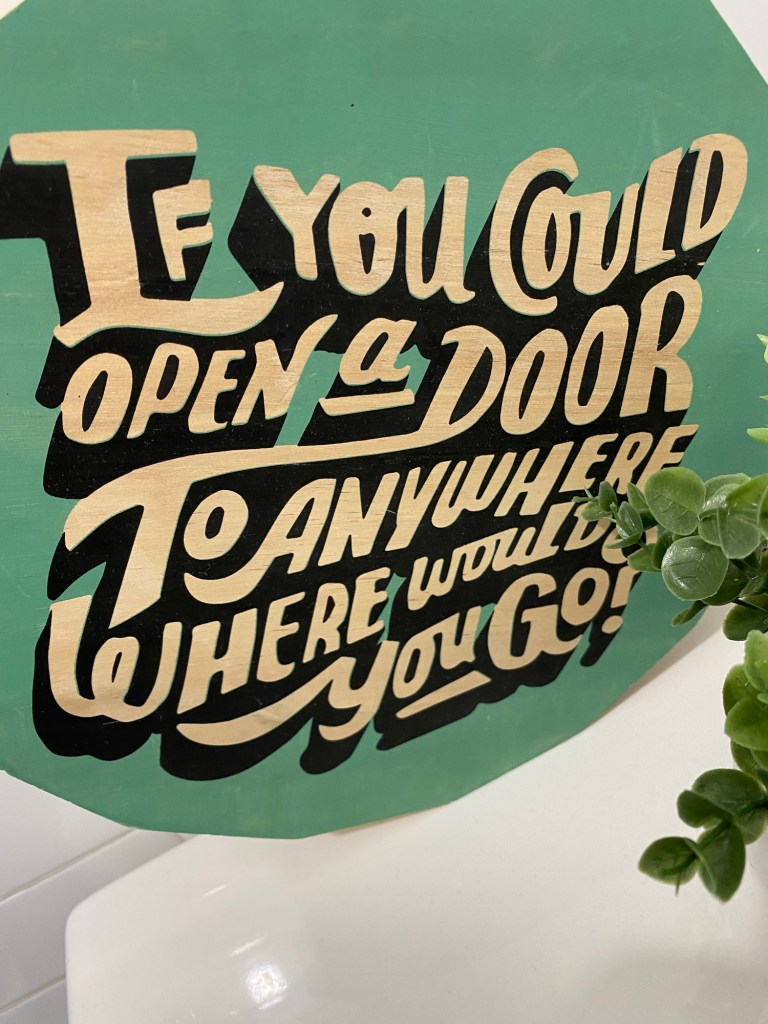
I came across this question when I was in a restaurant this week. I have thought about it often since I first read it.
By opening a door to anywhere, I also assume any time. Maybe you would walk through a door that would let you see a loved one again. You might choose to go through a door you skipped by when you were younger.
Or maybe you would stick to the present. You might want to cross a threshold to some place you always wanted to go. Or maybe you just want to use the door to exit where you are.
There’s also the future to consider. Do you want to go through a stage door of a famous theatre you might eventually perform in? Do you want to enter the Oval Office as president of the United States? Maybe it’s simply a cottage you want to retire to when you get older. All those doors await you.
With so many doors you could go through, which one do you choose? And why?
As Monty Hall would say: pick a door. Choose wisely.
These snack packs are amazing. Not because of the content, but because of the packaging the content is in.
The content itself consists of 5 or 6 small crackers and associated morsels of cheese and meat that goes on top of them. If you are a food producer, you could take slices of meat and cheese that are too irregular for your typical sliced meat/chese packaging, trim them, then put them in these things. Not only have you reduced your waste, but you have created a new product from it that cost the price of an entire package of sliced meat or of sliced cheese. Profit!
Whats sells the product is the package. The outside emphasizes their convenience: Grab (and) Snack. Who has time to make and eat a sandwich? Not you! Plus if you aren’t going to eat it right away, your sandwich or your own cheese and cracker snack-pack could get soggy. Not these guys: each bit of food is in its own section, so everything stays tastier, longer. Even better, it’s not just ham and cheese and crackers: it’s dry cured genoa salami (exotic), part skim mozzarella cheese (lean), Bear Paws cheddar crackers (tasty). And it’s been inspected by the department of agriculture, no less, so you know it isn’t sketchy.
Let’s not forget the protein. Besides the emphasis of convenience, there is also the highlighting of how much grams of protein in them. 10g of protein is a good amount, and it is something I see online fitness promoting. (“It’s garbage if it has less than 10g of protein!”, some exclaim.)
I suspect these are meant to appeal to young adults who may have grown up and loved Lunchables and other lunch snacks. Hey, this product whispers, you can still have your convenient snacks despite being a big person. You can even have your bear paws crackers for the kid in you, while having dry cured genoa salami like you just picked it off a charcuterie board at a fancy restaurant.
Are these environmentally sound? Are they good value? Heck no. But capitalism is often about taking raw materials — in this case bibs and bobs of meat and cheese — and packaging it into something much more appealing. This product is capitalism at its finest, or worst, depending on your point of view.
Scenius, that greater genius that comes from a particular community, is something I have thought about alot. If you haven’t heard of it before, I can recommend the following on it:
Each are great examples of very smart, very talented people coming together for an extended period of time. When they did, what they produced was special and associated with that community they were associated with. As the cliche goes, the sum was more than the parts.
This doesn’t mean you can only have genius appear communally. You can. If anything, that’s more of the norm. But when you have geniuses associating and working together, you have something really special.











 Space news comes fast and furious these days. There’s so much exploration going on, it can be hard to keep track. For example,





:max_bytes(150000):strip_icc():format(webp)/ms-shewrin-williams-least-popular-color-31bca14cce524747a5c06b71a1259819.jpg)


 Waste is a failure of imagination. Woodworkers know that especially. Good wood workers will try and






 AI a year ago was mostly talking about AI. AI today is about what to do with the technology.
:format(webp)/cdn.vox-cdn.com/uploads/chorus_asset/file/25193260/microsoft_copilot_app_logo.png)





 If you are using python packages like xmltodict or yaml to write and read your own XML and yaml files, you probably don’t need to know this. But if you are reading someone else’s files, here is something to be aware of.




 Smart People I Know
