Thanks to the folks from Roam, you can do just that. It sounds appealing. To find out more, check out: Forget Coworking—These Coliving Spaces Let You Travel the World For $1,800 a Month – Dwell

Thanks to the folks from Roam, you can do just that. It sounds appealing. To find out more, check out: Forget Coworking—These Coliving Spaces Let You Travel the World For $1,800 a Month – Dwell

The pomodoro approach to work seems smart. You set a timer for 25 to focus on a task. When the timer goes off, you take a 5 minute break. Then you repeat this process.
When I first heard of it, I thought: what a great idea! I tried it a number of times and failed. The reason I failed, and why you may be failing, is that I cannot focus for 25 minutes. It’s sad, but true.
The simple trick that works for me is to adjust the times from 25:5 to 15:5. I find I can focus for 15, and a 5 minute break is just enough.
I find that even though I take more breaks, I also have more focus time throughout the day, which means I still benefit. Plus, once I get on a roll, I skip some of the breaks.
If you want to get on and stay on the pomodoro bandwagon, adjust your focus time until you find your sweet spot. Your overall productivity will go up, I’m sure.

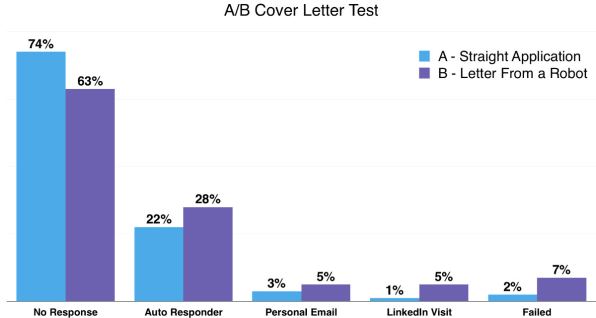
Don’t believe it? Read this: I Built A Bot To Apply To Thousands Of Jobs At Once–Here’s What I Learned. Not just to see what not to do, but what you want to do instead.

If you would like to work from home all the time, then you owe it to yourself to go here: Remote Jobs: Developer, Design, Writing, Customer Support & More
Lots and lots of jobs you can apply for that let you work remotely. Worth a look!
(Image via pexels.com)

I’m often disappointed by lists of software that supposedly help me work better. This is not one of those lists. I think the tools here are really great, and anyone with a Mac that works remotely should definitely check out this: These Are the 8 Best MacOS Apps for Working Remotely | Inc.com

The big takeaway from this fascinating article, Engagement Around the World, Charted, is that people who work on teams are significantly more engaged than people who are not.
But note the diagram above: working from home also makes people more engaged.
All managers and HR groups should take a look at this and proceed accordingly if they want higher employee engagement.

Here’s hoping you don’t get laid off, but if you do, keep this in mind: 17 things you should do as soon as you get laid off | Business Insider India
is written up, here: ATB Financial, IBM partnership focuses on digital transformation in banking | IT Business.
It was a great project, with a great team, a great client, and a great working environment. All around great. I am glad I had the opportunity to do it.
Worth reading: Senior Citizens Are Replacing Teenagers as Fast-Food Workers – Bloomberg.
Some thoughts:
I’ve had this saved from some time ago but I want to post it for two reasons: The Modern Meeting: Call In, Turn Off, Tune Out – The New York Times.
One reason is just as a placeholder for how work is now in this time period. I will be happy to go back in five or ten years from now and see how much has changed.
The second reason is that no matter what happens in five or ten years from now, people who work in offices will always struggle with meetings. There is no solution to effective meetings: there is only managing your time and how best to be effective in the time you are working and meeting. If you work with people, you will have meetings. Nowadays you have too many meetings and you need to manage them and your time as best as you can.
Once meetings were hard to schedule. There were no digital calendars, no videoconferencing. You had to call or talk to someone and arrange to meet them, they would write it down on a piece of paper, and then physically show up and have the meeting. You likely worked with a limited number of people. And even then, even though they were hard to set up, meetings were a pain. Meetings will always be a pain. If they weren’t occasionally useful, no one would ever have them.
But meetings are occasionally useful. Sometimes they are essential. As long as people work together, there will be meetings. If you are working on many different things with many different people, you will have many meetings. Try to be as effective as you can in them. For those holding the meeting, don’t expect so much of people: get what you can and then end the meeting.
Possibly, but as this article argues, there are at least three areas where robots and suck at:
Creative endeavours: These include creative writing, entrepreneurship, and scientific discovery. These can be highly paid and rewarding jobs. There is no better time to be an entrepreneur with an insight than today, because you can use technology to leverage your invention.
Social interactions: Robots do not have the kinds of emotional intelligence that humans have. Motivated people who are sensitive to the needs of others make great managers, leaders, salespeople, negotiators, caretakers, nurses, and teachers. Consider, for example, the idea of a robot giving a half-time pep talk to a high school football team. That would not be inspiring. Recent research makes clear that social skills are increasingly in demand.
Physical dexterity and mobility: If you have ever seen a robot try to pick up a pencil you see how clumsy and slow they are, compared to a human child. Humans have millennia of experience hiking mountains, swimming lakes, and dancing—practice that gives them extraordinary agility and physical dexterity.
Read the entire article; there’s much more in it than that. But if your job has some element of those three qualities, chances are robots won’t be replacing you soon.
These nine activities, listed here: swissmiss | The Bosses We Remember are nine things great bosses or leaders do continually. If you had one or more great bosses, then you likely saw that person do many of them. As you become more senior, you should do them too.
(Image via pexels.com)

A good thing to consider as you start your week is: does your work day contribute to staying well, or does it do the opposite? One way to know is to compare you typical workday to something like this one: How To Schedule Wellness Into Your Workday And Still Get Stuff Done.
You don’t need to do all the things in that article, but if you do none of them, consider incorporating some of them into your work day. I believe you will see your attitude towards work improve and your workday will feel better.
Work / life balance is important. But having a work routine that is balanced in itself is a better way to enjoy your work and stay healthy, especially during the winter months.

We all get in ruts where we use the same tools every day for our office work. When that happens, what we need is someone to come along with a new list of tools and what makes them great.
Here is such a list. I didn’t create it, but I have used 3 of the 11 tools here and I can say they are key to making me more productive every day. I plan to use the rest of them too, based on the description of them.
Sure, you can do fine with Microsoft Office tools. This list will help you do better: 11 Most Used Tools & Apps Essential to my Work – DESK Magazine
(Image via pexels.com)

Something to consider for the work week is to try and not use any of the phrases found in this piece. I can’t say I agree with their substitutions. Best to leave the cliches behind and strive for clear English.
Once we get rid of all the bad business cliches, we can strive to clean the world of bad office stock photos like the one above 🙂
P.S. If you don’t use those cliches, that’s great. Another thing to consider is starting a bingo card and score it every time you see or hear one of those cliches at work. Chances are you will fill your card by Friday.

If you suffer from the Sunday blues, whereby you spend Sunday evening dreading the upcoming week, I recommend you read this: Skip Monday Blues with Sort-Your-Life-Out Sundays – 99U. It is one way to hack your time and enjoy it more.
Another good hack is the making Thursday night the start of the weekend. Consider some of the things you enjoy doing on the weekend and schedule them for Thursday evening. Even people with jam packed weeks can do this occasionally. You still have to go in to work on Friday, but you feel you already have gotten a start on the weekend. It makes the weekend seem less stressed, at least for me.
Finally, if you feel every week is one busy day after another, try making Wednesday a night of putting everything down and just relaxing. Either pare back the things you’d normally do on Wednesday, or shift some of it to another day.
Ultimately you want to figure out how to do less throughout the week in order to enjoy each of the days in themselves, be they busy or slow. If you do that, the days you have to do things will help you enjoy the days you do not.
Pace yourself and enjoy yourself.
Ok, work doesn’t always suck, and sometimes it can be really great. But it sucks more often than it should. If you wonder why, these links can help you gain some perspective and insight.
(Image from the last link)

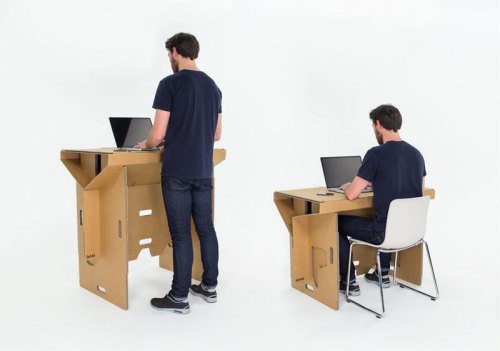
This: A Portable, Flexible and Affordable Cardboard Standing Desk over at the site Design Milk, is a great design of a desk that not only is capable of transforming from a typical to a standing desk, but is also capable of being packed up and easily transported to different locations. For standing desk fans that travel to different work locations, it might be just the thing you need.
It’s strong too. Check out the link above and see what this piece of furniture can do. Impressive.

If you are applying for a job and haven’t done so in a while, chances are you will have a difficult time with some of the questions asked of you, if only because you are expected to provide answers on topics you likely haven’t thought of in some time.
Two ways to deal with that. First, find friends who have recently gone to job interviews and get them to give you some of the questions they were asked. Second, try out some of the questions found here: swissmiss | My Favorite Interview Questions.
I should add, any place that asks you the kind of questions found at swissmiss.com is likely the kind of place you want to work.
Good luck. Ace that interview.
(Image linked to http://sscrecruitmentresults.in/hr-interview-questions-answers-freshers/)

Perhaps the hype around the standing desk is finally going to die. Here’s hoping. Based on this source, Standing All Day Is Twice as Bad as Sitting for Your Heart | Runner’s World, standing all day is no good either. It mentions an interesting study….
… just published in the American Journal of Epidemiology that finds jobs that require a lot of standing to be much worse for your health than jobs that require mostly sitting. The new study is a surprising counterweight to the ubiquitous “sitting is the new smoking” message
Like anything, standing or sitting at your job should be done in moderation. Ideally you would have a work station that allowed you to easily switch from sitting to standing (like the one in the image above from http://www.smallbiztechnology.com/). If you don’t have a set up like that, at least try and find opportunities to stand and sit throughout the day. Better still, get a walk or two in as well.
Be good to yourself and your body.
This piece in the New York Times is great advice for anyone young and struggling with networking. Is networking useless? Not at all. But like direct mail or many other forms of outreach, the effort to success ratio is far from 1:1.
If you are an extrovert, then you likely get something out of networking even if it isn’t a leg up at work. If you are are introvert, however, articles like that one are likely to make you never want to even try. For you introverts, I recommend you find ways to network that are pain free. You may not even have to directly talk to people: just be contributing to platforms that have alot of participants, you can get the benefits of networking. Networks are everywhere these days and embedded in much of the technology we use: take advantage of that fact to network in the ways most effective for you.
Hard work and luck are the keys to success. Networking is also a form of hard work, and if you work at it, it can bring luck! (After all, good luck is the residue of hard work.) Therefore include networking as part of what you are doing to be successful. Just hav the right expectation of what comes from such work.

Is this you: despite having a great resume and being really good at your job, you aren’t appreciated at your current workplace or you are struggling to find a new place to work? If so, I encourage you to read this: The Life of a Free Agent Kicker | The Players’ Tribune
It doesn’t matter if you love or hate football, it is a great example of how you need to think in order to stay positive and maintain perspective when your work situation gets tough.
You can be great at your job, you can have a record of success, and you can still be rejected by employers. It can happen to anyone. You have to stay ready, stay focused, and do your best when the next opportunity comes along. Read the article and grab some perspective.
This post on Quora has a long list of jobs unique to specific countries. For example, in Iran, there are professional licence plate blockers, like this guy:
And why doe such a job exist? You will have to read this: What is a unique job that you’ve only seen in your country? – Quora
The whole thread contains dozens of jobs you can’t believe exist, but once you know something about them, they make sense. A great read.
Put away that email you are about to send out and read this: Your Late-Night Emails Are Hurting Your Team. The same is true for the Sunday evening emails. Stop sending them.
Once you do that, look at how many emails you send out and try and find ways to reduce that, either with meetings, quick chats, or other media (e.g., internal blogs, status updates).
The result will be a better informed and a more motivated team.
It does sound too good to be true, and no, I haven’t tried it, but if you want to change your work routine, consider the pomodoro technique.

If you are still interested, there is an article on it: The Simple Technique To Fit A 40-Hour Workweek Into 16.7 Hours. I find it hard to believe, but for some of you, it may just be the thing you need to improve your work life.
The following is anuncritical and hyped-up analysis of robots, from Wired (On Cyber Monday, Friendly Robots Are Helping Smaller Stores Chase Amazon). A key quote from it is this (highlighting by me):
… (Amazon) is relying on more than 100,000 temp workers this holiday season to supplement its already massive warehouse workforce, the advantages of offloading more of that work onto machines are easy to see. Robots don’t slow. They don’t tire. They don’t get injured or distracted or sick. They don’t require paychecks or try to unionize.
Now check out this robot:
Once you get over the word “robot”, you can see it resembles alot of the other machines you see in workplaces. Machines like high speed printers, scanners and even vending machines. All of those things don’t slow, don’t tire and don’t unionize. They don’t get sick, but they break down alot, which is just the same. They don’t require a paycheck, but they do cost the organizations that use them. Sometimes they perform their function so poorly that people bypass them altogether. As well, robots need others to take care of them. An army of robots just doesn’t show up: there is an entire process of testing, deploying, fixing and replacing them that is costly and non-trivial. There is a process for deploying human resources, too, but to say that that is costly and the process of deploying robot resources is not costly is wrong.
Robots will take over some functionality in workplaces, be that function blue collar or white collar. But that is no different from alot of other machinery already in place. The difference with robots will be that they are mobile. That’s it. We should get over the notion of robot as some magical creature and just accept them as another machine.
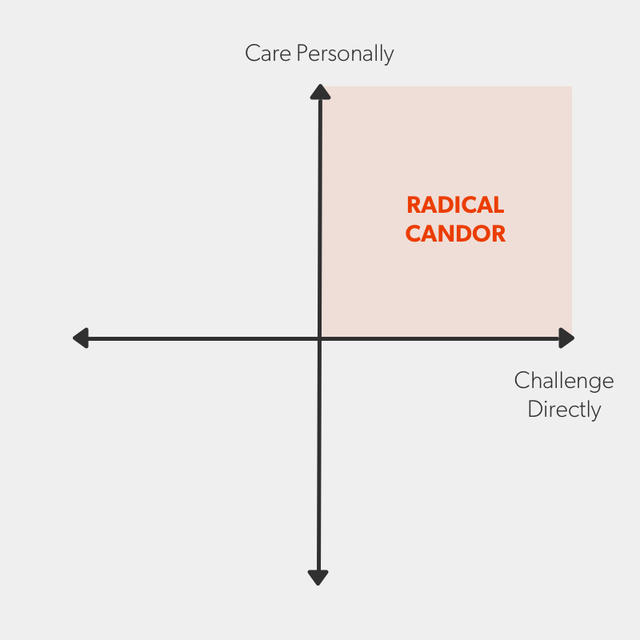
This article, Radical Candor — The Surprising Secret to Being a Good Boss | First Round Review, is making the rounds and is making my nervous. It makes me nervous because it is a terrible concept and it is very hard to do well. Even the example given – being called stupid – is a bad one. Be wary of any boss or any organization adopting this in your workplace.
My long work experience is that the Challenge Directly part takes little effort and energy, but the Care Personally part takes a lot of effort and energy. The result is a drift towards a demoralizing and toxic work environment with lots of criticism and little encouragement.
There is a rare exception where I have seen radical candor work: an elite athlete with an elite coach. Elite athletes sign up for and encourage radical candor because it is the best way to be the best. If you consider your work role similar to an elite athlete and you consider your boss an elite coach, then radical candor could work for you. Likewise if you are in the role of manager. Otherwise, I would recommend you pass on this approach and look for a better way to work.
And here over at A Cup of Jo are Six Stretches for People Who Sit at Desks
These are good stretches….even non-flexible people like myself can do them. 🙂
This piece may be the stupidest defence of Amazon’s workplace practices: Replace Just 2 Words in the New York Times Amazon Article and Something Amazing Happens | Inc.com.
Amazon employees are not entrepreneurs. There is nothing in the NYTimes.com article that gives any inkling that they are. If anything, they have all the downside of being an entrepreneurs with little if any of the upside. If someone can point out an article showing how Amazon consistently rewards employees as if they are true entrepreneurs, I’d love to read it.
There’s nothing wrong with being an entrepreneur. In fact, for some people, being an entrepreneur is the best type of work there is. Everything about it appeals to them, and working for a large corporation would kill them.
The Amazon employees are not entrepreneurs. If you want to be an entrepreneur, be one. Don’t try to be one working at a large corporation. That is antithetical to what being an entrepreneur is.
Over at Vox is your typical article critiquing multitasking: Multitasking is inefficient. Here are 6 tips for a more productive workday. – Vox.
If you do a search on the word multitasking, you will find similar articles. Like the Vox piece, they are all reasonable, and they all offer good advice.
What they all miss is why we multitask. I think there are three key reasons why we do, and they go hand in hand:
To give you an example of what I mean, consider your day. You likely have too much to do and not enough time to do it. Now let’s look at the tool you have at hand in an office. First, you have a computer and you use software like email and your browser. With email, you can start a number of tasks, but you cannot complete them. With your browser, you ask for information, then you wait for a response. If you are using a mobile device, a similar lag in request and response occurs. Now, you could just sit there and wait for a response to complete your task, but remember, you have too much to do and not enough time. As a result, you start other tasks. You are ….multitasking. You are maximizing your idle time while you wait for tasks to complete. Now you could just sit there, look out the window or go for a walk, but that would be ignoring the third point, which is that you will be penalized for not appearing busy.
If you are fortunate, you can focus on one task, complete it, and then move on to the next one. If you are like most of us, you have to multitask for the reasons above.

Vox raises that question here: All this digital technology isn’t making us more productive – Vox, and it implies that because people are slacking off on the Internet. I think that is incorrect, and here’s why.
The chart that Vox piece has shows big producitivity gains from 1998-2003 and smaller gains after that.
From 1998-2003 was the peak adoption of the Internet by companies. In the early 1990s, companies started to adopt email. In the later 1990s companies started adopting the Web. To me it is not surprising that companies would become more productive and they shifted away from snail mail and faxes to email. And then companies shifted further and started offering services over the Web, I imagine they became much more productive.
Slacking off on the Internet has been a problem since the Web came along. I know, because I used to monitor web server traffic. I don’t think that is the issue.
I think it is more likely that companies grabbed the big productivity gains from the Internet at the beginning, and then those gains slowed down after.
So what about smartphones? Have they made people more productive? I think they have, but I also think that the gains in being able to access information remotely may have been overtaken by the sheer amount of information to deal with. Being able to deal with email remotely makes you productive. Having to deal with way more email than you ever had to in the 1990s because now everyone has it makes you unproductive.
Furthermore, many of the features on smartphones are aimed at personal use, not professional use. I think smartphones make us more productive personally, but less so professionall.y
If you are highly motivated at work, that is excellent. If you are not, and need some food for thought that may help fuel you to be more motivated, I recommend this: On the Origins of Motivation at Work from The Book of Life.
I admire the work that Elon Musk does, be it Tesla, Space X, or other endeavours he takes on. I also had an opinion that the success he achieves is as close to a Given as success can be. I held that option until I read this article: Elon Musk Had a Deal to Sell Tesla to Google in 2013 – Bloomberg Business. This article shows just how touch and go it was for Musk and Tesla in 2013. Among other thoughts, it reinforced in me the notion that success in challenging areas is difficult for everyone, whether it be Elon Musk or anyone.
If you are trying to accomplish something difficult, and if you think that others have it easier than you, I recommend you read this article. I also recommend it to anyone who needs to be reminded that success is never a given, but with the right effort and focus and dedication, even the most challenging type of work can be accomplished.
The 10 questions are from this article: The only employee engagement questionnaire you’ll ever need and it is the kind of thing a manager would ask employees. But really, they are the kinds of questions you should be asking yourself.
I like the first three:
- Why are you still here?
- What would make you leave?
- Where would you be if you weren’t here? (What company would you really like to work for?)
The other seven are good too.
Anyone working anywhere should ask themselves these questions regularly.
That’s what this piece in the Globe and Mail says (Five key traits of successful consultants – The Globe and Mail), and as a long time consultant I find it hard to disagree. The traits?
You could argue successful consultants have more common traits, but these are a good basis for anyone who want to provide such services to clients. If you want to become a consultant, ask yourself if these apply to you. If you want more details on this, click on the link to the Globe.
This piece on the three day work week, Why Not a Three-Day Week? in The New Yorker explores the notion of working three and not five days a week and is well worth a read. But….
But….before you protest that you don’t work a five day week now, the better and more important question is: why do we have to work so much and so hard and why can we not have a lot more for a lot less? My own belief is that we are still shackled to a culture underlined by a Protestant work ethic and devoted to to a lower form of capitalism. We would lead better lives if our energies and our lives were devoted to more meaningful activities that addressed our higher needs, instead of tolling away to survive. The good/bad news is that even if we want to stay chained to this culture, we will not be able with the way mechanization and automation is proceeding. We need to start thinking about the way we work now, whether we want to or not.
I ask that because as you can see from these charts, in terms of impairment, there is not much difference from showing up for work tired and showing up for work drunk:
![]()
Weirdly, if you do show up tired from overwork, you may be praised: if you show up drunk, you may be fired.
Regardless, to do good work, you need to sleep. (I know, I should practice what I preach.)
Julia Kirby in HBR has more on this in this piece: Change the World and Get to Bed by 10:00. You’ll be convinced to go to bed earlier by the time you finish it.
If you think LinkedIn is a waste of time and something no one uses, think again. For starters, check out this chart:

More and more companies and people are using LinkedIn.
You might counter: I have never heard of anyone getting a job on LinkedIn. To that I say that people are losing jobs to LinkedIn, in that HR and others are using LinkedIn as a screening process. Good use of LinkedIn might not get you a job, but poor use of LinkedIn might lose you a job.
I’d add that lots of recruiters use LinkedIn, more than you think. The better your profile, the better chance you have to get linked in with someone with a new and better job for you.
Lastly, LinkedIn is becoming a longer and better version of a resume. Just like you should have an up to date version of that, you should have an up to date version of your career highlights on LinkedIn.
For more on this topic, and to see where I got the chart, go to The Economist’s excellent tumblr