You can still read the news and follow along, state by state, but what really matters more and more is the delegate count.
One thing that surprised me: right now, Ted Cruz is alot closer to Donald Trump than I imagined. Obviously there is a way to go still, but he is doing well. Will Cruz win? I think the odds are against him, but right now they are not insurmountable.
As for the other side, I believe Hillary Clinton is going to win, regardless of the Michigan surprise showing of Bernie Sanders. Sanders is performing better than many imagined, but she has a big lead in delegates and that will only get larger as we go along.
If you are not familiar with Unix, then you might wonder why you would want to create tarballs and then gzip them. Recently I had a directory that was over 12 GB in size and I wanted to zip it up and send it to someone. By creating a tarball from it and then gzipping it, I was able to shrink it down to under 5 GB. That made it alot easier to send to the person.
Another reason to do this is you want to send a file from Windows to Unix. By compressing the file this way, you can be sure that the Unix user can uncompress it in a straightforward way.
If you were wondering why Python programs often have this: `if __name__ == “__main__”:` and then a call to a function, a good explanation is here.
In short, if your program is used as input to other programs, then you want to have that snippet of code in them. If your programs are standalone, you can get by without it.
It’s 2 and a half minutes. What? You don’t have time? You have time to get a coffee. You have time to check your phone. You have time to read your inbox again. So you have time to watch this. Don’t play basketball? It doesn’t matter. Check it out.
Work harder. Think harder. Try harder. Fail harder. Be better.
My take is a simple one: most people are interacting less on Twitter. This likely leads to people contributing less on Twitter, which leads to a downwards spiral. I see this on other social media as well.
The one exception to those interacting less are active self promoters. Self promoters, whether doing it personally or professionally, are still interacting regularly with social media such as Twitter. After all, it’s free and it’s better than doing nothing.
Overall, though, I expect there to be a decline in use of all kinds of social media, until someone can invent a social media that is more effective than what we have today. That may be a few years off.
If you are going to talk about the Web or the Internet, it pays to know the history of it. The people at Pew put together the key dates and events of the World Wide Web here: Web History Timeline | Pew Research Center. Of course the history of the Internet is even older.
A very useful thing to consult whenever you read some think piece on “The Internet used to be X or Y”.
This popular science is a good primer on the TV: Will This Be The Year 4K Catches Fire? | Popular Science. As well, it talks about the direction of TV resolution, including 8K. (Yes, 8K!) Before you buy a new TV, check this article out.
When you hear of companies like Apple having their money offshore, you might imagine piles of gold bullion or paper bills sitting in a physical bank somewhere in Switzerland or Ireland. More likely that money is residing in one of the big banks head-quartered somewhere in the United States. (For that matter, it is likely residing as so many numbers in a computer run by one of these banks and not piles of paper or gold.)
For some time, I have been complaining that cappuccinos have evolved into something I call “latte-ccinos”, which is a drink that is somewhere between a latte and a cappuccino. Good to see that the New York Times has a piece on it highlighting the sad state of North American coffee and in particular the sham cappuccinos now commonly served.
But what is a true cappuccino? As the Times points out, there is a debate about what it is:
There was a time when cappuccino was easy to identify. It was a shot of espresso with steamed milk and a meringue-like milk foam on top. … “In the U.S., cappuccino are small, medium and large, and that actually doesn’t exist,” the food and coffee writer Oliver Strand said. “Cappuccino is basically a four-ounce drink.” … Others cling to old-school notions of what makes a cappuccino, with the layering of ingredients as the main thing. “The goal is to serve three distinct layers: caffè, hot milk and frothy (not dense) foam,” the chef and writer Mario Batali wrote in an email. “But to drink it Italian style, it will be stirred so that the three stratum come together as one.”
I agree with Strand: a cappuccino should be a small drink and the espresso, milk and foam proportional.. If you want a bigger drink, get a latte. And if you want a true cappuccino, find a good Italian establishment — in Toronto, Grano’s makes a superb one — and get your fix there.
Once you do that, look at how many emails you send out and try and find ways to reduce that, either with meetings, quick chats, or other media (e.g., internal blogs, status updates).
The result will be a better informed and a more motivated team.
This piece, The Selfish Side of Gratitude – The New York Times, is a scathing attack on gratitude by Ehrenreich. She makes some good points, but overall the writing is so dismissive, from the references to yoga mats to the numerous quotation marks around so many things, that I didn’t find it persuasive. No doubt some abuse the notion of being grateful, but I think there is more too it than a form of evasion. Read it and see if you agree.
My criticism of gratitude is smaller. My problem with the notion is that it isn’t as useful for me. I think there are better words for expressing how I feel, like glad or appreciative. Gratitude in the context of other people is subservient. I do not look down on the people who provide me a service, nor do I think they should think themselves somehow superior. Likewise if I do something for you, I don’t expect you to be grateful: if you are appreciative, that’s enough. And gratitude for certain aspects of nature or the universe make no sense if you are not religious.
There are people who I am grateful towards. Most of the time I can use other words to describe my feelings toward them and what they do. Grateful and gratitude are two words that should be used less often.
If you’ve decided to become more fit, work better, or be better generally, then consider these resources to support you as advance towards achieving your goals:
This is the first I’ve heard of a major failure for Uber: Uber’s No-Holds-Barred Expansion Strategy Fizzles in Germany from The New York Times. The focus is the city of Frankfurt, but in other cities in Germany and cities elsewhere throughout Europe, Uber seems to be getting serious push back. It seems tactics that have worked well in North American cities (and likely elsewhere) are backfiring in the cities mentioned. Whether you love Uber or hate it, this NYT story is worth reading.
And the journalists at Wall Street Journal have been leading on this story for some time now. Their latest piece, which is a good summary of what has been happening recently with the blood testing company is here: At Theranos, Many Strategies and Snags – WSJ.
Everything I see leads me to believe this will be a debacle. It’s hard to tell, since Theranos consistently defends themselves against the many charges against them. Perhaps they will come out successful in the end. I think we’ll find out soon enough.
If you want to get started running, first see your doctor and make sure you can without any risk to your health. Assuming you are cleared, then check out these worthwhile links and get ready to hit the road:
A year or so ago, a parking lot I use had a human in a booth to take tickets and provide other services. That human booth was replaced by the thing in the photo above.
It’s not a robot and it’s not A.I., but it is replacing humans.
Stories about A.I. or robots taking over work makes them interesting. It’s also secondary to the real story. What is really taking people’s jobs is a willingness of others to use technology, and a willingness of companies to replace people with technology. People are not afraid to use technology. If anything, sometimes they prefer to deal with technology. This makes it easier for companies to go with technology as compared to using people, and if companies can save money or make money, so much the better.
It is happening in all sorts of industries, from food to sportswriting. The technology isn’t the driver of this: it’s the willingness of people to prefer technology that is the driver.
… (Amazon) is relying on more than 100,000 temp workers this holiday season to supplement its already massive warehouse workforce, the advantages of offloading more of that work onto machines are easy to see. Robots don’t slow. They don’t tire. They don’t get injured or distracted or sick. They don’t require paychecks or try to unionize.
Now check out this robot:
Once you get over the word “robot”, you can see it resembles alot of the other machines you see in workplaces. Machines like high speed printers, scanners and even vending machines. All of those things don’t slow, don’t tire and don’t unionize. They don’t get sick, but they break down alot, which is just the same. They don’t require a paycheck, but they do cost the organizations that use them. Sometimes they perform their function so poorly that people bypass them altogether. As well, robots need others to take care of them. An army of robots just doesn’t show up: there is an entire process of testing, deploying, fixing and replacing them that is costly and non-trivial. There is a process for deploying human resources, too, but to say that that is costly and the process of deploying robot resources is not costly is wrong.
Robots will take over some functionality in workplaces, be that function blue collar or white collar. But that is no different from alot of other machinery already in place. The difference with robots will be that they are mobile. That’s it. We should get over the notion of robot as some magical creature and just accept them as another machine.
What you want to do next is head over to Mashable.com and read this: The 100 best iPhone apps of all time. Apps make your iPhone much better. While you likely have heard of a certain percentage of them, but most you have not. Get them and make your phone better.
This article, Will Body Cameras Work? – The Atlantic, is asking the wrong questions. The wrong questions are occurring because the initial answer to the question of “how do we deal with bad policing?” was often, “body cameras”. The better question to repeatedly ask: “how can we make police more accountable?” because if “body cameras” is the first answer to that question, the next question should be concerning the information captured by those body camera. How are police accountable for that? Which should then lead to another question: how are police accountable for information they capture generally? Because with new technology, police will soon be able to capture alot more information about you than just images. It will soon be possible for police to look at you or your vehicle and have that information feed back to centralized computer systems, essentially collecting information about you without you even knowing it. How will police be accountable for that?
Police accountability will come, likely through the courts. In the meantime, we will likely struggle with the fallout of police forces capturing more information.
It looks like the Fed in the US is going to raise rates. It is highly arguable whether it is a good idea. For a long time, it was a bad idea. Despite that, commercial banks recently have been arguing for the Fed to raise rates. Now whatever reasons they have been given, the true and underlying reason is mentioned here: Why Bankers Want Rate Hikes – The New York Times.
It is more difficult for banks to make money with lower rates. Higher rates make it easier for them to make money. Hence the push by some of them to raise the rates.
Banks aren’t stupid: they don’t want the economy to tank: they don’t make money that way either. But the sooner rates rise, the easier it is for them. Here’s hoping the US Fed continues to be smart enough to resist the pressure and do the right thing for the American economy.
Uber is a global logistics company based on sophisticated computer technology. It takes a modern software approach to delivering services. That’s the key thing to know about Uber.
Uber is not:
an app. The app is just your entry into the services that Uber provides. Behind that is the sophisticated computer technology that really makes it work.
a taxi service. Uber is a logistics company. “Logistics is the management of the flow of things between the point of origin and the point of consumption in order to meet requirements of customers or corporations” (Wikipedia). That’s what Uber is. If there is something that needs to get from A to B, Uber will do that. It could be people, it could be food, or it could be goods. Regardless, Uber is capable of doing that. If that is what your business does too, you will be competing with Uber.
local. Uber is not interested in just your city. Uber will disrupt your city, but it is not focused just on where you live. It is a global company looking to provide services globally, one city and territory at a time.
Finally, Uber is delivering logistic services, but it is delivering them the way other companies deliver software. That means it is going to take VC money and rapidly deploy service after service, upgrade after upgrade, to do what it needs to do to be successful. It doesn’t need to be profitable. It does need market share. If market share comes at the expense of your logistic services, so be it.
Lots of people talk about Uber. If they are not thinking this way, they are missing the bigger picture.
Earlier I wrote about how I don’t think Apple will get into the car business. However, after reading what Munster said, I can see how others think Apple will get into cars. Specifically, here’s are the pro-car points he makes:
Apple could align with and compete in the BMW market: BMW sold 1.8M cars in CY14.
If Apple priced them at $75K, 1.8M cars is $135B in revenue
Apple could start small: sell 30K in first year (similar to Tesla’s 35K in CY14)
In a market of 88M cars in CY15, 1.8M cars is nothing
The approach laid out in those points is a similar game plan that Apple followed in the smart phone market.
The more I thought about it, the more I am leaning towards Apple getting into the car business, at least in a limited way. The bulk of the market would not be Apple and there likely would still be lots of car manufacturers after Apple jumps in, just like there are many smartphone makers. But Apple would take over the most profitable part of the car manufacturing marketplace.
Read the analyst report: you will get great insight into where Apple is heading.
Michael Massaia spends his sleepless hours haunting NYC and Central Park, taking incredible photos. This is just a sliver and doesn’t do his photos justice:
Mr. Zuckerberg’s pledge is incredibly generous. But it is also likely to involve some very savvy tax planning.
It’s true, the donation is incredibly generous. You can use all the superlatives you want, and it still amounts to something out of the ordinary. Is the donation financial savvy? Of course, but why shouldn’t it be? Either way, will it be spent well? Possibly, possibly not. For that, we will have to wait and see.
As I read people arguing against the donation, I thought about what the alternatives could be. One alternative is no donation at all. Plenty of very rich people donate only a small fraction of their money to good causes. Young billionaires aspiring to be large benefactors is something that should be encouraged, not discouraged. Another alternative is donations to political causes I disagree with. Quite a few billionaires do that. I prefer to see the billions directed otherwise.
As for people arguing for the donation, I wondered if they considered the alternative of the donation going to taxes or charities. Perhaps Zuckerberg will be very good with directing the money, better than the state or NGOs. I’d like to see a good portion go to them, though. Too little of the wealth of the 1% (or .01%) go to paying taxes that pay for a lot of things like social services and health care and the military and infrastructure. More money to pay for those things would be better. Likewise, well run charities are already up and running and could spend the money in efficient ways that a new organization cannot.
This donation is a positive thing, but you should still be able to think critically of it. Mark Zuckerberg is a smart guy and he’s maturing. Let’s hope he uses his good fortune to do good in the world.
Facebook is a company. It’s not Mark Zuckerberg. It’s not an app you use on your phone. It’s a collection of services that is growing rapidly and it may be poised to grow at even crazier rates than it has now, if you believe what is in this piece, Inside Mark Zuckerberg’s Bold Plan For The Future Of Facebook. Key point it raises:
The Facebook of today—and tomorrow—is far more expansive than it was just a few years ago. It’s easy to forget that when the company filed to go public on February 1, 2012, it was just a single website and an app that the experts weren’t sure could ever be profitable. Now, “a billion and a half people use the main, core Facebook service, and that’s growing. But 900 million people use WhatsApp, and that’s an important part of the whole ecosystem now,” Zuckerberg says. “Four hundred million people use Instagram, 700 million people use Messenger, and 700 million people use Groups. Increasingly, we’re just going to go more and more in this direction.”
Reading this, you get the sense of a company that is going to bigger in a few years than it is now, which seems incredible to me. Note this article: it will be worth revisiting in a few years.
That said, there are a few points I’d like to add:
I actually think that Facebook the app/website is declining in active usage. It is very clever showing you things people like, even if people you know aren’t posting things. You get a sense of activity on Facebook the app/website whenever you log in. You never get the sense that it is not being used by people, even if many of the people you follow aren’t actively contributing at all. I suspect if you dropped your Facebook friends down to next to none it would still show you the same amount of information. If Facebook the company is going to remain successful, it needs to diversify from it’s main service.
It is interesting that people continue to compare Twitter to Facebook. To me, there is little to compare. Facebook seems to have a better growth plan and even have a better app. If Facebook the service declines, the diversification into places like WhatsApp and Instagram is strong in a way that is unlikely to be matched by services like Vine or Periscope. While there is some commonality between the two companies, I think the story of their divergence will become a bigger one over time. Contributing to that big difference is Facebook remains a stable company with a stable leadership while Twitter’s leadership remains chaotic and unstable.
The narrative in that story is very optimistic. If the numbers for any of those organizations start to slip, I could see the narrative changing, just like it has for so many IT companies. Right now the narrative is: Facebook is a very successful company and it is going to become more successful with all these promising ideas. The narrative can easily become: Facebook is a very troubled company and it is going to become more troubled with all these ideas doomed to fail. (See Yahoo! for an example of such a narrative.)
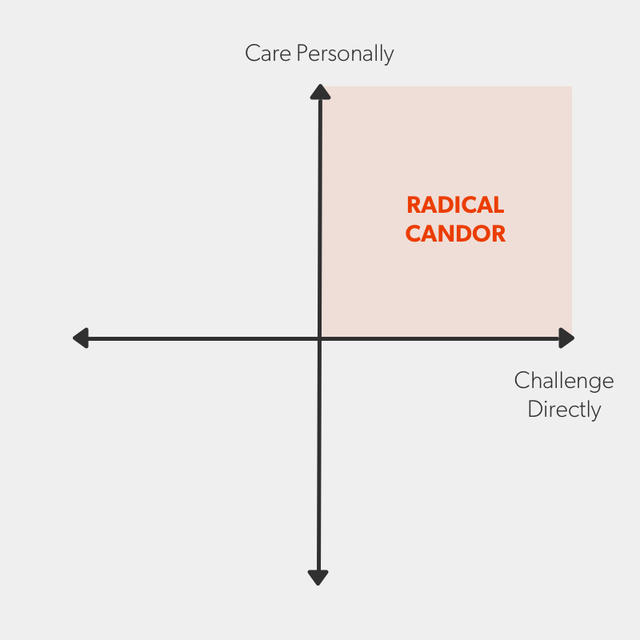
This article, Radical Candor — The Surprising Secret to Being a Good Boss | First Round Review, is making the rounds and is making my nervous. It makes me nervous because it is a terrible concept and it is very hard to do well. Even the example given – being called stupid – is a bad one. Be wary of any boss or any organization adopting this in your workplace.
My long work experience is that the Challenge Directly part takes little effort and energy, but the Care Personally part takes a lot of effort and energy. The result is a drift towards a demoralizing and toxic work environment with lots of criticism and little encouragement.
There is a rare exception where I have seen radical candor work: an elite athlete with an elite coach. Elite athletes sign up for and encourage radical candor because it is the best way to be the best. If you consider your work role similar to an elite athlete and you consider your boss an elite coach, then radical candor could work for you. Likewise if you are in the role of manager. Otherwise, I would recommend you pass on this approach and look for a better way to work.
March 2026: a good example of that rare exception happened when Maryland coach Brenda Frese went viral for yelling at Oluchi Okananwa during the 2026 NCAA basketball tournament. During the game, people watching the game were alarmed as the coach got in the player’s face and poked her with a finger. ‘“I believe in you,” Frese said forcefully, “but you’ve got to want this moment!”’ The entire article is a great example of how radical candor does (and does not) work, depending on the relationship and boundaries set up to make it work.
That review,here, is worth reading for anyone watching or interesting in watching the Amazon Prime series.
Anyone interested in works based on the novels of Dick should focus on this key quote (I added the emphasis):
Pop culture has exalted many of Dick’s wilder stories and novels. Since the release of Blade Runner (1982, based on the short novel Do Androids Dream of Electric Sheep?) and Total Recall (1990, based on the story “We Can Remember It for You Wholesale”), his pet motifs of false realities and artificial identities have captivated filmmakers. …Along the way to becoming popcorn entertainments, Dick’s motifs have shed a lot of their existential baggage. Today, the revelation that capsizes everything a movie character once believed about himself and his world is just another mind-blowing plot twist. No sooner have we gasped Whoa! than the film has moved on to the next chase scene, martial-arts display, or explosion. Nobody sits around questioning their own reality or humanity the way Dick’s protagonists do. Those questions, however, were the whole point of Dick’s fiction
That’s a great critique of even the better works based on Dick, like Blade Runner. Whenever you see or plan to see a film or TV series based on one of his works, it’s better if you can read the novel first. Doing so will add much more complexity and richness to whatever you are about to see.
…it makes no business sense. A key take away from the article linked to below:
Ford’s revenue and operating income: $134 billion, 3.9%. Apple’s corresponding numbers: $234 billion, 40%! Or consider the world’s two largest car companies, Toyota and Volkswagen, both of which hover around $200 billion in revenue. Toyota just reported a higher than usual 10% net profit versus Apple’s 22.8%. The Financial Times recently pegged the VW brand’s operating margin at about 2%. (We’ll see how the German auto giant, which was ever so close to taking the industry’s Ichiban ranking from Toyota, extracts itself from its current engine management software troubles.) Yes, the car industry is large (around $2 trillion—that’s two thousand billions), but it grows slowly. In 2015 it saw 2% annual growth—and that was considered a good year.
There are so many other lines of business that could bring more revenue and profit to Apple. Unless the car business changes dramatically — and that is possible — then I can’t see how it makes any business sense for them to become car makers.
When I first started off as a father, I was like a climbing rock: durable, constant, capable of bearing heavy loads.
As my children mature, I find I am more the attendant. I watch their events, I monitor their behavior, I whisk away what is unwanted, be it spiders, dirty dishes, tears, anxiety.
In time they will be independent. I will hover around, like a ghost, a memory, reminding them of what is good in them and their past. I will be there but not there.
This is the life of fathers.
—————–
Written on my BlackBerry Handheld to my old Posterous blog, October 12 2011, 7:34 PM
Simple: they are a complex piece of technology. The photo above shows a Macbook charger from Apple on the left: the charger on the right is from another company. You can clearly see that the one from Apple has a lot more technology packed in there. And for good reasons. To understand what those reasons are, see this piece: Macbook charger teardown: The surprising complexity inside Apple’s power adapter. It was surprisingly interesting, from an engineering and design perspective.
Thanks to Tom Plaskon for sharing this on Twitter!
An uplifting social media rumor about the purportedly heroic actions of a security guard named Zouheir during the Paris attacks was largely inaccurate.
It’s well known that Drake has suffered alot of mockery for his dancing in the video for Hotline Bling. This is too bad, because for whatever criticism you can raise for Drake’s dancing, he is no worse than most major pop stars when it comes to dancing. So what’s the problem?
The problem, I see it, is in the directing. Here is the Hotline Bling video. Count the length of the average shot. When I did it, it was in the 5 to 10 second range.
Compare that to Ariana Grande’s Focus video.
Count the length of each shot. The longest is usually no more than 3 seconds: the rest are 1 to 2 seconds. Is she a good dancer? It’s hard to tell. If you go to around the 3 minute mark, you seen alot of dancing, but the shots are still short and the camera is constantly moving. Any short coming in the dancing can be made up for in the editing room. And I’d argue that the Focus video is typical of most videos: very short cuts with lots of camera movement.
Now, it’s possible the director wanted the longer shots due to the changing nature of the lighting. But there is a similar use of dramatic lighting in Justin Timberlake’s Let Me Talk To You/My Love and he comes across well with no loss to the lighting effect
And like Ariana Grande’s video, this video has the performer do well defined step in a 1-4 second shot and then cuts away. This is typical of many music videos. (Yes, JT does have an extended dance routine at the end of My Love, but most of the video is all quick cuts….also, he has been dancing since his early days as a Mouseketeer :))
Drake would have been better off with shorter cuts and simpler dance moves, the kind of thing you find in most other videos.
If you hang around with or are involved in some way with IT people, you will come across individuals extolling the virtues of being a “Maker”. Making things (typically software or IT systems) is seen as a virtue, in some case one of the highest virtues, and the implication is that makers are virtuous people.
A well written critique of that is here: Why I Am Not a Maker – The Atlantic. If you consider yourself a maker or aspire to be considered one, you should read it. A key point is this:
When tech culture only celebrates creation, it risks ignoring those who teach, criticize, and take care of others.
This is true: tech culture sometimes places little or no value on other activities, such as the ones that the article mentions.
My main criticism of the article is that it has a blind spot for the middle ground. I know plenty of creative people whom I consider makers that also take care of others, teach, manage, administer…you name it. Often time the things they make are superior to those of people who devote themselves to being makers.
Being a maker is a virtuous thing, for the most part. But so is teaching, providing care, managing, cleaning, coaching and many other positive activities. Find the thing you are good at and contribute positively in your own way. If you can make some things along the way, all the better.









 Smart People I Know