Is warning people about how much exercise it takes to work off a meal a good idea?

According to this, it is: ‘Four hours to walk off pizza calories’ warning works, experts say – BBC News. For example, if you were to buy a pizza or a chocolate bar, they argue that…

Appreciating it would take four hours to walk off the calories in a pizza or 22 minutes to run off a chocolate bar creates an awareness of the energy cost of food, they say.

That’s true. But it’s also not a great comparison. It’s pretty much a given that exercise is not a great way of losing weight, so most foods will come across as requiring a lot of exercise to work off the food. And it may be a lot more exercise than most people do. This will just end up shaming more people than it benefits.

I think a better approach would be to highlight what percentage of your recommended caloric allowance a selection of food is. I believe this would be much better. Foods have something similar already: they tell you what percentage of vitamins, fibre, etc. a selection of food provides for your diet. They could do the same thing with calories. Hey, on some days when you hadn’t had much to eat, something that provides you 50% of your daily calories may be fine.

No matter what, providing health guidance is never simple. But if I had to decide, I’d go with percentages.

Mechanical Kiwis, or how the Kiwi’s food delivery bots are only semi-autonomous


Looks like autonomous robots have a way to go. So while Kiwi’s food delivery bots are rolling out to 12 more colleges (TechCrunch), they aren’t exactly autonomous robots. Instead…

The robots are what Kiwi calls “semi-autonomous.” This means that although they can navigate most sidewalks and avoid pedestrians, each has a human monitoring it and setting waypoints for it to follow, on average every five seconds. Iatsenia told me that they’d tried going full autonomous and that it worked… most of the time. But most of the time isn’t good enough for a commercial service, so they’ve got humans in the loop. They’re working on improving autonomy, but for now this is how it is.

The future is weird. Also, good luck with those in places with hostile weather, architecture, or people.

Friday night cocktails from Alison Roman


You might argue that spritzers and shandies are not cocktails, but that is just classist nonsense! 🙂 Besides, not everything needs to be prepared by a fancy mixologist. These cheap and cheerful mixes may be some of the best things to drink during these late great summer days.

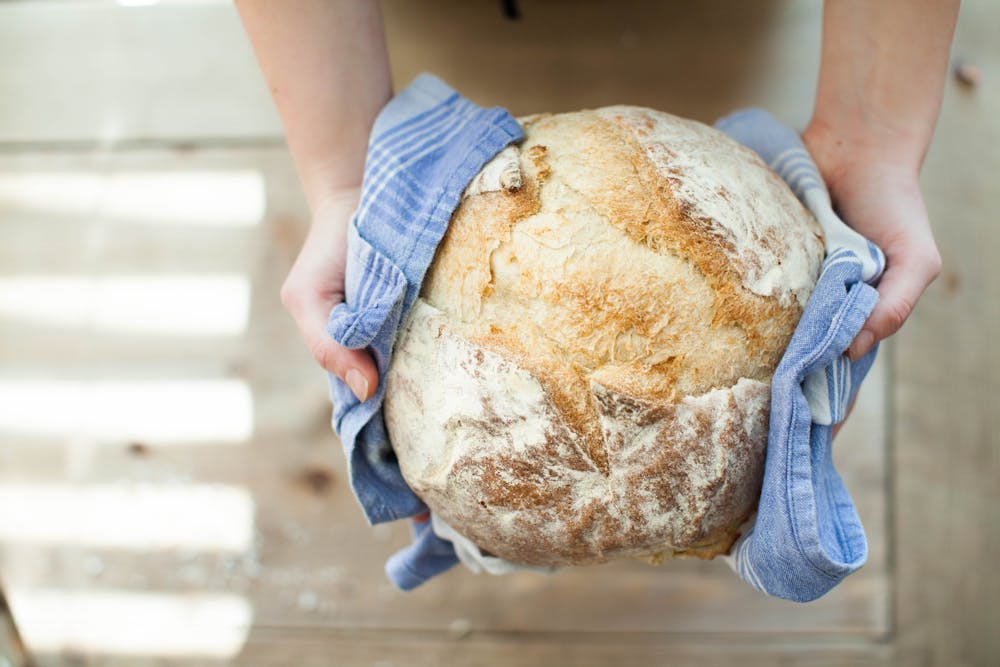
What is happening with bread and how certain men mess it up and why it doesn’t have to be that way

I started thinking this when I read this: How Tech Bros Fell in Love With Baking Bread – Eater.

First thought, I think this is something tech bros do to any subject area they stumble into: they are the equivalent of European explorers “discovering” places that have been inhabited for ages. Second thought, there is something patriarchal about men discovering and improving something as basic as bread.

I love bread. I think everyone would get joy out of learning to make it. And while you can really do amazing things in breadmaking, it should not be seen as something only the rarest of bakers can do.

To get you started, here is a bunch of recipes that are simple and varied. Good luck!


In praise of long recipes


Two pieces recently make the case for long recipes. This one, directly: The Case for Very Long Recipes | TASTE. 

And this one, indirectly:  Jerk Chicken So Good I’ve Been Making It Every Summer for 25 Years – The New York Times

The first one makes the direct case that long detail makes for a better recipe, and I agree with that. If you just need a list of ingredients and short steps, go to allrecipes.com and you can find it. If you want to know why things are done a certain way and why certain ingredients are used and how they should be cooked, then a long recipe is preferable.

The second one, by Gabrielle Hamilton, makes the case indirectly. The recipe comes at the end of a long essay that explains the origin of it. You could just read the recipe, but you’d be missing out on so much if you just did that.

I get why people hate long recipes. Not everyone who writes a long preamble before a recipe can writes as well as Hamilton. But it would be a shame if cooks stopped trying.

One site that does this really well is BudgetBytes.com. She has a button at the top that let’s you jump to the recipe, which is in the middle of the piece. At the top of the piece is her thoughts on the recipe. Then the recipe. Then detailed instructions on how to prepare the dish. Smittenkitchen.com also does long recipes, and they are also really worth reading through.

Image from here.

Is it the beginning of the end of the beef industry?


It sounds hyperbolic, but this piece makes a very strong case for that fact that it is: This Is the Beginning of the End of the Beef Industry | Outside Online

For pro-beef fans, consider this (emphasis is mine)

Sure, steak is great, but ground beef makes up 60 percent of beef sales, and most of it is more Salisbury than salutary, a greasy vehicle for the yummy stuff: ketchup, mushrooms, pickles, bacon, sriracha mayo. I knew I wouldn’t object if my central puck came from a plant, as long as it chewed right and tasted right. I suspected others might feel the same.

Even if people don’t go entirely vegan or vegetarian, there is going to be a lot less beef sold in the future, in my opinion.

Read the article: it’s great.

On appreciating established restaurants


A thought provoking piece on how we spend too much time on new restaurants and not enough on established ones: Why we should ignore the buzz surrounding new restaurants and give proper due to the ones that have lasted | National Post.

I think this is true. I pay attention to new places and hot places and places closing, but places that are great day in and day out I pay less attention to. I suspect many people are like that.

It would be great if publications that write on restaurants periodically round up places that are consistently great would write about them.

Eating less meat will have a positive effect on climate change. The collapse of the Soviet Union showed this.

Eating meat is a significant contributor to global warming.  I knew this, but the chart above and the article below really drove this home. As the Soviet Union was collapsing, people in that region started eating less meat. The result was a drop in carbon emissions. Now imagine if that was replicated worldwide for many years.

There’s actions we  can take to attack global warming. Eating less or no meat is one of them. For more on this, see: Soviet Union’s collapse led to massive drop in carbon emissions

The rise and fall of French cuisine?

So says this article: The rise and fall of French cuisine | Food | The Guardian.

I tend to disagree with the pessimistic assessment, but regardless, I recommend the piece because it really does cover what has happened to food and cooking in the last 50 or so years. For people who love food, it’s a worthwhile read.

I think the decline of French food is relative. So many more cuisines have been discovered and appreciated, from Italian to Vietnamese, that French cuisine has competition for people’s attention. That comes across in this piece: Bon appétit! How I rediscovered the joys of French cuisine | Food | The Guardian.  

It’s a good thing we have so many people writing and thinking and preparing food in new ways. French cuisine may no longer be dominant, but it is still great. And if you are going to Paris,  then check out this list of David Lebovitz for what he recommends in his city.  Or this list, somewhat dated, may still have value:
Top 10 budget restaurants and bistros in Paris | Travel | The Guardian

A marathon for food lovers: Marathon du Médoc

Not your average marathon, this. For example:

Marathons and footraces are a world of granola bars, blister care, and sugary packages of energy-giving goo. This classic French race through wine country has all that, as well as a party atmosphere and 23 stations that offer wine, cheese, oysters, and foie gras, often set out like a tasting at a picturesque winery. The tone is set the night before, when participants tend to complement the traditional carb-loading pasta dinner with healthy helpings of local wines. Each year’s race has a theme (think “Amusement Park” or “Tales and Legends”), so don’t be surprised to see a runner dressed as Robin Hood vomiting at mile five.

If this sounds like you kind of marathon, get more information here:  Marathon du Médoc – Gastro Obscura

Two thoughts on Jamie Oliver’s U.K. Restaurants Declare Bankruptcy

One, It’s always terrible when this type of thing happens: Jamie Oliver’s U.K. Restaurants Declare Bankruptcy – The New York Times.  

But two, I am curious about what has been happening with his businesses based on this:

… his British restaurants ran into financial trouble in 2016 and got into such dire straits that Mr. Oliver had to inject millions from his own savings to salvage the business. Even then, he had to close about 20 restaurants and pizzerias in the months that followed.

What has been happening in the past three years? I remember reading that at the time and it seemed like they had turned the corner at were going to be ok. They turned a corner but they were the opposite of ok.

I’d really like an in depth article of what happened.

Five links to help you with intermittent fasting

It’s not for everyone, and you can make a case that it is not a good way to be healthy or lose weight. But if you are interested in knowing more about it, here’s some good links I’ve found on this form of fasting.

  1. Intermittent Fasting for Beginners – The Complete Guide – Diet Doctor
  2. The Easier Way to Do Intermittent Fasting – Elemental
  3. Fast Diet facts and science – Business Insider
  4. Intermittent Fasting: What Is It, and Should I Try It? – GQ
  5. Intermittent Fasting: The Definitive Guide – The Mission – Medium

Bonus link, here


11 Easy Pesto And Salad Dressing Recipes | Chatelaine


If you find yourself in a cooking rut, steaming or sauteing the same basic meals, then here’s a suggestion. Make some of the pestos and dressing here (11 Easy Pesto And Salad Dressing Recipes | Chatelaine) and add them to whatever it is you are about to eat. A bowl of steamed vegetables or a plain pork chop transforms into a better meal. Later, you can mix some with mayo or yogurt and add it to a sandwich of your preference. Even a plain green salad is elevated.

(Image: Eric Putz, from a link to their web site)

Bon Appétit pays homage to red sauce restaurants

Bon Appétit has a rich list of articles and photos paying homage to red sauce restaurants in America. You likely know this type of joint. It has:

The oversize portions. The red-and-white-checked tablecloths. A carafe of the house red. Old-school Italian-American restaurants, a.k.a. red sauce joints, are the kind of institutions you’ll find, with very few deviations, in just about any city in America. But as we discovered upon reaching out to dozens of writers, chefs, and celebrities, these restaurants are about a lot more than a plate of penne alla vodka. Whether or not you’re Italian, red sauce likely means something to you—about family, or home, or history, or politics, or class, or citizenship, or selfhood, or otherness, or all the above, or a million other things. And that’s what this package is all about. Welcome to Red Sauce America.

For a feast of this type of dining, see here: Welcome to Red Sauce America – Bon Appétit. 


A great list of interchangeable ingredients to turn to when you are cooking, from Mark Bittman

Is this list.

Print it off, leave it in the kitchen, add your own items.

I often use sriracha for dried chilies, or even any hot sauce, for when you just need some heat. Likewise, if you don’t have jalapenos, you could also replace them with some of other heat source. (If it is a lot of jalapenos, you might use regular peppers with some chilies or other hot things to add the appropriate level of hotness.)

Finally, I’ve seen people suggest replacing creme fraiche with full fat greek yogurt.

My new favorite dish: Andrea’s Pasta with Pork Ribs from Mark Bittman

I made this last week and I’m thinking of making it again this weekend, it’s that good: Andrea’s Pasta with Pork Ribs, via Mark Bittman.

It has all the benefits of a good marinara dish, but the ribs really take it to a whole different and higher level. It is especially good with cheap pork ribs that might not make sense grilled due to being an odd shape. Those ribs are perfect here.

If you want, add more garlic…I added twice this amount. I also threw in sprigs of fresh herbs too. I went with basil, but I am sure rosemary or thyme or marjoram would be great.

I also doubled the ribs and I took  half, deboned them, then chopped them into bite sized pieces and added them to the sauce. The other ribs I garnished the pasta with.

Finally, since you have so few ingredients, try to use really good tomatoes and cheese. You can skimp on the ribs and get gnarly ones because they will still taste great, but the tomatoes especially make a huge difference here. Same with the cheese.

Superb.

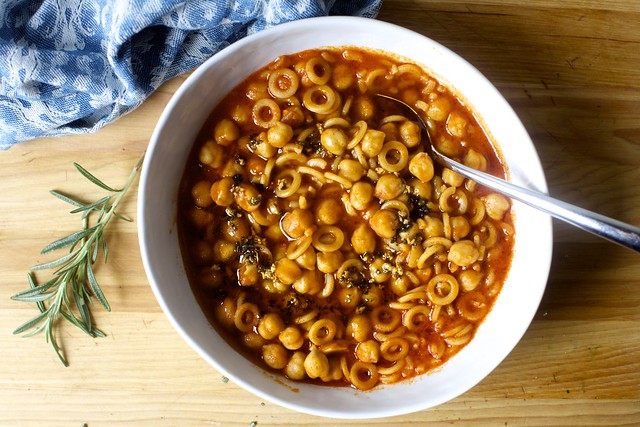
The joy of midnight pasta

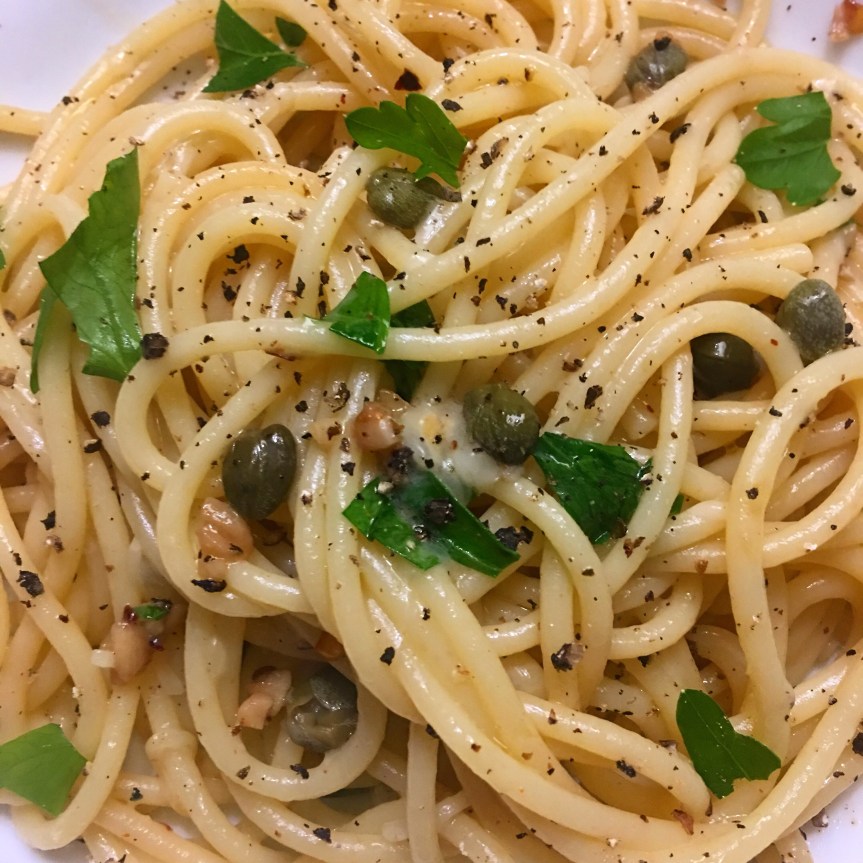
If you are busy, or don’t feel like cooking much, or don’t have much in your fridge, then this pasta recipe is for you. It’s hard to believe something this simple could be so good, but it is. Lots of flavour with very few ingredients, ingredients you can have in your pantry.

Give it a try, especially when you are short of time, money, or food.

The photo is of the dish I whipped up one night.

10 Spectacular Roast Recipes That Aren’t Turkey

Many people

  1. want to make a roast turkey for Christmas
  2. do not want roast turkey

If that’s you, Chatelaine has your back with this:  10 Spectacular Roast Recipes That Aren’t Turkey | Chatelaine.

They truly are spectacular recipes, perfect not just for Christmas but any time of the year (ahem, winter) when a good roast is just what you need.

Cook90: a goal for the new year

Can you cook 90 meals in a month? For many it sounds daunting. I like to cook and even I am not sure that I could do it.

If you like a challenge and the idea of it, there is a book you should consider: Cook90: The 30-Day Plan for Faster, Healthier, Happier by David Tamarkin from Epicurious, at Amazon. (Also available in Canada at Indigo).

I heard of it from Mark Bittman and his newsletter (which I recommend also).  One good quote from the newsletter was this:

“Entire industries want us to believe that cooking is so much harder and more time consuming than it really is.”

It’s true that you can make complex meals, but a simple green salad, a fried egg with toast, or those two things combined can make up a home prepared meal.


Thinking about sriracha


This is a great piece: Not So Hot: How I Fell Out of Love With Sriracha | TASTE  by David Farley. Sriracha is starting to reach the level of ubiquity that we associate with ketchup and it’s been so readily adopted that I doubt people think too much about it. If you have feelings about it — love or hate — then you want to read Farley’s piece.

How to make french fries at home with this amazingly simple recipe

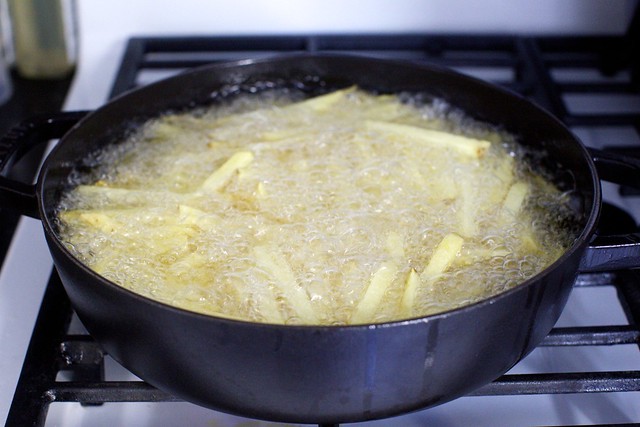
This recipe is amazing:  easiest french fries – smitten kitchen.

I have always been intimidated by the idea of making fries/frites at home. It turns out it could not be easier if you follow that recipe. It’s really a case of set it and more or less forget it.

Some notes:

  • I used corn oil because of it’s high smoking point. You could use other oils too.
  • I used a Dutch oven to make the fries.  It keeps the oil from splashing over onto the oven or burner.
  • I found a potato the size of a baseball feeds one person. A potato the size of a softball feeds two people.
  • I used Yukon gold potatoes.
  • I put big flaky salt on the fries right after I fish them out of the oil.
  • Regardless of how long the recipe says, remove the fries when they are a brown gold colour. It could be 20 minutes but it could be less.
  • Serve hot!


Cooking at home sucks. It’s also great.

I like this piece: Opinion | Never Cook at Home – The New York Times

The title is deceptive: it is not entirely anti-cooking, and it does talk about the benefits of home cooking, but it does throw a bucket of very cold water on all those excited ideas about how great it is to cook at home.

There are many benefits to cooking at home, just like there are benefits to working out. But there are significant efforts associated with achieving those benefits. Those efforts are likely the thing that can cause you to stop getting out your pans and turning on the oven and head to the local diner.

The other drawback about cooking at home is social media. Now so many people (including me) post photos of the food they make. You might look at your own cooking outcome and get discouraged. When you combine the effort and the outcome, plus the indifference you get from those you cook for, you may never want to cook again.

Like exercise, the trick is to find the right level of cooking that works for you, and not get down on yourself when you aren’t cooking at some level you think you should be cooking, whatever that is. Some days you just need to eat, and a piece of fruit and a frozen meal is all you need to no longer be hungry. Other days you may be enjoying making pasta from scratch. If you find you are in a rut, start a simple log of what you are eating over a week and then look for ways to improve slightly: replace boxed cereal with a cooked egg, make a simple pasta rather than get take out pizza. (Bonus: if you make pasta, you could have lunch made too.)

Good luck. There are rewards to cooking at home, if you find the right level of cooking that works for you. Enjoy the fruits of your labour, however great or humble.


Friday night cocktail: a Sazerac


Arguably the oldest cocktail made, with a fine New Orleans history. I had one the other night with bourbon, which is a good substitute for rye. You can go with just one form of bitters, and mine had Peychaud’s. Try an orange peel: it goes well with the bourbon. Experiment with leaving out the sugar cube: you might find you don’t need it with the bourbon and the orange peel.

Best Sazerac Recipe – How to Make a Sazerac Drink

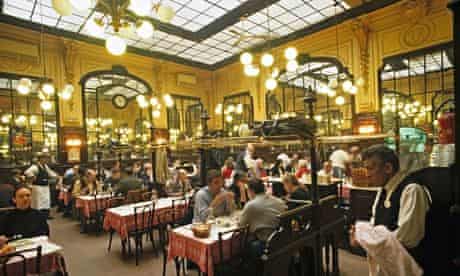
Are Paris bistros dying? Some thoughts…

bistro
According to this piece, they are. A key indicator/quote pulled from it:

Around 30 years ago, bistros represented about half of all restaurants in Paris…Today…that figure has dropped to 14%.

Bistros are challenged because the cost of providing that type of establishment in Paris is limited by such things as rent — a problem not limited to Paris — as well as international threats like fast food joints.

At one time bistros were fast food joints. But there’s more to bistros than fast food. I agree with that article that says a good bistro should be

open continuously morning to night, serves French comfort foods at moderate prices, and houses an active bar where locals can gather for a drink and some lively conversation

That seems right to me. McDonald’s in Paris will never be a bistro, no matter how fast the food or how French they make the decor.

Paris will always have low cost places to eat (e.g. cafes), but it would be a shame if they lost their bistros. (It would also be a shame if the ones that remain are expensive museum pieces and less casual places to dine.) Best to get yourself to them now while you still can.

A very visual way to remember healthy serving sizes

The good people of Cooking Light have put together an nice infographic on this: Here’s a Handy Way to Understand Healthy Serving Sizes – Cooking Light. 

Now you might find some of them weird (one small baked potato is the size of a hamster) or outdated (an ipod nano…really?) but most of them are relevant and very useful if you are working hard to control how much you eat.


New ideas for summer wine drinkers

For those of you looking to branch out beyond whites, roses, and heavy reds (for BBQ), here’s a good list: Chilled Red Wines to Drink All Summer – Bon Appétit.

Beaujolais is the obvious choice for Gamay, but lots of new world producers make wine with that grape. For Carignan, you may have to look around: if you can find a place that stocks a good selection of French wine, look in the Midi section. Also check out the Spanish wine section. The challenge there is it can sometimes (often times?) be blended with heavier reds. Ask the staff for help if you want something lighter. As for Zweigelt, the challenge there is finding it at all. If you can, get some.

If you want to know more about carignan, check out this from Winefolly.com:

Summerlicious 2018: the deals

I am a fan of Summerlicious (and Winterlicious) in Toronto: it’s a festival of sorts for people who like fine dining . It’s debatable if you are getting a deal on the meals, though I would argue that you are. If you lean the other way, then read this: 10 best deals for Summerlicious 2018 – NOW Magazine. By going to one or more of these 10 places, you’ll dine in a good restaurant and get a good deal as well.

St-Germain cocktails

If you ever wanted to grab a bottle of St-Germain but wondered how you can use it, then wonder no more. Here’s a list of cocktails you can whip up on a Friday night using the beverage in the lovely bottle. The Bon Appetit one is a simple mix of St. Germain, prosecco and club soda. But they all are good.

Are you in the market for an Instant Pot? You should read this before you buy one.


In case you don’t know, the Instant Pot is

a one-size-fits-all kitchen gadget promising to do everything from slow cooking to sautéing, steaming, stewing and yogurt-making (and more).

Sounds amazing. Despite that, you may want to hold off getting one. At least until you read this piece: Instant Pot review: Is the kitchen tool worth the hype? We test it to find out.

To summarize the review: if you had few appliances or wanted fewer appliances, then an Instant Pot may be the way to go. If you already had a slow cooker or pressure cooker or if you prefer to cook in a traditional way, then you may want to spend your kitchen budget on other things.

But read the article and decide yourself. They do a great job analyzing the device and assessing its strengths and weaknesses.

 (Image via Instantpot.com)

Save money: make your own grain bowls for lunch, starting on Sunday


I think it is great that fast food courts and other eating areas have seen a rise in places serving grain bowls. They are a nutritious alternative to many other meals there.

However, they aren’t cheap, and to be honest, it’s not that hard to make your own grain bowls in 6 easy steps.

Start with this: Healthy Lunch Bento Box Ideas – Bon Appétit | Bon Appetit.

Then cook some grains, roast some vegetables, saute some greens and prepare some proteins. When you get to work, toss on the acid and the dressing and you just saved yourself some money and a trip to the food court.

Good news regarding food and agriculture


The good news is this: There’s More Farmland in the World Than Was Previously Thought | Agweb.com.

There are still problems in preventing hunger and famine, but decreasing farmland should not be adding to that. Good! Now to decrease conflicts and ensure everyone has access to good, cheap, nutritious food.

(image via pexels.com)